Why You Don't Feel RDL in Your Hamstrings | Form Fixes for Lifters Whose Lower Back Takes Over
The most common reason an RDL misses your hamstrings is that your hips stop moving backward, and you make up the remaining distance by flexing and extending your lower back. Instead of chasing the floor, reverse the movement at the lowest point where you can maintain the relationship between your pelvis and rib cage.
Your lower-back muscles help hold your position, so you do not need to eliminate all fatigue there. The issue is not simply feeling your lower back work. It is losing control of the load while your hamstrings are lengthened and allowing another movement to end the set.
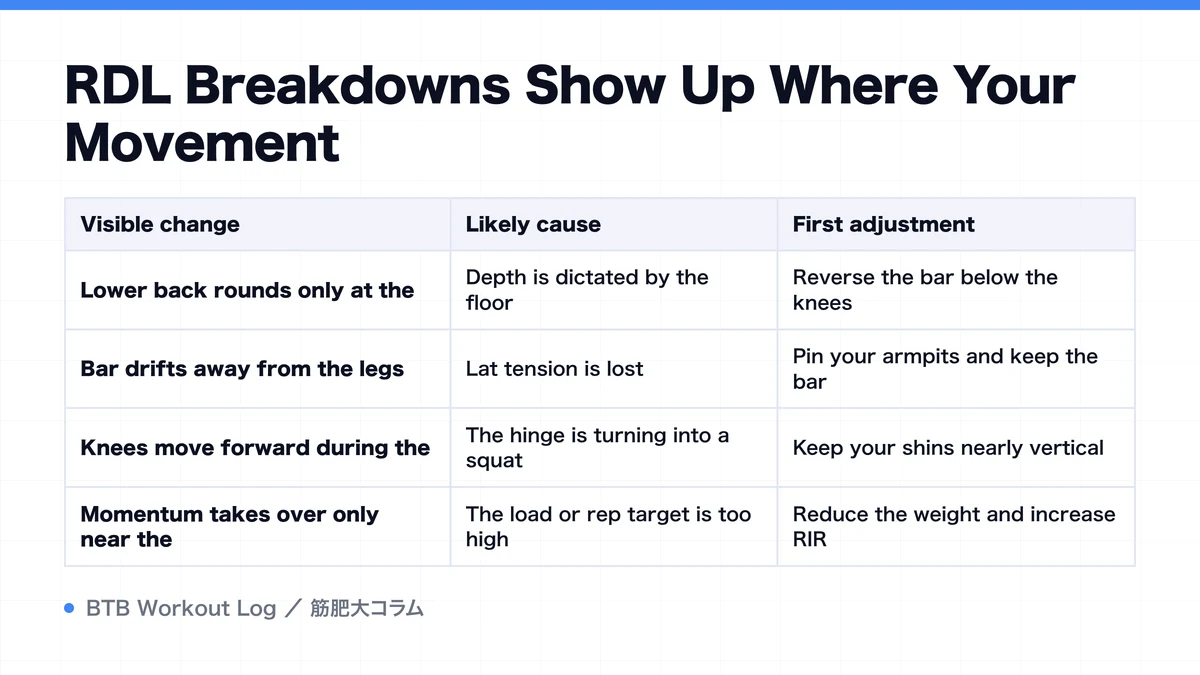
RDL Breakdowns Show Up Where Your Movement Changes, Not Just Where You Feel Tired
The RDL starts from the top. You keep a slight bend in your knees without moving them much, hinge at the hips, and then stand back up. Your hamstrings lengthen as your hips flex and work with your glutes to bring you upright. Your spinal erectors hold your torso in position, but forcefully flexing and extending the lumbar spine is not the primary movement.
How strongly you feel your hamstrings varies from person to person. A weak pump or little soreness does not necessarily mean they received no stimulus. Start by filming yourself from the side. Look for changes such as the bar drifting forward only on the final rep, your back rounding at the bottom, or your knees moving forward during the reversal. You can review the general principle of training at longer muscle lengths in loading the stretched position, but an RDL should only go as far as you can maintain your form.
| Visible change | Likely cause | First adjustment |
|---|---|---|
| Lower back rounds only at the bottom | Depth is dictated by the floor | Reverse the bar below the knees |
| Bar drifts away from the legs | Lat tension is lost | Pin your armpits and keep the bar close |
| Knees move forward during the descent | The hinge is turning into a squat | Keep your shins nearly vertical |
| Momentum takes over only near the end | The load or rep target is too high | Reduce the weight and increase RIR |
Causes 1 and 2: Stop Chasing the Floor and Keep the Bar Close to Your Legs
Cause 1: Lowering Past Your Available Mobility
Getting the plates closer to the floor does not automatically make an RDL better. If you keep descending after your pelvis can no longer tilt forward, you are likely to create the extra distance by rounding your lower back or dropping your shoulders. Stand with your feet about hip-width apart, tip your head, rib cage, and pelvis forward as one unit, and stop just before hamstring tension peaks. For many lifters, the bar will reach somewhere between just below the knees and mid-shin, but limb length changes the exact position.
Stand about one foot-length from a wall and practice touching it with only your glutes. This helps you learn to push your hips back without sending your knees forward. You can also establish the same movement with light dumbbells before returning to the barbell. Shortening your range of motion is not a cop-out. It defines the endpoint you can control. As with full range of motion versus partials, the right choice depends on the target muscle and movement.
Cause 2: Letting the Bar Drift Forward
The greater the horizontal distance between the bar and your hips, the harder your lower back must work to hold position. Before each set, pin your armpits without shrugging and guide the bar from your thighs down toward your shins. Do not row it backward with your hands. Let your arms hang like long straps, then press the floor away and drive your hips forward to stand. The bar does not need to scrape your skin, but from the side, its path should remain over your midfoot.
Causes 3 and 4: Keep Your Knee Angle Steady and Prioritize a Repeatable Hinge Over Load
Cause 3: Locking Your Knees or Continuing to Bend Them
Fully locking your knees can make discomfort behind the knee stop the movement. At the other extreme, bending your knees more as the bar descends drops your hips and turns the RDL into something closer to a squat. Begin with about 15–30 degrees of knee flexion and send your hips backward while keeping that angle roughly unchanged. The number is a guideline, not a single correct answer. Find the position that keeps your shins from shifting and lets you create hamstring tension.
Cause 4: Using More Weight Than Your Form Can Handle
With heavier loads, your grip, breathing, or lower-back position may reach its limit before your hamstrings do. Research comparing lower and higher loads shows that hypertrophy is not limited to heavy weights. When practicing the RDL, start with about 6–12 reps. Keep the first few sets at RIR 2–4, meaning you stop with 2–4 reps before failure. Once every rep follows the same path, progress either the reps or the load, one at a time.
If reducing the plates does not change what you feel, use a 2–3-second descent and reverse direction without bouncing. This is not a reason to lift slowly forever. It is a diagnostic tool for finding the exact moment when the relationship between your pelvis and the bar breaks down. Once you fix it, return to a natural, controlled speed.
Cause 5: Grip, Lat, or Prior-Exercise Fatigue Is Disrupting Your Hinge
Even if your hamstrings have reps in reserve, a failing grip can stop you from keeping the bar close to your legs, while a loose upper back can shift your center of mass forward. Use a double-overhand grip, and add straps if grip strength is clearly the only limiting factor. Straps will not fix your form automatically, so keep checking the bar position and torso shape after you put them on.
Exercise order also matters. After high-volume squats or bent-over rows, your spinal erectors and trunk may already be fatigued, causing your lower back to end even a light RDL set first. Move the RDL earlier in your lower-body session, or replace the row with a chest-supported variation and compare the conditions for just 2–3 weeks. This connects with how exercise order changes your results.
If you still cannot keep your hip-extension sets consistent, temporarily switch to a 45-degree back extension or cable pull-through. When building your overall hamstring program, use the 5 best hamstring exercises as a guide so hip-extension and knee-flexion movements have distinct roles. Progressing the movement you want to train matters more than insisting on the RDL.
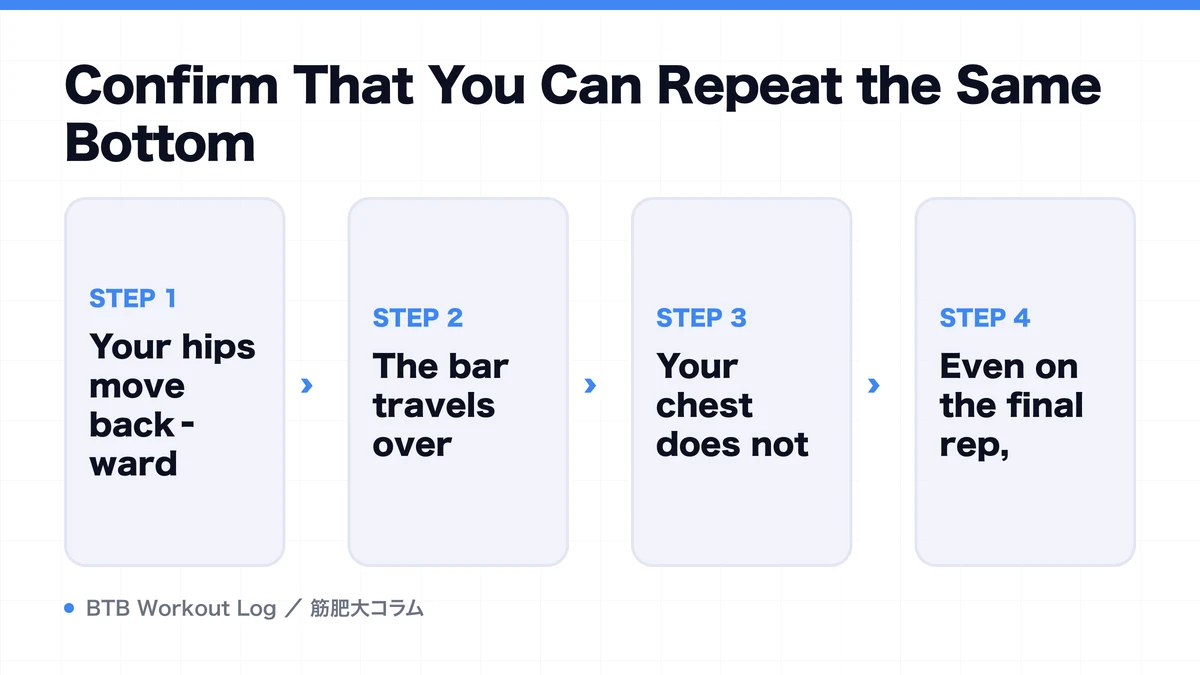
Confirm That You Can Repeat the Same Bottom Position and Bar Path Across 3 Sessions
Change only one variable at a time. In the first session, use 10–20% less weight than usual and film 3 reps from the side. In the second, keep the same weight and either add one rep or reduce RIR, then check whether the bar drifts forward near the end. If your form holds through the third session, add the smallest available load increment. If you change the weight, reps, bottom position, and knee angle together, you will not know what caused the improvement.
- Your hips move backward during the descent while your shin angle stays nearly unchanged.
- The bar travels over your midfoot and does not move farther from your legs near the end.
- Your chest does not drop independently at the bottom; your pelvis and torso reverse together.
- Even on the final rep, you stand through hip extension instead of using lower-back momentum.
If all four points are consistent and your hamstrings become the main reason the set ends, the correction is working. Apply the same standard when deciding when to increase the load. Do not treat sharp lower-back pain, numbness, or pain that persists with a lighter, controlled setup as a training issue about feeling the target muscle. Stop and consult a healthcare or exercise professional.
FAQ
- Does Lower-Back Fatigue During RDLs Mean My Form Is Wrong?
- Your lower-back muscles work to hold your torso in position, so fatigue alone does not prove your form is wrong. You need to make an adjustment if the bar drifts forward, your back rounds at the bottom, or you stand up using lower-back momentum. Also check whether your lower back, rather than your hamstrings, is ending the set.
- How Far Should I Lower the Bar on an RDL?
- Lower it to the point where you can still move your pelvis backward while maintaining your knee angle and back position, rather than aiming for the floor or a fixed point on your shins. For many lifters, this is somewhere between just below the knees and mid-shin, but it varies with body proportions and mobility. Reverse earlier if going deeper rounds your lower back.
- Should I Raise My Toes to Feel My Hamstrings During RDLs?
- Raising your toes is not required, and you should skip it if it disrupts your balance. Start by keeping all three points of each foot on the floor, holding the bar over your midfoot, and pushing your hips backward. Coordinating your hip movement and bar path matters more than manipulating your ankles.
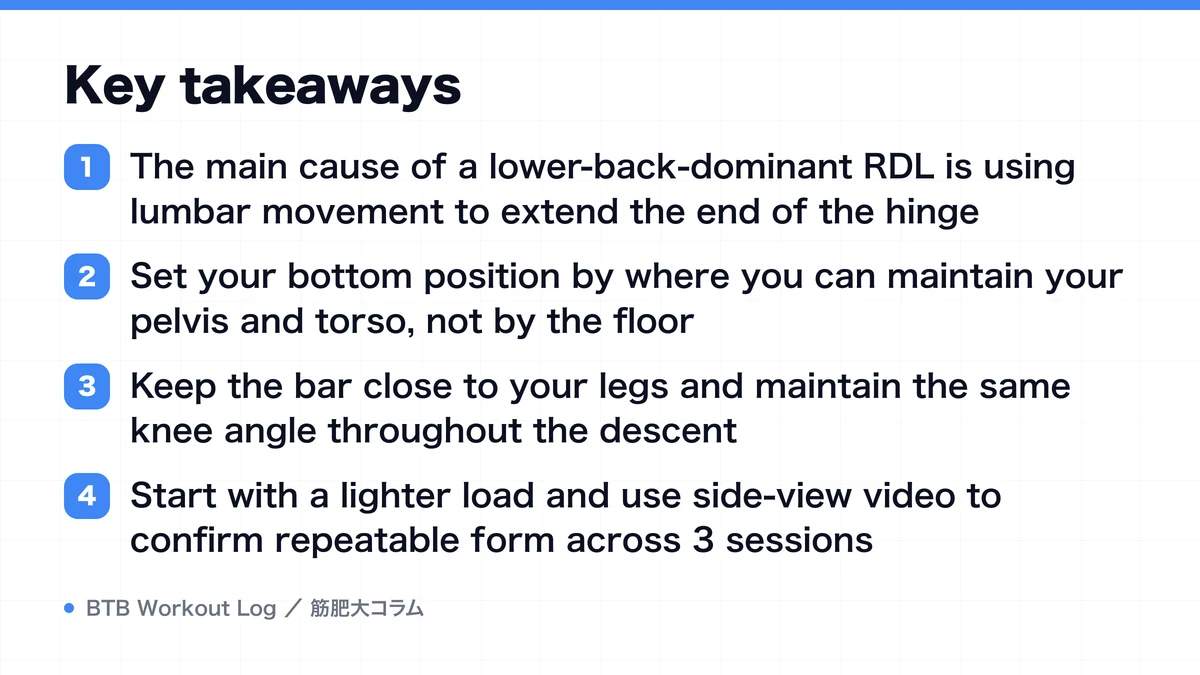
Key takeaways
- The main cause of a lower-back-dominant RDL is using lumbar movement to extend the end of the hinge
- Set your bottom position by where you can maintain your pelvis and torso, not by the floor
- Keep the bar close to your legs and maintain the same knee angle throughout the descent
- Start with a lighter load and use side-view video to confirm repeatable form across 3 sessions