Hypertrophy Programming: Build an 8–12-Week Plan with Periodization and Examples
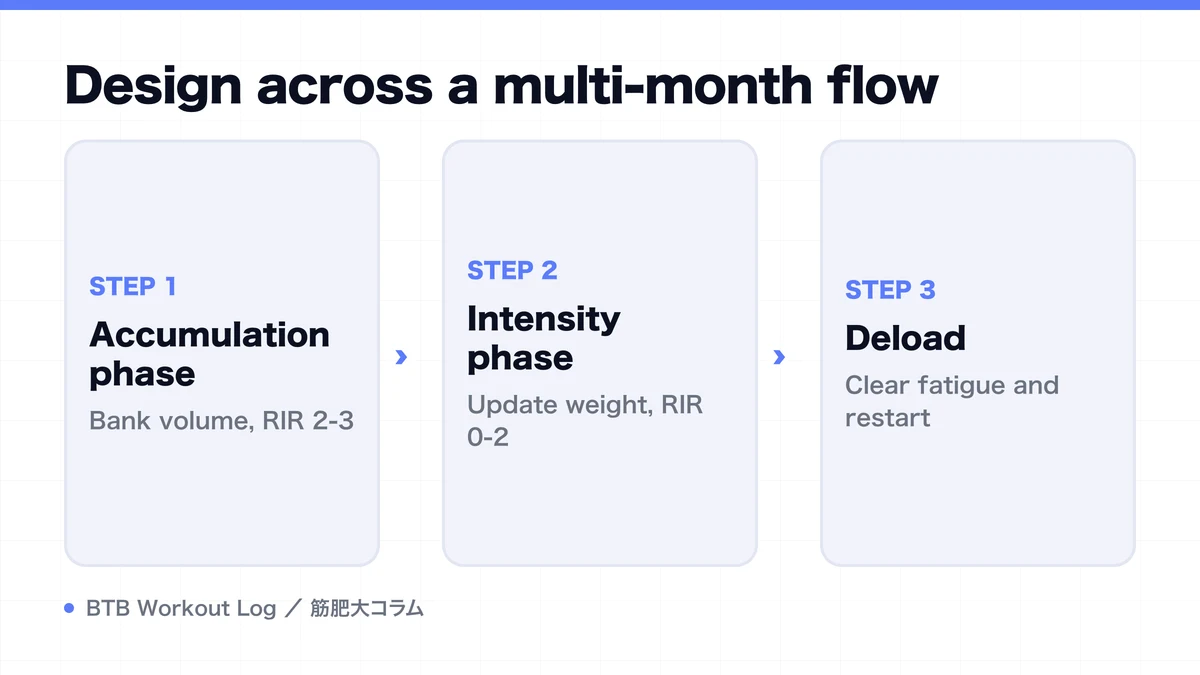
Design in terms of a few months rather than a single workout program, and your progress is far less likely to stall. The basic cycle: accumulation (volume), then intensification (load), then a deload (recovery).
Hold the same volume and intensity for a long stretch and fatigue accumulates, which can make progress hard to read. Periodization, which waves the load up and down, is one way to reset that build-up on a regular schedule.
What periodization means
Periodization is the practice of deliberately varying training volume and intensity in blocks of several weeks. Stay at the same weights and set counts forever and adaptation grinds to a halt while fatigue keeps stacking up. Separating a phase that banks stimulus through volume from a phase that pushes the loads upward, with recovery in between, lets you dodge both staleness and fatigue while stacking growth. It pays off most from the intermediate stage onward.
The three phases of a cycle
| Phase | Goal | Guidelines |
|---|---|---|
| Accumulation | Bank stimulus through volume | Higher weekly sets, RIR 2-3, mostly 8-15 reps |
| Intensification | Push the loads up | Fewer sets, RIR 0-2, mostly 5-8 reps |
| Deload | Drain the fatigue | Cut volume and intensity to 40-60% (how-to) |
A sample 8-12 week plan
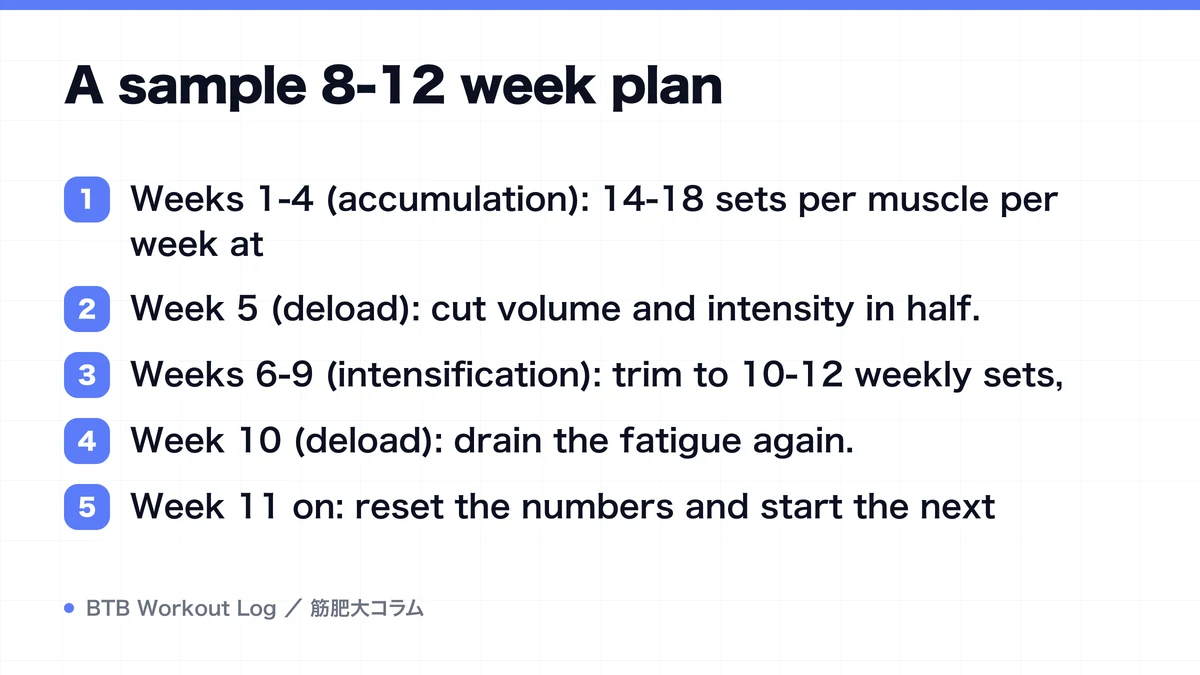
An example built on a 4-day upper/lower split.
- Weeks 1-4 (accumulation): 14-18 sets per muscle per week at RIR 2-3. Each week, add one set, or 1-2 reps.
- Week 5 (deload): cut volume and intensity in half.
- Weeks 6-9 (intensification): trim to 10-12 weekly sets, take the main lifts to 5-8 reps at RIR 0-2, and hunt new weights.
- Week 10 (deload): drain the fatigue again.
- Week 11 on: reset the numbers and start the next accumulation phase from a higher baseline than the last cycle.
Only a log can run the cycle
The heart of periodization is restarting each cycle from a higher point than the last. That only works if the weight and reps of every set of every exercise are on record. With a log, you can go back and compare how far you pushed volume in accumulation and how many kg you added in intensification. Having last time's numbers and the longer-term trend visible is the precondition for a successful long-term program (progressive overload / workout log app).
FAQ
- Do beginners need periodization?
- Not yet. Beginners are in the phase where they can add weight linearly almost every session (linear progression), so complex periodization is unnecessary. Milk those steady gains first; bring in periodization once they dry up at the intermediate stage.
- How long should one cycle be?
- 8-12 weeks is a manageable length. A typical structure is 3-4 weeks of accumulation and 3-4 weeks of intensification, with deloads in between and at the end.
- Should I change exercises between accumulation and intensification?
- Keep the core lifts fixed and change only the rep ranges, set counts, and RIR. Swapping exercises wholesale makes comparison against previous sessions difficult, and progressive overload becomes hard to track.
Key takeaways
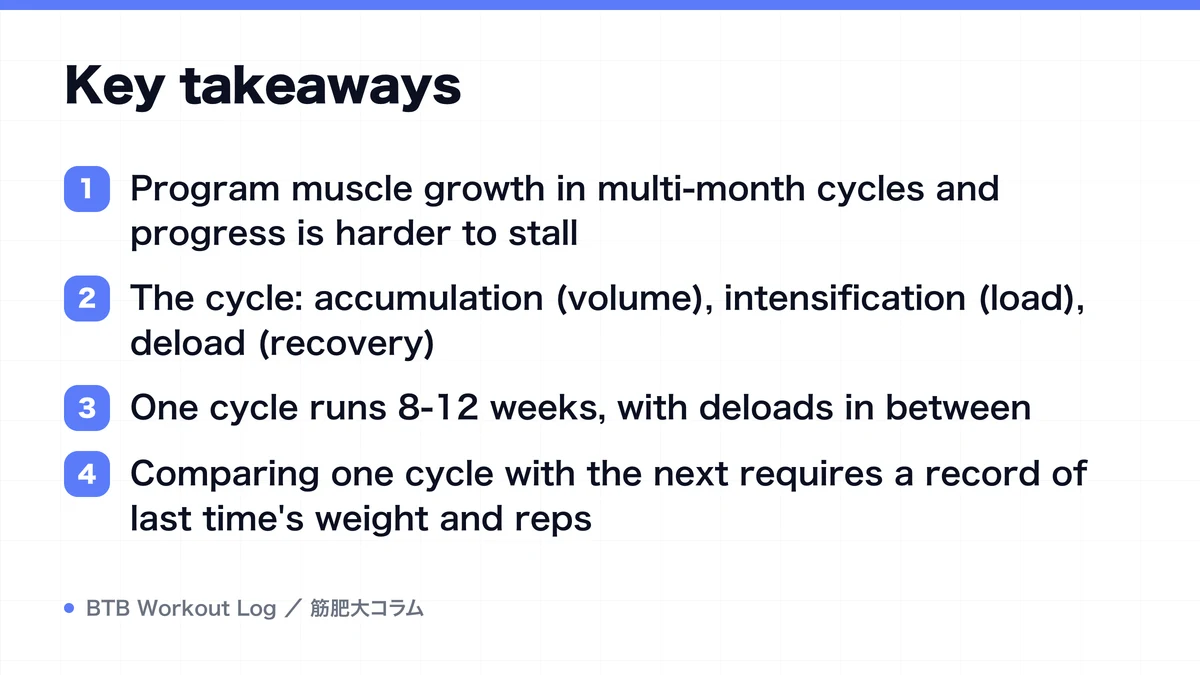
- Program muscle growth in multi-month cycles and progress is harder to stall
- The cycle: accumulation (volume), intensification (load), deload (recovery)
- One cycle runs 8-12 weeks, with deloads in between
- Comparing one cycle with the next requires a record of last time's weight and reps
References
- Periodization, Strength and Muscle Hypertrophy: Systematic Review and Meta-analysis
- Linear vs Daily Undulating Periodized Training and Hypertrophy: Meta-analysis
- ACSM Position Stand: Resistance Training Prescription for Muscle Function, Hypertrophy, and Physical Performance in Healthy Adults: An Overview of Reviews