
8 Reasons Your Bench Press Won't Go Up | A 4-Week Program to Break the Plateau If You've Been Stuck for Months
A stalled bench press almost always traces back to technique, a weak muscle (triceps, front delts, or upper back stability), or a programming problem. Fixing form and targeting weak links moves it far more often than simply grinding harder.
Stop testing your max every session. Find the cause, and address it.
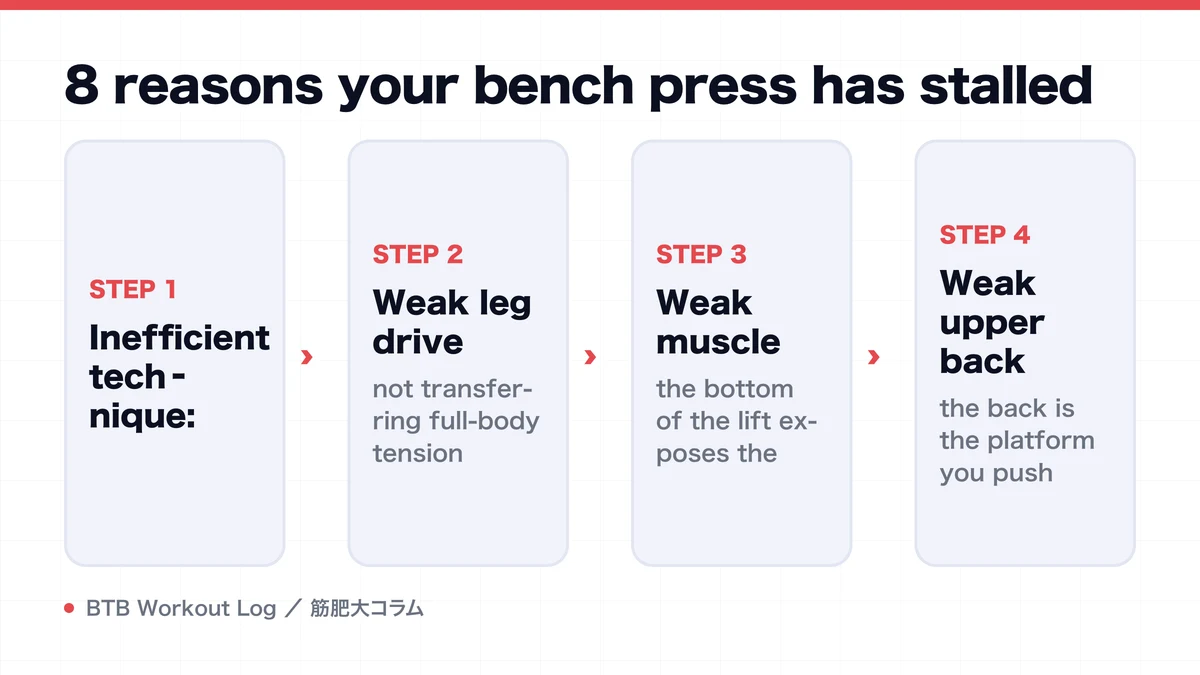
8 reasons your bench press has stalled
- Inefficient technique: not setting the shoulder blades down and back to create a stable base.
- Weak leg drive: not transferring full-body tension through the feet and legs.
- Weak muscle: the bottom of the lift exposes the chest and front delts; the midpoint exposes the pecs and bar speed; lockout exposes the triceps.
- Weak upper back: the back is the platform you push from - if it's soft, so is your press.
- Only training once a week: bench press is a technical lift; low frequency slows skill development.
- Testing your max every session: neural fatigue accumulates and your total volume suffers.
- Not enough volume: too few accessory exercises and not enough total work.
- Recovery and nutrition deficits: body weight not rising; insufficient sleep.
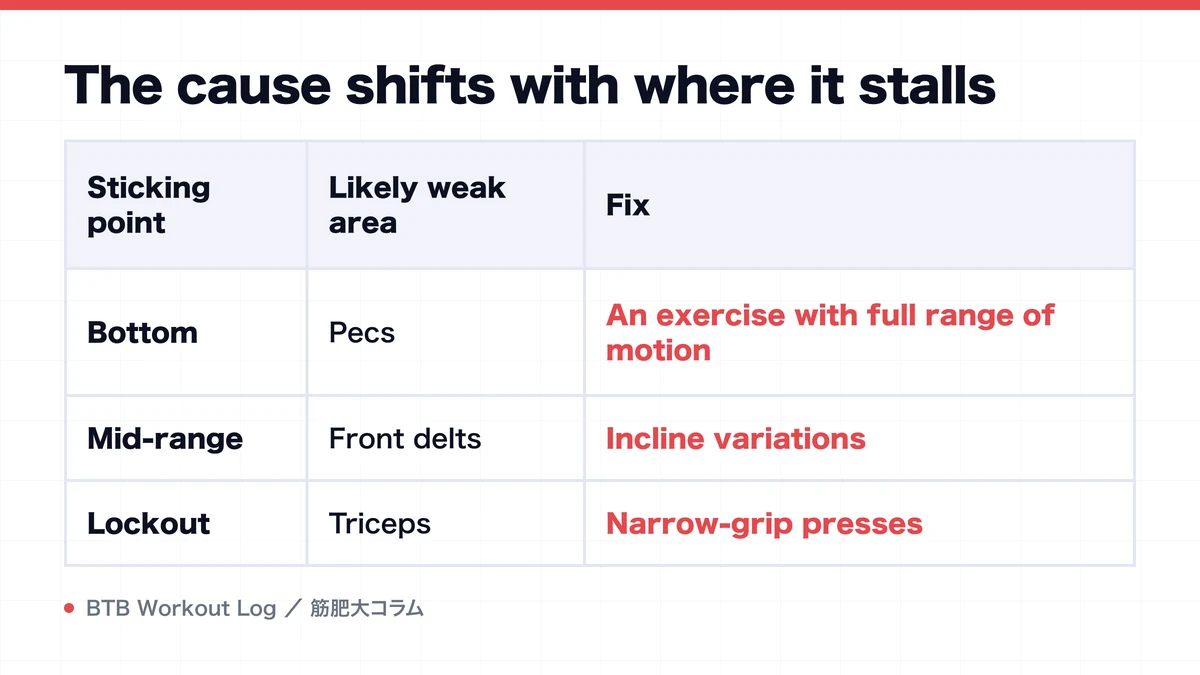
Identify your weak link by where the bar slows down
| Sticking point | Likely weakness | Accessory work |
|---|---|---|
| Just before the chest (bottom) | Chest / front delts | Paused bench, incline press |
| Stalling at the midpoint | Pecs / bar speed | Dumbbell press, speed bench |
| Just before lockout | Triceps | Close-grip bench, pushdown |
Logging where the bar stalls gives you objective data on which area needs accessory work.
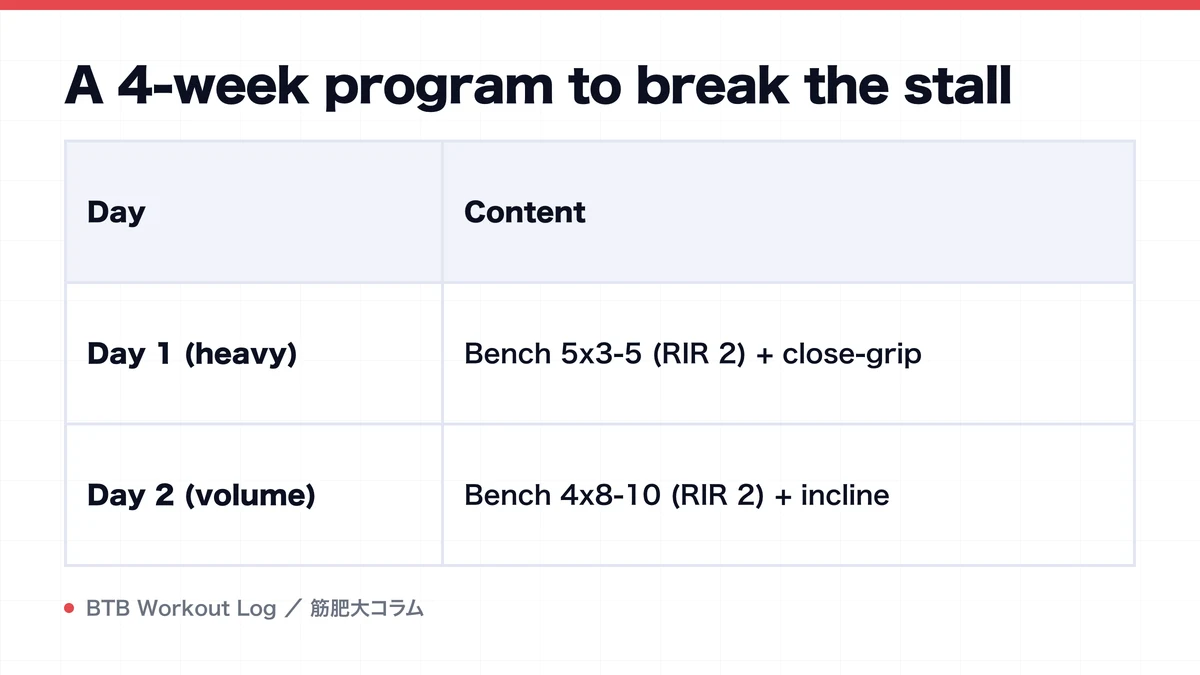
A 4-week program to break the stall
Bench twice a week, targeting technique, frequency, and weak links simultaneously.
| Day | Content |
|---|---|
| Day 1 (heavy) | Bench 5x3-5 (RIR 2) + close-grip bench 3x8 + rows |
| Day 2 (volume) | Bench 4x8-10 (RIR 2) + incline dumbbell press 3x10 + triceps and front delt work |
Add a small amount of weight or one rep each week for weeks 1-3, then take week 4 as a light deload. The heavy day builds neural drive; the volume day accumulates tonnage. That two-track approach works.
Manage the details with records
Breaking a bench press plateau is a process of stacking small wins. How far did the paused bench come? Is the close-grip trending upward? Where exactly did you miss the rep? When all of that is in your log, you can see the accessory work paying dividends in the main lift - the numbers connect the dots. Relying on gut feel alone, you'll keep guessing at the next step. A complete log of every set is the compass for breaking through.
FAQ
- Should I test my bench press max every session?
- No - that's counterproductive. Testing your max every session accumulates neural fatigue and kills volume. Run at RIR 2, build technical precision and total volume, and plan max-effort attempts strategically.
- Will my bench press get stronger if I only bench press?
- Bench press depends heavily on your triceps, front delts, and upper back. Bringing up those weak links with accessory work - and increasing frequency to twice a week - will move your bench faster than benching alone.
- Can my bench press improve without gaining body weight?
- To a degree, yes - technical improvements and more volume can move it. But at some point, more muscle mass is the limiting factor. If your bench has been stuck for months, a planned lean bulk is probably the next step.
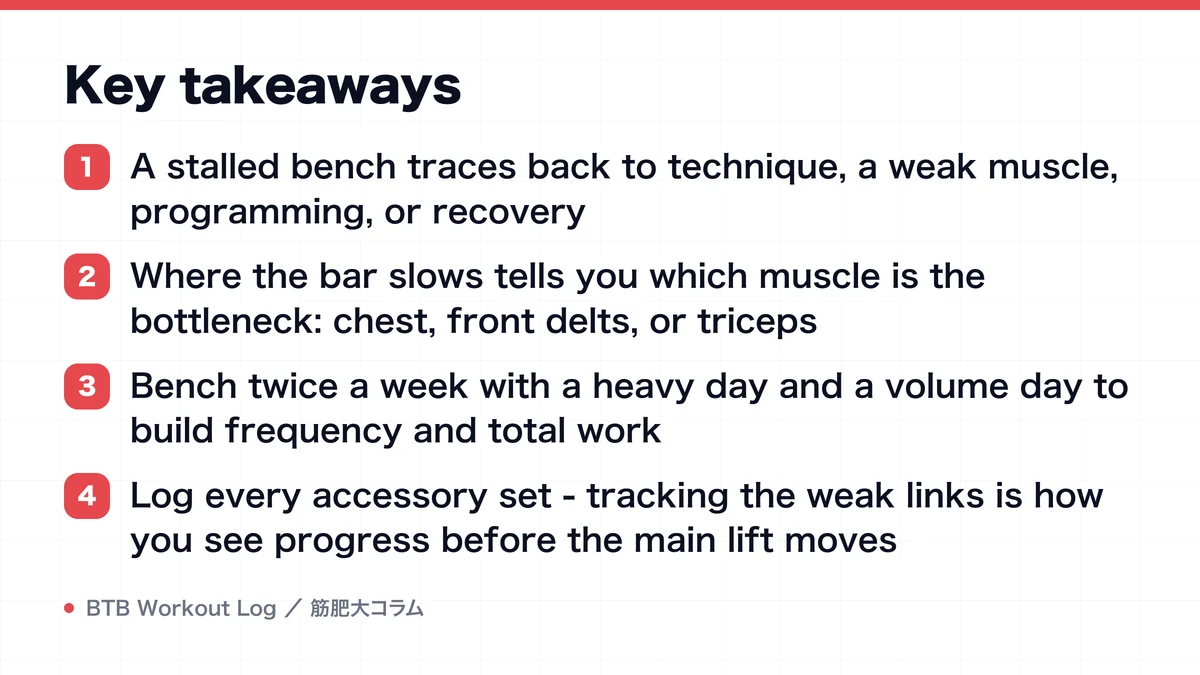
Key takeaways
- A stalled bench traces back to technique, a weak muscle, programming, or recovery
- Where the bar slows tells you which muscle is the bottleneck: chest, front delts, or triceps
- Bench twice a week with a heavy day and a volume day to build frequency and total work
- Log every accessory set - tracking the weak links is how you see progress before the main lift moves
References
- The Sticking Point in the Bench Press, Squat, and Deadlift
- The Effects of Bench Press Variations in Competitive Athletes on Muscle Activity and Performance
- ACSM Position Stand: Progression Models in Resistance Training for Healthy Adults
- Effects of Resistance Training Frequency on Muscle Hypertrophy: Systematic Review and Meta-analysis
- Periodization, Strength and Muscle Hypertrophy: Systematic Review and Meta-analysis