Why You Don't Feel One-Arm Rows in Your Lats | How Just the Elbow Path Changes the Stimulus This Much
The main reason you struggle to feel your lats is that your elbow flares out as you row the dumbbell toward your chest. Aim your elbow toward the hip on the same side and end each rep when your upper arm lines up with your torso to shift more of the load onto your lats.
But do not judge the exercise by muscle sensation alone. Separate technique issues from the reasons back training can be hard to feel, then assess the correction based on your elbow path, the limiting muscle, and your performance across several sessions.
Row Toward Your Chest for Upper Back, Toward Your Hip for Lats
You can change the target of a one-arm row without changing the exercise. Bringing your elbow closer to shoulder height and rowing the dumbbell toward your upper rib cage increases scapular retraction and demands more from the middle traps, rhomboids, and rear delts. That is not an incorrect row. It is simply a different variation for building upper-back thickness.
If your main goal is to train the lats, you do not need to pin your elbow tightly against your side. Keep your upper arm roughly 20–30 degrees from your torso and drive your elbow toward your back pocket rather than the wall behind you. The dumbbell still travels vertically, so there is no need to angle your forearm just to bring your hand closer to your hip. Your hand should pass roughly beneath your shoulder; adjust the target through the direction of your upper arm.
Pulling your elbow farther back does not always produce a stronger contraction. Once your upper arm passes your torso, it becomes easy to create extra distance by letting the shoulder roll forward or twisting your torso. The end position where you can maintain lat tension may fall short of your maximum range of motion that day.
Check These 5 Reasons the Load Shifts Away From Your Lats
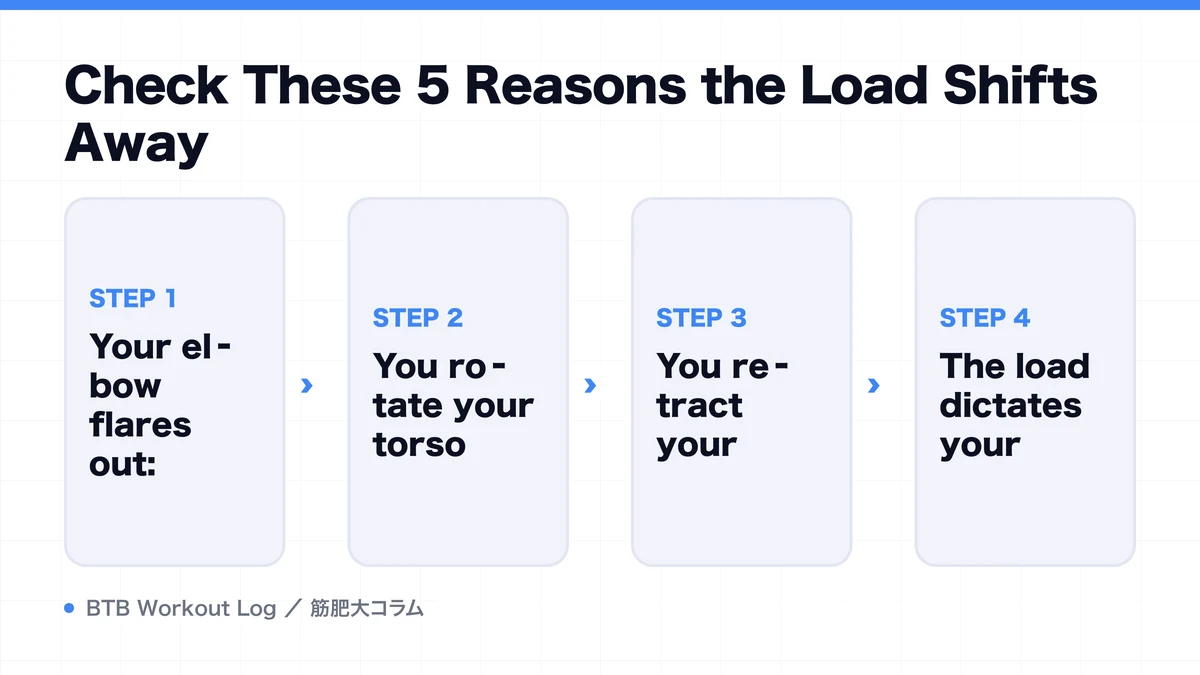
- Your elbow flares out: As you try to lift the dumbbell toward your chest, your upper arm moves out to the side and turns the exercise into an upper-back row. Set the end point of your elbow closer to your hip.
- You rotate your torso as you pull: Turning your shoulder toward the ceiling may lift the dumbbell higher, but it replaces shoulder-joint movement with torso rotation. Keep your sternum facing the floor.
- You retract your shoulder blade from the start: This shortens the stretched position and prevents your upper arm from reaching forward. On the way down, allow your shoulder to move slightly toward the floor to create a stretch along the side of your rib cage.
- The load dictates your end position: Heavier weights encourage more momentum, a shorter range of motion, and excessive gripping. If you miss the intended path 3 reps in a row, you are not ready to add another plate.
- Your support position is unstable: If your bench hand is too far away, your stance is too narrow, or your lower back is excessively arched, maintaining position will demand your attention before you can train your back effectively. Rebuild a stable three-point base.
Your forearms and biceps assist the movement, so feeling some fatigue there is not inherently a problem. It becomes a problem when the same assisting muscle ends every set before your lats can produce a high level of effort.
Break Down Each Rep With a Light Load and Fix Your Elbow End Point
Start with a dumbbell that is roughly half to 70% of your usual load and place one hand on a bench. Position your support hand close to directly beneath your shoulder, set your feet wider than your pelvis, and leave enough space to lower the working-side shoulder toward the floor without rounding your lower back. Your spine does not need to be perfectly horizontal. Prioritize an angle that keeps your pelvis and rib cage from twisting.
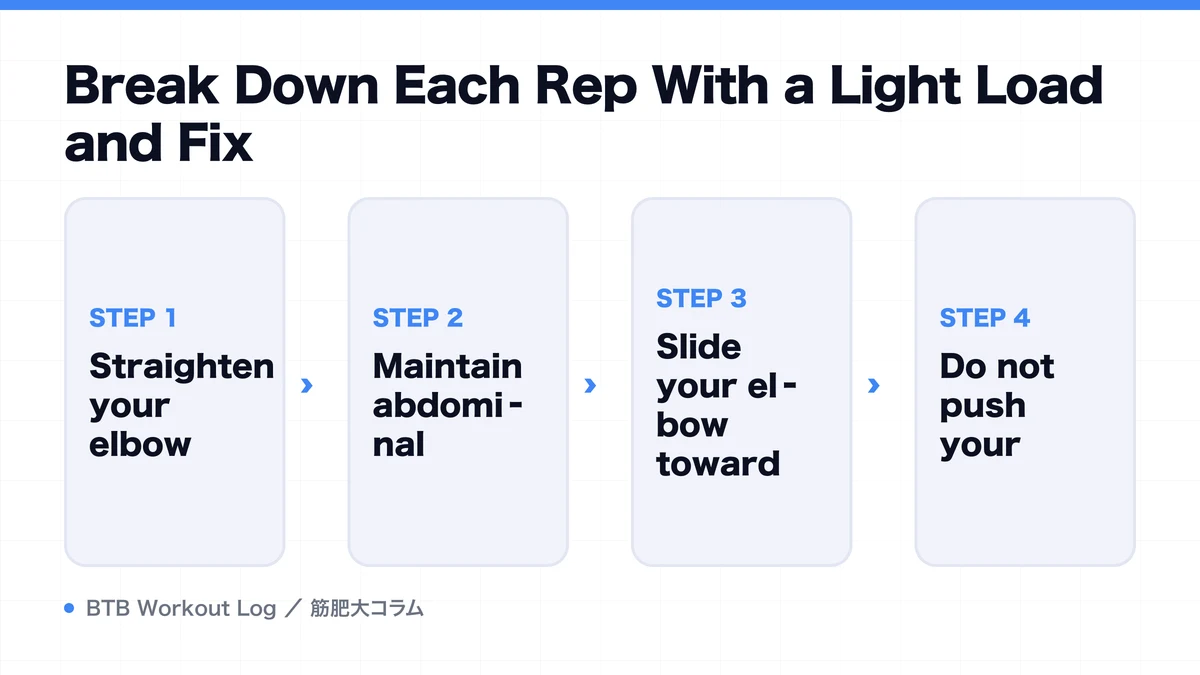
- Straighten your elbow and lower the dumbbell until your shoulder blade moves slightly outward.
- Maintain abdominal pressure and begin moving your upper arm while keeping your sternum pointed toward the floor.
- Slide your elbow toward the outside of your pelvis and stop when your upper arm is roughly in line with your torso.
- Do not push your shoulder forward at the top. Return under control along the same path.
At first, you can use your free hand to touch the outer edge of your lat and match the movement of your elbow with the point when the muscle tightens. Touch is a learning aid, not a measure of hypertrophy. Once you understand the path, there is no need to touch the muscle during every set.
If Bench Support Does Not Suit You, Recreate the Movement With Different Equipment
One knee and one hand on the bench
This setup makes it easy to stay stable, but some lifters let one hip rise and twist through the lower back. Position your knee slightly behind your hip and keep both hips facing the floor.
Three-point support with both feet on the floor
Placing only your supporting hand on the bench lets you adjust your stance width freely and build a solid base for heavy loads. Avoid shifting too much weight onto your front leg, and press into the floor through the heel on your rowing side as well.
Switching to a single-arm cable row
If the dumbbell's vertical line of resistance doesn't align well with your elbow path, a cable set at a low to middle height lets you align the resistance with the pull toward your hip. Consistently repeating the intended shoulder movement matters more than sticking with a particular exercise. For options that emphasize the lower lats, see choosing exercises for the lower lats.
Start with a load that lets you keep your torso stable for around 8–15 reps. Check that your elbow stays at the same height even on the final rep, and increase the weight slightly once you reach the top of the rep range. You don't need to push every set until your form breaks down; stopping just before your elbow path changes can still mean training with high effort (training to failure doesn't necessarily produce more hypertrophy).
Evaluate the Fix Through Sensation, Video, and Progress
During the set, look for tension running from the outside of your rib cage toward the back of your armpit, and check whether your arms alone are ending the set. Even without a strong pump, the exercise remains a viable option if the target muscle makes the final reps difficult.
In video from behind or at a rear diagonal angle, check whether your elbow moves far outside your hand, whether your working-side shoulder rotates toward the ceiling, and whether you open your chest only at the end of the rep. You cannot make useful comparisons if you film from a different angle every time, so keep your device and bench in the same positions.
Do not review only your best rep. Compare the beginning, middle, and end of the set. If your elbow follows the intended line early but drifts outward as you fatigue, you understand the path but cannot maintain it under that load and rep target. Next time, reduce either the weight or the target reps.
Across 3–5 sessions, check whether your reps remain stable or increase with the same dumbbell, range of motion, and RIR. RIR is your estimate of how many more reps you could have performed. A temporary drop in weight after changing your technique is not a problem if you can resume progressing under the new conditions. Progressive overload is about improving your ability with consistent form, not catching up to numbers achieved through your old compensations.
If sharp shoulder or elbow pain continues after correcting your path, stop trying to make the exercise hit your lats and consult a healthcare professional.
FAQ
- Should I Row the Dumbbell Toward My Hip?
- Focus on moving your elbow toward your hip rather than dragging your hand diagonally toward it. The dumbbell itself should travel almost vertically with gravity. Keep your forearm in a natural position and guide your upper arm until it lines up with your torso, which also makes it easier to limit wrist strain.
- Should I Keep My Shoulder Blade Still When Targeting the Lats?
- No. Allow room for your shoulder blade to move outward as you lower the weight, then let it move with your upper arm during the pull. Trying to squeeze your shoulder blades together as hard as possible can turn the movement into an upper-back row, so prioritize the direction of your elbow.
- Will Straps Stop My Arms From Fatiguing?
- Straps can help if your grip fails first, but they will not fix flared elbows, torso rotation, or an excessive load. First, clean up your path with a lighter weight. Use straps only after confirming that your grip still limits the set under those conditions.
Key takeaways
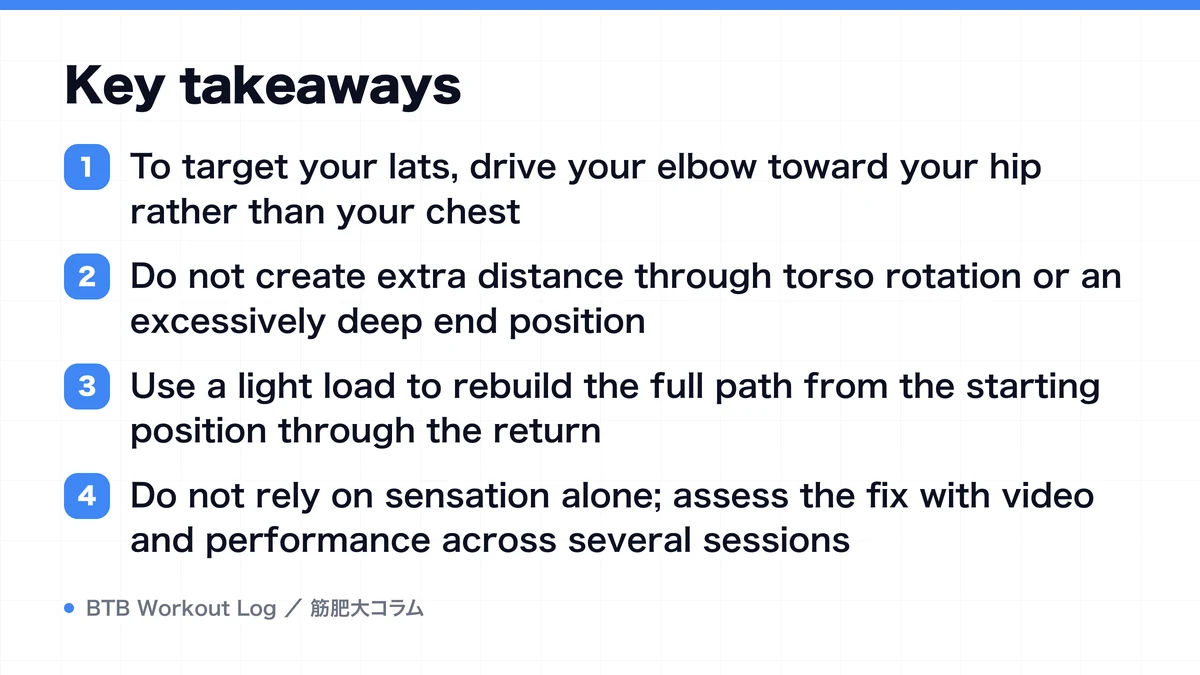
- To target your lats, drive your elbow toward your hip rather than your chest
- Do not create extra distance through torso rotation or an excessively deep end position
- Use a light load to rebuild the full path from the starting position through the return
- Do not rely on sensation alone; assess the fix with video and performance across several sessions