The Ultimate Back Hypertrophy Workout | Exercise Selection for Lifters Who Want Both Width and Thickness
A V-tapered back is built from both the vertical pulls you drive from overhead (width) and the horizontal pulls you draw toward you (thickness). Lean too far one way and you end up with a back that is only wide, or only thick.
The back is a region you cannot see yourself, and your arms and grip tend to hit their limit first. Start by deciding which direction of pull to use and where you are going to drive your elbow.
Think of the back in two directions: width and thickness
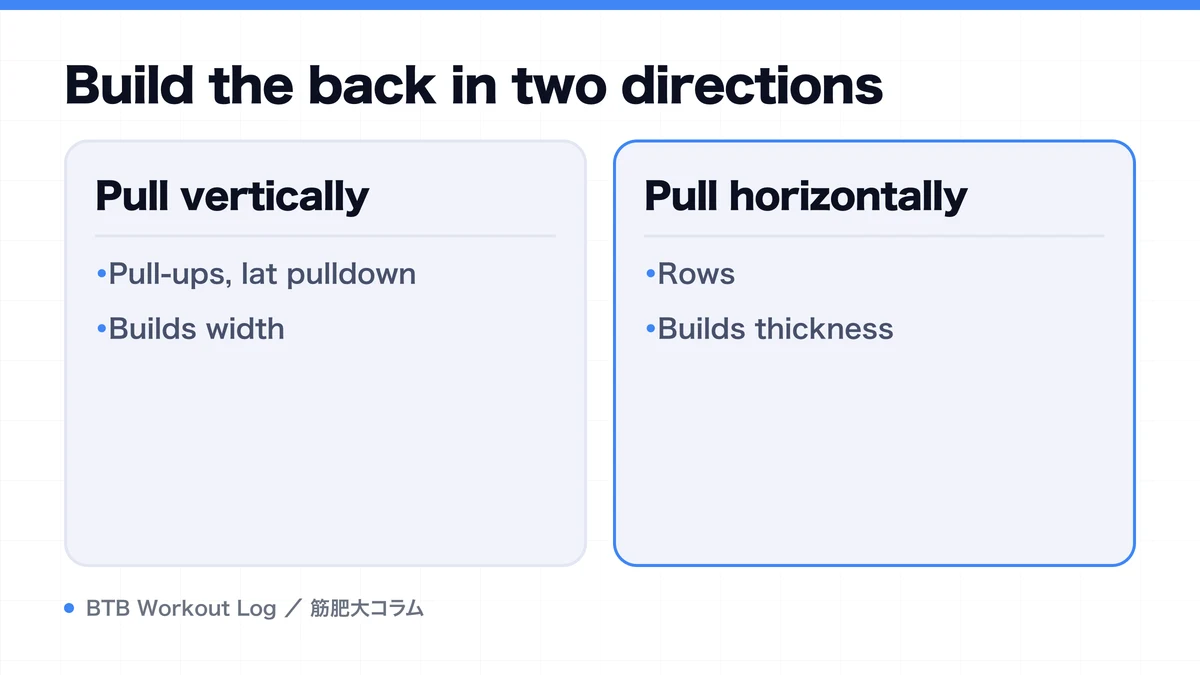
The look of your back comes down to two elements. Width (side to side) is handled by the lats and is stimulated by vertical pulls that come from overhead - pull-ups and lat pulldowns. Thickness (front to back) is handled by the mid-traps, rhomboids and similar muscles, and is stimulated by horizontal pulls that you draw toward you - rows. The basic template is at least one vertical and one horizontal exercise in every session.
These two directions are not exclusive. The lats work during rows, and the traps work during pull-ups. It is only a question of which way the balance leans, and as long as you cover both every week, small differences in that balance do not change results much. Cover both directions first, then add work to the weaker one (exercises for width / exercises for thickness).
Judge which one is lacking from photos, not from the mirror. From the front with your arms down, look at how wide your outline is; from the back, look at the relief between your shoulder blades. Shoot under the same conditions every few weeks and the imbalance shows up more reliably than it does by feel.
Back exercises involve many muscles, and a single exercise covers several roles at once. Because of that, adding more exercises can end up adding nothing but fatigue. Organizing your work by direction of pull lets you separate whether what you are missing is an exercise or volume.
Vertical pulls and horizontal pulls: the exercises
| Direction | Exercises | Main target |
|---|---|---|
| Vertical pull | Pull-ups, lat pulldown | Lats = width |
| Horizontal pull | Bent-over row, seated row | Mid-traps, rhomboids = thickness |
| Accessory | Pullover, face pull | Lat contraction, rear delt finishing |
For your main vertical pull, either pull-ups or the lat pulldown is fine. Pull-ups use your bodyweight, so fine-tuning the load is harder, while the lat pulldown lets you adjust the weight in small steps. Make whichever one lets you hit your rep range consistently the main lift and move the other into an accessory role, and it becomes easier to manage.
The same goes for horizontal pulls: the barbell row and the seated row differ in how much they tax your trunk and in range of motion. If your lower back fatigues first, swapping in machines or chest-supported variations makes it easier to get the volume in on the back itself.
Grip orientation is another choice. A neutral grip with your palms facing each other makes it easier to drive your elbows along your sides, and many people find it puts less load on the arms, while an overhand grip makes it easier to produce shoulder blade retraction. Rather than one being correct, make whichever one lets you reproduce the same path your main option.
The basics of feeling it in your back (not letting your arms take over)
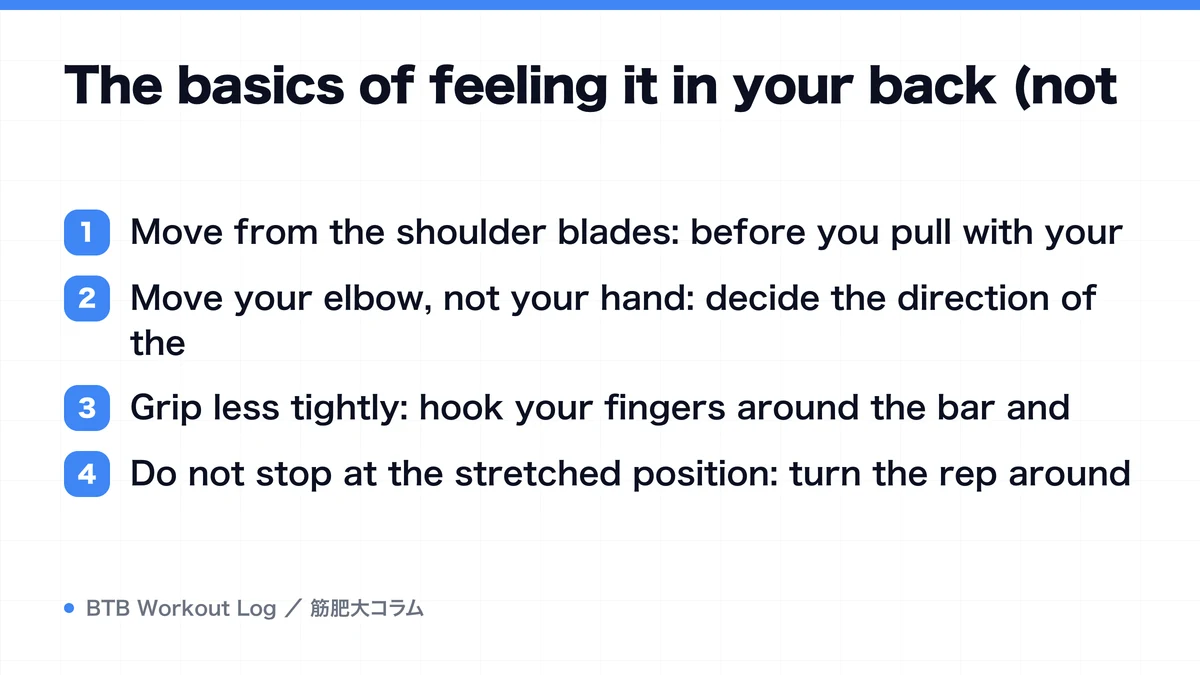
- Move from the shoulder blades: before you pull with your arms, let depression and retraction of the shoulder blades happen first.
- Move your elbow, not your hand: decide the direction of the pull by where you are taking your elbow.
- Grip less tightly: hook your fingers around the bar and reduce how much the forearms contribute.
- Do not stop at the stretched position: turn the rep around while you still feel your back being stretched at the top or out in front.
Even then, the back is a region where the working sensation is hard to pick up. Not feeling it is not a failure in itself; if your weight and reps are going up, the stimulus is getting in. Chasing the sensation and dropping the weight too far costs you more.
For exercises where you feel nothing at all, suspect the movement path. On the one-arm row, for example, whether you bring your elbow in close to your side or flare it out changes how much of the work goes to the lats.
While you are experimenting with technique, leave the weight where it is. If you change the path and add weight at the same time, you end up muscling through the form breakdown with load, and you can no longer tell what worked. Once the path is settled, build weight and reps under those conditions.
Building width: grip width and pulling angle
The lats are involved in bringing your upper arm down to your side and in moving it from in front of you to behind you. A wider grip width is not automatically better: too wide and the range of motion shortens, too narrow and your arms contribute more. Start from 1.2-1.5 times shoulder width and look for the width that makes it easiest to drive your elbows toward your hips.
If you want the pull to reach the lower portion, lean your torso back slightly to change the pulling angle (lower lats). When you change the angle, keep the range of motion and the rep range fixed while you compare. Change two things at once and you will not know which one did the work.
Exercises performed with the elbows extended, such as the pullover, let you work the lats through shoulder extension alone, which makes them an option if your arms fatigue first. That said, it is realistic to treat them as an accessory rather than a main lift.
When width stalls, the tempting move is to add vertical pull sets, but the first thing to check is range of motion. Are you letting the bar carry your shoulders up at the top, and can you drive your elbows down toward your hips at the bottom? Adding volume while the range of motion is short only adds more work over the same range.
Building thickness: elbow position and torso angle
On rows aimed at thickness, keep your elbows slightly away from your sides and use shoulder blade retraction all the way to the end. Pulling with your elbows tight to your sides shifts the work toward the lats; pulling with them slightly flared shifts it toward the mid-traps and rhomboids. Even under the same exercise name, this difference changes which muscle does the job.
Torso angle changes the balance too. The closer your upper body is to parallel with the floor, the more the load sits on the middle of your back; the more upright you are, the more the lats and arms contribute. If lower back fatigue stops you from holding the angle, switch to a supported machine or an exercise where you rest your chest on an incline bench.
Whether to add shrugs for the upper traps depends on how much work they already get from deadlifts and rows (whether shrugs are necessary).
On thickness exercises, choosing a weight you can hold for a beat in the pulled position gives you more reproducibility than pulling all the way through. If the movement has become nothing more than swinging the weight in and letting it back out, drop the weight and get the shoulder blade movement back. The numbers dip for a while, but the progress you make from there is progress you can compare.
Where deadlifts fit in
The deadlift works the whole posterior chain, but it is not essential for hypertrophy. Because it handles heavy loads, it produces a lot of systemic fatigue and can lower the quality of your rows and squats over the following days.
If you include it, put it first on your back day and keep the set count low. It has value in phases where you want to build overall strength, but if the goal is to fill a gap in width or thickness, sending that volume to vertical and horizontal pulls maps more directly onto the goal.
The test is whether your weight and reps on the other exercises go up in a week where you drop the deadlift. If they do, then for you at that point the fatigue cost outweighs the benefit.
Even if you keep the deadlift, you do not need to go heavy every week. Making it a heavy day once every two weeks and a lighter day in the other week keeps your form practice up while holding fatigue down. Cover your total back volume with rows and vertical pulls.
Structuring the week and distributing sets
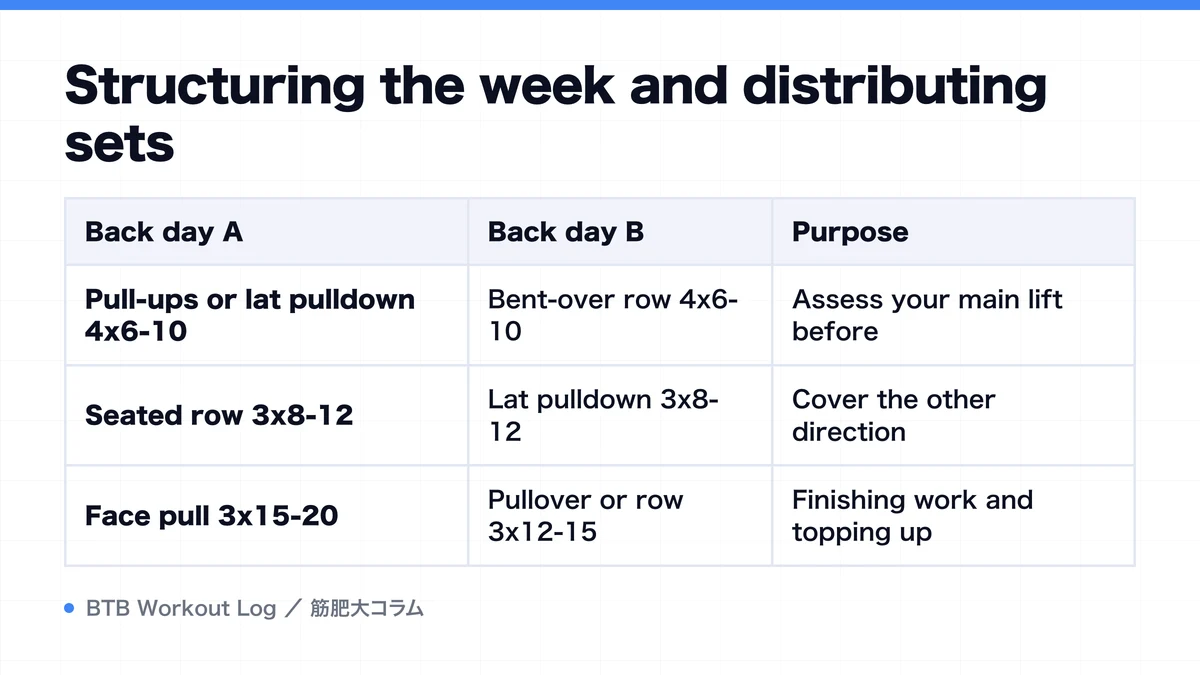
The back is a large muscle group too, so split 12-18 hard sets per week across two sessions. Up to two vertical and two horizontal exercises per session, for a total of 6-9 sets, is a manageable range.
| Back day A | Back day B | Purpose |
|---|---|---|
| Pull-ups or lat pulldown 4x6-10 | Bent-over row 4x6-10 | Assess your main lift before fatigue |
| Seated row 3x8-12 | Lat pulldown 3x8-12 | Cover the other direction |
| Face pull 3x15-20 | Pullover or row 3x12-15 | Finishing work and topping up volume |
Only while the weaker direction is clearly identified, put that direction first on both days. There is no need to skew it permanently.
Handling grip strength, and judging whether you are progressing
If your forearms hit their limit before you can push your back to failure, straps are an option. Rather than worrying that relying on equipment makes you weaker, prioritize whether you can deliver enough effort to the muscles you are targeting. If you also want to build grip strength, keeping a separate block of sets without straps lets you have both.
Judge progress separately for vertical and horizontal pulls. Are weight or reps going up at the same grip width and the same torso angle, are you holding the range of motion, and within a set are your arms or grip giving out before your back? A question like whether pull-ups alone are enough can be answered from your own data once you have these records.
When the numbers stop moving you will want to swap exercises, but re-fixing just one of grip width, elbow path, or rep range and watching for 2-3 weeks does more to identify the cause (progressive overload).
FAQ
- What if I can't do pull-ups yet?
- The lat pulldown covers the same direction of pull. Set the rep range at 8-12 and build the weight, and you can create plenty of stimulus for the lats. Adding assisted pull-ups and negatives alongside it also builds your ability to handle your own bodyweight in parallel.
- My arms (biceps) fatigue before my back does. What am I doing wrong?
- Gripping less tightly and switching your focus to moving your elbow changes the balance. Try grip widths and torso angles one at a time, and look for the conditions that produce tension in your back at the same weight. Even if the sensation never comes, if your weight and reps are going up the stimulus is getting in.
- Is deadlifting necessary for a big back?
- It is not essential. It has value for building whole-body strength, but the fatigue is high and it can lower the quality of your other exercises. In a phase where width or thickness is the priority, sending that volume to vertical and horizontal pulls maps more directly onto the goal.
- Should I train width or thickness first?
- Include both every week, and put whichever looks weaker in your photos first in each session. Changing the order alone shifts the balance, so try adjusting the order before you add more exercises.
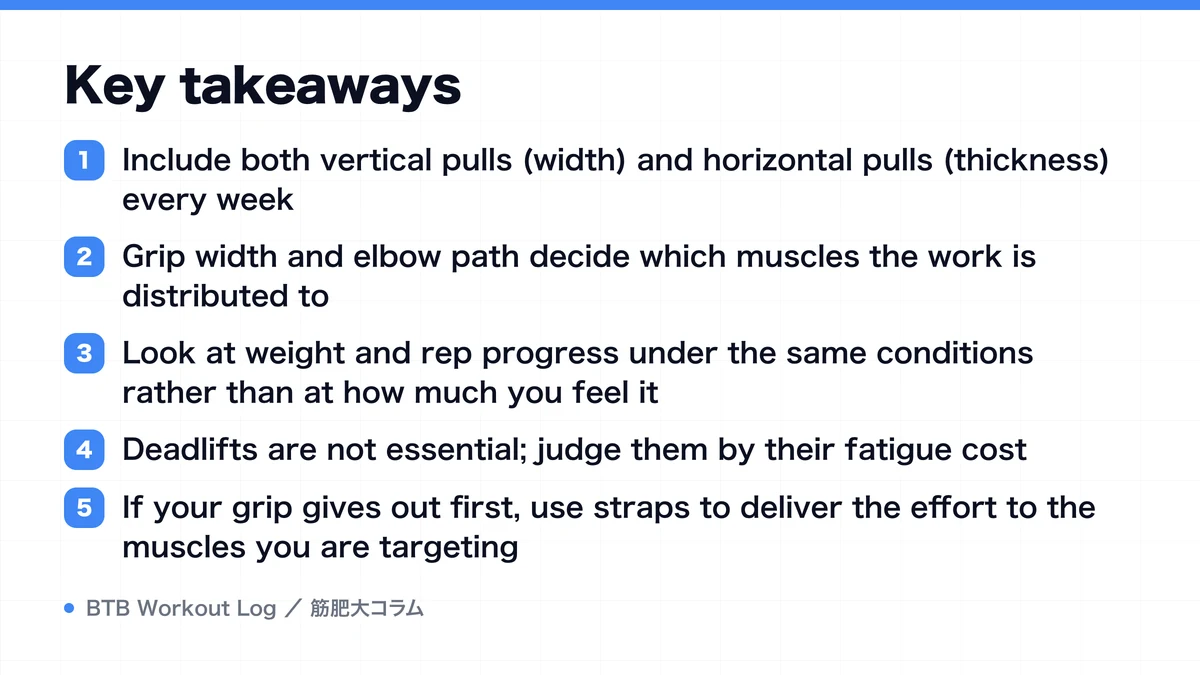
Key takeaways
- Include both vertical pulls (width) and horizontal pulls (thickness) every week
- Grip width and elbow path decide which muscles the work is distributed to
- Look at weight and rep progress under the same conditions rather than at how much you feel it
- Deadlifts are not essential; judge them by their fatigue cost
- If your grip gives out first, use straps to deliver the effort to the muscles you are targeting