Why Lateral Raises Keep Hitting Your Traps Instead | Form Fixes for Lifters Whose Shoulders Won't Round Out
The main reason your traps fatigue is that you shrug before moving your arms out to the sides, using scapular elevation to move a load that is too heavy.
You do not need to eliminate trap involvement. The fix is to initiate the upper-arm abduction handled by the middle delts while allowing the shoulder blades to rotate upward naturally.
Separate Letting the Traps Work From Lifting With the Traps
Your shoulder blades move during lateral raises, not just your upper arms. As your arms rise, the shoulder blades rotate upward, with the upper traps and serratus anterior helping to control that motion. Some tension at the base of your neck is therefore normal, and keeping your shoulders completely still should not be the goal.
The problem is when your shoulders move toward your ears from the start of each rep while your elbows barely travel outward and only the dumbbells rise. Scapular elevation then dominates, shortening the portion of the movement in which the middle delts move the upper arms. Instead of judging by how tight your traps feel after the set, watch the sequence of your shoulders and elbows as you begin the rep to identify the cause.
In a complete shoulder workout, presses primarily train the front delts, while lateral raises mainly supplement the middle delts. Rather than repeating general shoulder programming advice, this article focuses specifically on correcting the points where tension shifts toward your neck during lateral raises.
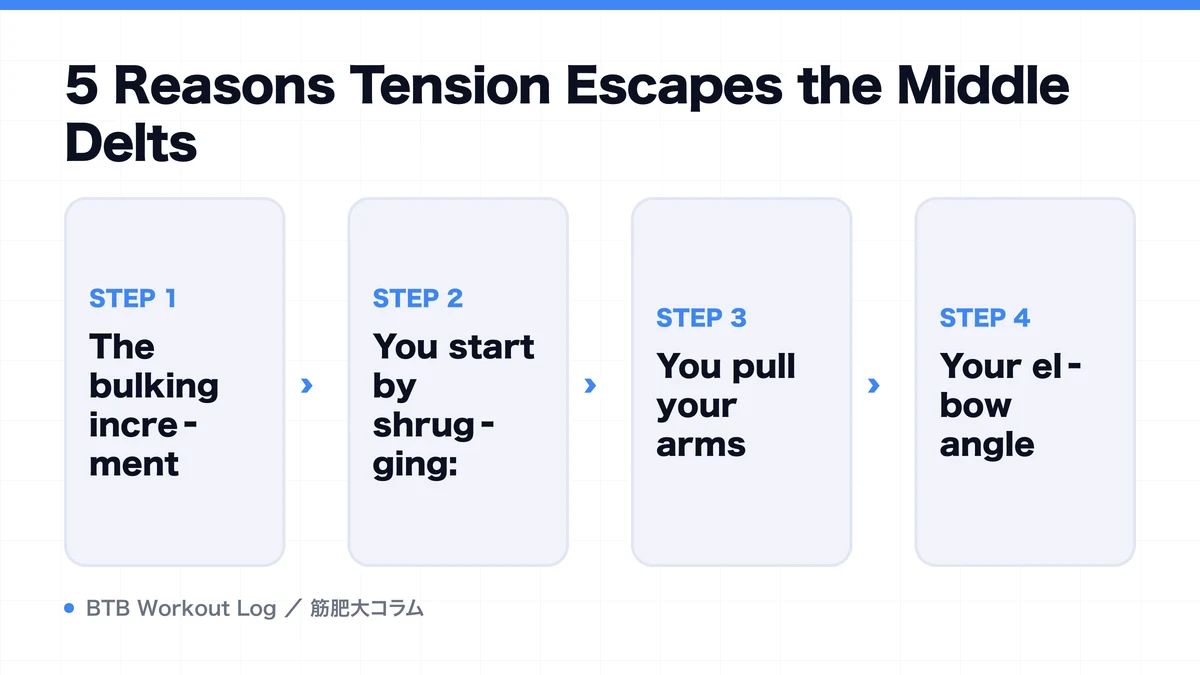
5 Reasons Tension Escapes the Middle Delts
- The bulking increment is too large: If your elbows stop rising after bulking and you use momentum from your knees and lower back to get the weight moving, the load is too heavy for your current strict form.
- You start by shrugging: Your neck shortens before the rep begins because you are lifting only the shoulder blades. Instead of raising your hands, think about sliding your elbows outward in opposite directions.
- You pull your arms behind your sides: This puts your shoulders on a less comfortable path and increases compensation from your torso and shoulder blades. Start by raising your upper arms in the scapular plane, about 15–30 degrees forward of your sides.
- Your elbow angle changes during the rep: Bending your elbows at the bottom and straightening them at the top changes the lever length, making it impossible to compare the load and range of motion. Maintain the same slight bend throughout the set.
- You are competing for height: The farther you continue above shoulder height, the more scapular rotation and elevation increase. For sets targeting the middle delts, use the point where your elbows reach roughly shoulder height as the standard endpoint.
These issues rarely occur in isolation. Increasing the weight often triggers a chain of momentum, shrugging, and altered arm paths. Instead of trying to monitor everything at once, record a short video from the side or front and address the first item that breaks down.
Rebuild the Movement From the Start With a Light Load
Start with the dumbbells at your sides, set a stable stance, and avoid aggressively flaring your ribs. Do not force your shoulders downward. Begin from a neutral position that keeps your neck looking long. Rather than lifting the backs of your hands, move as though your slightly bent elbows are reaching farther apart.
Move your upper arms through the scapular plane, slightly forward of directly beside your torso. Keep your forearms and wrists in line with your elbows, and avoid letting your hands rise much higher than your elbows. Aggressively leading with your pinkies can internally rotate the upper arms and make the front of the shoulders feel cramped. Use a pain-free hand position ranging from palms facing the floor to the thumbs sitting slightly higher.
On the way down, do not relax and let the weights drop. Take around 2 seconds to return to the starting position. Because abduction torque decreases when your arms hang straight down, you can also begin the next rep before fully resting at the bottom. However, do not increase the weight simply because you shortened the range of motion. Use the same bottom position on every rep. See full range of motion vs. partials for the broader principles behind range of motion.
Change the Resistance Curve and Stability if Your Form Still Breaks Down
For retraining the movement, choose a weight that lets you perform 15–25 reps with RIR 2–3 while preserving the shoulder-and-elbow sequence through the final rep. This rep range is not uniquely optimal for the middle delts; it is simply a useful starting point for learning a precise movement. If going lighter still leaves you capable of more than 30 reps, the stimulus is too low. If going heavier causes momentum before 10 reps, the conditions for learning the movement have broken down.
If even the smallest dumbbell bulking increment changes your form, cables or machines allow finer load adjustments. Pulling a cable from the opposite side of your body also creates resistance while your arm is lowered. Machines make it easier to stabilize your torso and check for shrugging on video. See cables vs. dumbbells for a focused comparison of the equipment.
Heavy lateral raises are not inherently wrong. If you use a variation with momentum, track it separately rather than mixing it with your strict-form records, since it serves a different purpose. Leave the high-load versus low-load decision to the lateral raise load comparison. Here, choose a weight that lets you shift the work back to the middle delts.
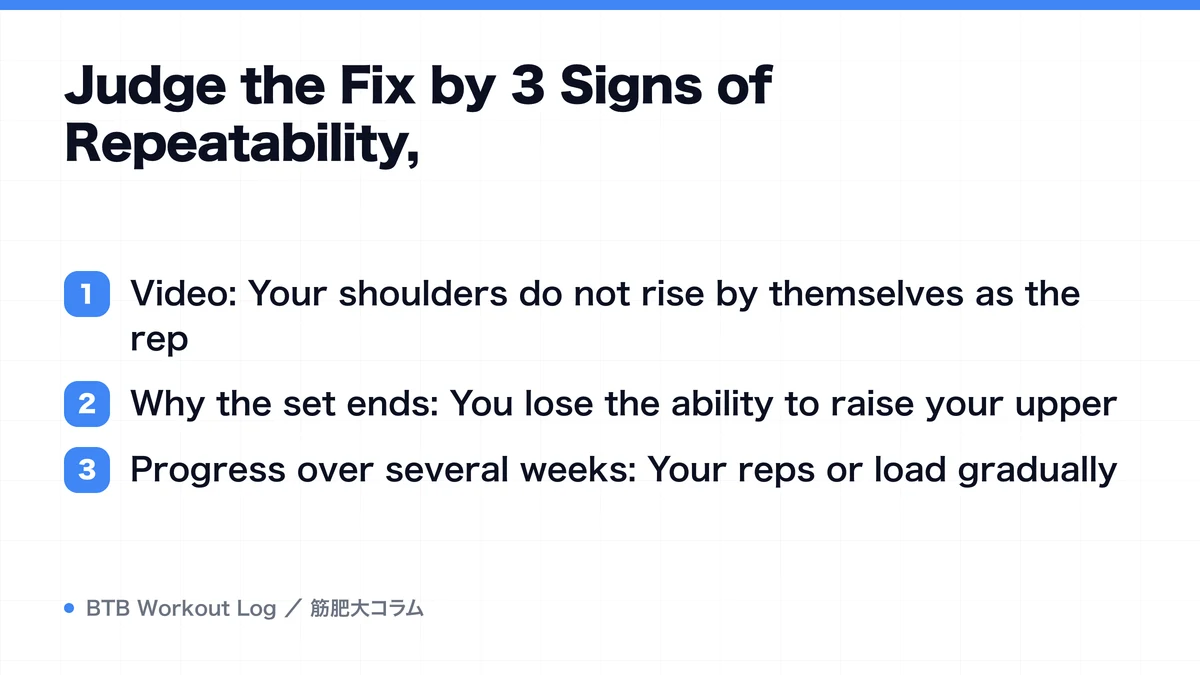
Judge the Fix by 3 Signs of Repeatability, Not How Your Neck Feels
Check whether the adjustment worked in this order.
- Video: Your shoulders do not rise by themselves as the rep begins, and your elbows travel outward along a consistent path
- Why the set ends: You lose the ability to raise your upper arms to the same height before neck tightness or breathlessness forces you to stop
- Progress over several weeks: Your reps or load gradually increase while the bottom position, top position, and RIR remain consistent
A pump can help you adjust your form, but a burning sensation in the middle delts is not enough to prove the movement is correct. Conversely, if your upper-arm path is stable and your middle-delt performance is improving, there is no need to forcefully eliminate all trap activity.
If there is a large difference between sides, use a one-arm cable lateral raise while holding a support and assess each side separately with the same load. Match your reps to the weaker side rather than adding extra reps only on the stronger side. Leaning your torso too far during unilateral work changes the movement path, so use the support to stabilize your position, not create momentum.
Keep the same equipment and rep range for 2–4 weeks, and begin bulking only after every set reaches the top of the rep range. Alongside the load, reps, and RIR, record a short form standard such as “no shrugging” or “elbows to shoulder height.” This separates genuine technical progress from numbers alone. If you experience sharp pain, numbness, or symptoms that persist at night, stop attempting form corrections and consult a medical or exercise professional.
FAQ
- Can I Avoid Using My Traps by Keeping My Shoulders Pulled Down?
- Your shoulder blades need to rotate upward with your arms, so you do not need to force them down throughout the movement. Prevent the initial shrug, then allow natural scapular motion as your arms rise. Focus on keeping your elbow path consistent rather than stiffening your neck.
- Should You Avoid Raising the Weight Above Shoulder Height on Lateral Raises?
- People who can raise their arms higher without pain can use that range. However, while correcting the movement to keep tension on the middle delts, using the point where your elbows reach roughly shoulder height as the benchmark makes shrugging and torso momentum easier to spot.
- Are Straps or Wrist Cuffs Useful?
- Cable cuffs reduce the influence of grip strength and wrist position, which can help you learn to lead with your elbows. However, they do not automatically fix shrugging or an excessively heavy load, so assess them using the same form standards.
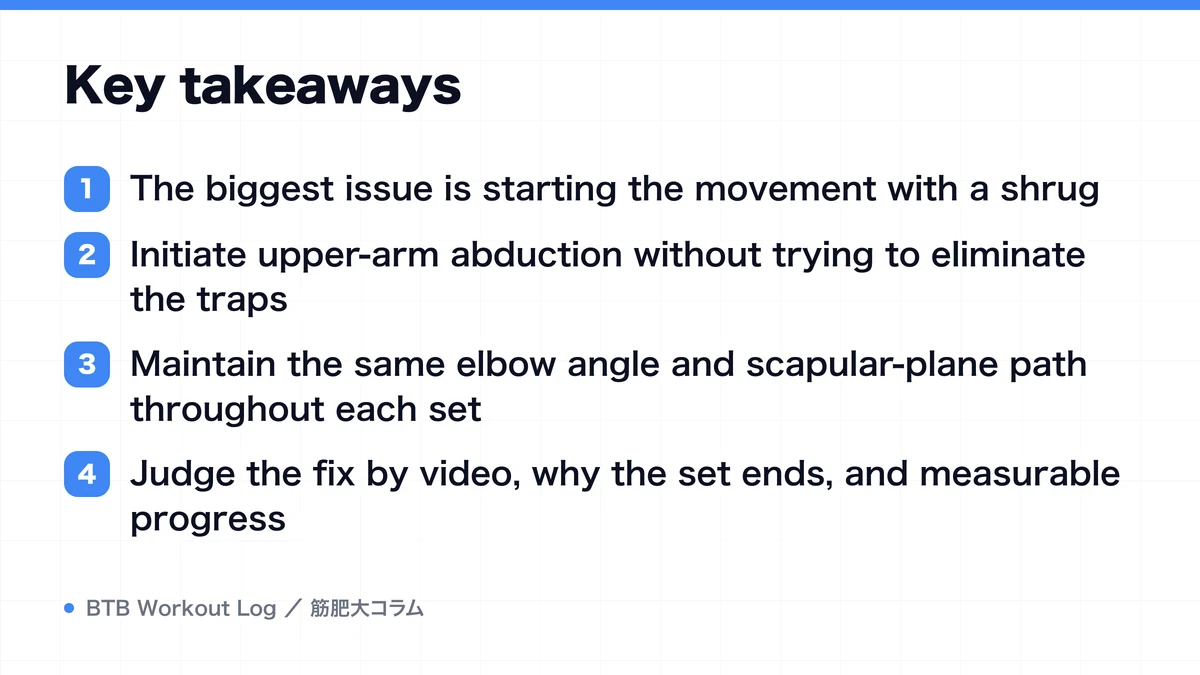
Key takeaways
- The biggest issue is starting the movement with a shrug
- Initiate upper-arm abduction without trying to eliminate the traps
- Maintain the same elbow angle and scapular-plane path throughout each set
- Judge the fix by video, why the set ends, and measurable progress