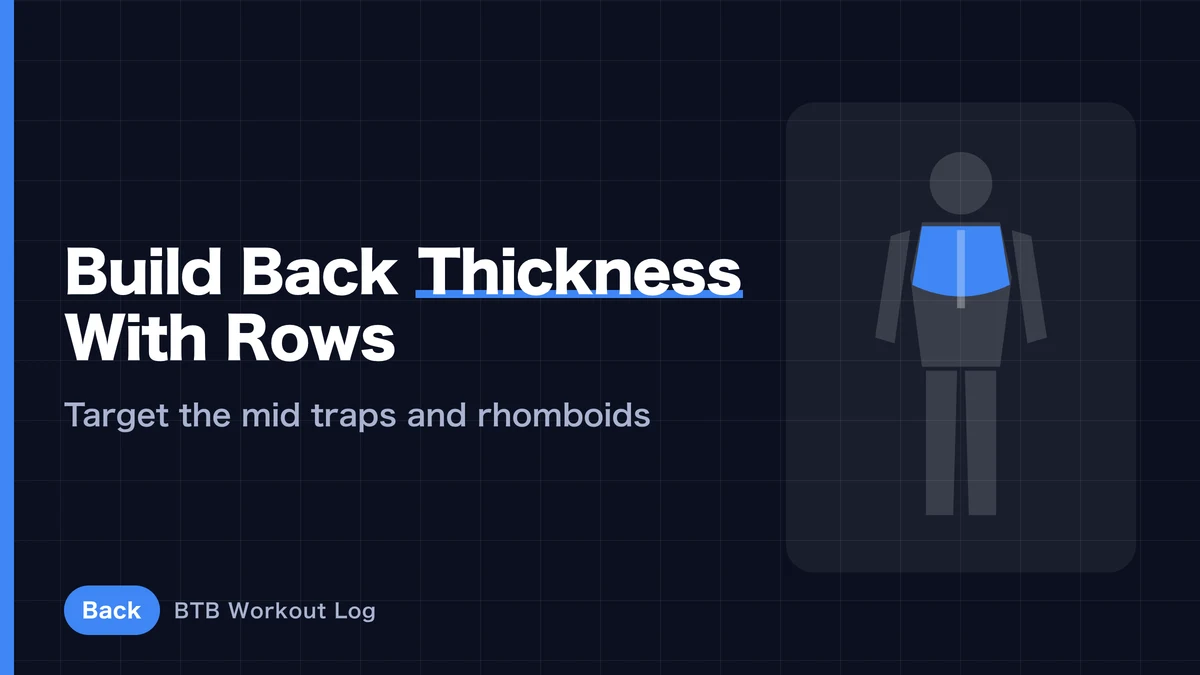
Training for Back Thickness | 5 Rowing Exercises for the Mid-Traps and Rhomboids That Show Up From the Side
To build back thickness, choose rows that let you flare your elbows slightly, pull toward your lower chest, and move your shoulder blades forward and back. Stability that keeps your mid traps and rhomboids working matters more than how much weight you can lift.
With the lat-focused work in a complete back workout still covered, here are 5 horizontal pulls that make it easier to load the muscles around your shoulder blades.
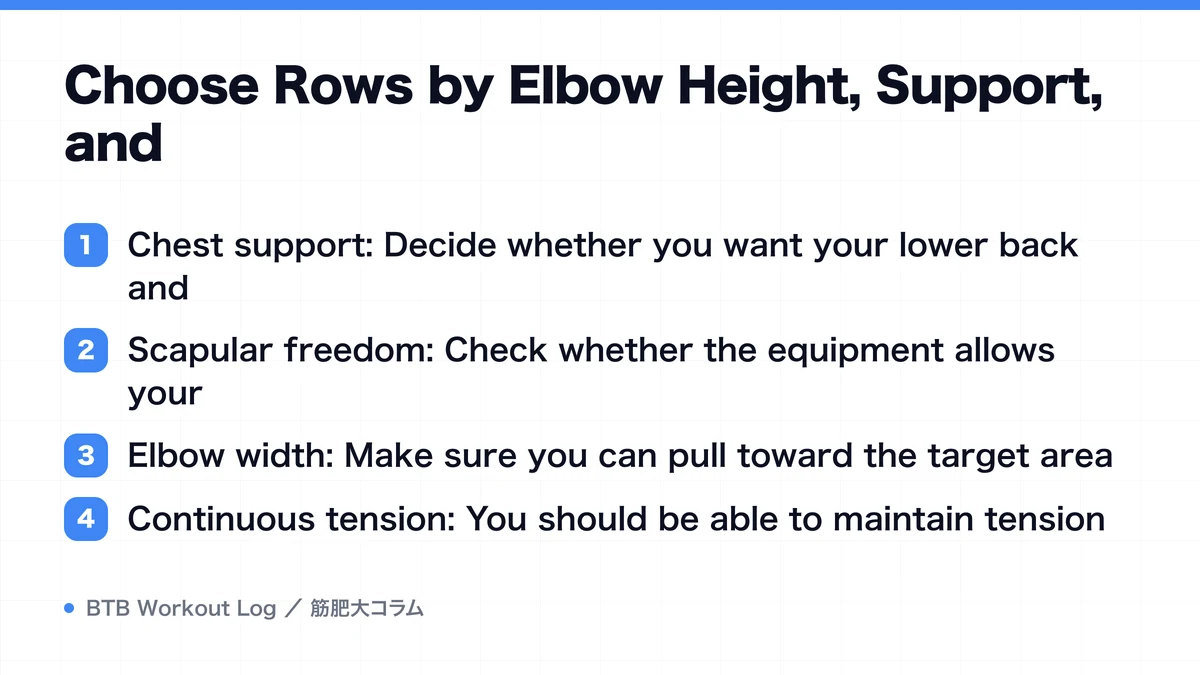
Choose Rows by Elbow Height, Support, and Scapular Movement
Several muscles contribute to back thickness, including the middle trapezius, rhomboids, rear delts, and spinal erectors. Here, "thickness" refers primarily to the middle trapezius and rhomboids around the space between your shoulder blades. The goal differs from holding your torso steady during a deadlift or targeting the upper traps with shrugs. If your priority is the rear delts, rear delt flyes, where you keep your shoulder blades stable as you move your arms out, make them easier to target. Squeezing your shoulder blades together hard, as you would in a row, shifts the load toward your back.
Even within rowing exercises, tucking your elbows close to your sides and pulling toward your waist shifts the emphasis toward the lats, especially the lower lats. Letting your elbows flare roughly 30–60 degrees and pulling toward the area between your upper abdomen and lower sternum makes it easier to emphasize the muscles around your shoulder blades. That angle is a guide, not a fixed target. Find a position that feels comfortable at your shoulders and lets you keep your forearms aligned with the direction of resistance through the end of the pull.
- Chest support: Do you want your lower back and hamstrings to share the fatigue, or keep the work focused on your back?
- Shoulder blade freedom: Does the equipment let your shoulder blades spread apart at the start and come together at the end?
- Elbow position: Can you pull toward your target without discomfort at the front of your shoulders?
- Continuous tension: Can you maintain tension from the stretched position through the contracted position without using momentum?
5 Row Variations for the Mid Traps and Rhomboids
1. Chest-Supported Dumbbell Row
Lie chest-down on an incline bench and pull a dumbbell in each hand toward your lower sternum. This almost completely removes the need to stabilize your lower back while letting you adjust your hand position and elbow angle on each side. If the bench is too high, however, the dumbbells may hit the floor. Set it low enough to let your arms extend and your shoulder blades move forward at the bottom.
2. Wide-Grip Seated Cable Row
Grip a long bar slightly wider than shoulder width, drive your elbows outward, and pull toward your upper abdomen. The cable keeps resistance on the muscles at the start and makes it easy to repeat scapular protraction and retraction. If you force your chest up and lean back, you create extra range of motion through your torso. Keep the distance between your pelvis and rib cage consistent instead.
3. Chest-Supported T-Bar Row
Chest-supported T-bar machines provide enough stability to progressively lift heavier loads with both arms, making this a strong primary exercise for back thickness. Even if only a narrow neutral-grip handle is available, do not flare your elbows straight out to the sides. Point them about 30–45 degrees outward and choose a setup that lets you pull the handle near your upper abdomen.
4. Seal Row
Lie face-down on a nearly horizontal bench and row a barbell or dumbbells from the floor. This setup makes it difficult to use leg drive or lift your torso, creating clear and repeatable conditions from rep to rep. It requires a sufficiently high bench, and starting a heavy load with your shoulders extended forward can disrupt the bar path. Use a moderate weight and keep each rep controlled.
5. Bent-Over Barbell Row
This is a good option if you want to train back thickness and torso stability together with free weights. Keep your torso angle fixed throughout the set and pull the bar toward your upper abdomen to emphasize the muscles around your shoulder blades. During weeks when your lower back or hamstrings fatigue first, switch to a chest-supported exercise instead of forcing the barbell row into your program.
Do Not Pin Your Shoulder Blades Back—Include the Stretch in Every Row
When targeting the middle trapezius and rhomboids, “squeeze your shoulder blades and lift your chest” can work as a cue at the finish. Holding that position before the rep begins, however, reduces the distance they can travel. On the return, let your upper arms move forward and allow your shoulder blades to glide outward around your rib cage. Then drive your elbows back until the inner edges of your shoulder blades move toward each other.
If you shrug so hard at the finish that your neck looks shorter, tension will tend to shift toward the upper traps. Trying to force your shoulders down can also restrict natural scapular movement. Keep your neck comfortably long and focus on moving your shoulder blades toward your spine rather than pulling them downward.
You do not need to count exact seconds for your tempo. What matters is controlling the return and preventing the weight from dropping at the deepest stretch. Choose a load that lets you follow the same path from start to finish, not one you can move quickly through only the second half of the range of motion. Straps are an option if your forearms reach failure first, but if your wrists are simply bending, adjust your grip width before adding them.
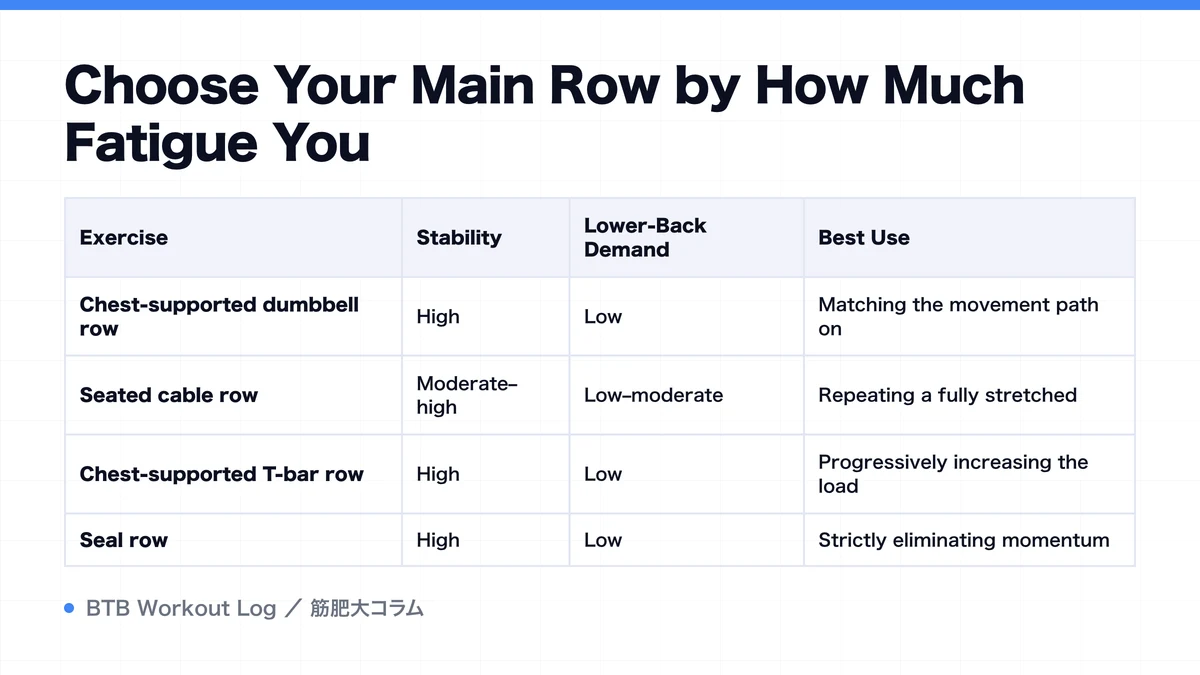
Choose Your Main Row by How Much Fatigue You Can Accept Outside Your Back
| Exercise | Stability | Lower-Back Demand | Best Use |
|---|---|---|---|
| Chest-supported dumbbell row | High | Low | Matching the movement path on both sides |
| Seated cable row | Moderate–high | Low–moderate | Repeating a fully stretched position |
| Chest-supported T-bar row | High | Low | Progressively increasing the load |
| Seal row | High | Low | Strictly eliminating momentum |
| Barbell row | Low–moderate | High | Training torso stability at the same time |
The relative strengths of barbell and seated cable rows are covered in detail in this comparison of the 2 row variations. When thickness is the goal, your choice should also account for any lower-back fatigue left from the previous day’s squats or RDLs and whether it will carry over into your next leg workout. If 2 exercises provide a similar local stimulus, use the one that does not disrupt the rest of your weekly program.
Train a Heavy Main Row and a Controlled Row on Separate Days
If you split back training across 2 days, give each session a different focus: increasing load on day A with 3 sets of chest-supported T-bar rows for 6–10 reps, and maintaining a consistent range of motion on day B with 3 sets of wide-grip seated cable rows for 10–15 reps. Include the amount of lat-focused vertical pulling you need across both days, rather than endlessly adding more thickness exercises.
If you use barbell rows, place them on a day with fewer lower-body hip-hinge exercises. Keep their combined volume with chest-supported rows within your recovery capacity. Rest between sets until you can repeat the same elbow path as the previous set, rather than simply waiting until you catch your breath. If short rests cause your grip or cardiovascular capacity to give out before your back, the factor ending your set does not match the muscles you want to train.
Judge progress within the same exercise and setup, rather than comparing the weight labels on different machines. Record your seat position, handle, torso angle, and where each rep ends. This makes it easier to spot whether extra reps came from shortening your range of motion. Even if you go from 6 reps to 12, barely moving your shoulder blades means those records reflect different conditions.
FAQ
- Do You Need Deadlifts to Build Back Thickness?
- No. Deadlifts heavily load the spinal erectors and challenge whole-body bracing, but they serve a different role from horizontal pulls that train the middle trapezius and rhomboids dynamically. Include them separately when they suit your goal and you have enough room in your fatigue budget.
- Should You Squeeze Your Shoulder Blades as Hard as Possible on Every Row?
- Retract them only as far as they move naturally and without pain. Forcing maximum retraction can push your shoulders forward or make you shrug. Let your shoulder blades spread on the return, then move them toward your spine as you pull. The goal is to repeat that full movement without the load changing your form.
- Are Heavy Weights and Low Reps Best for Back Thickness?
- Heavy loads are one option, but they are not the only effective approach. If adding weight changes your torso angle or elbow height, the target muscles change. You can use several ranges that let you maintain good form, such as 6–10 reps for your main row and 10–15 reps for a stable cable variation.
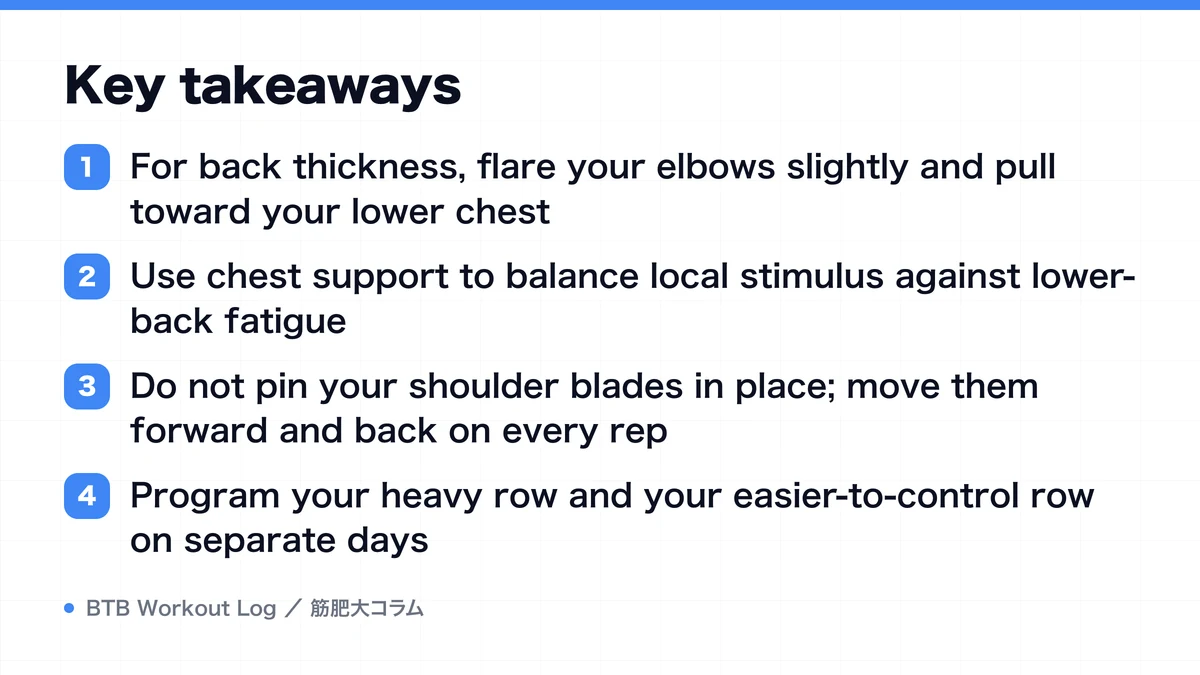
Key takeaways
- For back thickness, flare your elbows slightly and pull toward your lower chest
- Use chest support to balance local stimulus against lower-back fatigue
- Do not pin your shoulder blades in place; move them forward and back on every rep
- Program your heavy row and your easier-to-control row on separate days