Why Rear Delt Fly Keeps Sneaking Into Your Back | Form That Keeps the Load on the Rear Delt
The biggest reason you feel rear delt flies in your back is that you squeeze your shoulder blades together before opening your arms, turning the fly into a row.
You cannot completely remove the middle traps and rhomboids from the movement. The goal is not to relax your back, but to keep your shoulder blades stable while moving your upper arms so the rear delts become the limiting factor in the set.
The More You Retract Your Shoulder Blades, the More the Fly Becomes a Row
The rear delts work when you move your upper arms behind your body or open them out around shoulder height. The middle traps and rhomboids, meanwhile, pull the shoulder blades toward the spine. Both actions can occur during a rear delt fly, so feeling some work in your back is completely normal.
The problem starts when you reset by lifting your chest on every rep and pull until your shoulder blades squeeze together as hard as possible. The movement may look bigger, but its second half is driven more by the shoulder blades than the upper arms. Pulling your elbows toward your hips also turns a horizontal fly into a rowing path, allowing the larger back muscles to handle more of the load.
Programming exercises for the entire shoulder explains why the rear delts may need dedicated work. Here, the focus is not how many exercises you perform, but how to make one fly rear-delt dominant again. Instead of judging the movement by whether your back feels tight, look at which joint action is producing each rep.
Fix These 5 Reasons Your Back Fatigues First
| Cause | What Is Happening | Fix |
|---|---|---|
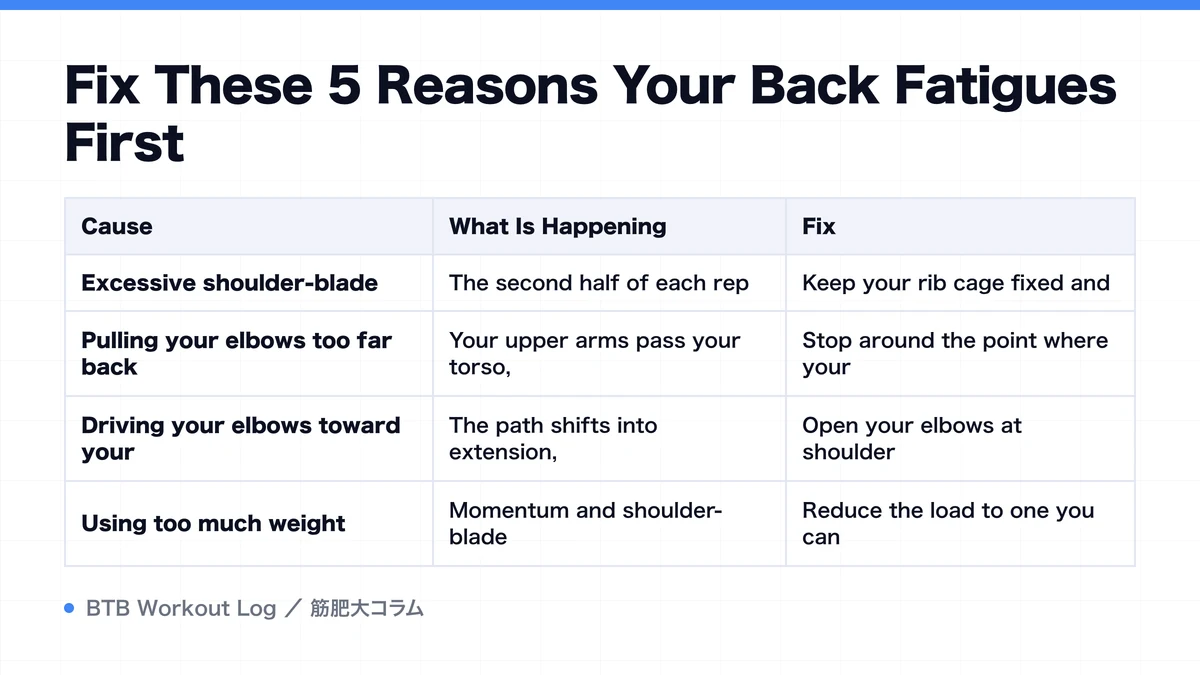
| Excessive shoulder-blade retraction | The second half of each rep becomes shoulder-blade retraction | Keep your rib cage fixed and minimize shoulder-blade movement |
| Pulling your elbows too far back | Your upper arms pass your torso, making the movement more like a row | Stop around the point where your elbows reach the line of your torso |
| Driving your elbows toward your hips | The path shifts into extension, making it easier to use the lats | Open your elbows at shoulder height or slightly below |
| Using too much weight | Momentum and shoulder-blade movement compensate for the excess load | Reduce the load to one you can control for 12–25 reps on the same path |
| Unstable torso | Raising your upper body produces the rep | Support your torso with a chest pad, bench, or machines |
Trying to focus on everything at once can make the movement stiff. Start by reducing the load and stabilizing your torso. Then address your shoulder blades, followed by the end point of your elbow path. Your arms do not need to be completely straight. Keeping a slight bend in your elbows unchanged throughout the set makes it easier to compare the load from rep to rep.
Start with a neutral hand position. Aggressively turning your thumbs or pinkies does not guarantee that you will selectively recruit only the rear delts. Use the position that does not cause pinching or discomfort in your shoulders. If pain persists after adjusting your form, do not train through it; consult a qualified professional.
Standardize the Movement From Setup to End Point in 4 Steps
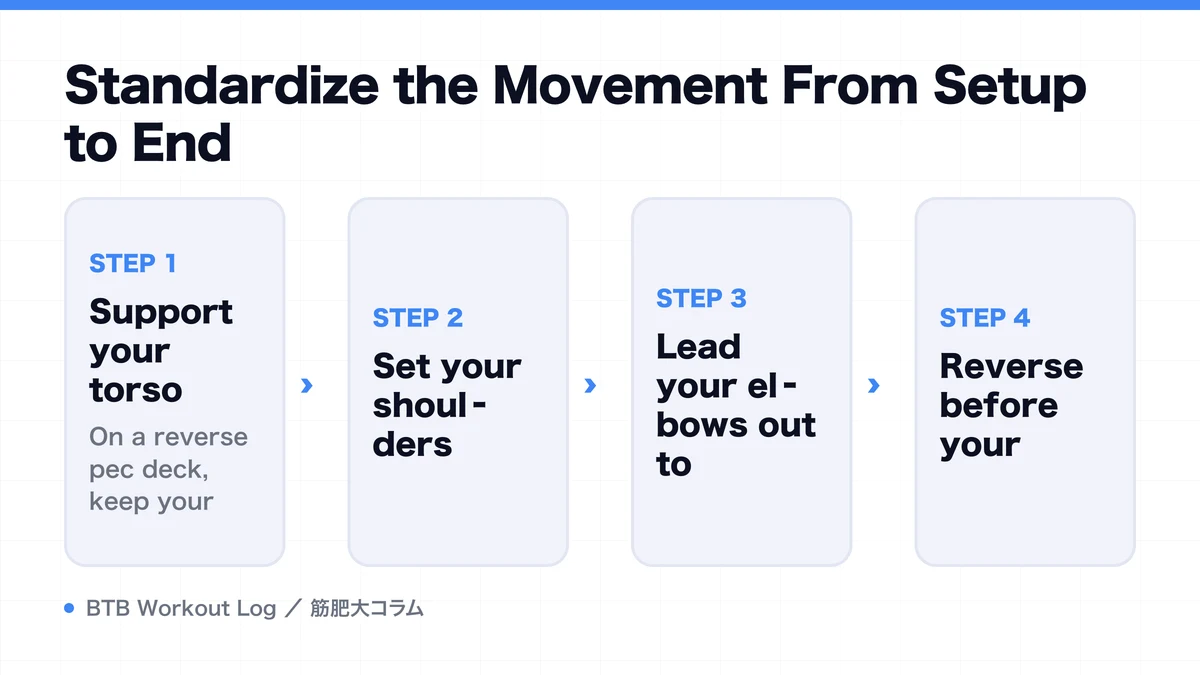
- Support your torso: On a reverse pec deck, keep your chest against the pad. With dumbbells, lie face down on an incline bench. Set up so you cannot lift your chest by arching your lower back.
- Set your shoulders naturally: Do not shrug or force them down. Keep your shoulder blades quiet against your rib cage. Do not use the pressing cue to "pin your shoulder blades back and lift your chest."
- Lead your elbows out to the sides: Instead of swinging the weight with your forearms, move your upper arms through an arc. Your elbows do not have to stay exactly level with your shoulders; try a slightly lower position if it feels better.
- Reverse before your back takes over: End the rep where you would need to retract your shoulder blades farther to continue. Repeat the range of motion that keeps tension on your rear delts instead of chasing the widest possible range of motion.
Reach your arms forward at the start to feel a stretch in the rear delts. You do not need to dump your shoulders forward and round your entire torso. Control the return instead of suddenly releasing the load, using a speed that lets you reach the same starting position on every rep. This approach to range of motion is also covered in the comparison of full range of motion and partials, but it is important not to confuse your largest pain-free range of motion with the range that keeps the target muscle loaded.
Choose Equipment and a Rep Range That Let You Hold Your Form
When first correcting your form, a reverse pec deck or a rear delt fly performed with crossed cables is usually easiest to control. Machines make it easier to support your torso, while cables maintain tension more effectively at the starting position. Both let you repeat the movement without excessive shoulder-blade motion. Dumbbells also work with chest support, but the resistance decreases at the bottom, so avoid using momentum to reverse direction.
Start with roughly 12–25 reps and stop at RIR 1–3, meaning you have 1–3 reps in reserve with your chosen form. Lighter is not automatically better. If you can exceed 30 reps comfortably, the load may be too light. If your shoulder blades start moving noticeably at around 10 reps, it is probably too heavy. General load research suggests that hypertrophy can occur across a wide range of loads when effort is matched, but those findings do not directly compare specific rear delt fly techniques.
Some studies report differences in acute muscle activity across the regions of the deltoid depending on the exercise. However, EMG measures activity at that moment, not long-term muscle growth itself. Do not choose equipment based only on the strength of the pump. Prioritize whether you can add reps or load while keeping the same movement standard. For the full range of exercise options, see 5 Rear Delt Exercises; here, the only focus is the quality of your fly.
Judge the Fix by What Ends Each of Your 3 Sets
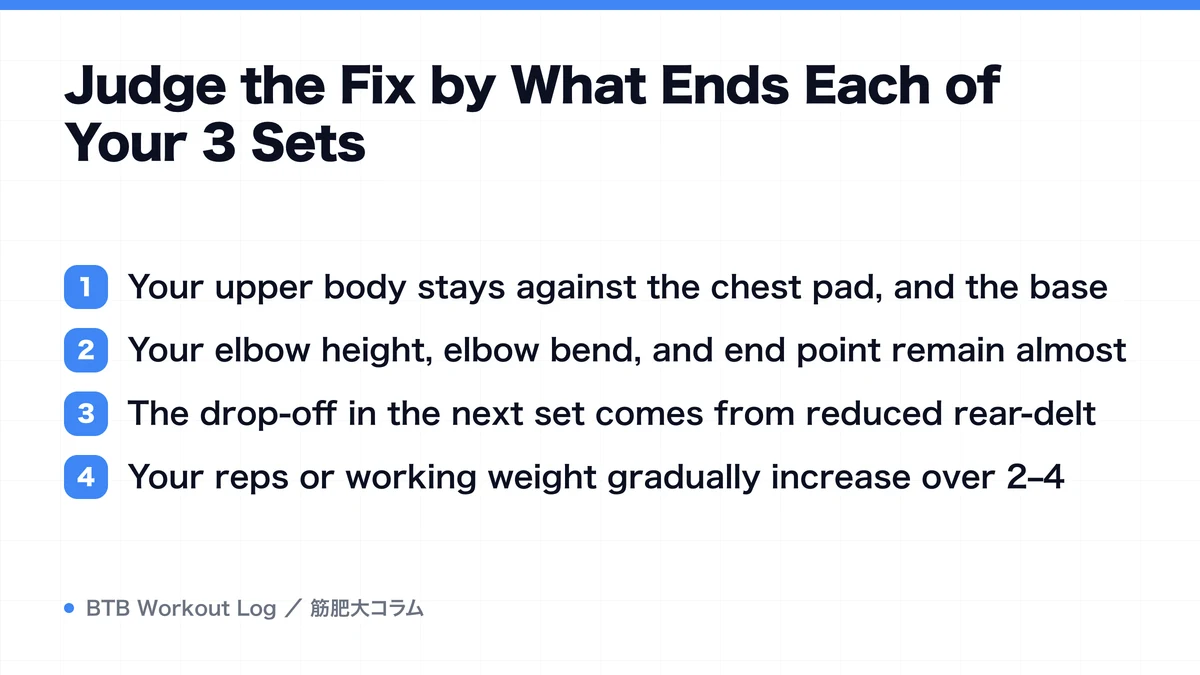
A good set is not one where you feel nothing in your back. You are getting closer to the intended load distribution if fatigue builds locally in the rear delts and the set ends because you can no longer maintain your chosen elbow end point, even though retracting your shoulder blades would let you keep moving.
- Your upper body stays against the chest pad, and the base of your neck does not tighten first
- Your elbow height, elbow bend, and end point remain almost identical from the first rep to the last
- The drop-off in the next set comes from reduced rear-delt output rather than back fatigue
- Your reps or working weight gradually increase over 2–4 weeks under the same standards
Keep the equipment, seat position, grip, and rest periods fixed while evaluating the change. Adjust only one variable at a time so you can identify the cause: use Week 1 as your baseline, reduce the load and stabilize your shoulder blades in Week 2, then shorten the elbow end point in Week 3. If the rear delts still do not limit the set once your form is consistent, switch equipment or revisit your rep-range selection.
FAQ
- Is It a Problem if I Feel Rear Delt Flies in My Traps?
- The middle traps and rhomboids help stabilize your shoulder blades, so you cannot eliminate their activity. Do not judge the exercise as a failure just because your back feels tight. Instead, check whether you can reproduce the same elbow path without excessive shoulder-blade retraction and whether the rear delts are what end the set.
- Should My Elbows Be Level With My Shoulders?
- Shoulder height is a starting point, not a universal rule. If that position causes pinching, you can lower your elbows slightly. Choose an angle that keeps tension on the rear delts while remaining comfortable for your shoulders, without letting the movement turn into a row toward your hips.
- Does a Pump With Light Weight Mean My Rear Delts Are Working?
- A pump is one useful clue, but it does not prove hypertrophy or correct form by itself. Also check that you can reach RIR 1–3 within your chosen range of motion, maintain the same path across sets, and increase your reps or load over several weeks.
Key takeaways
- Excessive shoulder-blade retraction turns the fly into a row
- Support your rib cage and make opening your upper arms out to the sides the main action
- End your range of motion just before your back starts taking over
- Judge the fix by local fatigue, repeatable technique, and progress over several weeks