When Your Forearms Give Out Before Your Back Does | Are Lifting Straps Cheating, or Bad for Hypertrophy?
Lifting straps are not necessarily bad for back hypertrophy. If your forearms or grip end the set first, straps can help you reach the intended effort level for your back.
Simply wrapping straps around the bar does not increase back stimulus, however, and long-term studies directly comparing hypertrophy with and without straps are limited. Here is how to determine when removing grip as a limiting factor makes sense and when strapless work still serves a purpose.
Straps Reduce the Demand on Your Grip, Not the Work of Pulling
Wrist straps connect your wrist to the bar or handle, reducing how hard your fingers must work to maintain your grip. They do not automatically engage your lats or correct your shoulder-blade movement. What mainly changes is how much your grip limits the set.
Pulling exercises train the back, biceps, and forearms together. Feeling your forearms work is not a problem by itself. The issue is the order of failure: your hands open during a lat pulldown even though you can still drive your elbows down, or you lose the handle during a row while your back still has reps in reserve. In these cases, grip strength ended the set, not your back. For the broader reasons back training can be difficult to feel, see why the mind-muscle connection with your back can feel unclear. Here, we will focus only on cases where grip fails first.
Conversely, if your hands remain secure but your torso rises, your elbow path changes, or your range of motion shortens, the limiting factors are technique and load selection. Even if straps let you perform more reps, that does not mean you completed more effective reps for your back.
Focus on What Ends the Set for Your Back, Not Whether You Use Straps
For hypertrophy, the priority is repeatedly applying sufficient tension to the target muscles and progressing within what recovery can support. RIR estimates "how many more reps you could have completed with the same form." If your back still has roughly RIR 4–5 when your grip reaches its limit, straps may help you maintain your hold and bring your back closer to failure.
Taking every set to complete repetition failure is not essential for hypertrophy. A meta-analysis comparing training to failure with stopping short has not shown a consistent advantage for reaching failure, while a review of proximity to failure found variation across study conditions. The goal, therefore, is not to use straps to grind out reps until failure. It is to prevent grip from leaving your back at a much higher RIR than intended.
There is also an important limitation. The available research does not include long-term trials directly comparing back and forearm hypertrophy after several months of training with versus without straps. We therefore cannot claim that straps make your back any specific % bigger or reduce forearm growth by any specific %. The reasonable practical inference is that removing grip as a bottleneck can make it easier to maintain set quality for the muscles you intend to train.
Separate the Situations Where Straps Help From Those Where They Do Not
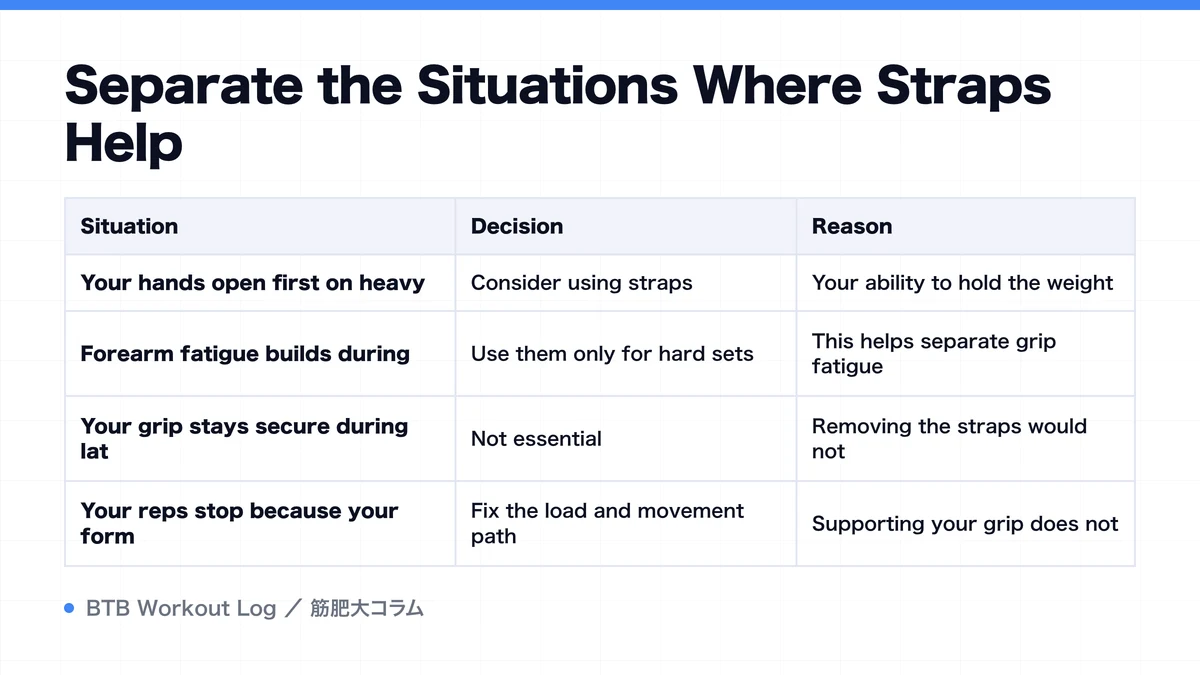
| Situation | Decision | Reason |
|---|---|---|
| Your hands open first on heavy rows | Consider using straps | Your ability to hold the weight is cutting back reps short |
| Forearm fatigue builds during later back exercises | Use them only for hard sets | This helps separate grip fatigue from earlier exercises |
| Your grip stays secure during lat pulldowns | Not essential | Removing the straps would not change where your back reaches its limit |
| Your reps stop because your form breaks down | Fix the load and movement path | Supporting your grip does not remove the cause |
| Grip and forearm strength are your main goals | Keep some strapless work | You need opportunities to train your ability to hold the weight |
Straps tend to help most on exercises such as chest-supported rows and lat pulldowns, where your position is stable and you can maintain the intended movement path once grip is removed as a limitation. If your lower back loses position first during bent-over rows, or you are using momentum to move the bar, first consider adjusting the load or switching to a chest-supported exercise. Build your overall back routine around the roles of vertical and horizontal pulls, then identify the limiting factor in each direction.
Body weight alone does not determine when to use straps. Some lifters lose grip first with moderate loads and high reps, while others have sufficient grip strength even at heavy loads. Do not use a fixed rule such as "wear straps above this many kg." Base the decision on whether your back or your grip ended the reps first.
Give Strapless Sets and Strapped Sets Different Jobs
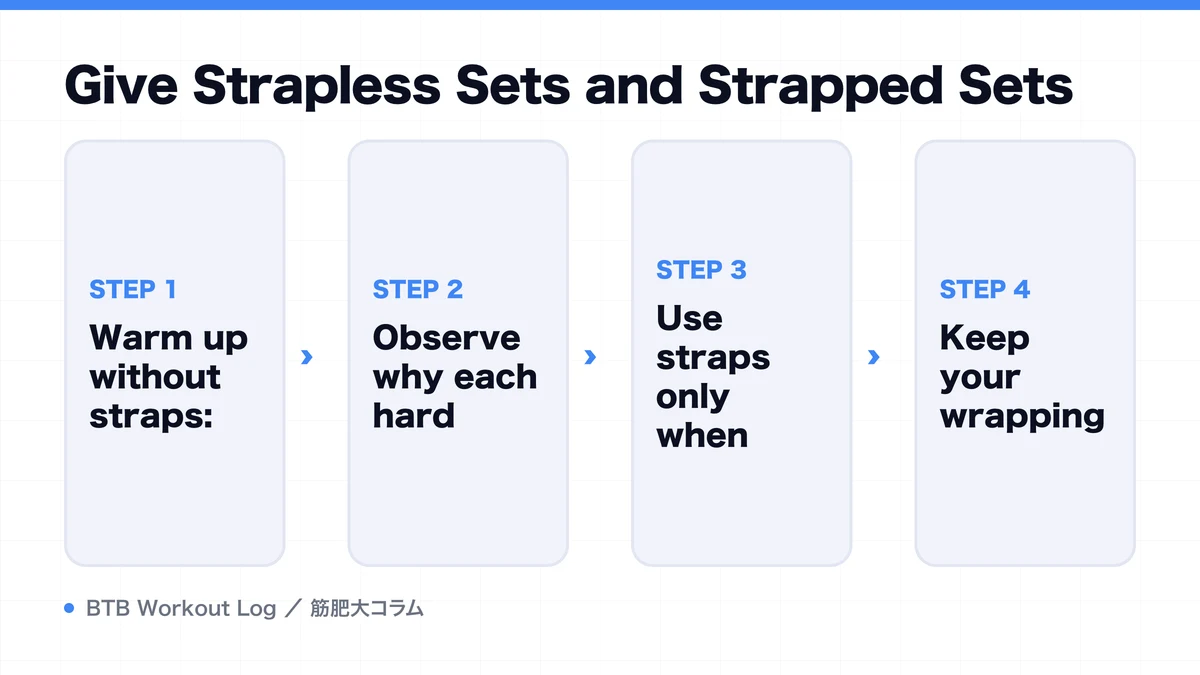
- Warm up without straps: Check whether you have any trouble holding lighter loads, and save the time required to wrap the straps.
- Observe why each hard set ends: Distinguish between your hands opening, your elbows no longer pulling, and your body position breaking down.
- Use straps only when grip fails first: Keep the load, rest period, and range of motion unchanged so the straps are the main variable.
- Keep your wrapping method and tightness consistent: If the amount of assistance changes each time, you introduce another variable when comparing reps.
- Train your forearms separately when needed: Do not rely on back sets to double as grip training indefinitely. Keep some strapless holds or direct exercises if necessary.
You do not have to choose between performing every pulling exercise strapless and using straps from the first set onward. For example, you can perform your first row without straps to assess your holding strength, then use straps on later lat pulldowns to keep your back reps consistent. If bigger forearms are also a goal, treat them as a separate priority through exercises for building thicker forearms. This lets you manage back-set quality and grip progress independently.
Do not continue using a wrapping method that causes wrist or skin pain. While learning to use straps, practice the wrapping direction with lighter sets and start with equipment you can safely release if the bar drops.
Check Whether Back-Set Quality Improved, Not Just Whether You Did More Reps
Once you introduce straps, compare performance using the same exercise, load, rest periods, and range of motion. Total reps aren't the only thing that matters. If straps let you complete more reps while maintaining your elbow path and torso position, and your back muscles finish the set closer to your target RIR, removing the grip limitation has served a purpose. If you get more reps only by shortening your range of motion and using more momentum toward the end, the case for using straps is still weak.
Don't judge straps by a single pump. Keep the conditions consistent for about 2–4 weeks and check whether you can increase the load or reps and allow enough recovery before your next session. If your back performance doesn't change, grip may not have been the bottleneck in the first place. Instead of adding sets, review exercise stability, rest periods, and total volume.
If you track your training in BTB Workout Log, note whether you used straps and compare sets with and without them as separate conditions. Your records can only help you assess progressive overload when you can reproduce the same conditions, including equipment. Support your grip on sets that prioritize your back, while keeping dedicated grip work in your training. With that division of work, straps become a tool for managing what limits you, rather than a shortcut that compromises hypertrophy.
FAQ
- Can I use straps for every set from the start of my back workout?
- That is an option if your grip consistently fails first and you can maintain your movement path and range of motion while using straps. You do not need them for every lighter set, however. Check your holding strength during warm-ups or selected strapless sets, then reserve straps for the hard sets where your back is the priority.
- Will using straps make my forearms smaller?
- There is not enough direct long-term evidence showing that using straps alone makes your forearms smaller. However, replacing every opportunity to hold heavy loads without straps will reduce the amount of grip practice you get. If forearms are also a priority, keep some strapless sets or direct forearm exercises in your weekly training.
- Why do my arms still fatigue first when I use straps?
- Straps mainly support your ability to hold the weight. They do not remove biceps involvement in elbow flexion or correct a poor elbow path. Reduce the load and use movement that matches your target, such as driving your elbows toward your pelvis during vertical pulls. Add straps if your hands still open first.
Key takeaways
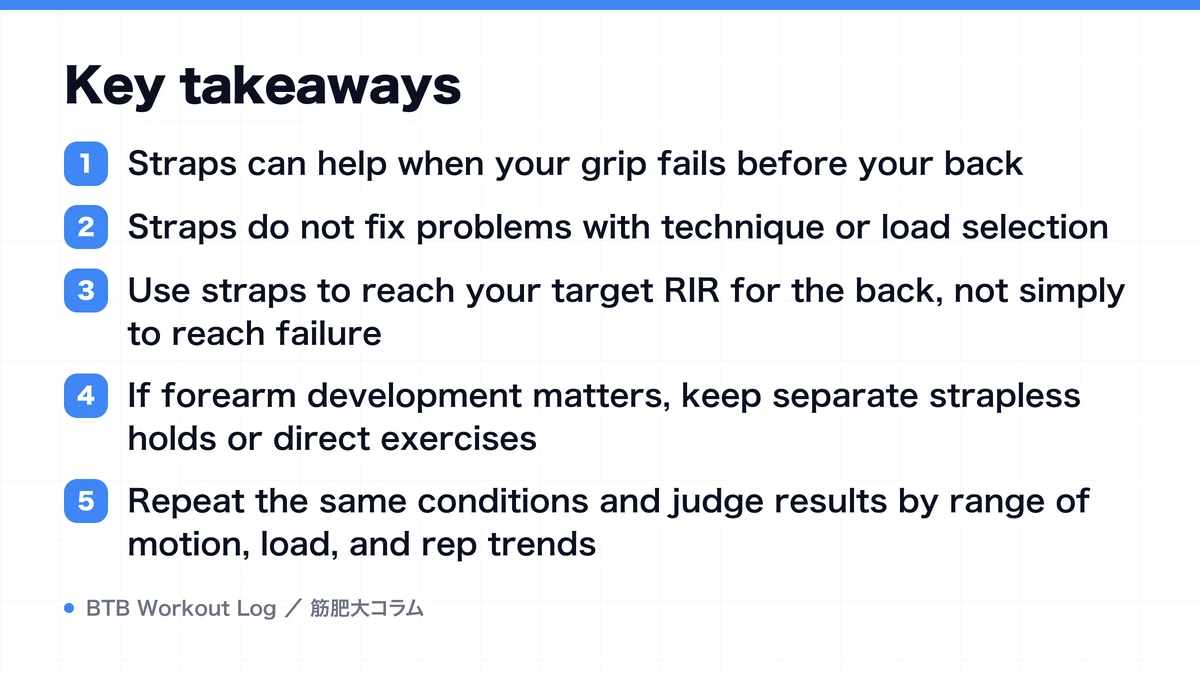
- Straps can help when your grip fails before your back
- Straps do not fix problems with technique or load selection
- Use straps to reach your target RIR for the back, not simply to reach failure
- If forearm development matters, keep separate strapless holds or direct exercises
- Repeat the same conditions and judge results by range of motion, load, and rep trends