Building a V-Taper Back | 5 Exercises for a Bigger Lat
For a wider back, build your training around vertical pulls, then use unilateral and straight-arm exercises to vary the direction of resistance. You do not need to perform all 5 exercises in the same session.
For a complete back routine, see our back hypertrophy workout. Here, we are focusing only on exercises that load the lats effectively and make progress easy to track.
Do Not Choose Lat-Width Exercises by Fiber Direction Alone
The lats help pull your upper arm down toward your side and move it backward from an overhead or forward position. This means you can train them through shoulder adduction in pull-ups and lat pulldowns, as well as shoulder extension in rows and pullovers. But there is no simple rule that says a specific angle will grow only the "outer lats." Your apparent back width also depends on overall lat development, skeletal structure, and body fat.
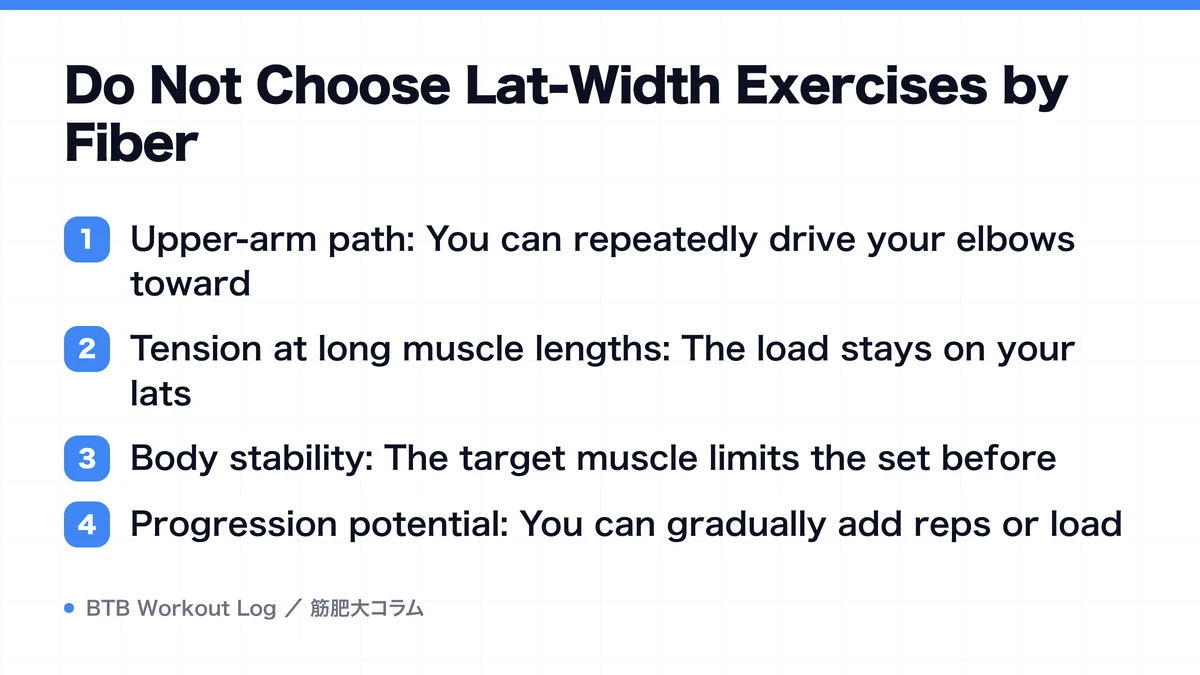
Use these 4 criteria to narrow down your options.
- Upper-arm path: You can repeatedly drive your elbows toward your pelvis without using momentum.
- Tension at long muscle lengths: The load stays on your lats at the starting position with your arms raised.
- Body stability: The target muscle limits the set before your grip or lower-back stability does.
- Progression potential: You can gradually add reps or load while maintaining the same range of motion.
EMG data can help identify promising exercises, but it only measures muscle activity at that moment. An exercise producing a higher reading should not automatically be considered superior for long-term hypertrophy.
5 Lat Exercises That Serve Different Roles
1. Neutral-Grip Lat Pulldown
Use parallel handles set roughly shoulder-width apart and drive your elbows down toward your sides. The machine makes it easy to stabilize your body and increase the load in small increments, making this a strong choice for your primary exercise. Instead of dramatically arching your chest at the bottom, keep your forearms roughly aligned with the cable and end the rep when your upper arms reach your sides.
2. Pull-Up or Assisted Pull-Up
This is a vertical pull that moves your bodyweight through space. If your bodyweight forces you to shorten the range of motion, use assistance. If the movement is already comfortable, add a small amount of weight. See our comparison of both exercises when deciding between pull-ups and pulldowns. Here, prioritize consistent form from rep to rep.
3. Half-Kneeling One-Arm Pulldown
Kneel on one knee and pull one elbow from a high cable toward the hip on the same side. Training each side separately lets you adjust the path of each arm and makes it easier to start with the shoulder naturally elevated at the top. Leaning sideways to move the handle changes the direction of resistance, so keep your sternum facing forward.
4. Chest-Supported Lat Row
Brace your torso against the chest pad, keep your elbow low, and pull toward your hip. Although this is a horizontal pull, it serves a different role from an upper-back row performed with the elbows flared. Removing lower-back stability from the equation makes it useful if your posture breaks down first during free-weight rows or vertical pulls do not suit your shoulder mechanics.
5. Cable Straight-Arm Pulldown
Keep the bend in your elbows nearly fixed and sweep your arms in an arc from overhead to your thighs. This limits biceps involvement and adds shoulder-extension work for the lats. Chasing heavier loads by dropping your torso turns it into a different movement, so treat it as a controlled accessory rather than a primary exercise.
Let Your Shoulder Blades Move and Bring Your Elbows Toward Your Pelvis
When targeting the lats, do not make "keep your shoulder blades pinned back" a universal rule. As your arms rise, allow your shoulder blades to move upward, and avoid forcing your chest up before you begin the pull. Then focus on moving your elbows rather than your hands, shortening the distance between your elbows and pelvis. If going deeper causes your shoulders to roll forward or your elbows to travel far behind your back, you are extending the range of motion with muscles other than the lats.
If your grip gives out first, compare your lat performance with and without straps. Feeling your biceps work does not mean the exercise has failed, but if only your arms reach their limit at the same point in every set, reduce the load by one increment, keep your wrists neutral, and relearn the path. Do not force a range that causes sharp shoulder pain. If the pain continues after changing your grip, consult a qualified professional.
A rep passes the consistency test when the starting position, elbow endpoint, and torso angle all remain the same. If these 3 points change on the day you add weight, your apparent strength gain includes a change in technique.
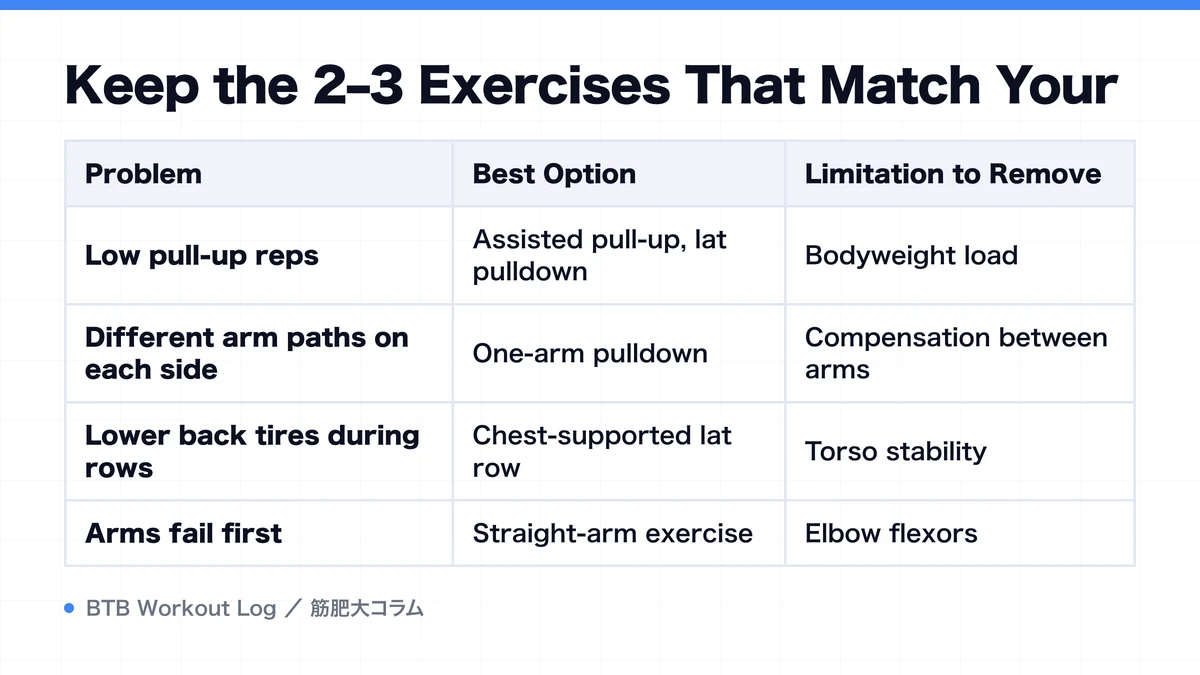
Keep the 2–3 Exercises That Match Your Current Limitations
| Problem | Best Option | Limitation to Remove |
|---|---|---|
| Low pull-up reps | Assisted pull-up, lat pulldown | Bodyweight load |
| Different arm paths on each side | One-arm pulldown | Compensation between arms |
| Lower back tires during rows | Chest-supported lat row | Torso stability |
| Arms fail first | Straight-arm exercise | Elbow flexors |
Do not choose an exercise based on the one time it produced the strongest sensation. Look for whether you can repeat the same path without pain, push the target muscle to a high effort level, and make a small improvement next time. The rep range can vary by exercise; there is no reason to use the same number of reps for every movement.
Keep the testing order consistent as well. Evaluating a new exercise for just 1 set at the end of a tiring session is not comparable to testing it first as your primary movement. If you are deciding between 2 exercises, place them in the same position on separate days and compare technique and performance during your working sets after warming up.
Avoid Overloading Vertical, Unilateral, and Straight-Arm Work in the Same Week
If you train back 2 times per week, one option is to perform 3 sets of neutral-grip lat pulldowns and 2 sets per side of one-arm pulldowns on day 1. On day 2, perform 3 sets of pull-ups, 3 sets of chest-supported lat rows, and 2 sets of straight-arm pulldowns. This is not a fixed prescription. It simply places a vertical pull on both days while using other exercises to address different limitations.
If you already perform a high number of weekly sets, replace existing exercises instead of adding all 5. Perform each set at a challenging RIR, meaning how many more reps in reserve you had, without adding reps that cause your form to break down. Once you reach the top of the rep range, increase the load. If your range of motion becomes shorter, return to the previous load.
Do not judge changes in back width over a matter of days. Track whether the reps or load on your 2 primary exercises improve with the same form over several weeks. Only after you reach a plateau should you reassess effort, recovery, and exercise fit, in that order. Our article on the value of pullovers for the lats explains when adding that movement pattern makes sense.
FAQ
- Do I Need Both Pull-Ups and Lat Pulldowns for My Lats?
- No. Either exercise can work as your sole primary movement if you can maintain a full range of motion, train with sufficient effort, and progressively add reps or load. Use the other option when you need to overcome a limitation such as excessive bodyweight resistance, large jumps between loads, or poor joint comfort.
- Does a Wider Grip Build More Back Width?
- Grip width alone does not determine how much back width you build. Going too wide can shorten your range of motion and cause shoulder discomfort. Start around shoulder width, then adjust based on how well you can drive your elbows toward your pelvis and make steady progress.
- How Many Reps Should I Do for Lat Exercises?
- You might use roughly 6–15 reps for primary pulls and rows and 10–20 reps for straight-arm exercises, provided you can maintain the intended path. More important than the number itself is whether the target muscle limits the set and whether you are adding load or reps under the same conditions.
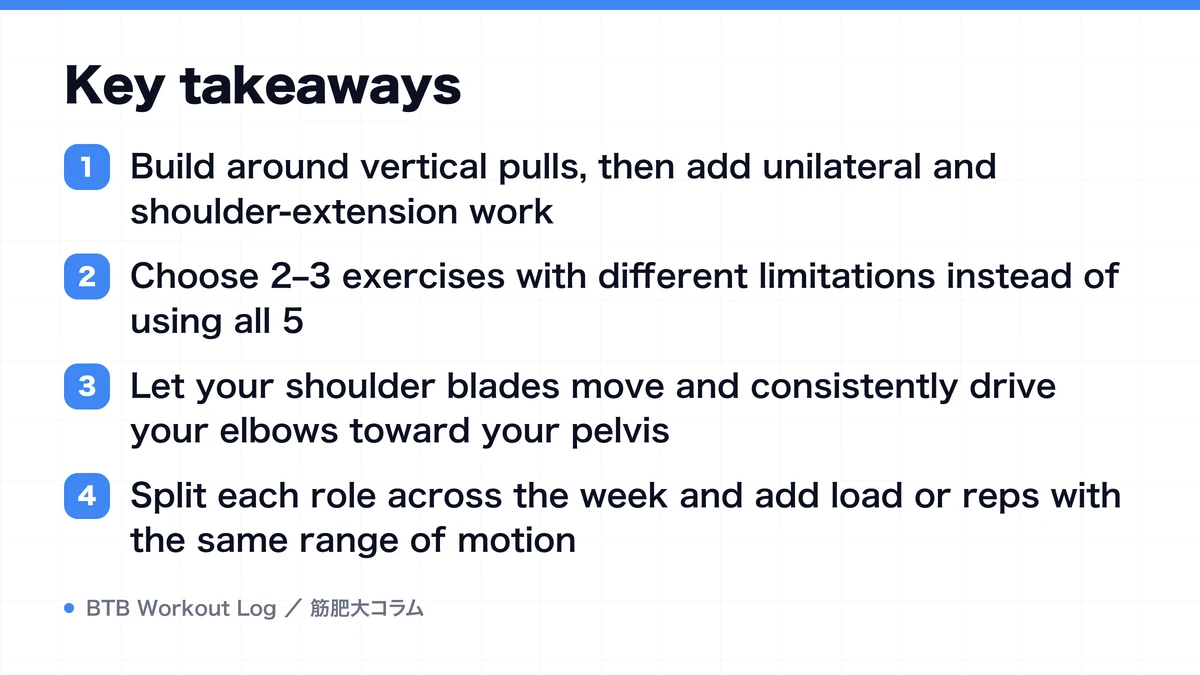
Key takeaways
- Build around vertical pulls, then add unilateral and shoulder-extension work
- Choose 2–3 exercises with different limitations instead of using all 5
- Let your shoulder blades move and consistently drive your elbows toward your pelvis
- Split each role across the week and add load or reps with the same range of motion