
Is Training Twice a Week Better Than Once? | Revisiting Schoenfeld 2016
Conclusion: The 2016 analysis suggested that twice a week was more advantageous than once a week, but a subsequent study updated that the independent effect of frequency was small when weekly volumes were equalized. Frequency is a tool to distribute the required number of sets with high quality.
If we leave only the conclusion that "twice a week is required", we will overlook the problem of the small number and volume of original papers.
Paper details
| Original title | Effects of Resistance Training Frequency on Measures of Muscle Hypertrophy |
|---|---|
| Authors | Brad J. Schoenfeld, Dan Ogborn, James W. Krieger |
| Journal | Sports Medicine, 46(11), 1689-1697 |
| Year | 2016 |
| Study design | Systematic review/meta-analysis |
| Participants / scale | 10 studies (interventions over 4 weeks) |
| Comparison / methods | Comparing low and high frequency per muscle group |
| Main outcomes | Muscle hypertrophy indicators such as muscle thickness, muscle cross-sectional area, and fat-free mass |
| DOI | 10.1007/s40279-016-0543-8 |
10 studies comparing muscle groups multiple times per week
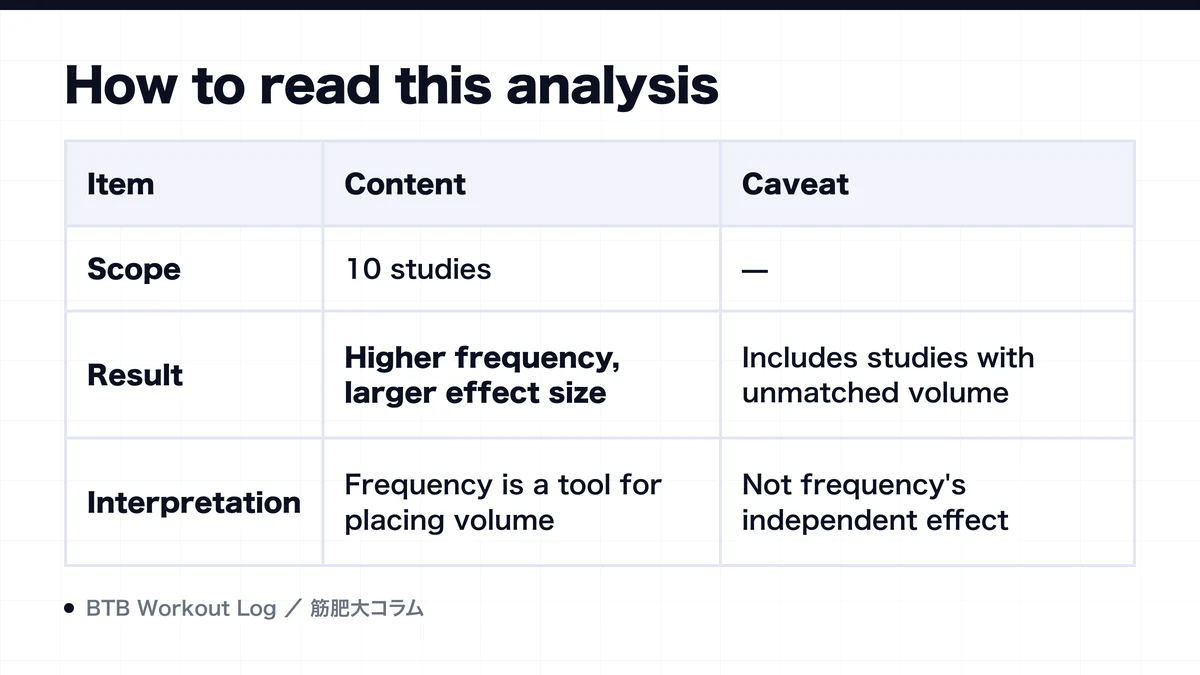
This meta-analysis combined 10 resistance training studies over 4 weeks and compared muscle hypertrophy when the same muscle groups were trained at low or high frequency.
Frequency here is not the number of days you go to the gym, but the number of times you stimulate each muscle group. Even if you do upper body and lower body 4 days a week on separate days, each muscle group will be worked twice a week.
Effect size is 0.49 vs. 0.30, favoring high frequency
Effect size for high frequency condition is0.49±0.08, for low frequency condition0.30±0.07, the difference was significant (p=0.002). Analysis of studies with similar volumes suggested that twice weekly is more advantageous than once weekly.
However, there were only 10 studies, and there was not enough data to decide between 3 times a week and 2 times a week. Studies that differ in frequency as well as total number of sets are also included.
How did the conclusion change in the 2019 and 2026 analyzes?
In the 2019 updated meta-analysis that integrated 25 studies, it was concluded that when the weekly volume is the same, the difference in muscle hypertrophy due to frequency is not significant. The conclusion is that frequency is a matter of personal preference.
A 2026 meta-regression of 67 studies also found that the independent effect of frequency on muscle hypertrophy was negligible. On the other hand, the positive effect of frequency remained on muscle strength.
Why twice a week is a practical starting point
Even if the independent effects are small, frequency has practical value. If you are doing 12 sets of chest a week, it will be easier to maintain the number of repetitions and form in the second half if you divide the exercises into 6 sets over 2 days rather than concentrating on 12 sets in one day.
On the other hand, beginners who are improving with 4 to 6 sets per week don't need to force themselves to divide their weight. Decide based on the total amount required, time required for one treatment, recovery date, and daily life schedule.
When changing the frequency, fix the number of weekly sets
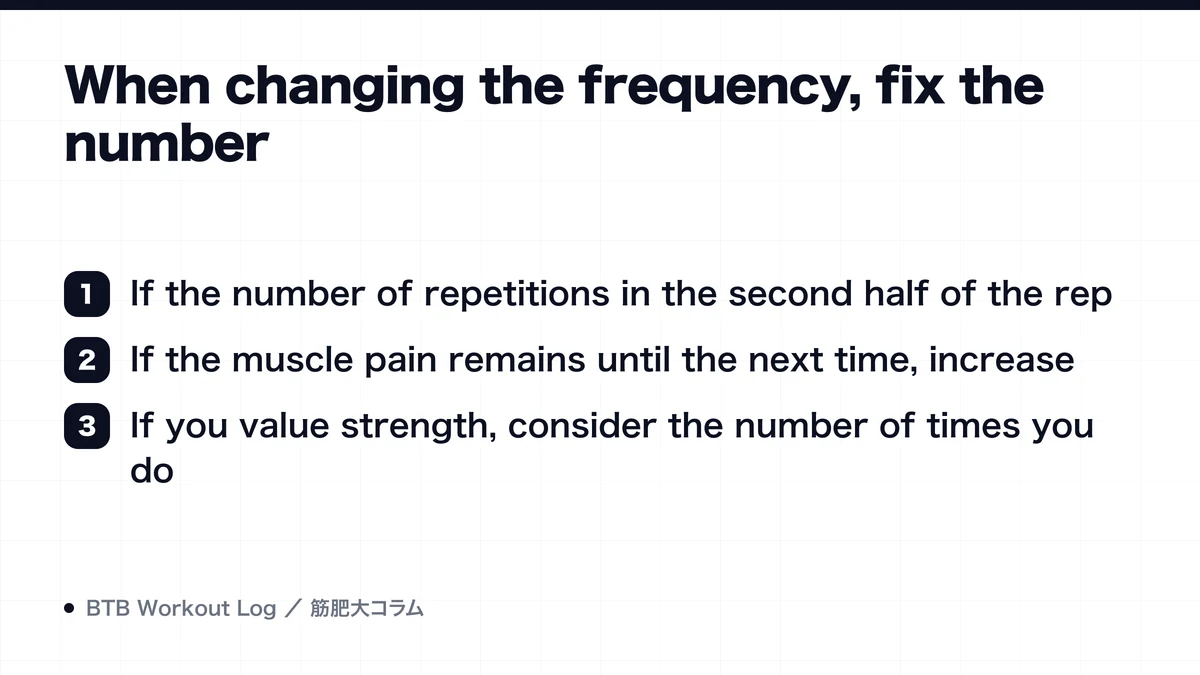
For the first 2 to 4 weeks of changing from once a week to twice a week, do not increase the total number of weekly sets, only change the distribution. This allows you to distinguish the effects of frequency changes from simple volume increases.
- If the number of repetitions in the second half of the rep decreases, split the reps
- If the muscle pain remains until the next time, increase the interval
- If you value strength, consider the number of times you do the same exercise
FAQ
- Is it necessary to do each part twice a week?
- Not required. If the weekly volume is the same, the difference in muscle hypertrophy will be small, and you can choose the frequency that suits your lifestyle and recovery.
- Won't you gain muscle by doing it once a week?
- Muscle hypertrophy. If you can perform the required number of weekly sets with high quality, it will work.
- Is 3 times a week better than 2 times a week?
- An independent advantage for muscle hypertrophy has not been established. Use when it is possible to improve total volume distribution, practice technique, or time per session.
Key takeaways
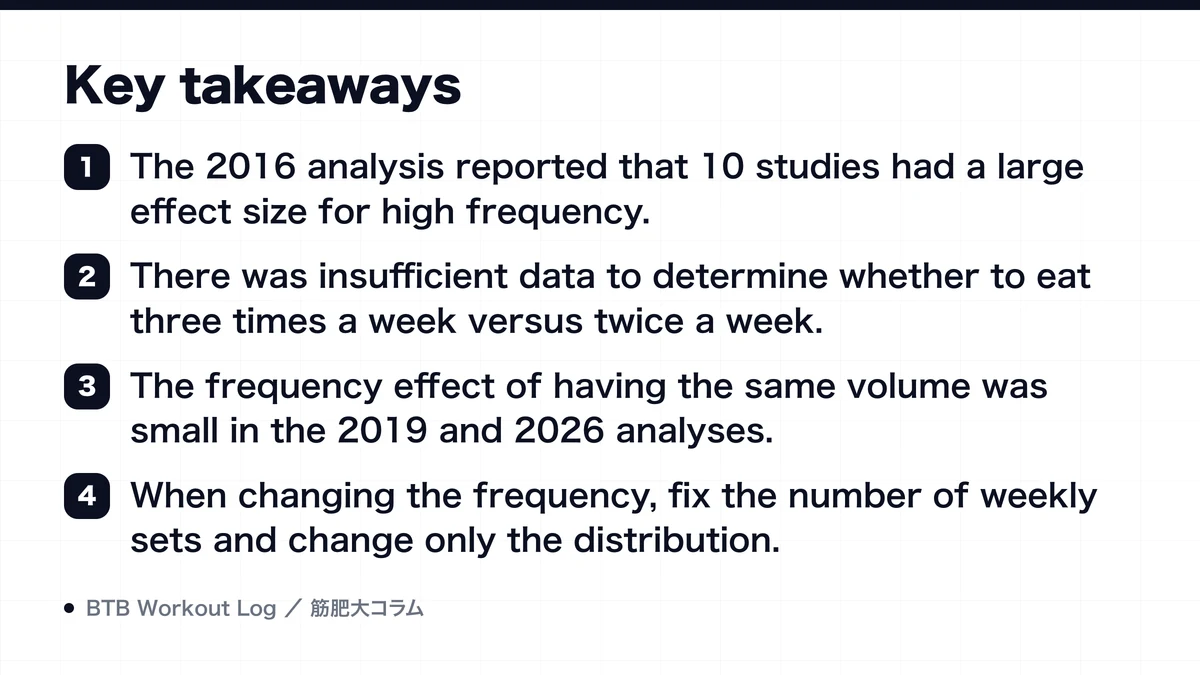
- The 2016 analysis reported that 10 studies had a large effect size for high frequency.
- There was insufficient data to determine whether to eat three times a week versus twice a week.
- The frequency effect of having the same volume was small in the 2019 and 2026 analyses.
- When changing the frequency, fix the number of weekly sets and change only the distribution.
References
- Effects of Resistance Training Frequency on Muscle Hypertrophy: Systematic Review and Meta-analysis
- Resistance Training Frequency and Muscle Hypertrophy: Systematic Review and Meta-analysis
- The Resistance Training Dose Response: Meta-Regressions Exploring the Effects of Weekly Volume and Frequency on Muscle Hypertrophy and Strength Gains