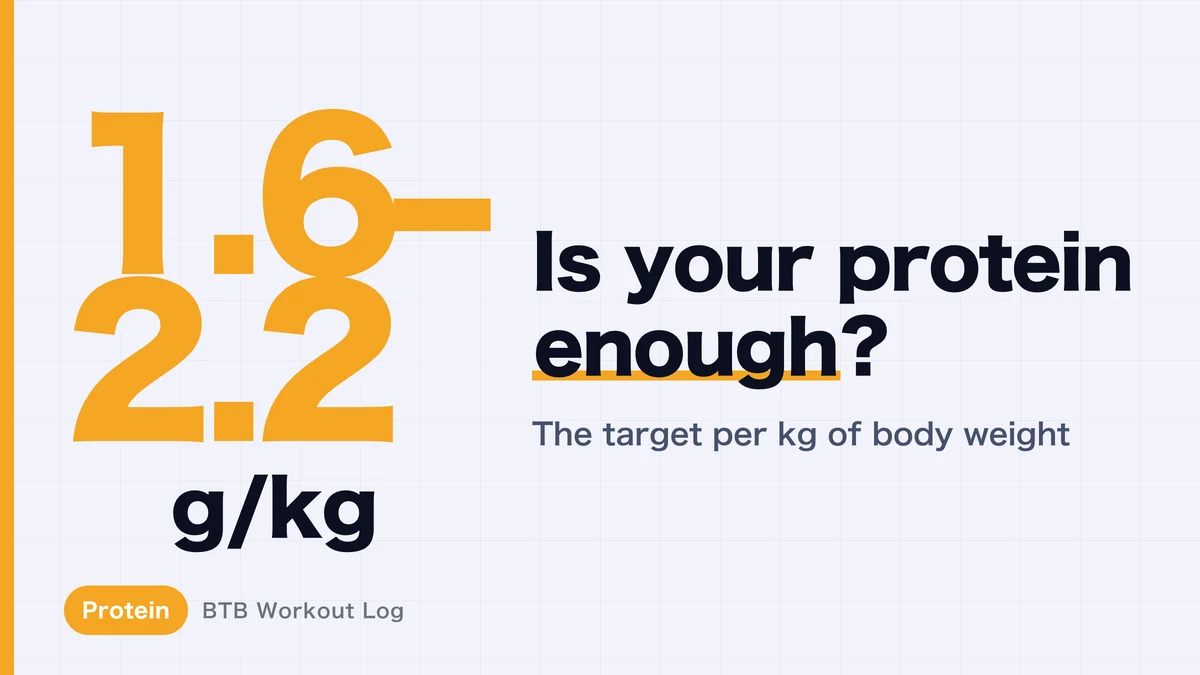
Hypertrophy Needs 1.6–2.2g of Protein per kg of Bodyweight | The Chart to Check If You Think You're Already Eating Enough
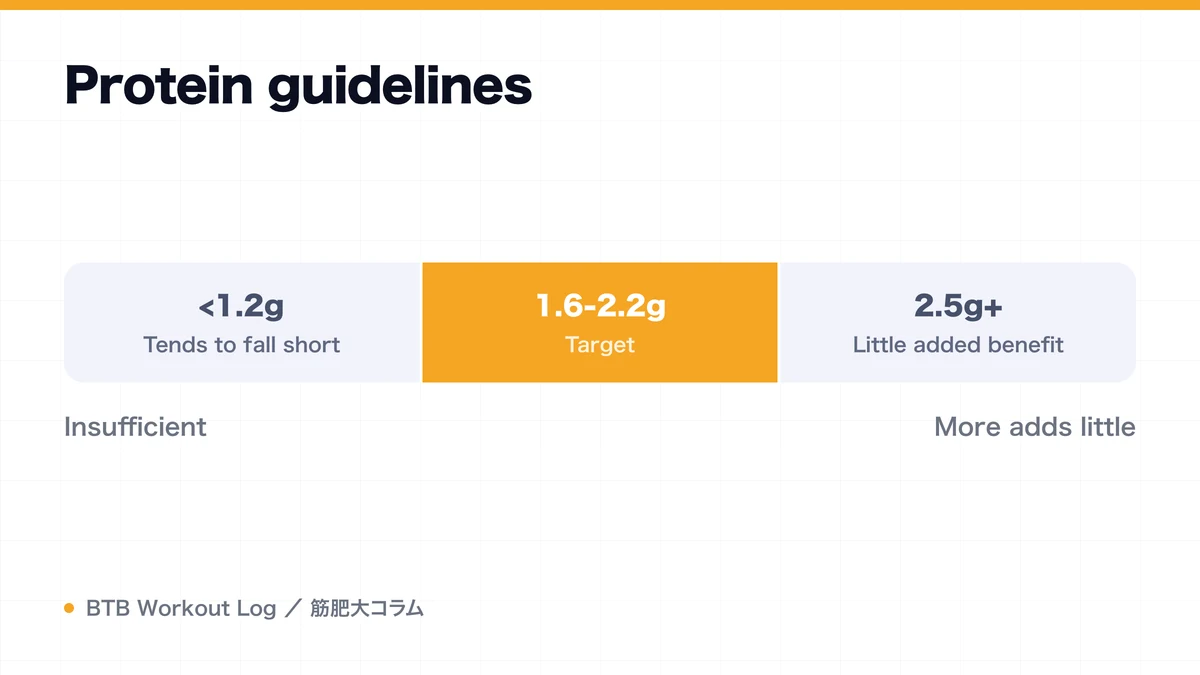
For hypertrophy, treat 1.6-2.2g of protein per kg of bodyweight per day as the practical range. Meet 1.6g/kg consistently first, and adjust toward the upper end if you are cutting or under dietary restrictions.
1.6g/kg is not an absolute line dividing too little from too much; it is a rough guide for where the additional benefit got smaller on average across the studied populations. Decide it by looking not just at the daily total but at your calorie balance, how it is spread across meals, and your training progress together.
The research behind 1.6-2.2 g/kg
Meta-analyses covering protein intake and hypertrophy show that adding protein supplementation to resistance training produces an average gain in lean mass and strength, and that the additional benefit tends to get smaller as intake approaches roughly 1.6g per kg of bodyweight per day. A detailed reading is collected in Morton et al.'s 2018 meta-analysis.
1.6g/kg is not a boundary where everyone hits a ceiling. The estimate carries a range, and there is measurement error in diet records as well as individual variation. So in daily practice, it is easier to manage if you center on 1.6g/kg and put the upper end at around 2.2g/kg when you want some margin. Rather than pushing to 3g or 4g, it can be more useful to hand that energy to carbohydrates or fats and make the diet as a whole work.
Earlier research syntheses comparing supplementation against none also report an average gain in lean mass over resistance training alone. Training is the main driver, though, and supplementation fills a shortfall. You can check the populations and figures in Cermak et al.'s 2012 meta-analysis.
Daily protein targets by bodyweight
| Bodyweight | 1.6g/kg | 2.0g/kg | 2.2g/kg |
|---|---|---|---|
| 50kg | 80g | 100g | 110g |
| 60kg | 96g | 120g | 132g |
| 70kg | 112g | 140g | 154g |
| 80kg | 128g | 160g | 176g |
| 90kg | 144g | 180g | 198g |
Current bodyweight x the multiplier is enough for the calculation. At 70kg the rough guide for the floor is 112g, around 140g if you want some margin in managing it, and 154g if you take the upper end while cutting. There is no need to match it to the decimal place; prioritize having the 1-2 week average land inside the range over day-to-day error.
For people with a fairly high body fat percentage, calculating from current bodyweight alone can produce a larger number than necessary and make the diet hard to build within the total calories. In that case, start from target bodyweight as the reference and adjust by watching hunger, digestion, the bodyweight trend, and training output.
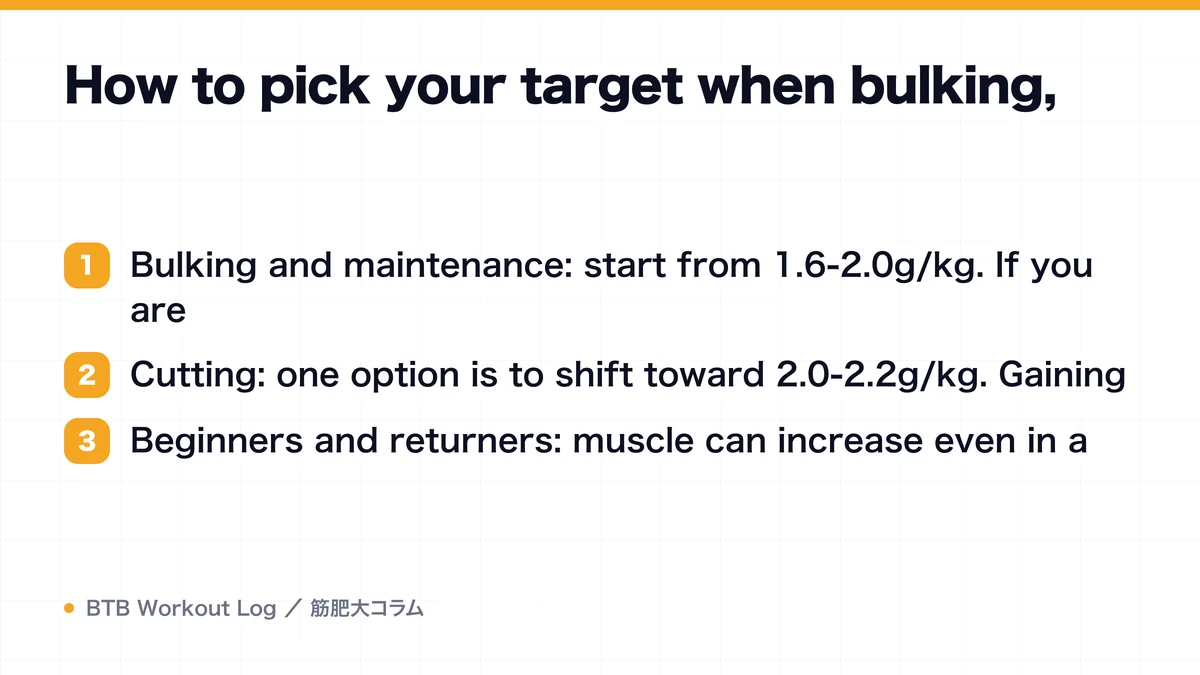
How to pick your target when bulking, maintaining, or cutting
Where you land within 1.6-2.2g/kg depends not on protein alone but on your energy balance. In designing a diet for hypertrophy, the basic order is to set total calories first and secure the protein you need within them.
- Bulking and maintenance: start from 1.6-2.0g/kg. If you are meeting the target, prioritize carbohydrates you can spend in training and a diet structure you can keep up over chasing the upper limit.
- Cutting: one option is to shift toward 2.0-2.2g/kg. Gaining muscle tends to be harder in an energy deficit, so alongside securing protein it matters not to make the deficit too large.
- Beginners and returners: muscle can increase even in a calorie deficit in some cases, but the same expectation does not carry over unchanged to intermediate and advanced lifters. The longer your training history, the easier progress is to read when you separate the goals of bulking and cutting.
The size of the surplus for bulking is covered in how to set your bulking calories, and the pathways by which a deficit constrains hypertrophy in how a calorie deficit relates to growth. Raising protein alone cannot compensate for an overall energy shortfall or a training plateau.
How much per sitting, and tips for splitting it up
Once the daily total is met, a manageable starting point is to split it into 20-40g per meal, or around 0.4g per kg of bodyweight, across 3-4 sittings. At 70kg that means using about 28g per sitting as the reference, and if you are aiming for 120-150g a day, building four meals of roughly 30-40g.
Protein is digested into amino acids, which become both the raw material for muscle protein synthesis and a nutritional signal. A single serving does not translate directly into an amount of muscle gained, though. Together with a training stimulus and recovery, accumulating time where synthesis exceeds breakdown over the long run is what leads to hypertrophy. That sequence is explained step by step in how protein drives muscle protein synthesis.
This does not mean that anything over 40g at once goes unabsorbed. The protein you eat is digested and absorbed, but the response of muscle protein synthesis to any one serving has a limit, and the excess is also used by other tissues and metabolic processes. It is a practical rough guide: securing enough at each meal is easier to carry out than settling the account at dinner alone.
You don't need to aim for the minutes around training
Rather than arguing to the minute over whether right before or right after exercise is better, set the daily total and the distribution across meals first. There are acute trials where intake before exercise showed large amino acid uptake, but they are short-term responses in small groups, and they do not show that before beats after for long-term hypertrophy. The study conditions and limitations are laid out in Tipton et al.'s 2001 study.
In practice, a normal high-protein meal within a few hours before or after training is enough. If a long stretch has passed since your last meal, cover it on one side or the other, and if food sitting in your stomach makes you sluggish, move it to after the session. Before bed is not a special mandatory slot either; treat it as an opportunity to top up if you are short of the daily target.
If splitting it finely makes meal prep fall apart, putting enough into the three meals of breakfast, lunch, and dinner comes first. If optimizing timing leads to missing the total or losing sleep, the order has been reversed.
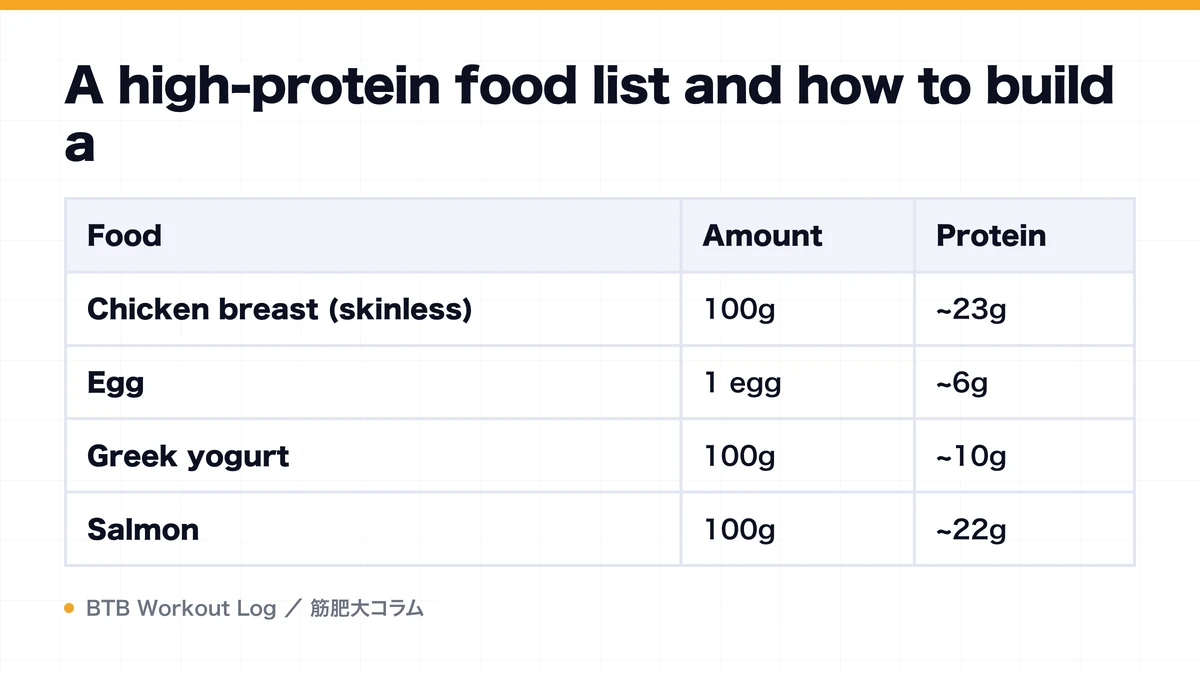
A high-protein food list and how to build a meal
| Food | Amount | Protein |
|---|---|---|
| Chicken breast (skinless) | 100g | ~23g |
| Egg | 1 egg | ~6g |
| Greek yogurt | 100g | ~10g |
| Salmon | 100g | ~22g |
| Firm tofu | 150g | ~10g |
| Protein powder | 1 scoop | ~20-25g |
The listed values are approximations, since they shift with the product, how it is cooked, and the cut. Pick one main dish and add eggs, dairy, soy foods, and the like to get close to the target for that meal. Plant foods work too, but rather than leaning on a single item, combining several foods makes it easier to secure both the amount you need and the nutrition of the meal as a whole.
Protein powder is not an essential with a growth effect superior to food; it is an option for covering constraints on portability and cooking time. On days when meals get you there it is unnecessary, and using it only to make up the missing 20-30g keeps its purpose clear. You can compare its priority against other supplements in how to choose supplements for hypertrophy.
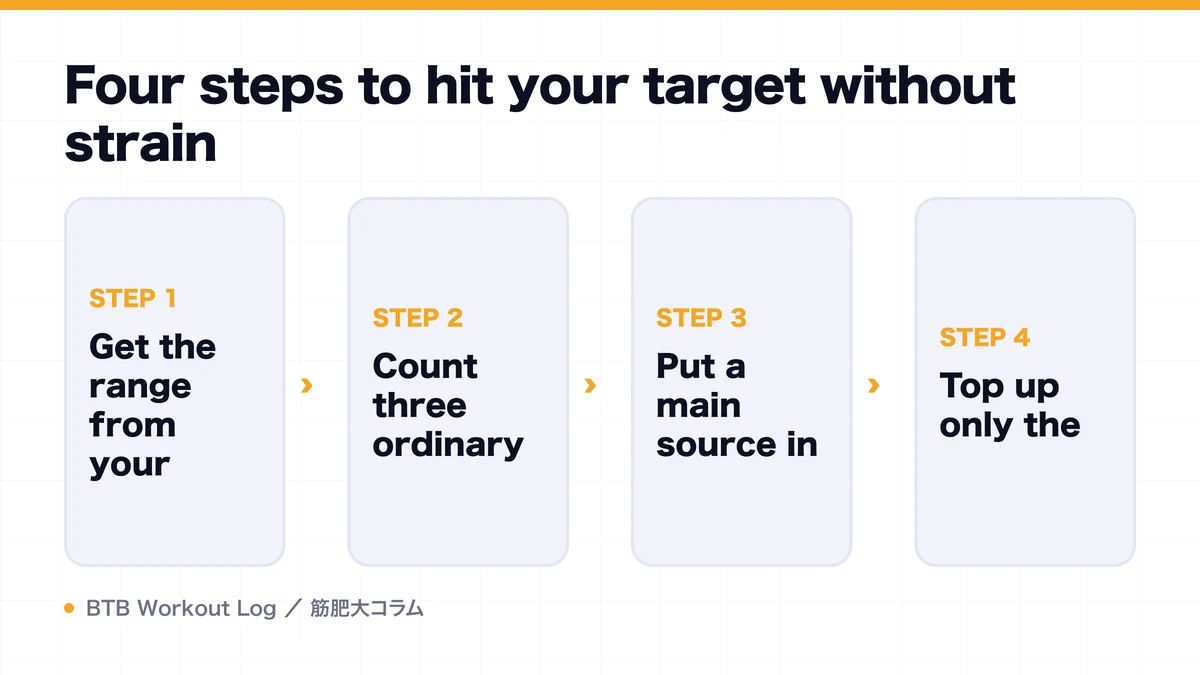
Four steps to hit your target without strain
- Get the range from your bodyweight: calculate 1.6g/kg first, and 2.0-2.2g/kg as well if you need it.
- Count three ordinary days: log two weekdays and one day off, and work out your average and your shortfall before adding any supplement.
- Put a main source in every meal: add eggs or yogurt if breakfast is light, and meat, fish, or soy foods at lunch, instead of concentrating it all at dinner.
- Top up only the shortfall: use protein powder only on days that are hard to fill with meals, and adjust it into a form you can keep up for about two weeks.
When you evaluate it, look not only at intake but at how weight, reps, and RIR (reps you could have left in reserve before failure) move on the same exercises under the same conditions. A logging tool such as BTB Workout Log gives you the material to check not that you raised protein as such, but whether you reproduced training progress over that period.
Judge whether you are getting there from both diet and training
When you are meeting your target but muscle isn't increasing, there is no need to immediately push past 2.2g/kg. Check your weekly average bodyweight, calorie intake, hard sets per body part, RIR, the trend in weight and reps, and sleep first. Even with enough protein, other constraints remain, such as a weak stimulus, failing to recover, or not having the energy that bulking requires.
Conversely, if you are not reaching the target day to day and the size of your main dishes isn't steady either, improving the total comes before fine timing or amino acid supplements. If you can sustain around 1.6g/kg without strain and your condition and training are stable, use that setting as your baseline. Don't change the setting over a single day under or over; judge it on the weekly average. Recalculating only when you start a cut, take on a dietary restriction, or see a large change in bodyweight is enough.
If your protein intake is restricted for a condition such as kidney disease, don't apply this general range on your own judgement; follow your medical provider's instructions instead.
FAQ
- Does more protein mean more muscle?
- On average, the additional benefit gets smaller as you approach about 1.6g per kg of bodyweight per day. Rather than pushing past 2.2g/kg, checking your total calories, training stimulus, and sleep comes first.
- Is there a limit to how much protein one meal can use?
- It is not that anything over 20-40g goes unabsorbed. Because the response of muscle protein synthesis to any one serving has a limit, splitting the daily total across 3-4 sittings is a manageable rough guide in practice.
- Is protein powder necessary?
- It is not essential if meals get you to your target. For topping up the roughly 20-30g that food alone leaves short, at breakfast or when you are out, it is a practical option that keeps prep time and stomach load down.
- Do results drop off if you don't drink it right after training?
- There is no need to hurry it to the minute. If there is a meal with enough protein within a few hours before or after, prioritize holding the daily total and the split across 3-4 sittings first. Adjust the meals on either side only when a long stretch of hunger is involved.
Key takeaways
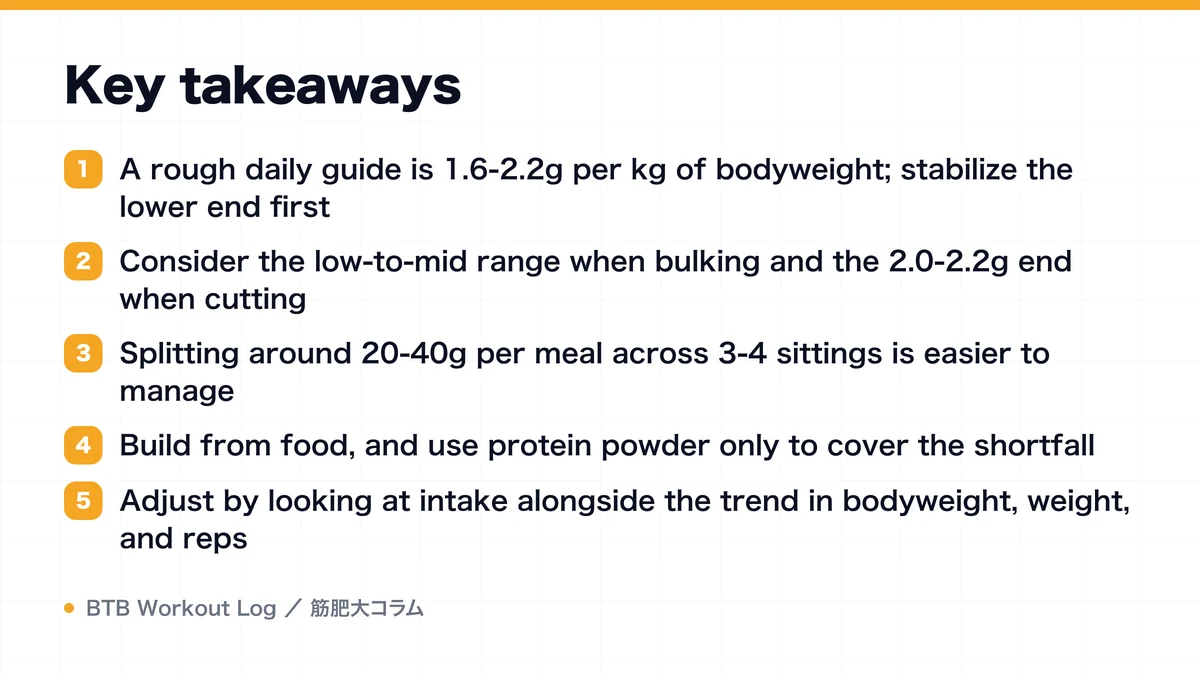
- A rough daily guide is 1.6-2.2g per kg of bodyweight; stabilize the lower end first
- Consider the low-to-mid range when bulking and the 2.0-2.2g end when cutting
- Splitting around 20-40g per meal across 3-4 sittings is easier to manage
- Build from food, and use protein powder only to cover the shortfall
- Adjust by looking at intake alongside the trend in bodyweight, weight, and reps