How Do You Build the Lower Chest? | Using Dips and Decline Press to Sharpen Your Chest Outline
Both forward-leaning dips and decline presses can train the lower chest. Dips are a good fit if you can control your bodyweight and feel chest tension in the deep bottom position. Choose the decline press if you want tighter control over load and range of motion.
Base your choice on the pressing direction relative to the muscle fibers, loading in the stretched position, stability, and the repeatability of your progression, not the exercise's reputation.
Choose a Lower Chest Exercise Using 4 Criteria
The "lower chest" is not a separate small muscle. The term refers to the lower fibers of the pec major's sternocostal and abdominal regions. These fibers contribute more readily when you press your upper arms down toward your torso from an elevated position. However, regional emphasis is limited, and you cannot train the lower chest in complete isolation from the rest of the pecs.
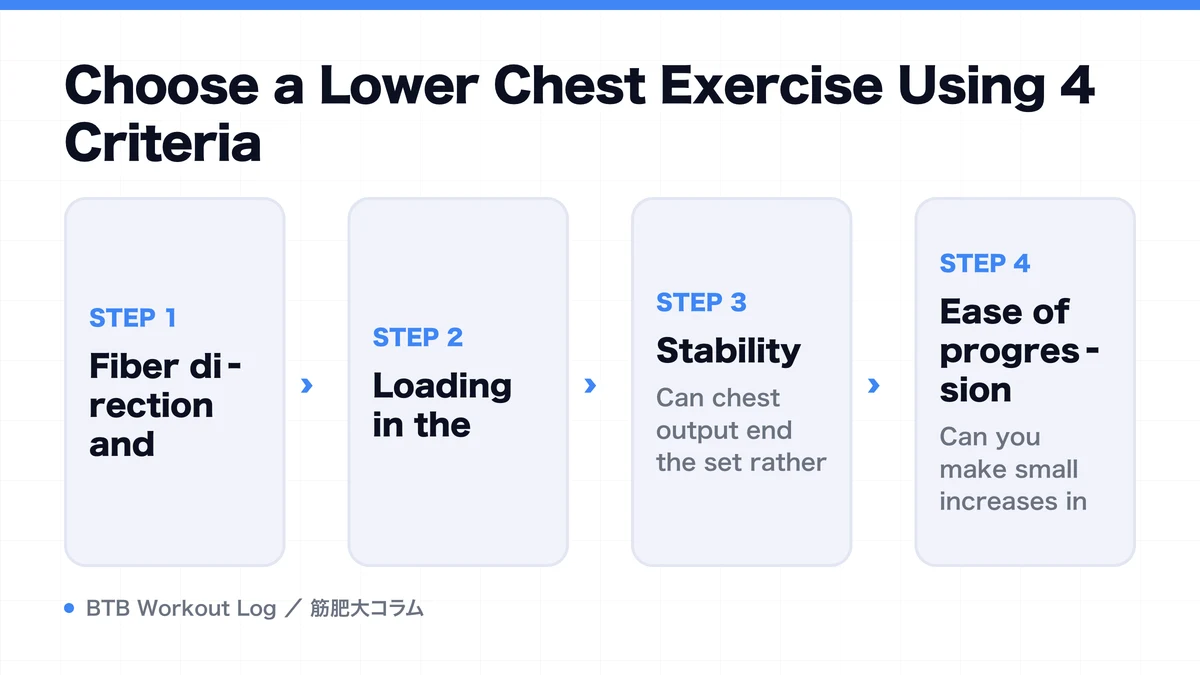
- Fiber direction and joint angle: Can you create a path that presses your upper arms slightly downward relative to your torso?
- Loading in the stretched position: Can you maintain tension on the target fibers near the bottom, where the chest is stretched?
- Stability: Can chest output end the set rather than the effort required to maintain balance?
- Ease of progression: Can you make small increases in weight or reps while keeping the same range of motion?
You do not need to add another exercise just because your lower chest lacks definition. First, review your overall chest exercise selection, then replace one of your existing presses with either option.
Dips Suit Lifters Who Can Control Their Bodyweight Through a Deep Stretch
During dips, lean your torso slightly forward and let your elbows bend without pinning them directly behind you. This allows your upper arms to move behind your torso and stretch the pecs. The key is to lean while keeping your rib cage and pelvis moving as one unit, not to swing your legs hard behind you.
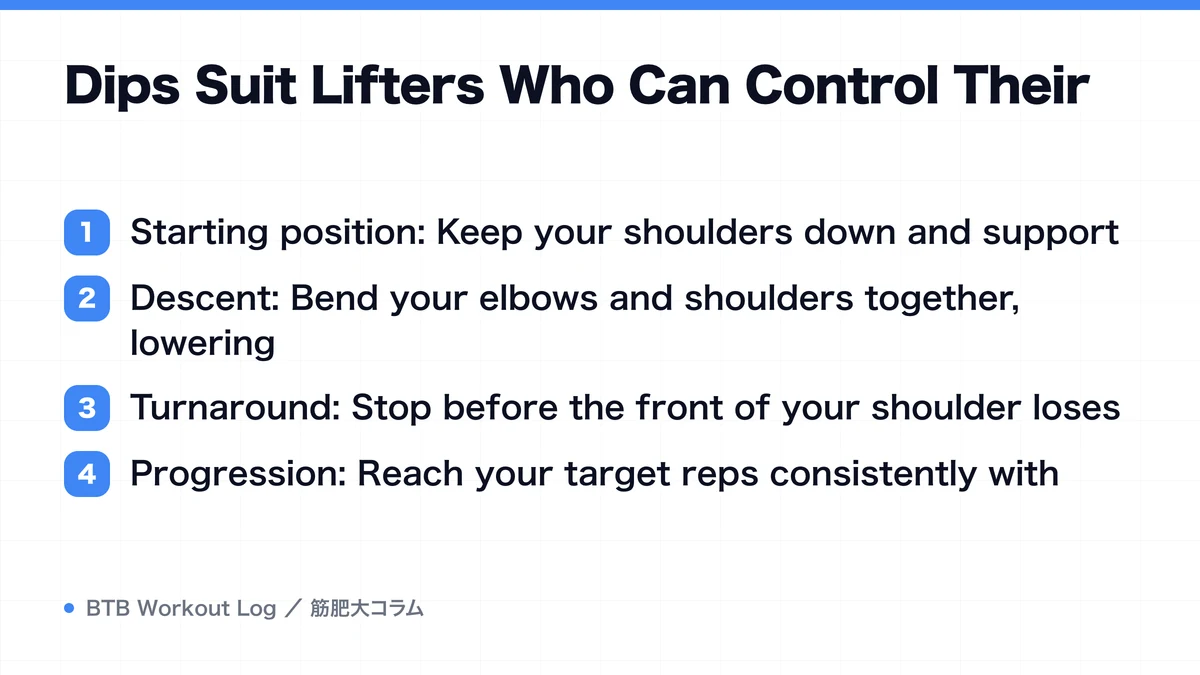
- Starting position: Keep your shoulders down and support your upper body directly over the handles.
- Descent: Bend your elbows and shoulders together, lowering until your upper arms move behind you far enough to stretch the lower chest.
- Turnaround: Stop before the front of your shoulder loses position, then rise by driving the bars downward.
- Progression: Reach your target reps consistently with bodyweight before adding weight in small increments. Use assistance if needed.
Dips can produce a high relative load with minimal equipment and make it easy to get a strong stretch at the bottom. The downside is that bodyweight is the minimum load, leaving little room to scale down if you can only perform a few reps. Dips fail the selection criteria if they cause discomfort at the front of the shoulder or around the sternum, if your triceps give out before you feel tension in the lower chest, or if your depth changes from rep to rep. Do not force more depth through pain. Switch exercises.
The Decline Press Makes Load and Bar Path Easier to Control
The decline press uses a bench with your head below your hips, creating a downward pressing direction relative to your torso. A barbell makes it easier to keep both sides on the same path, while dumbbells give you more freedom to adjust your grip angle. If your gym has dedicated machines, the simple setup is another advantage.
A steeper bench is not automatically better. Start with a mild 10–20-degree decline, secure your feet, and stabilize your glutes and back against the pad. Lower the bar toward your lower chest, not your neck, keeping your forearms nearly vertical to the floor. Do not flare your elbows straight out to the sides, and use a repeatable depth that does not irritate the front of your shoulders.
The decline press lets you start light even if assisted dips are unavailable, and progression is easy to manage in increments such as 2.5kg. However, setup becomes awkward in gyms where mounting the bench or adjusting the rack is difficult. A decline angle also makes it easy to shorten the range of motion and lift heavier weights, so chasing numbers alone can cost you the portion of the rep that stretches your chest. As with the range of motion comparison, your records only mean something if you maintain the same depth every time.
Keep the Exercise That Best Fits Your Constraints
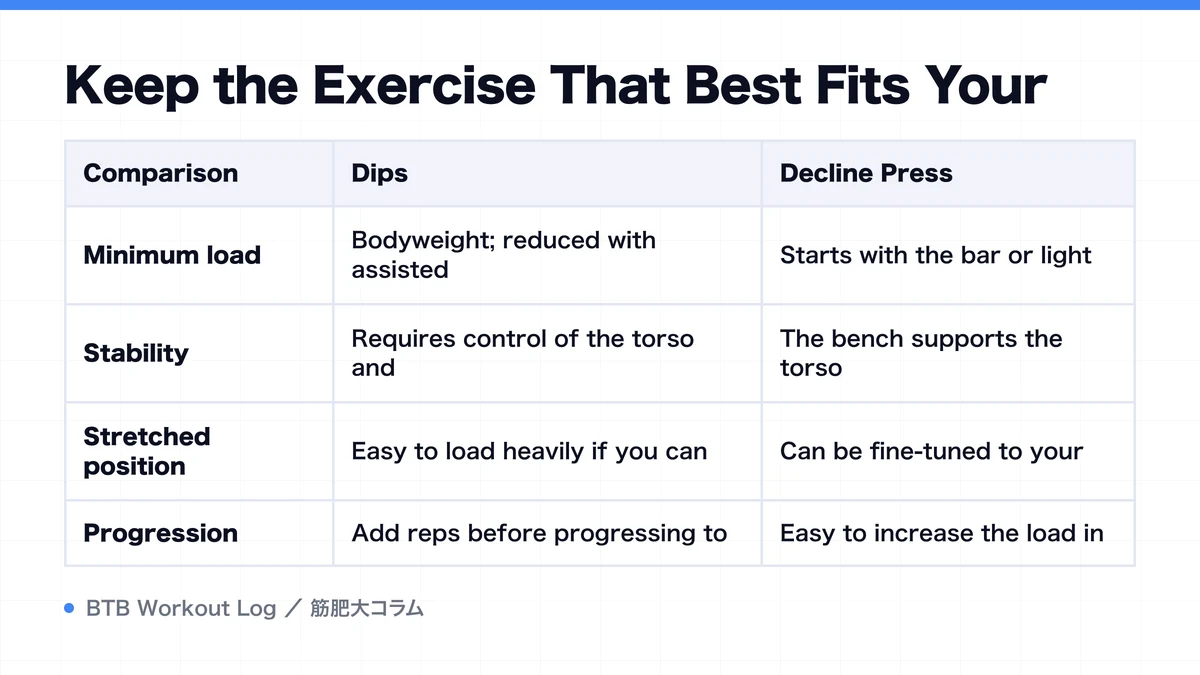
| Comparison | Dips | Decline Press |
|---|---|---|
| Minimum load | Bodyweight; reduced with assisted equipment | Starts with the bar or light dumbbells |
| Stability | Requires control of the torso and shoulder girdle | The bench supports the torso |
| Stretched position | Easy to load heavily if you can reach sufficient depth | Can be fine-tuned to your shoulders and equipment |
| Progression | Add reps before progressing to weighted dips | Easy to increase the load in small increments |
| Setup | Quick if parallel bars are available | Requires bench and rack adjustments |
In an acute study of competitive bench press athletes lifting at 6RM, surface muscle activity in the pec major did not differ significantly between the flat press, 25-degree incline, and 25-degree decline. This cannot tell us whether dips and decline presses produce different hypertrophy outcomes, nor does it show that the decline press is superior for lower chest growth. EMG measures muscle activity during that trial, not long-term development.
Even for the same lifter, there may be periods when weighted dips progress well and others when the decline press keeps the joints more comfortable. Do not stay attached to one exercise indefinitely. Use it for a training block while you can maintain the intended path and adequate recovery.
If your shoulders feel good and you can perform consistent bodyweight reps, choose dips. If you want to manage load independently of your body weight, choose the decline press. That is enough. Performing both on the same day can duplicate their role and reduce set quality.
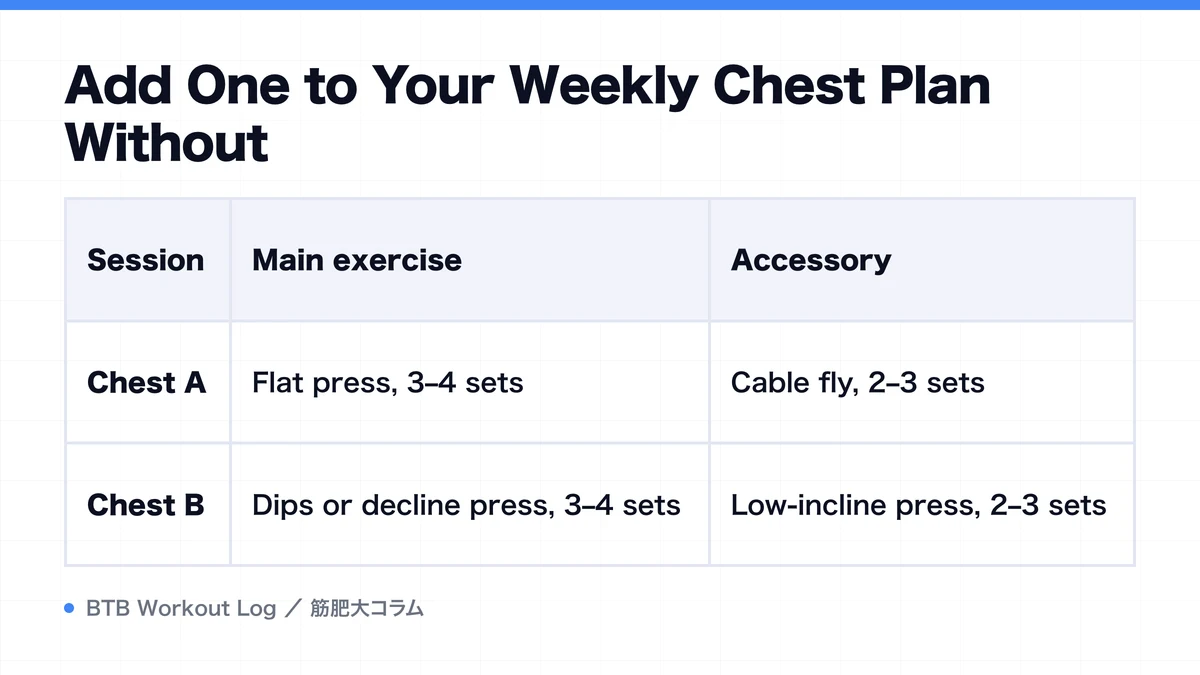
Add One to Your Weekly Chest Plan Without Redundant Work
If you train chest twice per week, center the first session on horizontal pressing and the second on a downward pressing path. Avoid filling both sessions with presses that serve the same purpose, which helps prevent excessive overlap in joint angles and fatigue.
| Session | Main exercise | Accessory |
|---|---|---|
| Chest A | Flat press, 3–4 sets | Cable fly, 2–3 sets |
| Chest B | Dips or decline press, 3–4 sets | Low-incline press, 2–3 sets |
Once you choose an exercise, keep it for 4–6 weeks. For dips, track total weight, reps, and bottom depth. For the decline press, track the weight used, reps, and touch point. Compare sets performed at a similar RIR (how many more reps you could complete), and keep the exercise where your chest is the limiting factor and your reps or weight are improving. For more on increasing load, see progressive overload.
Changes in lower chest appearance are hard to judge over a short period, so use photos taken under the same lighting as supporting evidence. If your numbers improve but every set ends because of elbow extension, adjust your path. If you cannot correct it, switch to the other exercise. The exercise earns its place only if you can reproduce and progress the intended movement, regardless of its name.
FAQ
- Do I Need Both Dips and Decline Presses for the Lower Chest?
- Usually, one is enough. Their pressing directions and roles overlap, so replace one of your existing presses instead of adding both. Keep the exercise where your chest is the limiting factor and you can track progress through the same range of motion.
- How Deep Should I Go on Dips?
- There is no universal depth. Keep your shoulders down, maintain a stretch in the lower chest, and stay within a range that does not irritate the front of your shoulders. If you cannot reach the same depth on every rep, use more assistance or reduce the range of motion.
- What Angle Should I Use for the Decline Bench?
- Start with a mild 10–20-degree decline. Do not chase a steep angle. Choose a setup that lets you stabilize your feet and back while lowering to the same point on your lower chest with a consistent path.
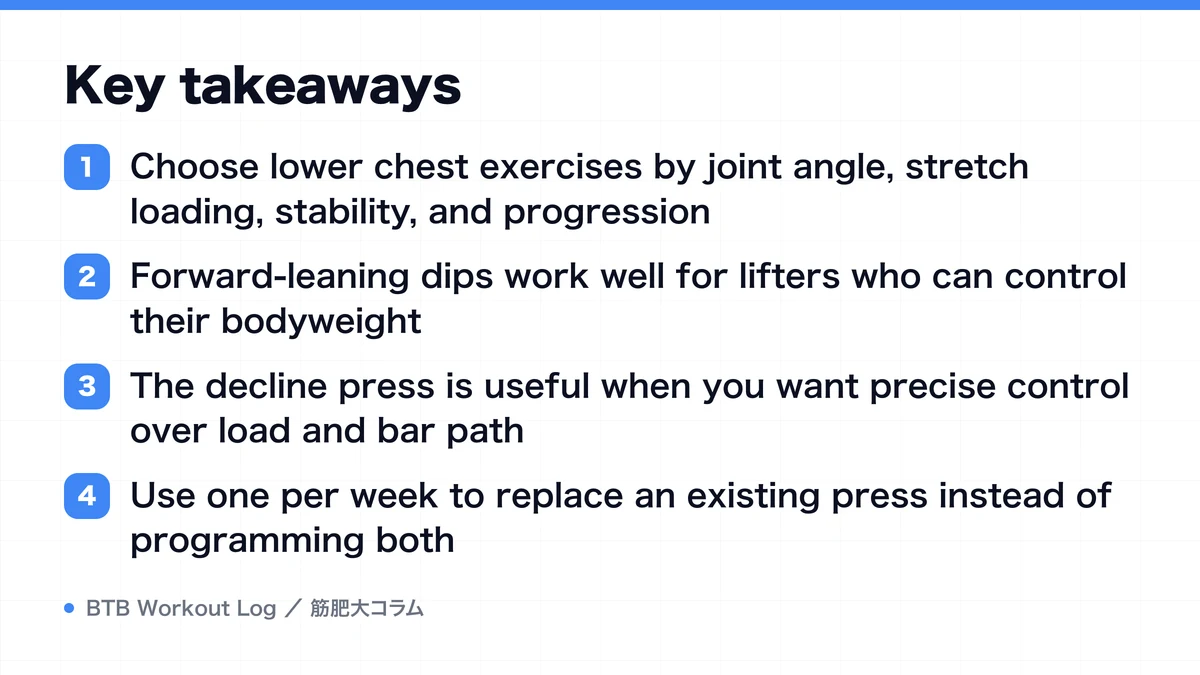
Key takeaways
- Choose lower chest exercises by joint angle, stretch loading, stability, and progression
- Forward-leaning dips work well for lifters who can control their bodyweight
- The decline press is useful when you want precise control over load and bar path
- Use one per week to replace an existing press instead of programming both