The Ultimate Chest Hypertrophy Workout | Exercises and Angles for a Thick Chest, Upper Pecs Included
A thick chest comes down to two things: using the angles deliberately, and a pressing form that keeps the pecs as the prime mover. Build around flat and incline, add decline or dips if you need them, and grow the load or the reps along the same bar path.
Adding more exercises does not automatically make the routine better. Use your log to work out which of the three - angle, equipment, or order - your own chest responds to.
Pec anatomy and how angles change the target
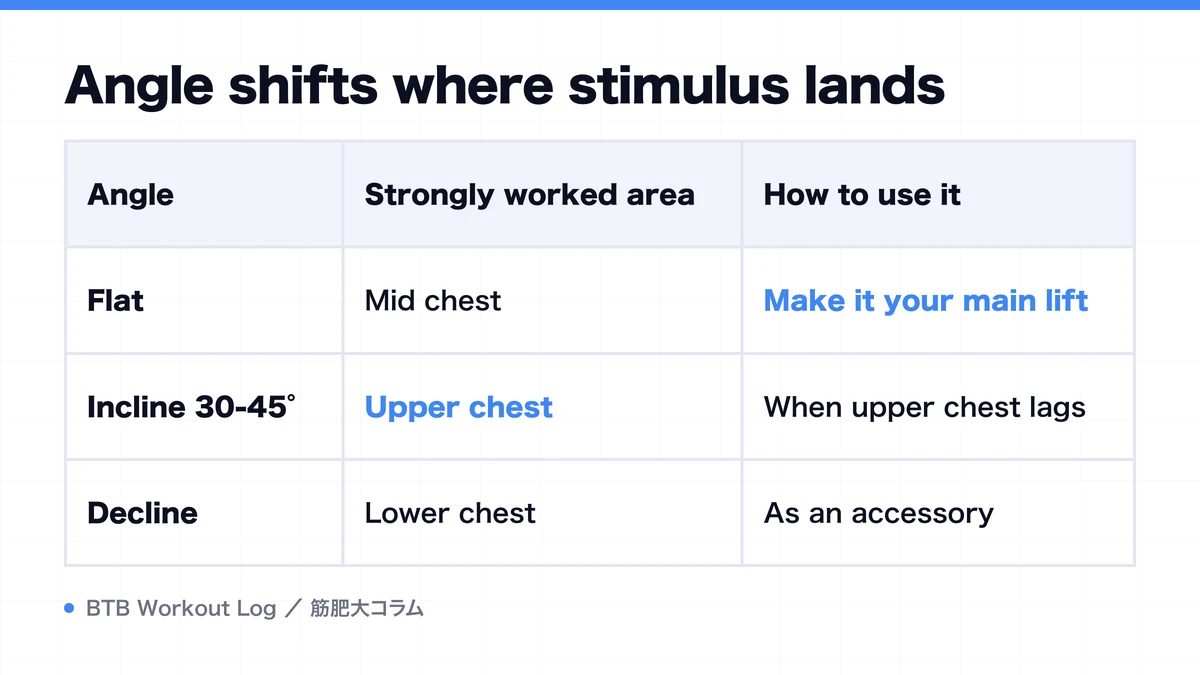
The pectoralis major splits into a clavicular head (upper) and a sternocostal head (middle and lower), and the angle of your upper arm relative to your torso changes which region works hardest. Flat (horizontal) centers the work on the middle, incline (head up) on the upper, and decline (head down) on the lower. Most people lean heavily on the flat bench and tend to end up with a weak upper chest, so settling on your incline angle early is what gives the chest depth.
That said, you cannot train the regions completely separately. Changing the angle moves where activity is highest, but the pectoralis major works as one sheet of muscle. Rather than trying to carve out "the upper chest only" or "the inner chest only", the realistic approach is to grow the whole muscle while shifting more of your sets toward the weaker direction.
Equipment also labels angles differently. Even at the same "30 degrees", the mark on the bench and your actual torso angle do not always match, so recording both the number and the notch the backrest sits at lets you reproduce the same conditions next time. During a block where the upper chest is the priority, that reproducibility decides the result.
Decide what each exercise is for
| Exercise | Target | Role |
|---|---|---|
| Bench press | Middle and overall | Heavy loading that builds the base of your total volume |
| Incline dumbbell press | Upper | Shifts sets toward the upper chest, which tends to lag |
| Dumbbell fly / cable fly | Tension in the stretched position | Widens the range of motion and finishes the chest off |
| Dips (forward lean) and decline | Lower and overall | The lower chest plus a large stretch stimulus |
If you are running two or more pressing exercises in one session, keep their roles from overlapping. If you press both flat and incline, keep flies to a single exercise. If you only press once, use flies to add range of motion and volume. Overlapping roles only add fatigue, and they make progress harder to judge.
When you assign roles, think in terms of the range of motion and the point of peak load each exercise covers, not the name of the exercise. Presses are the slot for adding weight, flies are the slot for loading the stretched position, and dips are the slot for a deep range of motion under bodyweight. If two exercises sit in the same slot, it is more efficient to drop one and move that volume to your main lift.
Fixes for when the shoulders and arms take over
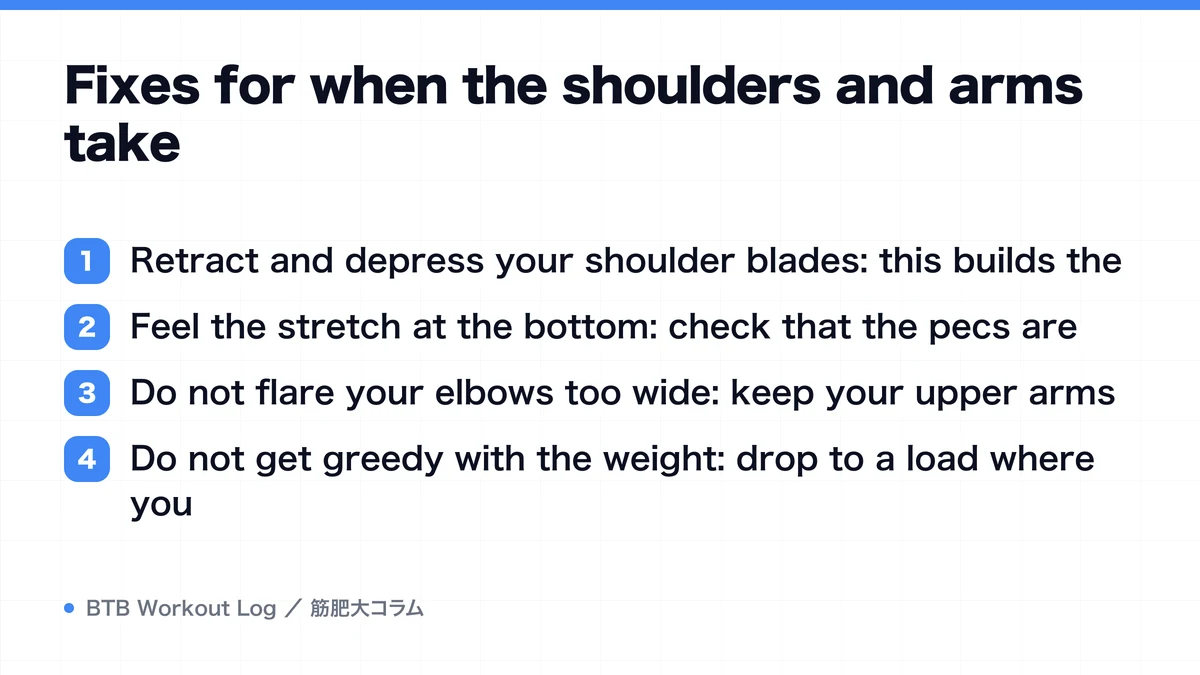
If the front of your shoulders or your triceps fatigue before your chest does, look at your form before you look at the weight.
- Retract and depress your shoulder blades: this builds the base that keeps your chest up. Once it collapses, the load moves to the front of the shoulder.
- Feel the stretch at the bottom: check that the pecs are being lengthened through the lower half of the range of motion.
- Do not flare your elbows too wide: keep your upper arms from opening out extremely, and press within the range where your forearms stay roughly vertical to the floor.
- Do not get greedy with the weight: drop to a load where you can hold the bar path, and prioritize the range of motion.
If that still does not fix it, isolate the causes one at a time. Why the bench press does not hit your chest and why the triceps fatigue first are separate problems, and the fixes are separate too.
The process is simple. First drop the weight by 20-30% and run the same movement, then see whether you get tension in the chest. If you do, the problem is your load selection; if you do not, it is your bar path or your range of motion. If fixing the bar path changes nothing, switching the incline or the equipment instead of staying on flat is sometimes the faster route. If it hurts, stop adjusting your form and see a professional.
Barbell, dumbbell, machine, and cable
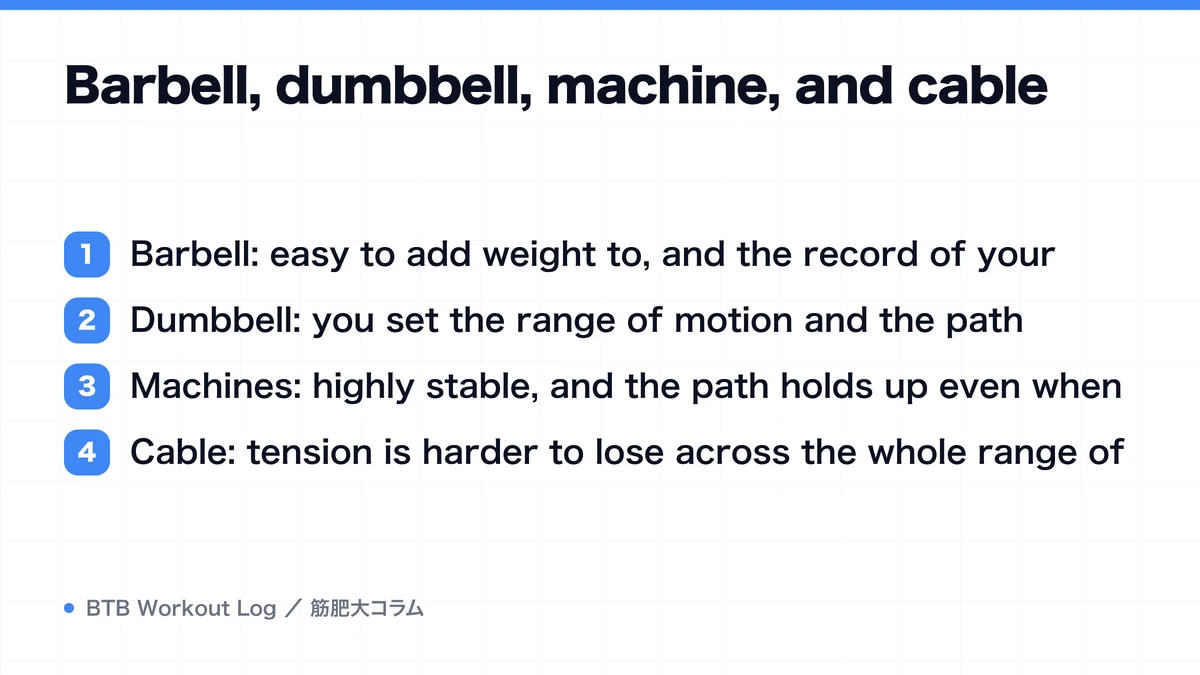
Even within pressing, the weight you can handle, how free the bar path is, and where the load peaks all differ by equipment.
- Barbell: easy to add weight to, and the record of your progress stays steady. The range of motion is limited by the bar itself.
- Dumbbell: you set the range of motion and the path yourself, but the weight increments are coarse and handling them takes skill (comparison).
- Machines: highly stable, and the path holds up even when you are pushing to failure (when to use which).
- Cable: tension is harder to lose across the whole range of motion, which suits fly variations (compared with dumbbells).
Choose on which one lets you stack up progress, not on which one is superior. Swapping equipment often leaves you nothing to compare against last time, so it is easier to manage if you keep your main lift fixed for a few months and vary the accessories instead.
How many chest exercises do you need
The number of exercises follows from your goal and your time. As long as your weekly chest volume is covered, even one exercise can grow the chest. But relying on a single exercise locks the angle in place, and leaves you no way out when you plateau on it.
In practice, treat three exercises - two presses (flat and inclined) plus one fly - as a rough upper limit. Go up to four only during a block where a weak point is obvious, then come back down once it is resolved. To judge whether the bench press alone is enough, watch your upper chest development and how comfortable your shoulders are over a few weeks.
Base the decision to add an exercise on recovery, not on time. After you add chest sets, if you can hold the previous weight and reps on the next chest day, that is a volume you are absorbing. If you cannot, the sets you added have outrun your recovery. Before you add exercises, first check whether you have taken the range of motion and the reps on your current exercises as far as they go.
Building the week and distributing sets
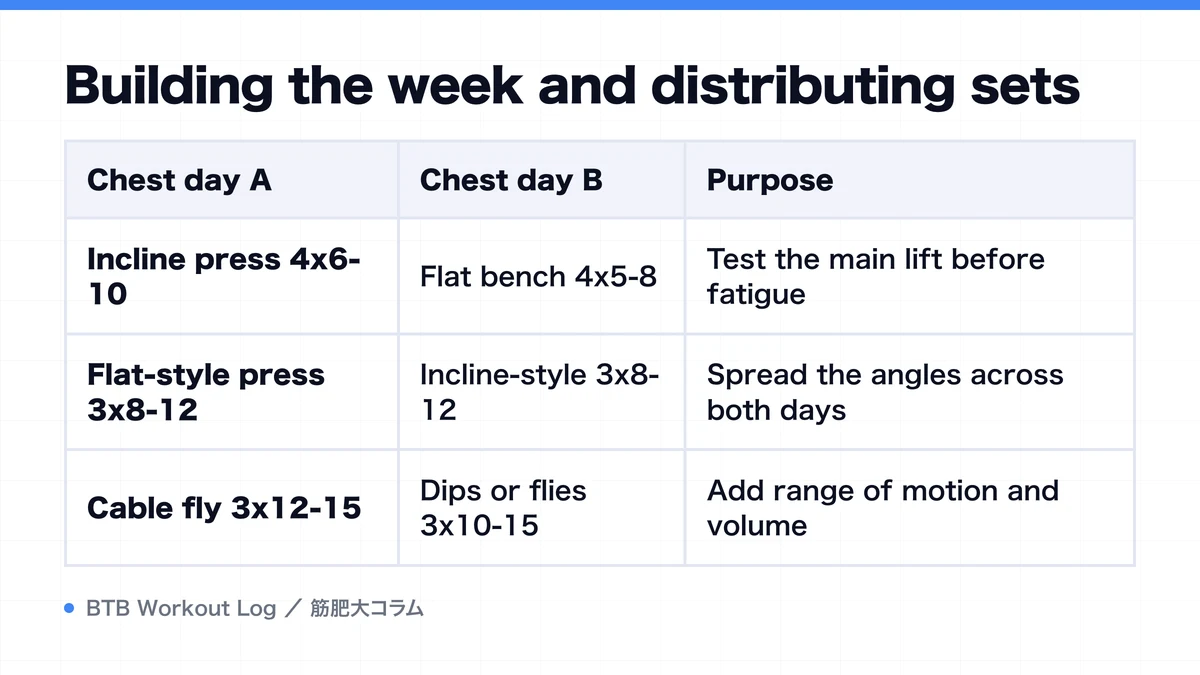
The chest is a large muscle group, so use 12-18 hard sets per week as a rough guide and split them across two sessions. Splitting the work over two days makes it easier to hold the quality of your later sets than cramming it all into one.
| Chest day A | Chest day B | Purpose |
|---|---|---|
| Incline press 4x6-10 | Flat bench 4x5-8 | Test the main lift before fatigue |
| Flat-style press 3x8-12 | Incline-style 3x8-12 | Spread the angles across both days |
| Cable fly 3x12-15 | Dips or flies 3x10-15 | Add range of motion and volume |
If the upper chest is your weak point, put incline work first, while you are still fresh. Just changing the order shifts the distribution even at the same set count.
It is easier to judge the effect if you do not raise the set count too much at once. Start at 12 sets per week, add 1-2 sets every two weeks, and check that your weights and reps keep beating the previous session. Slightly before the point where progress stops is the volume that suits you at that time.
If you tend to get tightness or discomfort at the front of the shoulder, review the number of pressing exercises before the total set count. Running flat, incline, and dips all at high intensity in the same week wears out the shoulder joint before it wears out the pecs. If you want to lower the strain without cutting pressing volume, swapping one exercise for a machine or a cable steadies the path.
Progress means beating last session under the same conditions
Once your angles and exercises are set, there is only one thing left to do: add weight or reps while keeping the same range of motion and the same bar path (progressive overload). If you change the angle every week, you cannot tell whether you improved or the conditions simply changed.
As a rough guide, once you reach the top of the rep range you set, add the smallest available increment and rebuild from the bottom of the range. This assumes you never load up to where your form breaks down, and never cut the range of motion just to move the numbers.
Even in periods where the weight will not move, progress shows up in several forms. One more rep at the same weight, one more rep in reserve at the same reps, a deeper range of motion, a steadier movement. All of these are preparation for the next jump in weight. If you watch only one metric, it is easy to misread progress as a plateau.
Manage upper and lower chest development with numbers
Visual change is hard to judge over a few weeks, and lighting and posture change the impression. What you judge on is the weight and reps at each angle, whether you are holding the range of motion, and which area got close to failure first during a set.
If a bias shows up - the numbers move everywhere except on incline, or flat keeps climbing but you get no tension in the upper chest - that is grounds for changing how you distribute your sets. Keeping your log separated by angle lets you reinforce only the weak direction rather than the whole chest.
A 4-6 week cycle is a manageable unit for making that call. Anything shorter gets buried in day-to-day differences in condition, and anything too long delays the correction. Keep the set count and the exercise order fixed through the block and change only one of angle or weight, and you can pin down the cause.
Conversely, if the numbers move at no angle and your range of motion is not widening either, the shortfall may not be the chest itself but your total volume, frequency, sleep, or calorie intake. Checking those before you rearrange your chest exercises solves it faster.
FAQ
- Can bench press alone build a complete chest?
- It will develop the chest, but because the angle stays fixed, the upper chest tends to get too small a share of the work. Adding one incline exercise while the bench stays your main lift is the easier fix. Check your upper chest progress in the log over a few weeks.
- Why do I feel chest exercises in my shoulders and arms instead of my chest?
- The common causes are one of three: shoulder blades that are not retracted and depressed, elbows flared too wide, or a weight so heavy that it cuts your range of motion. Drop the weight and rebuild the bar path, and if that still changes nothing, review your exercise selection and angle.
- Are fly exercises necessary?
- They are not essential, but they add tension in the stretched position that pressing alone rarely gives you. While your press weights are still climbing there is no need to force them in; the easiest way to use them is to add them when you want more volume or a wider range of motion.
- How many chest days per week should you do?
- Splitting into two sessions per week keeps the sets per session down while still covering your total volume. Once per week is unlikely to make a big difference if the total is the same, but bear in mind that the quality of your later sets tends to drop.
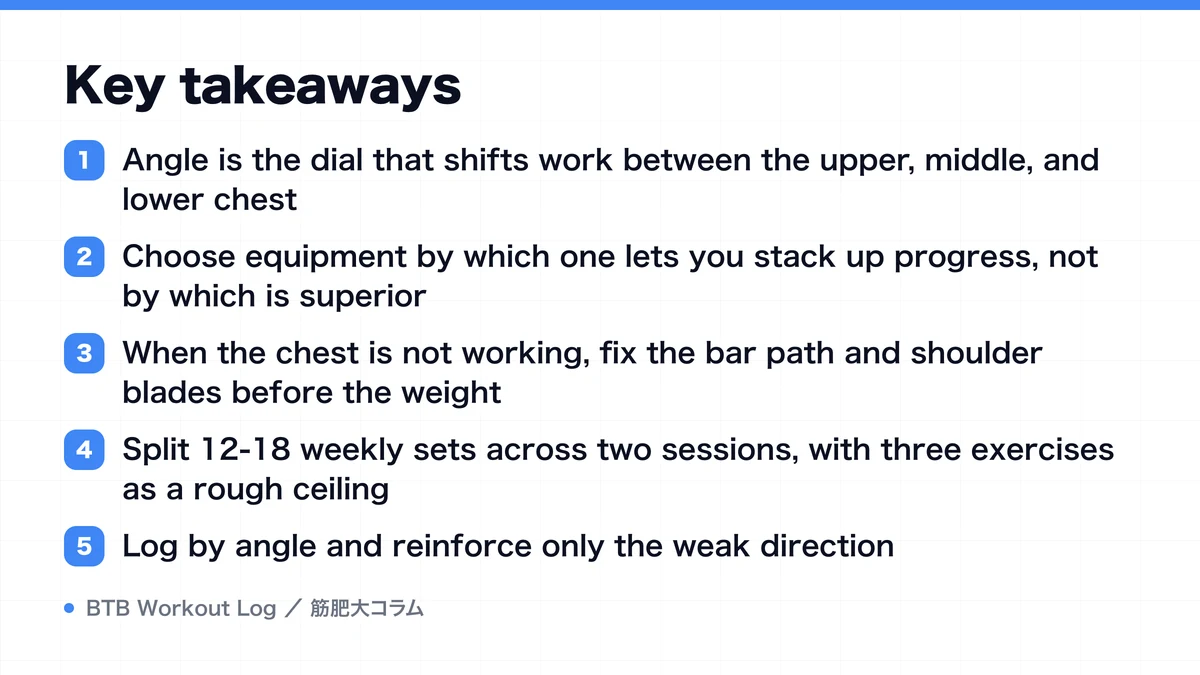
Key takeaways
- Angle is the dial that shifts work between the upper, middle, and lower chest
- Choose equipment by which one lets you stack up progress, not by which is superior
- When the chest is not working, fix the bar path and shoulder blades before the weight
- Split 12-18 weekly sets across two sessions, with three exercises as a rough ceiling
- Log by angle and reinforce only the weak direction
References
- Non-uniform Excitation of the Pectoralis Major During Flat and Inclined Bench Press
- The Effects of Bench Press Variations in Competitive Athletes on Muscle Activity and Performance
- Dose-response Relationship Between Weekly Resistance Training Volume and Muscle Mass
- ACSM Position Stand: Progression Models in Resistance Training for Healthy Adults