Does Pullover Really Work the Lats? | Is It Worth a Spot on Back Day, Put to the Test
The pullover does train the lats, but it is not a replacement for pull-ups or rows. Its value lies in working the shoulder with minimal elbow bend, making it a useful accessory.
Do not judge it by how strongly you feel it. Judge it by whether it adds a stimulus missing from your current back routine and whether you can recover from the extra work.
Use Three Criteria to Decide Whether Pullovers Train the Lats
The question is not simply whether the lats work at all during a pullover. To earn a place in a hypertrophy program, the exercise must meet three criteria: it must place enough load on the lats, serve a sufficiently different role from your existing exercises, and allow measurable progress that justifies the fatigue.
A complete back workout generally centers on vertical pulls from overhead and horizontal pulls toward the torso. Both involve elbow flexion, so the biceps or forearms may become the limiting factor. Pullovers keep the elbow angle relatively fixed while bringing the upper arm from overhead toward the torso, reducing reliance on the elbow flexors.
However, no pullover variation can build lat width, upper-back thickness, and the spinal erectors all by itself. If you remove both vertical and horizontal pulls and perform only pullovers, your back will lack key directions of stimulus. What matters is how well the exercise complements your program, not whether it can do everything.
The Lats Work, but the Load Peaks Differently by Equipment
The lats attach to the humerus and help extend the shoulder, bringing an elevated arm back toward the body. That matches the primary motion of a pullover, so the exercise can load the lats from an anatomical standpoint. However, the teres major, pectoralis major, and long head of the triceps also contribute depending on your position and range of motion. You cannot isolate the lats completely.
With a dumbbell pullover, the external moment created by gravity is greatest toward the overhead position, so the exercise tends to feel hardest there. As the arms approach a position above the chest, the external load on the lats decreases. A cable lets you adjust your body relative to the anchor, making it easier to maintain tension near the bottom. Even if cable tension remains constant, however, joint torque may not. Focus on where resistance is strongest, not merely on the equipment you use.
Electromyography compares muscle activity at a given moment. Studies have reported differences in activity between traditional lat exercises under various conditions, but those findings do not determine how much hypertrophy will occur over time. Even if pullovers produce high activity or a strong stretch, do not base your decision solely on feeling your back work. Compare exercises with load, range of motion, and effort held consistent.
Research Does Not Establish Pullovers as the Best Lat Exercise
Based on the available research, evidence that the lats contribute to the pullover is not the same as evidence that it produces more hypertrophy than other back exercises. Comparisons of muscle activity can help guide exercise selection, but they do not directly compare muscle thickness several months later. Loading also changes between dumbbells and cables and with differences in elbow angle or bench position, even when every variation is called a pullover.
Hypertrophy does not result from a single peak in muscle activity. It develops through repeatedly applying sufficient tension to the target muscle and recovering from that stimulus. We can therefore say that pullovers train the lats, but we cannot make a universal claim that they outperform pull-ups. Treat the choice between pull-ups and lat pulldowns as a comparison between vertical pulls, and treat the pullover as a separate, fixed-elbow movement.
When direct comparisons are limited, do not fill gaps in the research with absolute form rules. Claims that going as deep as possible overhead is always better, or that arching the chest harder always stretches the lats more, ignore individual shoulder tolerance and body structure. Prioritize a range of motion you can reproduce instead of forcing the largest possible range.
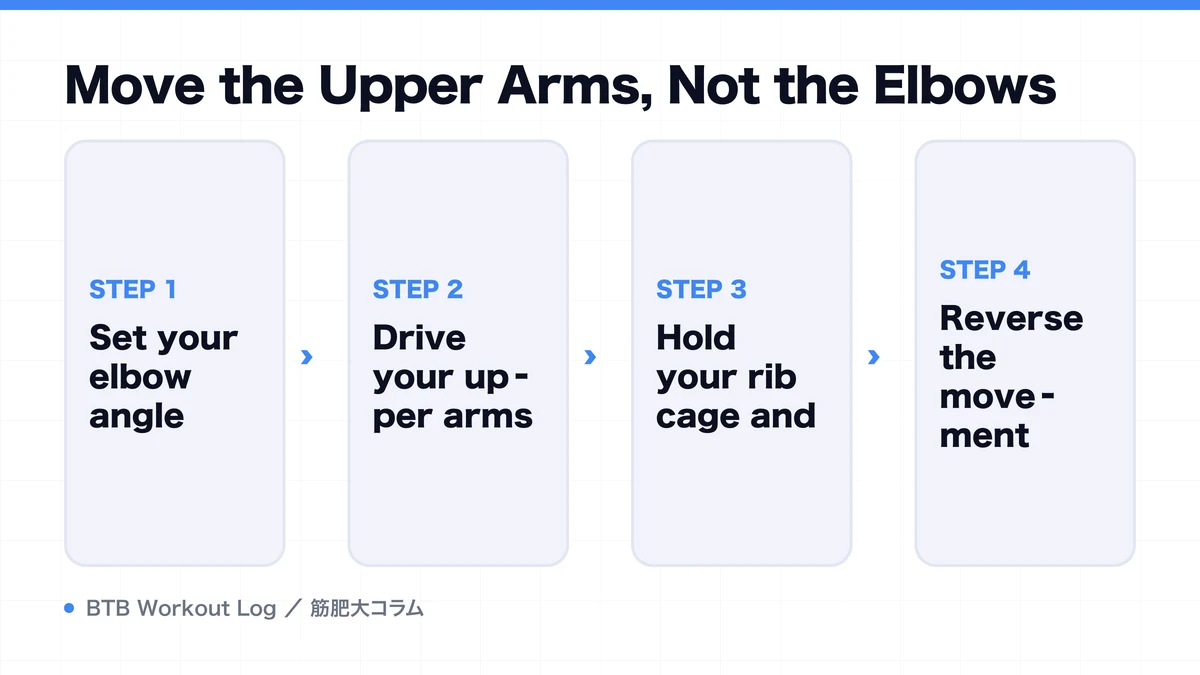
Move the Upper Arms, Not the Elbows
- Set your elbow angle first: Keep the elbows slightly bent, and do not flex and extend them as you lower the weight. Excessive elbow bend increases triceps involvement and turns the movement into a different exercise.
- Drive your upper arms toward your pelvis: Instead of pressing the implement with your hands, bring your upper arms toward your torso while contracting the area behind your armpits. With a dumbbell, do not flare your elbows excessively. With a cable, do not slam the bar into your thighs.
- Hold your rib cage and lower back steady: If you arch your lower back to lower your arms, you replace shoulder motion with trunk extension. Keep breathing, and stay within a range that does not make your rib cage flare sharply upward.
- Reverse the movement where your shoulders allow: You may feel tension in the lats toward the overhead position, but do not use a depth that causes pain or numbness at the front of the shoulder. If changing your form does not resolve the symptoms, stop training and consult a qualified professional.
Start with a manageable load for roughly 8–15 reps at RIR 2–3, leaving 2–3 reps in reserve. Once the movement is stable, add reps within RIR 1–3 and make a small weight increase only when you reach the top of the rep range. Adding weight while changing your depth and elbow angle does not provide a valid comparison of progressive overload.
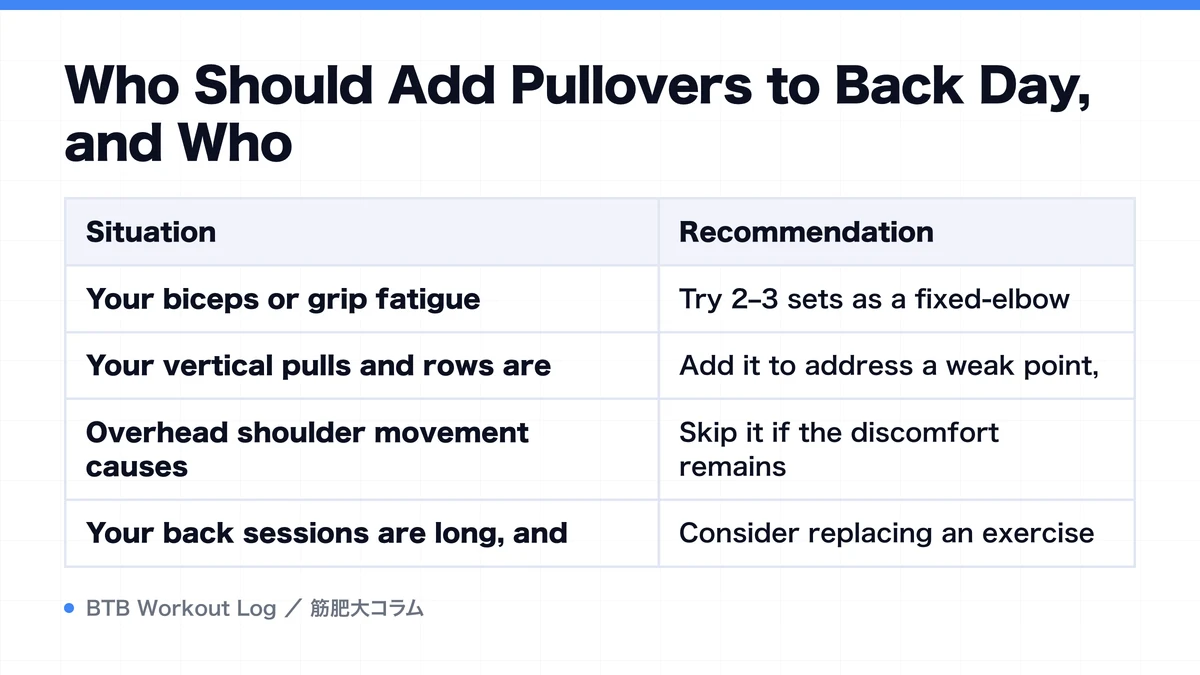
Who Should Add Pullovers to Back Day, and Who Can Skip Them?
| Situation | Recommendation |
|---|---|
| Your biceps or grip fatigue first, making it hard to add more work for the lats | Try 2–3 sets as a fixed-elbow movement |
| Your vertical pulls and rows are progressing, and you recover well from your weekly volume | Add it to address a weak point, then monitor its effect on your existing exercises |
| Overhead shoulder movement causes discomfort | Skip it if the discomfort remains after reducing the depth |
| Your back sessions are long, and set quality declines toward the end | Consider replacing an exercise instead of adding another |
If you include pullovers, placing 2–3 sets after your heavy vertical pulls or rows is practical. Performing them first may preserve your grip, but local lat fatigue can also reduce the loads you use on your main exercises. Put your highest-priority exercise first, then use pullovers to cover what remains.
Keep the equipment, range of motion, and rep range consistent for 4–6 weeks. Check whether reps or load increase at the same effort level and whether your vertical pulls suffer the following week. If you add the exercise, increase only your total number of sets, and then hit a plateau, the pullover itself may not be the problem. You may have exceeded the weekly set volume from which you can recover. Pullovers earn a place on back day when they complement your other work without stopping your progress.
FAQ
- Are Dumbbells or Cables Better for Training the Lats?
- Dumbbells tend to work well when you want more load in the stretched overhead position. Cables make it easier to maintain tension closer to the bottom. Prioritize shoulder comfort and a repeatable movement path rather than judging the exercise by equipment alone.
- Is the Pullover Also a Chest Exercise?
- Yes. The pectoralis major also contributes because it acts on the shoulder joint. Elbow position, range of motion, and the direction of resistance change how the load is distributed, but complete isolation is impossible. To emphasize the lats, consistently drive your upper arms toward your pelvis.
- How Many Sets of Pullovers Should I Do for My Back?
- Start with 2–6 sets per week as part of your existing back volume, then monitor recovery and progress. There is no single correct number. The useful amount depends on your total weekly volume from vertical pulls and rows, your RIR, and your training experience.
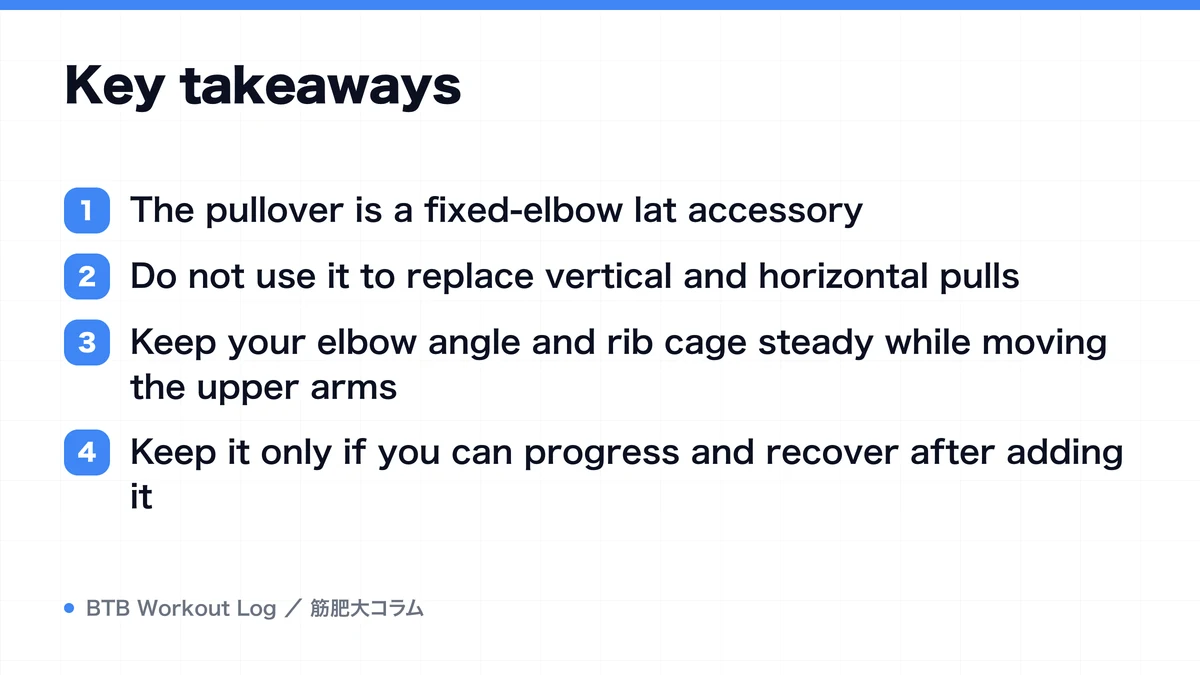
Key takeaways
- The pullover is a fixed-elbow lat accessory
- Do not use it to replace vertical and horizontal pulls
- Keep your elbow angle and rib cage steady while moving the upper arms
- Keep it only if you can progress and recover after adding it