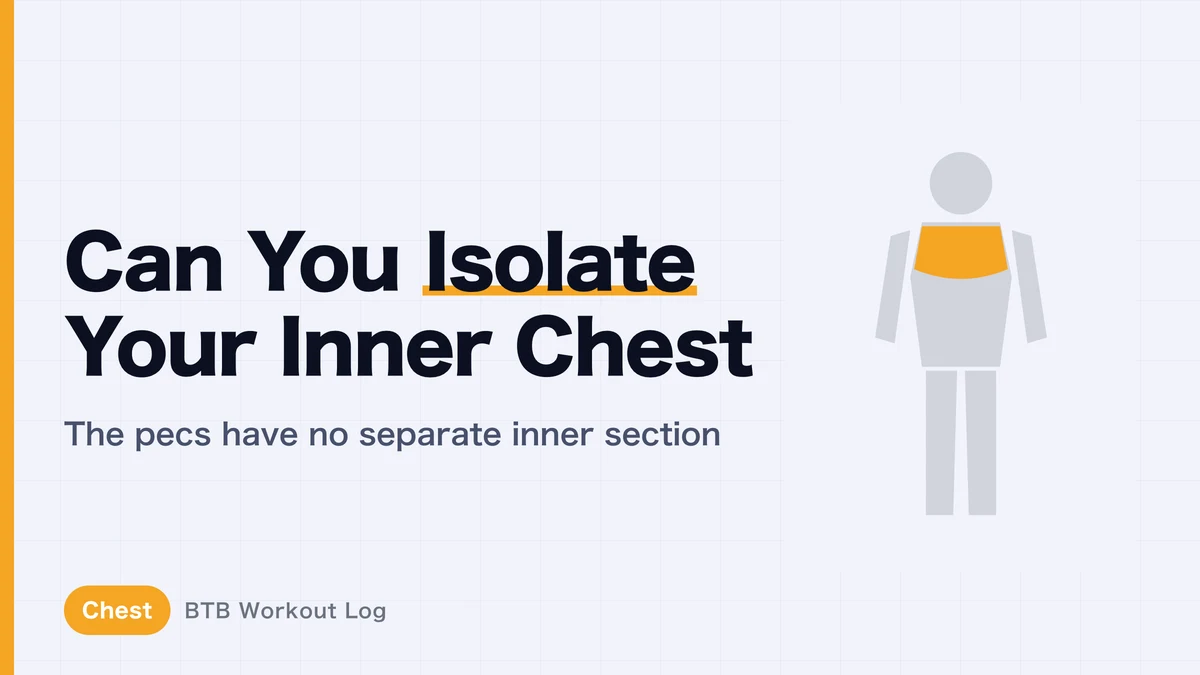
Can You Isolate the "Inner" Chest? | The Truth About Pec Anatomy for Lifters Chasing a Deeper Cleavage
The "inner chest" is not a separate muscle head, so you cannot isolate it for growth. What you can do is use exercises that maintain tension in the shortened position and build more overall pec thickness, which can make the line between your pecs more visible.
The question is not whether you can feel an exercise in your inner chest. It is whether you can make that area grow independently and which factors you can actually control to change its appearance.
There Is No Separate "Inner Chest" Muscle
The pectoralis major is generally divided into regions such as the clavicular and sternocostal heads. It helps press the arm forward and bring it inward across the body. Lifters often call the area near the sternum the "inner chest," but it does not have its own tendon or separate joint action. Even if you feel a strong contraction near your sternum during cable crossovers, that does not mean only the inner fibers are working.
That said, every region of a muscle does not always contribute in the same proportion. A high-density surface EMG study comparing flat and 45° incline pressing found that activity distribution changed along the upper-to-lower axis of the pectoralis major. This points to regional differences between the upper and lower portions, but it does not prove that you can selectively grow only the sternal side. Calling regional training either "completely impossible" or "fully customizable" goes beyond what the research shows.
For a broader approach, see our guide to building a complete chest workout. Here, we will focus specifically on the inner chest.
Pec Separation Depends on More Than Muscle Mass
How much separation you see from the front depends on total pec mass, the shape of the attachments near the sternum, the space between the two muscle bellies, rib-cage structure, and body fat. Training can primarily change muscle mass. No exercise can shift your insertions or the outline of your muscle bellies farther inward.
- Your chest lacks overall thickness: Accumulate productive sets of both presses and flyes where the chest is the limiting factor.
- Your upper-chest outline is underdeveloped: Assess development at different angles before adding more inner-chest work. Treat upper-chest adjustments separately by reviewing how to choose an incline angle.
- You need to get leaner: A hypertrophy program cannot selectively remove fat from your chest. That requires a separate approach that includes nutrition.
- Your insertion shape creates a wider gap: Do not use someone else's pec separation as your benchmark. Track changes in thickness from your own starting point.
If you add "inner-chest exercises" without identifying the real issue, you may only increase total volume and compromise recovery. The right adjustment depends on what is actually limiting the look you want.
Cable Crossovers Add Shortened-Position Loading, Not Inner-Chest Isolation
Dumbbell flyes place the greatest load on the chest when the arms are spread apart. As the dumbbells move closer to directly above the shoulders, the external load pulling the arms apart decreases. With cable flyes, you can adjust the pulley position and maintain tension more easily as your hands come together in front of you. This is why cables often create a stronger sensation of fully squeezing the chest.
But a strong contraction does not mean only the sternal side will grow. The reason to choose cable crossovers is not "inner-chest isolation." It is their ability to add shortened-position loading that may be missing from presses or dumbbell flyes. See dumbbell flyes versus cable flyes for a detailed comparison.
Use a Repeatable Technique
- Do not push your shoulders forward just to cross your hands. Keep your rib cage and shoulder blades reasonably stable.
- Keep your elbow bend nearly fixed throughout each rep so the movement does not turn into a press.
- Focus on bringing your upper arms toward each other in front of your body, not on how far your hands cross.
- Control the return and stretch your chest only as far as you can without discomfort in the front of your shoulders.
Excessively crossing the handles does not necessarily increase the pectoralis major's range of motion by the same amount. If it only makes your shoulders roll forward, reduce the crossover and keep both upper arms moving along a consistent path.
Inner-Chest Work Only Matters When It Fills a Gap in Your Program
Forget the "inner chest" label for a moment. If your current program includes almost no loading in the shortened position, adding a cable movement can make sense. But if presses on machines and cable flyes already provide enough hard sets through the chest-squeezing portion and your performance is improving, there is little reason to add even more crossover work.
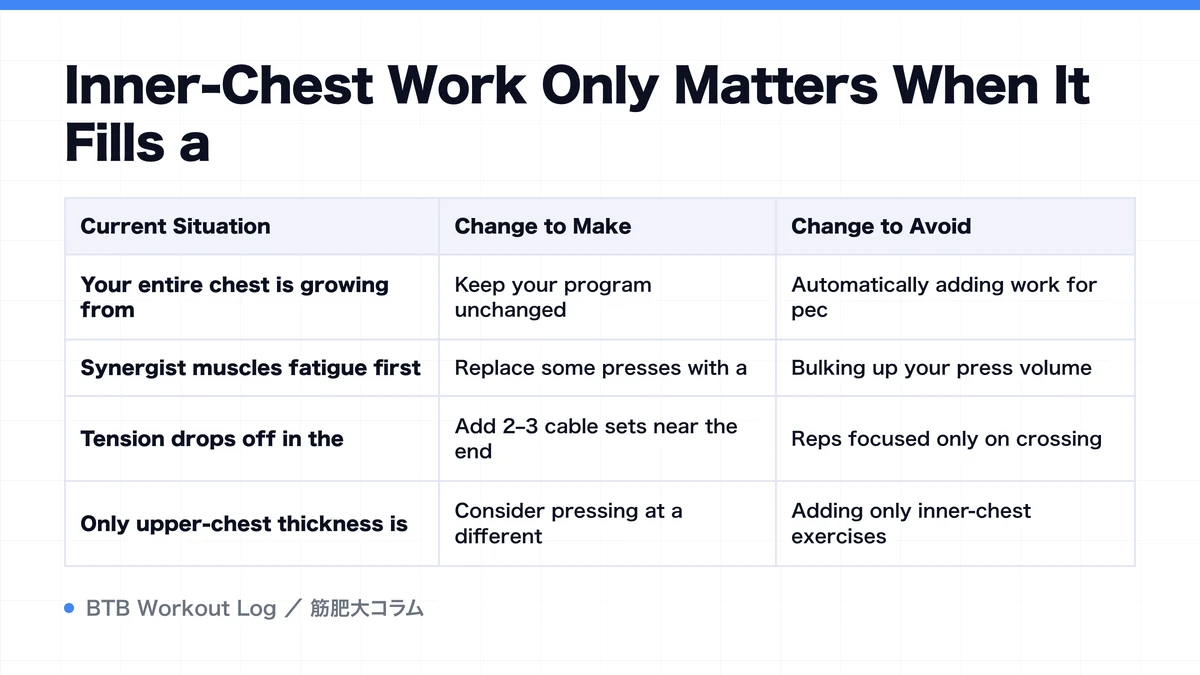
| Current Situation | Change to Make | Change to Avoid |
|---|---|---|
| Your entire chest is growing from presses alone | Keep your program unchanged | Automatically adding work for pec separation |
| Synergist muscles fatigue first | Replace some presses with a stable fly variation | Bulking up your press volume |
| Tension drops off in the shortened position | Add 2–3 cable sets near the end | Reps focused only on crossing your hands farther |
| Only upper-chest thickness is lagging | Consider pressing at a different angle | Adding only inner-chest exercises |
Start by replacing an exercise instead of adding one so you can compare your response while keeping weekly volume unchanged. Use a consistent path for around 8–15 reps, aim for an RIR of 1–3, and make sure your grip or shoulders are not failing before your chest.
Track Thickness and Progress Under Consistent Conditions, Not the Pump
Your pec separation may look deeper after cable work because of the temporary pump and lighting. That immediate appearance can help you check your technique, but it cannot confirm localized hypertrophy. Keep the exercise, pulley height, and foot position unchanged for 4–8 weeks, then see whether you can increase the load or reps within the same rep range.
If you take photos, capture both front and angled views using the same distance and lighting. Do not fixate on the line near your sternum; compare overall chest thickness and left-to-right differences. If your pressing performance falls and recovery slows after adding more flyes, the issue may be excessive total volume rather than extra growth stimulus for the inner chest.
Even if your fly performance improves, it may not represent the same workload if your position or pulley height has changed. Mark your position on the floor, use the same handle height and elbow bend, and count only reps performed under comparable conditions. Treat the feeling of squeezing your chest as supporting information; base your main assessment on performance under repeatable conditions.
If you already meet the conditions for building your chest with the bench press alone, there is no need to overhaul your program just because you are worried about pec separation. Steadily build the muscle mass you can control and assess it separately from the insertion shape you cannot change.
FAQ
- Are There No Exercises That Target the Inner Chest?
- No exercise has been shown to grow only the sternal side of the chest independently. Cable crossovers can maintain tension into the shortened position and supplement the stimulus to the chest as a whole, but they do not isolate the inner chest.
- Should You Cross Your Hands During Cable Crossovers?
- There is no need to exaggerate the crossover. Bringing your upper arms together in front of your body without pushing your shoulders forward is enough. Prioritize keeping your elbow angle and shoulder-blade position consistent from rep to rep.
- Does a Lack of Pec Separation Mean You Are Not Training Enough?
- Insufficient muscle mass can be one factor, but muscle insertion shape, rib-cage structure, the distance between your pecs, and body fat also affect their appearance. Exercise cannot change your skeleton or insertion points, so assess changes in overall chest thickness from your own starting point.
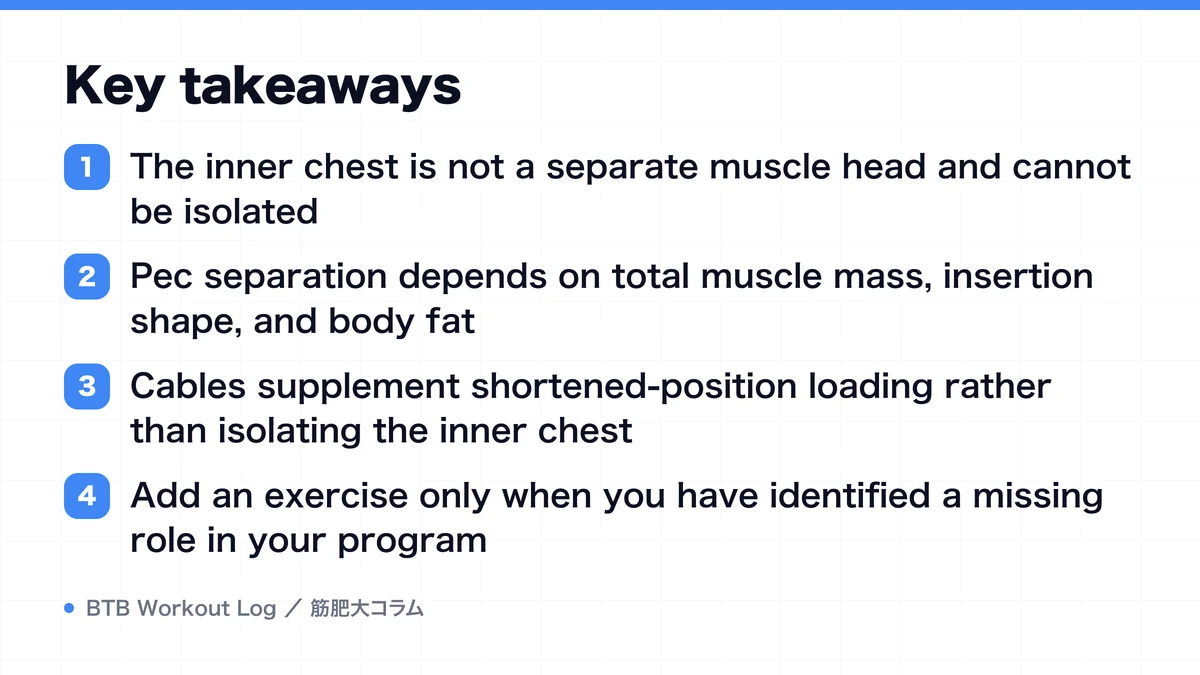
Key takeaways
- The inner chest is not a separate muscle head and cannot be isolated
- Pec separation depends on total muscle mass, insertion shape, and body fat
- Cables supplement shortened-position loading rather than isolating the inner chest
- Add an exercise only when you have identified a missing role in your program