Low Load vs. High Load: Is There a Difference for Hypertrophy? | The Answer From Schoenfeld 2017
Conclusion: In a synthesis of 21 studies, low- and high-load muscle hypertrophy was similar when performing sets to the point of no-repeatability. On the other hand, higher loads were advantageous for improving 1RM.
A condition that is often overlooked in searches is "up to the limit". This result cannot be extended to lighter weight sets that are easier to complete.
Paper details
| Original title | Strength and Hypertrophy Adaptations Between Low- vs. High-load Resistance Training |
|---|---|
| Authors | Brad J. Schoenfeld et al. |
| Journal | Journal of Strength and Conditioning Research, 31(12), 3508-3523 |
| Year | 2017 |
| Study design | Systematic review/meta-analysis |
| Participants / scale | 21 studies (interventions over 6 weeks) |
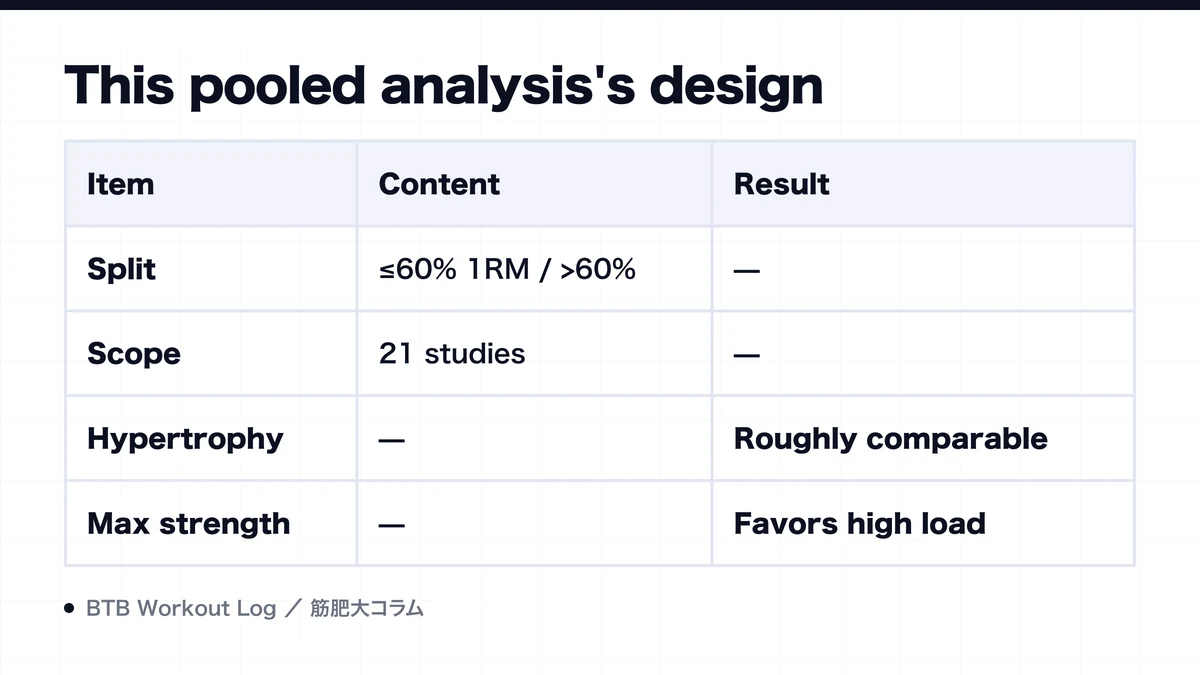
| Comparison / methods | Comparison of low loads below 60% 1RM and high loads above 60% 1RM until temporary inability to repeat |
| Main outcomes | 1RM muscle strength, isometric strength, muscle hypertrophy |
| DOI | 10.1519/JSC.0000000000002200 |
Comparing low loads below 60% 1RM and high loads above 60% 1RM
The authors collected longitudinal studies of 6 weeks or more and defined low loads as below 60% 1RM and high loads as above 60% 1RM. Inclusion conditions included performing the set to temporary non-repeatability.
We integrated 21 studies and separately analyzed muscle hypertrophy indicators such as event-specific 1RM, isometric strength, muscle thickness, and muscle cross-sectional area.
Muscular hypertrophy is similar, but higher loads are advantageous for 1RM
No significant difference was confirmed in the effect size of muscle hypertrophy between low and high loads. The conclusion is that muscles can grow in size if you put in enough effort over a wide range of loads.
On the other hand, high loads were advantageous for increasing 1RM. This is because the skills and neural adaptations to handling heavy weights are more likely to develop the more you actually practice that weight. There was no clear difference in isometric muscle strength.
Conditions that established "same at low weight"
Low loads require more repetitions than high loads, and the closer you get to being unable to repeat, the more set time and local pain you will experience. Therefore, low loads are not necessarily easy or short-lived.
Also, although the inclusion condition for this meta-analysis was the inability to repeat, subsequent studies have not shown that performing to the full limit on every set is essential for muscle hypertrophy. There is room to manage fatigue aroundRIR 1 to 3.
Equivalent does not mean exact same
Lack of significant difference does not prove that the effects are exactly the same at all loads. There are limitations in the number of studies, participants, and methods for measuring muscle hypertrophy, and there is not much data on extremely light loads.
Furthermore, the safety of the event, time efficiency, cardiopulmonary burden, and joint condition are not reflected in the muscle hypertrophy effect size in the meta-analysis. These are also important factors to consider when selecting an actual load.
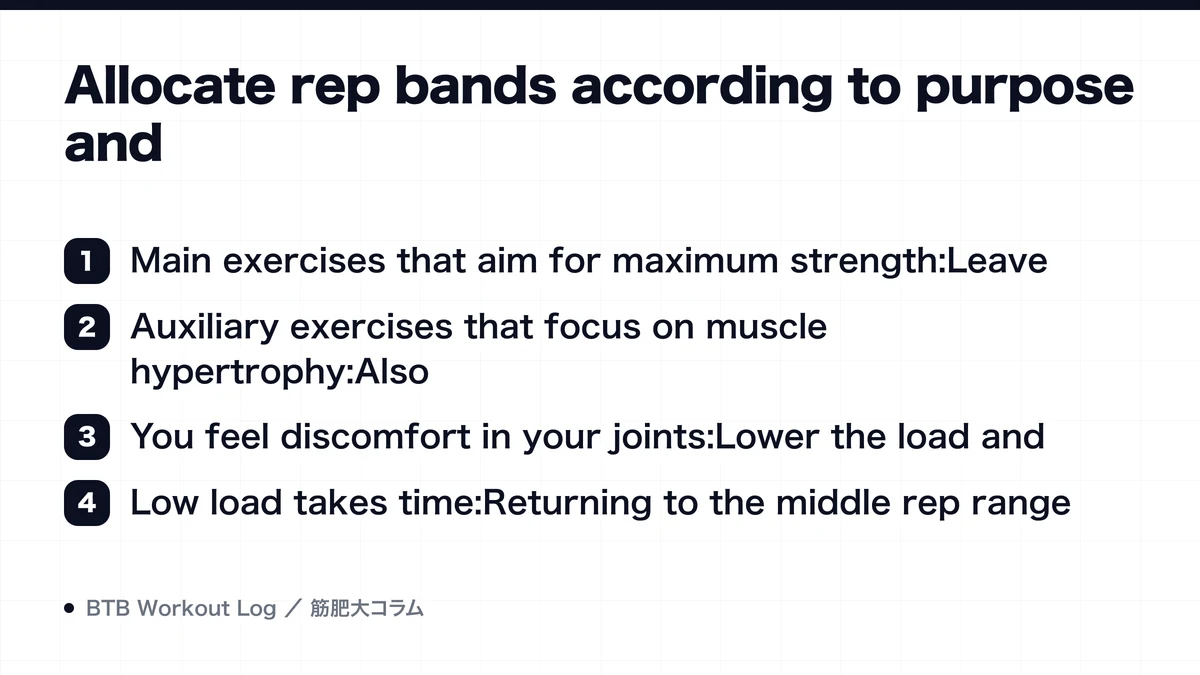
Allocate rep bands according to purpose and event
- Main exercises that aim for maximum strength:Leave high-load sets
- Auxiliary exercises that focus on muscle hypertrophy:Also use medium to low loads
- You feel discomfort in your joints:Lower the load and maintain a stable level of effort
- Low load takes time:Returning to the middle rep range
Do not aim at the load range, instead compare stimulation of target muscles, repetition quality,weekly volume, and recovery in the log.
FAQ
- Is there an optimal number of repetitions for muscle hypertrophy?
- No single optimal number is indicated. Multiple rep ranges can be used depending on the event, safety, effort level, and time efficiency.
- Is low load always necessary to the limit?
- This meta-analysis employed marginal studies. Nowadays, it is not considered necessary to reach the full limit every set, but the lower the load, the closer you should get.
- What if you also want to increase your muscle strength?
- Leave high-load sets as the main events. Additional volume for muscle hypertrophy can be achieved through medium- to low-impact supplementary exercises.
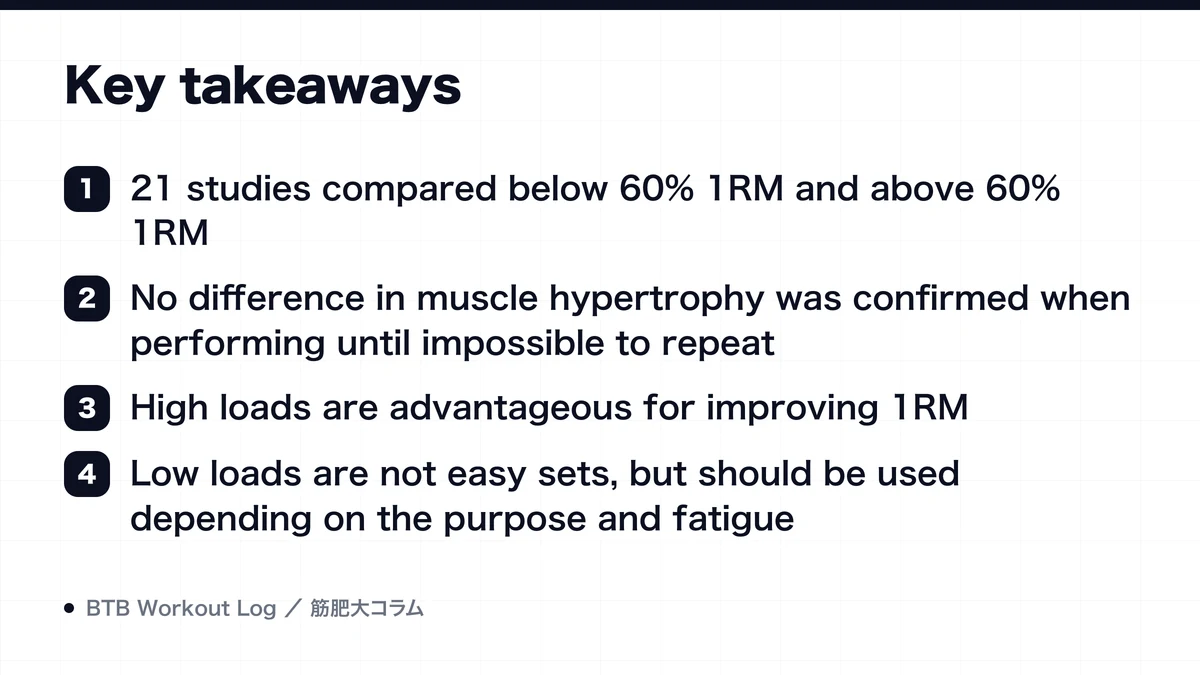
Key takeaways
- 21 studies compared below 60% 1RM and above 60% 1RM
- No difference in muscle hypertrophy was confirmed when performing until impossible to repeat
- High loads are advantageous for improving 1RM
- Low loads are not easy sets, but should be used depending on the purpose and fatigue