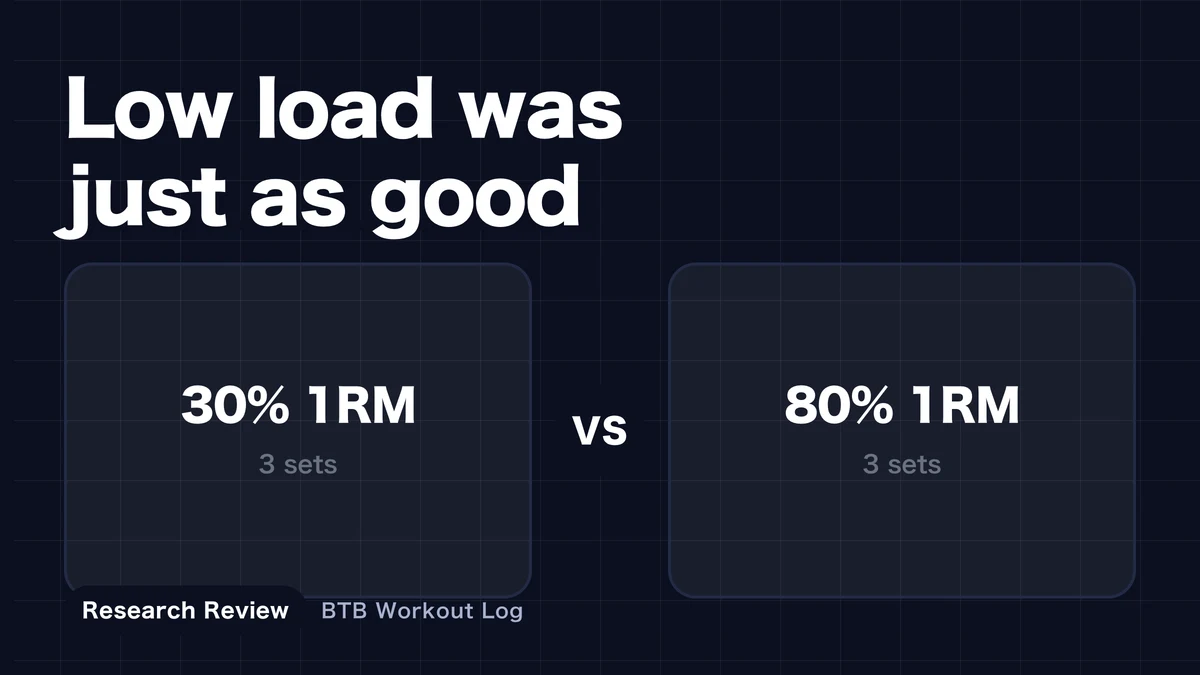
Does Light Weight Also Build Hypertrophy? | The Results and Limits of Mitchell 2012, Which Shook Up Conventional Wisdom
Conclusion: Legs that performed 3 sets of 30% 1RM to unrepeatability gained the same amount of muscle as legs that performed 3 sets of 80% 1RM. However, higher weights favor maximum strength, while lighter sets involve more repetitions and greater fatigue.
What this study rejected was the idea that only heavy weights are effective for muscle hypertrophy, not the value of heavy weights themselves.
Paper details
| Original title | Resistance Exercise Load Does Not Determine Training-mediated Hypertrophic Gains in Young Men |
|---|---|
| Authors | Cameron J. Mitchell et al. |
| Journal | Journal of Applied Physiology, 113(1), 71-77 |
| Year | 2012 |
| Study design | A randomized, within-leg comparison intervention study |
| Participants / scale | 18 healthy young men |
| Comparison / methods | One-leg knee extension at 30% 1RM for 3 sets, 80% 1RM for 1 set, or 80% 1RM for 3 sets for 10 weeks, 3 times a week until unable to repeat |
| Main outcomes | MRI quadriceps muscle volume, muscle fiber area, isometric/isokinetic/1RM muscle strength |
| DOI | 10.1152/japplphysiol.00307.2012 |
Comparison of 3 conditions on the left and right legs of 18 people
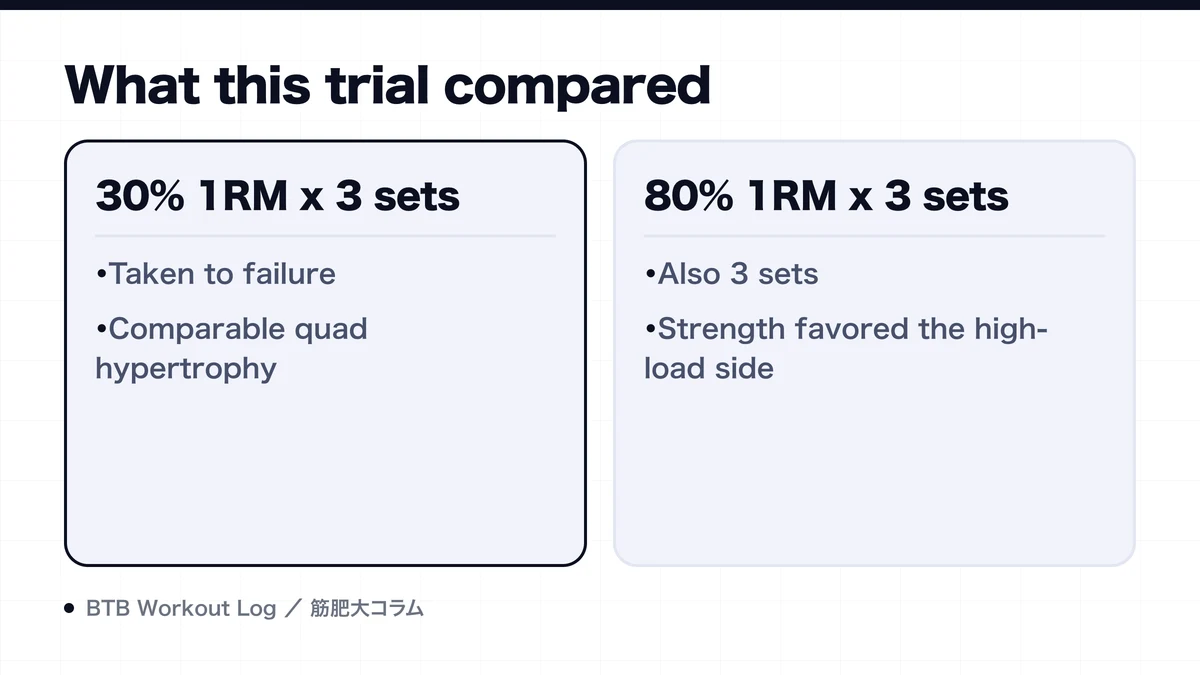
18 young men performed single-leg knee extension three times a week for 10 weeks. Each leg was assigned to either 3 sets at 30% 1RM, 1 set at 80% 1RM, or 3 sets at 80% 1RM, and all sets were repeated until unable to continue on their own.
A design in which the left and right legs of the same participant are subjected to different conditions can reduce the influence of individual differences such as genetics and diet. Muscle hypertrophy was assessed by quadriceps muscle volume by MRI and muscle biopsy.
Quadriceps muscle volume increased by 6.8%, 3.2%, and 7.2%
Quadriceps muscle volume measured by MRI was 30%/3 sets6.8±1.8%, 80%, 1 set3.2±0.8%, 80%, 3 setsIncreased by 7.2±1.9%. The difference between conditions was not statistically significant (p=0.18).
The low-load 3 sets and high-load 3 sets are close together, and the high-load 1 set appears small, so it can be interpreted that not only the weight but also sufficient repetitions and set volume are important.
Even if muscle hypertrophy is the same, maximal strength is not the same
Isometric maximal voluntary contraction increased in all conditions. On the other hand, improvements in 1RM similar to the events used were greater under high load conditions, and high weight exercises were advantageous for the ability to lift heavy weights.
Muscle size and 1RM are not the same ability. In addition to muscle mass, maximum strength involves neural adaptation, form, and habituation to higher weights.
These are the results for 18 young men and one leg event.
The subjects were 18 people, the event was one-leg knee extension, and the duration was 10 weeks. It cannot be generalized to chest, back, women, advanced athletes, and combined events. Also, since all sets were performed to the point of being unable to repeat, this does not apply to low loads that leave a large margin.
A subsequent meta-analysis and a 2025 study comparing upper and lower limbs using 30-40% 1RM vs. 70-80% 1RM support the idea that muscle hypertrophy with equal effort does not depend greatly on load.
Differentiate between low load and high load for each event
For events such as squats and bench presses where you want to improve your technique and maximum strength, focus on medium to high loads. For side raises, leg extensions, and cable exercises, use low to medium loads to help reduce joint strain.
Low loads require a good effort towards the end of the set, but you don't need to reach your full limit every time.RIRRecord this and move as close to your limit as you can while maintaining your form.
FAQ
- If it is a light weight, can I do it as many times as I like?
- It will not be easy to finish, but it will require effort close to the limit. Extremely high repetitions increase pain and time, so choose a range that suits the event.
- Is heavy weight unnecessary for muscle hypertrophy?
- Not necessary. Higher weights also lead to muscle hypertrophy, with clear benefits for maximal strength and lifting technique.
- Should I go to the limit every set?
- Not required. Although this study was carried out to the limit, in subsequent studies, muscle hypertrophy can be achieved even at non-limit levels, so we will balance this with fatigue.
Key takeaways
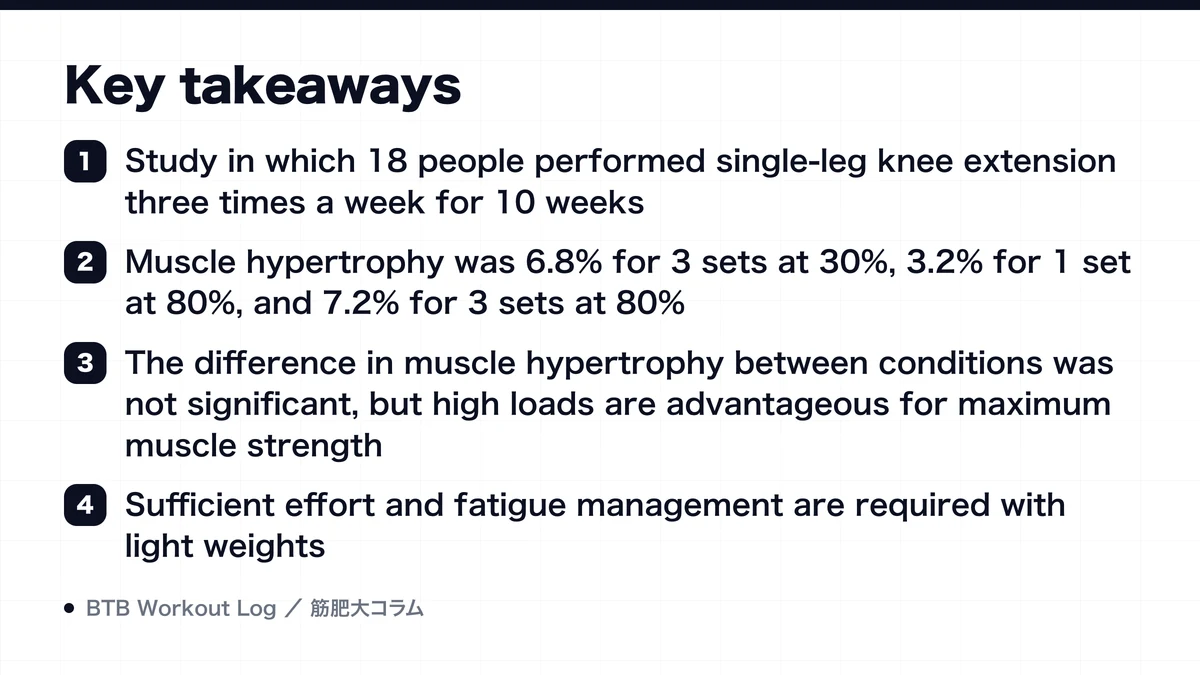
- Study in which 18 people performed single-leg knee extension three times a week for 10 weeks
- Muscle hypertrophy was 6.8% for 3 sets at 30%, 3.2% for 1 set at 80%, and 7.2% for 3 sets at 80%
- The difference in muscle hypertrophy between conditions was not significant, but high loads are advantageous for maximum muscle strength
- Sufficient effort and fatigue management are required with light weights