5 Exercises for Bigger Thighs | How to Combine Them to Hit All 4 Heads of the Quad
Build your quad training around a squat pattern that allows deep knee flexion, then fill the gaps with a more stable exercise and leg extensions. The 5 top options are the heel-elevated high-bar squat, hack squat, leg press, Bulgarian split squat, and leg extension.
You do not need to cram all 5 into one week. Choose one main lift where your quads approach failure first, one accessory with a different limiting factor, and one isolation exercise if needed.
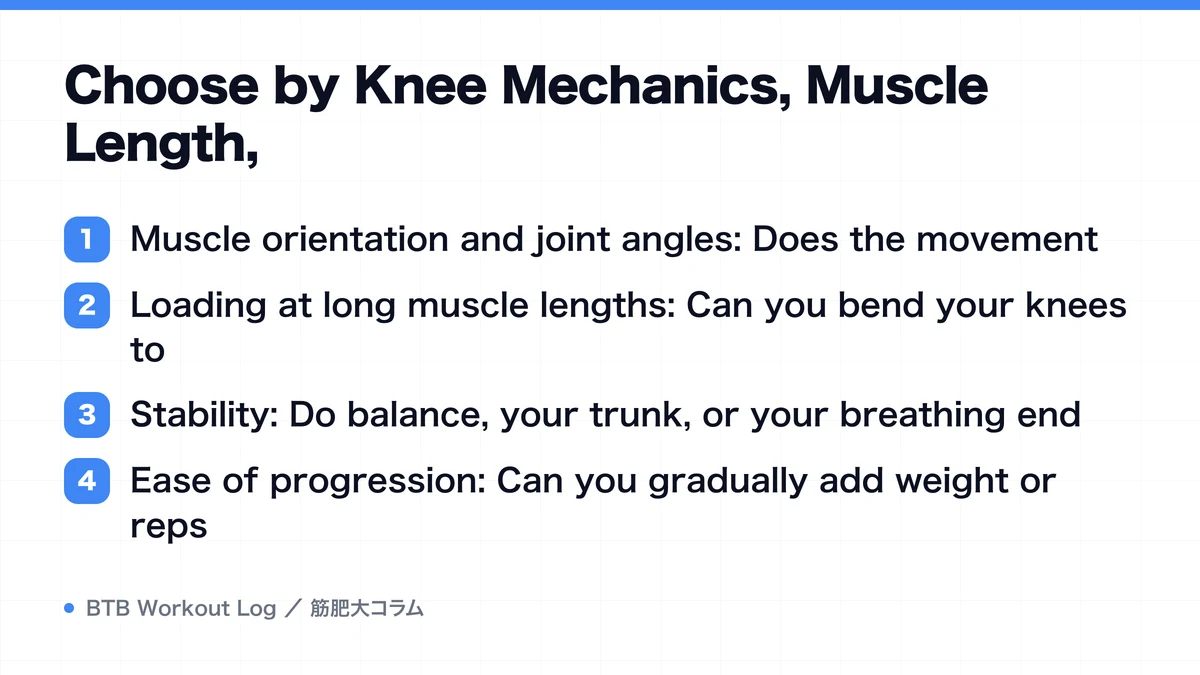
Choose by Knee Mechanics, Muscle Length, Stability, and Progression
The quadriceps consist of the vastus lateralis, vastus medialis, vastus intermedius, and rectus femoris. All 4 extend the knee. Only the rectus femoris also crosses the hip, so it does not work under the same conditions as the other 3 during squats, where the hips and knees extend together. Still, do not expect to completely isolate the vastus medialis just by changing your toe angle. Train the quads as a whole, then use other exercises to complement specific roles.
Assess each exercise using these 4 criteria.
- Muscle orientation and joint angles: Does the movement involve substantial knee extension, and are the quads the limiting factor?
- Loading at long muscle lengths: Can you bend your knees to a tolerable depth and control the change of direction?
- Stability: Do balance, your trunk, or your breathing end the set before your quads do?
- Ease of progression: Can you gradually add weight or reps while keeping the same foot position and range of motion?
Depth is not a competition. Compare lifts only within a range you can reproduce without pain while maintaining control of your pelvis and feet. If you change your range of motion, treat full versus partial range of motion separately rather than logging it as the same exercise as last time.
1 and 2: Heel-Elevated High-Bar Squat and Hack Squat
1. Heel-Elevated High-Bar Squat
Elevate your heels slightly on plates or a wedge and position the bar high across your upper back. This reduces ankle restrictions, makes it easier for the knees to travel forward, and suits lifters who can reach deep knee flexion while keeping a relatively upright torso. Start with your feet around hip-width apart and let your knees track in the same direction as your toes. Set your depth just before your heels lift or your lower back begins to round significantly.
Your glutes, adductors, and trunk work alongside your quads, making this a useful option when you want one main exercise for the entire lower body. However, it is less efficient for direct quad work if your breathing or upper back gives out first. Whether you can build your legs with squats alone is a separate question covered in testing a squat-only leg program.
2. Hack Squat
With your back and pelvis supported by the pad, you squat along a fixed path. This reduces the need to control your posture and lets you focus on bending and extending your knees. Place your feet near the middle of the platform, keep your heels down, and find the deepest position you can reach without your knees collapsing inward. If your quads are the local limiting factor, this is easy to progress as a main lift for around 6–12 reps.
The feel can change substantially with the machine's angle and pad position, and the fixed path may not suit every build. Use the hack squat versus barbell squat comparison to choose between it and free weights based on your goal.
3 and 4: Leg Press and Bulgarian Split Squat
3. Leg Press
The external stability of the leg press makes it easier to push your quads close to their limit, even at higher reps. Once you have set the seat and backrest, place your feet around the middle of the platform and lower the weight only as far as you can without your lower back lifting off the pad. Keep your reps consistent within 8–15 and avoid taking long rests at lockout.
A lower foot position tends to allow more knee travel, while a higher position tends to increase hip movement, but this varies with the machine and your build. The leg press setup guide covers foot width and placement in detail. For now, prioritize placing your feet in the same position every set.
4. Bulgarian Split Squat
Training one leg at a time makes left-to-right differences easier to identify and allows you to load the front leg heavily with less external weight. To emphasize the quads, avoid an excessively long stance, allow the front knee to travel toward the toes, and do not lean your torso farther forward than necessary. Rest your rear leg lightly on the bench and drive the floor away with your front leg.
The main drawback is that your cardiovascular fitness or balance may end the set first. Adding stability by holding a support with one hand or using a Smith machine does not make the exercise less effective. Choose a weight you can perform for the same number of reps on both sides, and start with the weaker side.
5: Isolate Knee Extension with Leg Extensions
Leg extensions let you extend the knee without substantial hip movement, so you can add quad work even if your trunk or glutes fatigue first during squat patterns. Position the pad just above your ankle and align your knee's axis of rotation as closely as possible with the machine's axis. Do not kick the weight up with momentum; control it from the extended position through the lowering phase.
The rectus femoris is a biarticular muscle, so its role differs from squat patterns where the hip and knee move together. That does not mean leg extensions let you isolate each of the 4 quad heads at will. Instead of forcing your toes sharply inward or outward to target a specific area, use a foot angle that allows your knees to move naturally.
The value of leg extensions examines when this exercise is useful and what squat patterns may leave undertrained. Here, it is not a replacement for your main lift but an option for adding direct work in the 10–20 rep range.
Split Main, Accessory, and Isolation Work Across 2 Weekly Sessions
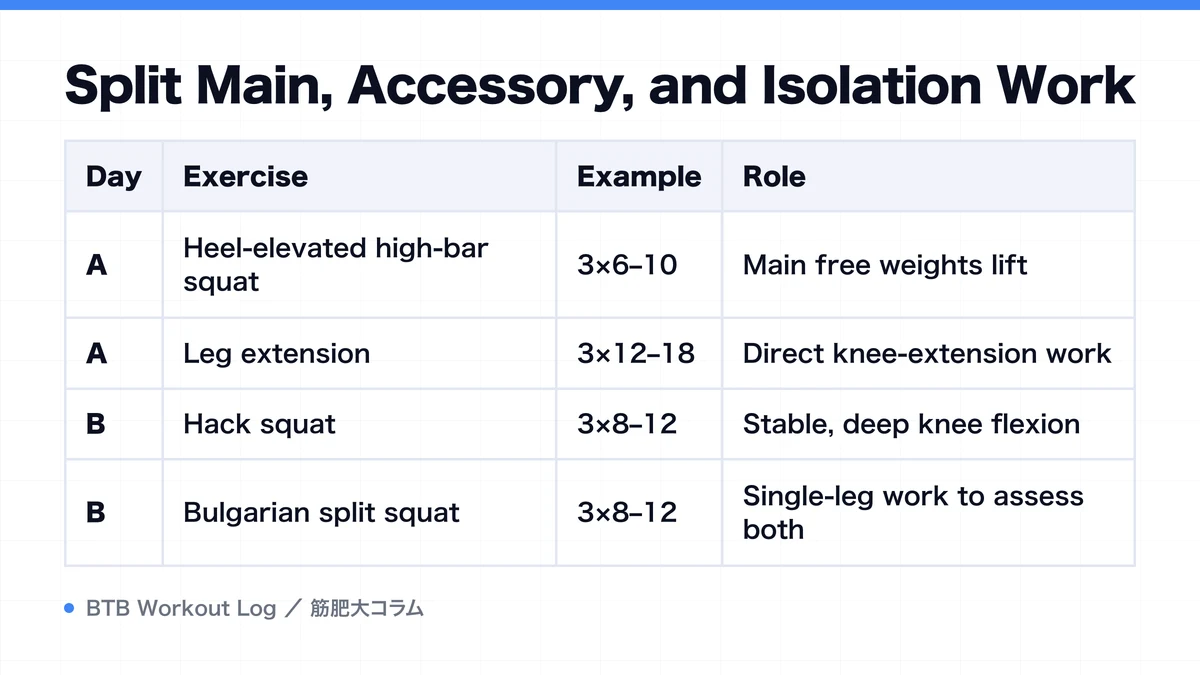
If you perform 12 weekly sets for your quads, you could divide the roles as follows.
| Day | Exercise | Example | Role |
|---|---|---|---|
| A | Heel-elevated high-bar squat | 3×6–10 | Main free weights lift |
| A | Leg extension | 3×12–18 | Direct knee-extension work |
| B | Hack squat | 3×8–12 | Stable, deep knee flexion |
| B | Bulgarian split squat | 3×8–12 | Single-leg work to assess both sides |
This example does not use all 5 exercises. If you choose the leg press, swap it for either the hack squat or Bulgarian split squat. Stacking hack squats, leg presses, and squats on the same day may add exercises, but the later sets are more likely to become shallow.
Use RIR 1–3 as your baseline for each exercise and apply double progression. Once you reach the top of the prescribed rep range at the same depth, increase the load slightly and build up again from the bottom of the range. Do not change exercises every week based only on how the outer or inner quad looks. Keep your primary exercises for at least 4–6 weeks, then decide whether to swap them based on whether your quads are the limiting factor and whether recovery is complete by the next session.
FAQ
- Can You Completely Isolate the 4 Heads of the Quads with Different Exercises?
- No. All 4 heads work together to extend the knee. Regional activation and growth may differ, but the differences are limited. First, give the quads enough total loading, then consider adding isolation knee-extension work for the rectus femoris.
- Should You Perform All 5 Quad Exercises?
- No. Choose one main lift where your quads reach their limit first, one accessory that adds a different role such as greater stability or single-leg work, and leg extensions if needed. Prioritize measurable progress under consistent conditions over duplicating exercises that serve the same purpose.
- How Many Reps Should You Do for Quad Exercises?
- A practical starting point is 6–12 reps for squats and hack squats, 8–15 for leg presses, and 10–20 for leg extensions. These are not fixed rules. Choose a range that lets you maintain your range of motion while approaching RIR 1–3.
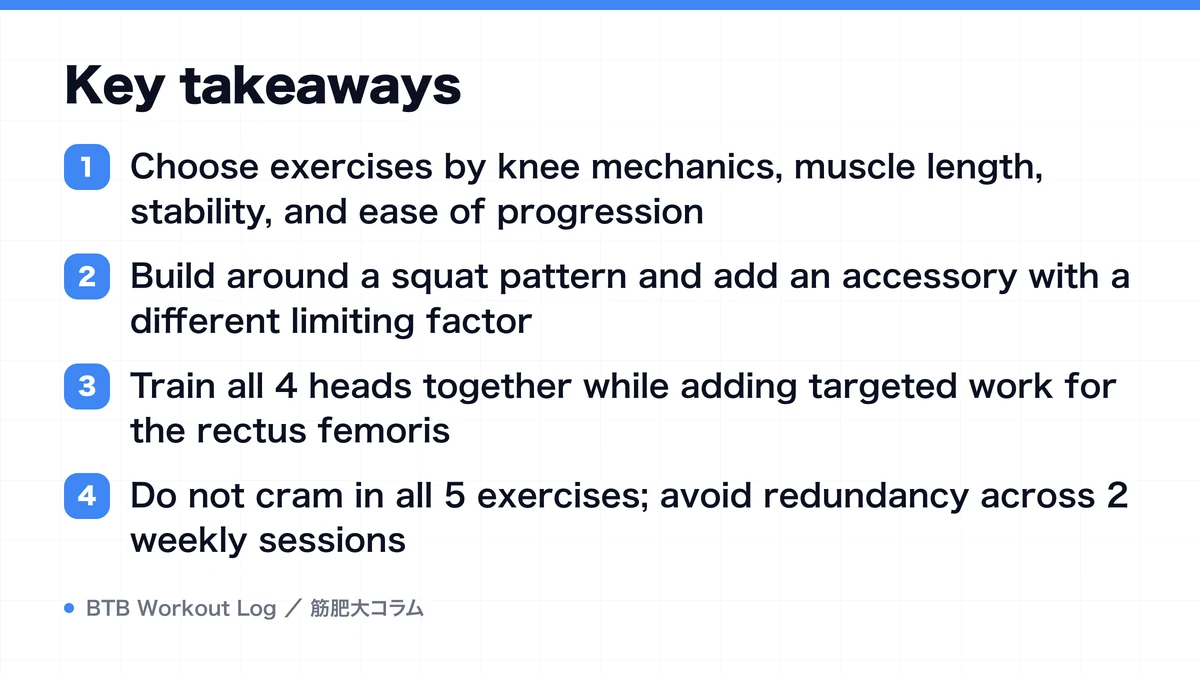
Key takeaways
- Choose exercises by knee mechanics, muscle length, stability, and ease of progression
- Build around a squat pattern and add an accessory with a different limiting factor
- Train all 4 heads together while adding targeted work for the rectus femoris
- Do not cram in all 5 exercises; avoid redundancy across 2 weekly sessions
References
- Muscle Hypertrophy Is Independent of Load Across Upper and Lower Limbs When Effort Is Matched
- Hypertrophic Effects of Single- versus Multi-Joint Exercise: A Direct Comparison Between Knee Extension and Leg Press
- Lengthened Partial Repetitions Elicit Similar Muscular Adaptations as Full Range of Motion Repetitions During Resistance Training in Trained Individuals