Does Foot Placement Change What Leg Press Hits? | Targeting Thighs vs. Glutes
Leg press foot placement can shift how the work is distributed between your quads and glutes, but it is not as simple as "low and narrow for quads, high and wide for glutes." The real driver is the range of motion at your knees and hips, not the coordinates of your feet.
The platform angle, seat, leg length, and ankle mobility can produce different joint angles from the same foot position. First find a position that lets you reach a consistent depth without pain, then choose one that makes the target muscle the limiting factor in the set.
Judge Foot Placement by Joint Motion and the Limiting Factor
Moving your feet on the leg press changes how far your knees flex, how far your hips flex, and whether you can keep your pelvis against the pad. More knee-extension work tends to increase quad involvement, while more hip-extension work tends to increase the contribution from the glutes and adductors. That is the basic starting point.
But placing your feet low on the platform does not give your quads a long range of motion if you can only lower the sled a short distance. Some lifters can place their feet high, still achieve plenty of knee flexion, and reach their quad limit first. Instead of relying only on where you "feel" the exercise, compare these three points:
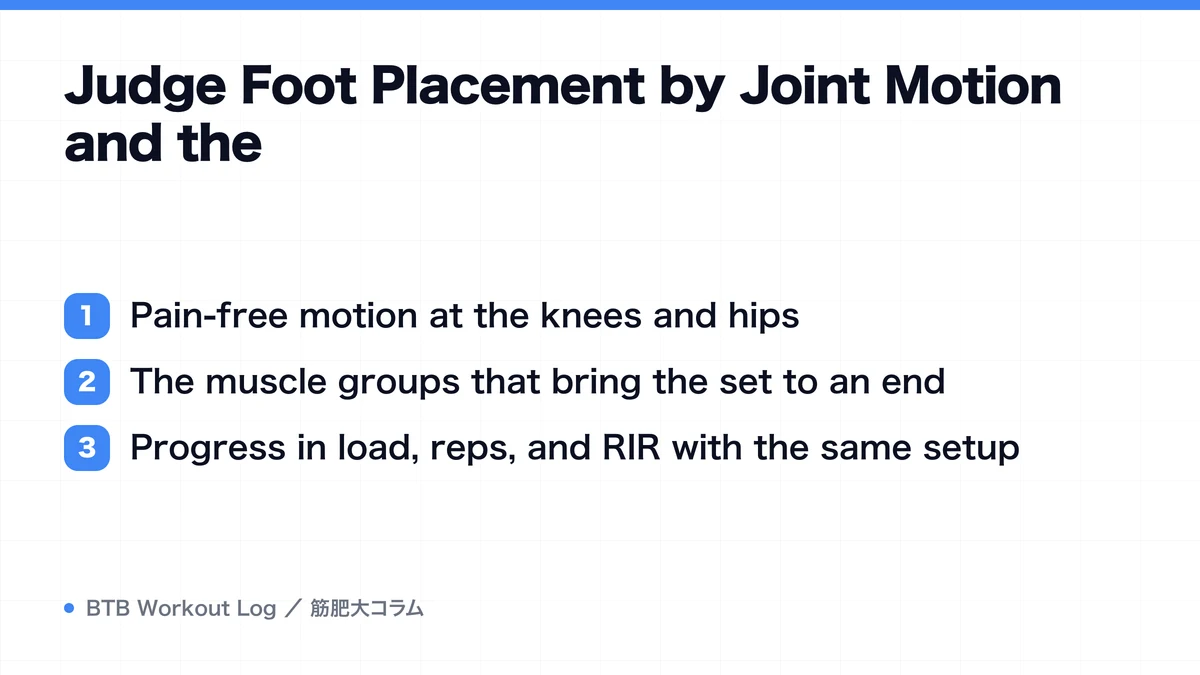
- Pain-free motion at the knees and hips
- The muscle groups that bring the set to an end
- Progress in load, reps, and RIR with the same setup
The broader differences from squatting are covered in Squat vs Leg Press. Here, the focus is strictly on choosing a setup for leg press machines.
Lower Foot Placement Usually Increases Knee Motion; Higher Placement Increases Hip Motion
A lower platform position can emphasize the quads, but ankle mobility matters
Moving your feet lower tends to let your knees travel farther forward and increases knee flexion for the same amount of sled travel. If you can keep your heels down, track your knees over your toes, and keep your pelvis stable, this setup is more likely to make the quads the main limiting factor. It is too low if your heels lift, pressure shifts toward your toes, or you have to cut the depth because your ankles cannot move far enough.
A higher platform position uses more hip motion, but it does not isolate the glutes
Moving your feet higher usually reduces forward knee travel and increases the relative amount of hip flexion and extension. This can increase the contribution from your glutes and adductors, but knee extension does not disappear. If placing your feet too high shortens the movement, or your lower back rounds and your pelvis lifts at the bottom, you have not meaningfully increased the glutes' range of motion.
This is not a switch between quads and glutes. It is a small adjustment to how the work is distributed between them. When you change foot placement, record the sled's travel distance too. Otherwise, you cannot tell whether foot placement or range of motion caused the difference.
Stance Width Can Create More Hip Room, but It Cannot Isolate the Inner or Outer Quads
A narrow stance makes it easier for some lifters to drive their knees forward, while others run out of room at the hips or abdomen and lose depth. A wider stance can make it easier to open the hips and may increase the work done by the glutes and adductors, but the relationship is not linear: wider does not automatically mean more glute involvement.
Start somewhere between hip and shoulder width. Turn your toes slightly outward and track your knees in the same direction. If your knees collapse inward at the bottom, the outer edges of your feet lift, or you feel pinching at the front of your hips, adjust your stance width, toe angle, or depth one at a time. Before offsetting an imbalance by placing your left and right feet differently, check that your pelvis is centered on the seat.
Avoid claims that a narrow stance grows only the vastus lateralis or a wide stance grows only the vastus medialis. The heads of the quadriceps work together to extend the knee, and a brief difference in EMG activity does not guarantee long-term regional hypertrophy. If you want more complete quad development, consider when to add leg extensions as a separate question instead of using an extreme stance width.
EMG, Pumps, and Load Alone Cannot Predict Long-Term Hypertrophy
Some foot-placement studies compare quad and glute activity using EMG. But EMG shows acute activity at the electrode site; it does not directly measure muscle thickness several months later. Small differences in activity, small sample sizes, and testing on only one machine model do not justify prescribing one universal position for every leg press.
A pump can provide useful feedback while you test a setup, but it is not proof of growth. Even if a low foot position gives you a strong quad pump, the comparison breaks down if your range of motion shrinks as you chase more reps. Likewise, loading more plates with a high foot position does not make it superior if the sled travel and joint motion are different.
To assess hypertrophy, keep the same setup for several weeks and see whether load or reps improve through a controlled range of motion. Treat choosing a different range of motion as an intentional programming variable rather than mixing it with the effects of foot placement.
Start from a Baseline, Change One Variable, and Compare Across Three Sessions
Start with your feet centered on the platform, somewhere between hip and shoulder width, with your toes turned slightly outward. Record the backrest and seat positions, and keep three points of contact on the platform: your heel, the ball of your big toe, and the ball of your little toe. Lower the sled until just before your lower back lifts from the pad, keeping your knees tracking toward your toes.
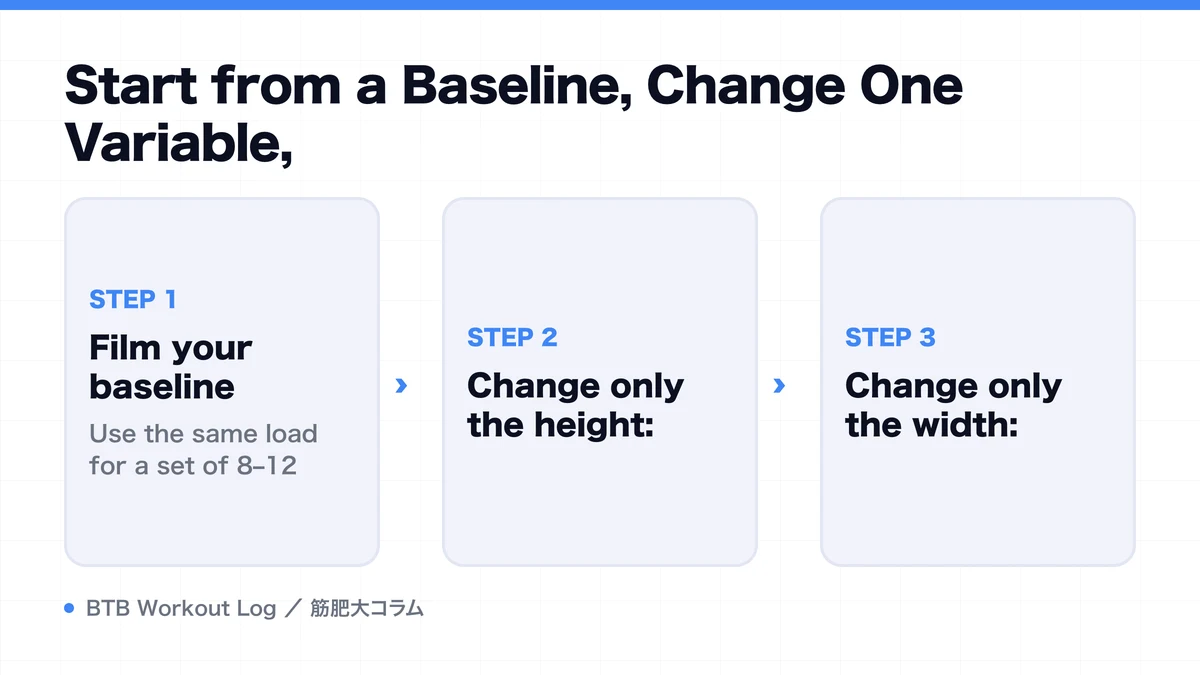
- Film your baseline: Use the same load for a set of 8–12 reps at around RIR 2, then review your depth and limiting factor.
- Change only the height: For more quad emphasis, lower your feet by a few cm rather than a full foot-length, then check whether your heels and pelvis stay in place. For more glute involvement, raise them by a few cm without changing the width.
- Change only the width: Return the height to baseline or hold it constant, then test a stance about one foot-width wider or narrower while comparing hip discomfort and knee tracking.
Drawing conclusions from a single day lets exercise order and fatigue skew the result. Use each option in at least three separate sessions and compare it under the same load, rep range, and RIR conditions. Changing only one of foot height, stance width, and seat position at a time is the fastest way to isolate the effect of foot placement.
Use Different Selection Criteria for Quad and Glute Emphasis
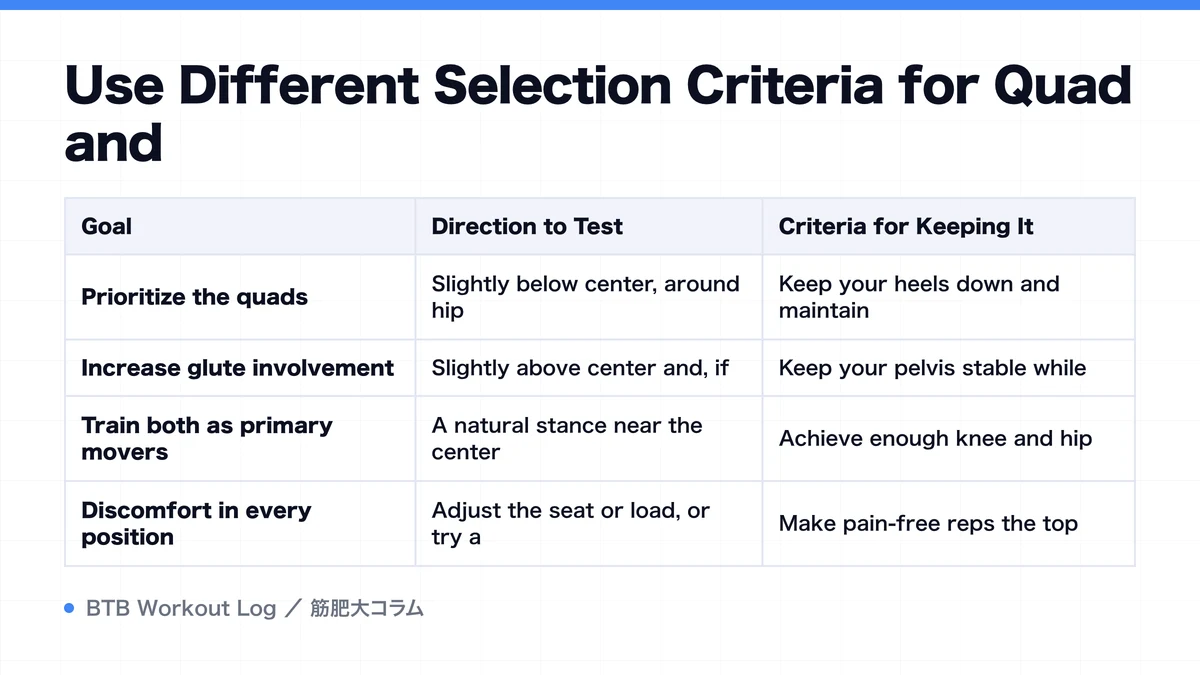
| Goal | Direction to Test | Criteria for Keeping It |
|---|---|---|
| Prioritize the quads | Slightly below center, around hip width | Keep your heels down and maintain depth while the quads fail first |
| Increase glute involvement | Slightly above center and, if needed, a little wider | Keep your pelvis stable while increasing hip range of motion |
| Train both as primary movers | A natural stance near the center | Achieve enough knee and hip motion while making steady progress |
| Discomfort in every position | Adjust the seat or load, or try a different model | Make pain-free reps the top priority |
For quad emphasis, cross-check your setup against the criteria for choosing quad exercises. If the leg press cannot produce a focused stimulus, switch to a hack squat or single-leg exercise. If stronger glute involvement is the goal, pairing the leg press with an exercise that makes hip extension the primary action may be clearer than placing your feet extremely high and losing range of motion.
Once you choose a setup, use a small reference mark for your foot placement and keep the seat setting, depth, load, reps, and RIR consistent as you progress for 4–6 weeks. The right position is one you can reproduce, that makes the target muscle the limiting factor, and that allows recovery before your next session. There is no need to copy the visible coordinates of someone else's feet.
FAQ
- Where should I place my feet on the leg press to target my quads?
- Start slightly below the middle of the platform with a stance around hip width. You should be able to keep your heels down, track your knees toward your toes, and achieve plenty of knee flexion while keeping your pelvis against the pad. What matters more than how low your feet sit is whether your quads become the limiting factor.
- Can I isolate my glutes by placing my feet high?
- No. A high foot position tends to increase hip motion, but knee extension remains, so your quads still work. Do not place your feet so high that your pelvis lifts or the movement becomes shallow. Confirm that the setup actually increases your hip range of motion.
- Does a wide stance target the inner thighs and a narrow stance target the vastus lateralis?
- The distribution of work may change, but you cannot completely isolate a specific region. Use stance width to create enough room at the hips and maintain good knee tracking. Do not infer long-term hypertrophy from acute EMG activity or a pump alone.
Key takeaways
- Work shifts with knee and hip range of motion, not foot placement alone
- Lower placements tend to increase knee motion; higher placements increase hip motion
- Stance width cannot fully isolate the inner and outer quadriceps
- Change one variable at a time from your baseline and compare it for several weeks
References
- Hypertrophic Effects of Single- versus Multi-Joint Exercise: A Direct Comparison Between Knee Extension and Leg Press
- The Influence of Frequency, Intensity, Volume and Mode of Strength Training on Whole Muscle Cross-sectional Area in Humans
- Lengthened Partial Repetitions Elicit Similar Muscular Adaptations as Full Range of Motion Repetitions During Resistance Training in Trained Individuals