Hack Squat vs. Barbell Squat: Which Builds Bigger Thighs?
If your quads are the priority and your trunk or balance tends to give out first, the hack squat is usually the easier choice. But if you can consistently reach deep knee flexion in a barbell squat and your quads are the limiting factor, it can absolutely serve as your main hypertrophy lift.
What matters is not the machines-versus-free-weights label. Compare how hard your quads work, how much recoverable fatigue the lift creates, whether you can progress under consistent conditions, and how well it fits your body.
Set the Criteria for Quad Hypertrophy Before Comparing the Lifts
Here, “hack squat” means the common setup on machines where your back and pelvis are supported by pads as you drive an angled sled. “Barbell squat” means a squat performed with the bar on your back. The movement changes with the machine model, bar position, and stance, so comparing names alone only tells you so much.
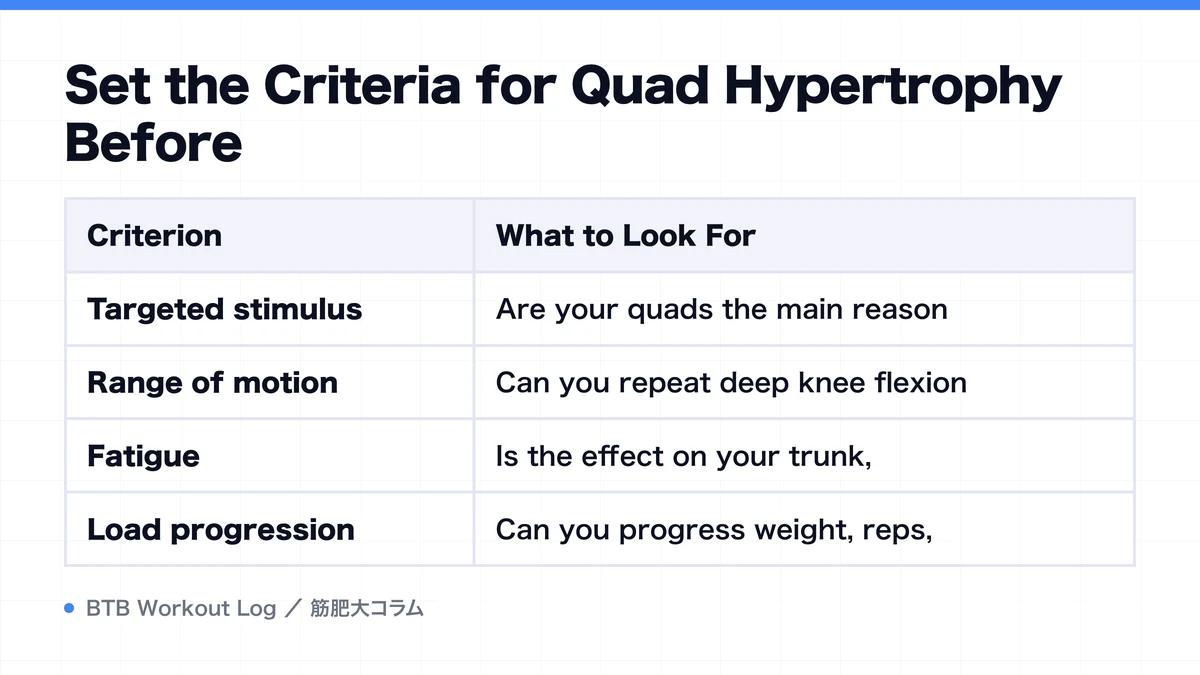
| Criterion | What to Look For |
|---|---|
| Targeted stimulus | Are your quads the main reason the set ends? |
| Range of motion | Can you repeat deep knee flexion with consistent form? |
| Fatigue | Is the effect on your trunk, breathing, and other exercises worth it? |
| Load progression | Can you progress weight, reps, and RIR in small increments? |
| Time | Include setup, warm-ups, and waiting for equipment |
| Individual fit | Does it suit your build, ankles, shoulders, and available equipment? |
Our squat vs leg press comparison covers free weights and pressing machines more broadly. Here, the focus is narrower: when quad development is the goal, which set of constraints should you choose within the squat movement pattern?
Quad Stimulus Depends on Knee Flexion and What Limits the Set
Hack squats let the machine handle more of the stability
Because your back stays against the pad throughout each rep, you can direct more effort into bending and extending the knees instead of managing balance or holding the bar. Many lifters can achieve deep knee flexion by placing their feet near the middle of the platform and allowing the knees to travel in line with the toes. Judge the targeted stimulus by whether knee extension eventually fails, not by how intense the quad burn feels.
The conditions change if you place your feet high, reverse only through a shallow depth, or descend until your lower back lifts away from the pad. A fixed path may also clash with some lifters’ natural hip or knee mechanics. A machine supporting your body does not automatically mean it fits your body.
Barbell squats offer freedom but demand more skill
You can adjust stance width, toe angle, bar position, and torso angle to suit your build. A high-bar squat with slightly elevated heels can be a strong option if you can keep your feet planted, achieve enough knee flexion, and bring your quads close to failure first. If you have long femurs or limited ankle mobility, however, you may lean farther forward and find that your glutes, adductors, spinal erectors, or breathing end the set first.
Deeper is not automatically better. First, choose a tolerable depth and reach the same bottom position on every rep. If you compare a shallow version of one lift with a deeper version of the other, you are comparing range of motion rather than equipment.
Choose Between More Systemic Fatigue and More Focused Quad Work
Barbell squats demand coordination from your trunk, upper back, and breathing as well as your legs. That broad demand is useful if you want one exercise to train your entire lower body and improve your squat skill. But you may not need to pay that cost every time you simply want more quad volume. The concentration, rack setup, and warm-ups involved can also affect later hinge movements or back training.
Hack squats reduce the postural demands, making them an easy way to add 2–4 quad sets after your main lift. However, heavy sets taken close to RIR 0 still create substantial local fatigue and may not feel easy the next day. Any setup advantage also disappears on machines that require loading and unloading many plates or in a crowded gym.
Do not declare the harder-feeling lift the winner. Look at whether you can restore the same performance for later exercises and your next leg day. If barbell squats leave persistent lower-back fatigue, shift more work to hack squats. If discomfort around the knees or declining reps continue after hack squats, reassess the load, depth, and weekly volume. Stop comparing exercises and consult a qualified professional if sharp pain persists.
Track Progress Within Each Lift Instead of Comparing Displayed Weight
A 100kg barbell squat and a 100kg hack squat do not provide the same resistance. Hack squat sled angle, starting weight, friction, and leverage all vary by model. Compare them by keeping foot position, depth, and tempo consistent within each lift, then tracking weight, reps, and RIR separately.
You might choose a practical range of 5–10 reps for barbell squats and 6–15 reps for hack squats, but these are not hard boundaries. Hypertrophy can occur across a wide range of loads when effort is sufficient, so the lift that lets you move more weight is not automatically better. Keep most sets around RIR 1–3 and add the smallest available increment only after reaching the top of your rep range.
Squats have a sticking region where rep speed often drops after you reverse out of the bottom. Slowing down there does not automatically mean your form has failed, but a rep completed by cutting knee depth should not count as equivalent progress. If you change your range of motion strategy, review how to use partial reps and evaluate it as a separate condition.
Choose Your Main Lift, Accessory, and Training Day Based on Your Goal
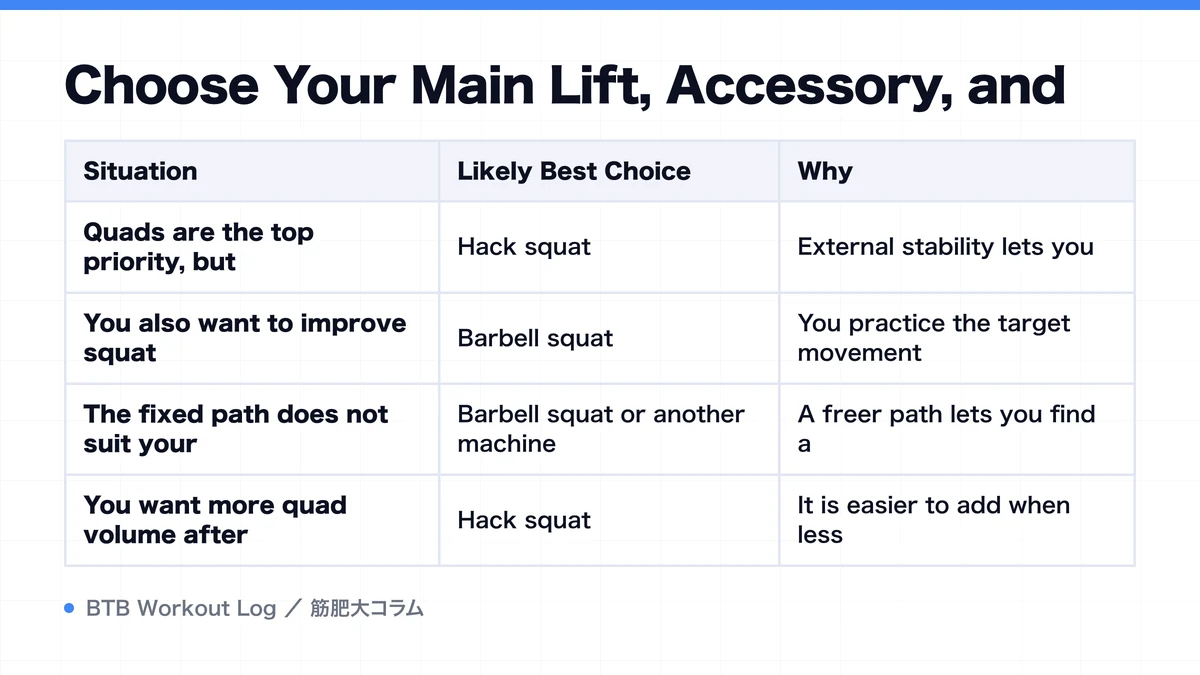
| Situation | Likely Best Choice | Why |
|---|---|---|
| Quads are the top priority, but your trunk fails first | Hack squat | External stability lets you direct more effort into the target muscles |
| You also want to improve squat skill and your entire lower body | Barbell squat | You practice the target movement while training multiple muscle groups |
| The fixed path does not suit your body | Barbell squat or another machine | A freer path lets you find a movement pattern that fits |
| You want more quad volume after your main lift | Hack squat | It is easier to add when less postural control is required |
| Your quads limit both lifts | Use both during the week | You can progress under different constraints |
One way to combine them is 3 sets of barbell squats on Day A and 4 sets of hack squats on Day B. If you perform both on the same day, do 2–4 sets of the lift you most want to improve first, then use the other for 2–3 accessory sets, replacing part of your existing volume. If you simply add both and sharply increase weekly volume, you will be measuring the effect of more volume rather than the difference between exercises.
If neither movement suits your build, you can choose a leg press or single-leg movement from our 5 quad exercises. If squat skill is not one of your goals and you can make consistent quad progress with hack squats, you have no obligation to return to free weights. Likewise, if barbell squats are producing the results you want, there is no reason to switch to machines.
FAQ
- Is the Hack Squat Better If I Only Care About My Quads?
- It is often the easier choice if your trunk or balance fails first, but it is not better for everyone. If you can consistently achieve deep knee flexion with a barbell, your quads are the limiting factor, and recovery is good, the barbell squat can work perfectly well as your main lift.
- Can I Do Hack Squats and Barbell Squats on the Same Day?
- Yes, but you do not need to perform full main-lift volume for both. Start with 2–4 sets of your priority exercise, then use the other for 2–3 accessory sets. Replace existing work instead of suddenly increasing weekly sets, and monitor your response.
- Where Should I Place My Feet on the Hack Squat?
- Start near the middle of the platform, then find a position where your heels stay down, your knees travel in line with your toes, and your lower back stays against the pad. Do not judge the position by whether it looks too high or too low. The standard is whether you can repeat the same pain-free depth.
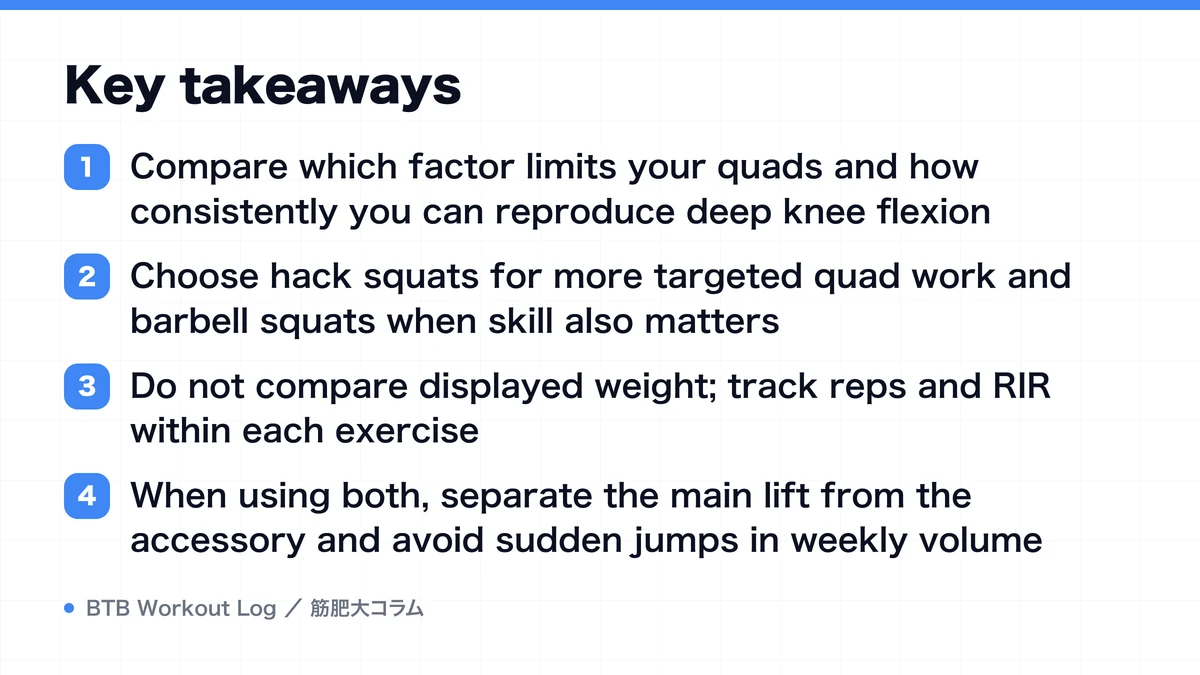
Key takeaways
- Compare which factor limits your quads and how consistently you can reproduce deep knee flexion
- Choose hack squats for more targeted quad work and barbell squats when skill also matters
- Do not compare displayed weight; track reps and RIR within each exercise
- When using both, separate the main lift from the accessory and avoid sudden jumps in weekly volume