Squat or Hip Thrust for Bigger Glutes? | Comparing Their Effect on the Glute Max
Both squats and hip thrusts can build your gluteus maximus. A direct comparison found no clear difference in hypertrophy over nine weeks, so choose based on your goal: hip thrusts to focus the work on your glutes, or squats to train your legs as a whole at the same time.
Muscle activity during a single session or the kg lifted won't tell you which exercise is better. We'll compare five factors: long-term changes in the gluteus maximus, how the work is distributed across other muscle groups, whole-body fatigue, setup, and the movement you want to improve. To explore options beyond these 2 exercises, see 5 exercises to build your gluteus maximus, organized by their role in your training.
Both Train the Gluteus Maximus, but the Loaded Joint Angles and Muscles Involved Differ
In a squat, you bend your knees and hips before standing back up, with the quadriceps and adductors sharing a substantial amount of work alongside the gluteus maximus. At the bottom, the hips are flexed and the glutes produce force from a lengthened position. In a hip thrust, you place your back against a bench and extend your hips with your knees bent, making it easier to maintain external load near the top.
That difference alone is not enough to conclude that squats are better because they stretch the glutes, or that hip thrusts are better because they create a stronger contraction. The load-curve rationale can help you combine exercises, but long-term measurements are needed to determine hypertrophy outcomes. See full range of motion versus partials for the broader principles of range of motion; here, we will focus specifically on the gluteus maximus.
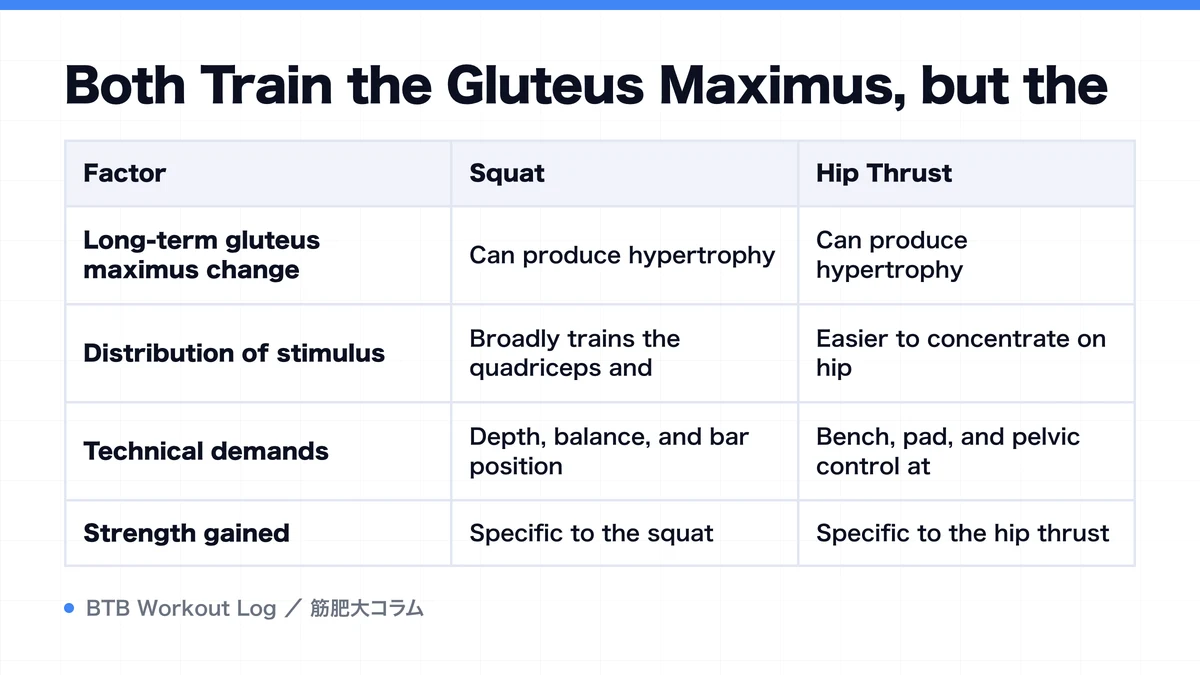
| Factor | Squat | Hip Thrust |
|---|---|---|
| Long-term gluteus maximus change | Can produce hypertrophy | Can produce hypertrophy |
| Distribution of stimulus | Broadly trains the quadriceps and adductors too | Easier to concentrate on hip extension |
| Technical demands | Depth, balance, and bar position | Bench, pad, and pelvic control at the top |
| Strength gained | Specific to the squat | Specific to the hip thrust |
In a Direct Comparison of Beginners, Both Exercises Produced Similar Glute Growth
One study divided 34 men and women aged 18–30 with little training experience into a back-squat group and a barbell-hip-thrust group. For 9 weeks, participants performed only their assigned exercise twice per week, using the same number of sets. MRI measurements showed similar changes in the cross-sectional area of the upper, middle, and lower gluteus maximus in both groups.
In the same study, the squat group gained more muscle in the quadriceps and adductors, while 3RM strength improved more in the exercise each group practiced. So even when glute growth is similar, the overall adaptations are not. Squats become more valuable if you also want better squat technique and greater thigh development. Hip thrusts become more useful when you want to dedicate an exercise slot to the gluteus maximus.
Surface EMG was higher during hip thrusts in the first session, yet gluteus maximus hypertrophy was similar after 9 weeks. This is a good example of why acute muscle activation alone cannot rank exercises for future hypertrophy. However, the participants were beginners and the study lasted only 9 weeks, so the findings cannot automatically be generalized to long-term outcomes in experienced lifters.
The Cost of Adding Glute Sets Differs Between Squats and Hip Thrusts
Squats train more muscle at once, but come with more potential constraints
Squats are time-efficient for training the entire lower body, but breathing, trunk strength, upper-back strength, or balance may end the set before the glutes do. If you use squats for every additional glute set, your quadriceps or systemic recovery may reach its limit first. We compare the two lifts from a quadriceps-focused perspective in squats versus leg presses; avoid counting the same sets twice toward separate goals.
Hip thrusts are easier to localize, but setup is not always quick
Hip thrusts limit the demands of knee extension and make it easier to focus on hip extension by the gluteus maximus. However, you must consistently reproduce the bench height, bar pad, plates, and foot position, and setup can take longer in a crowded gym. If you arch your lower back and lift only your ribs at the top, the weight may increase even though the hip-extension mechanics have changed. Keep your chin slightly tucked, posteriorly tilt your pelvis at the top, and adjust from a foot position that leaves your shins nearly vertical.
Do not compare fatigue by asking which exercise feels worse the next day. Judge it by the effect on later exercises and your next session. Someone whose whole-leg performance drops after squats may reach the opposite conclusion about recovery cost from someone whose local fatigue lingers after hip thrusts.
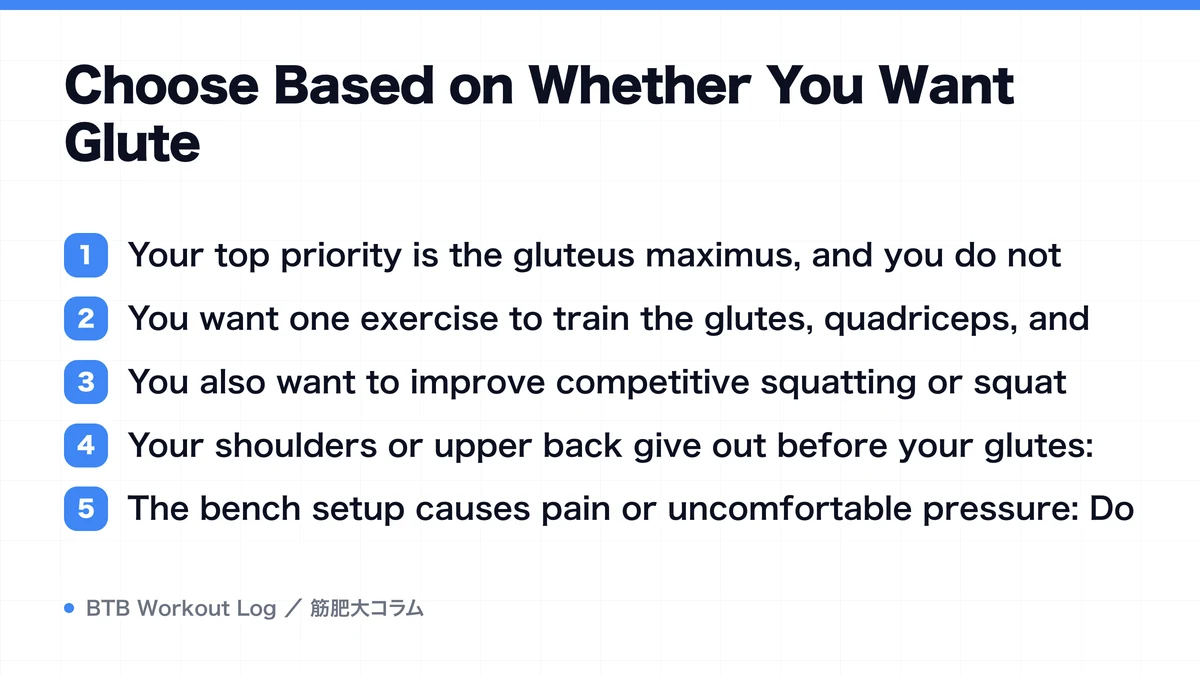
Choose Based on Whether You Want Glute Growth, Whole-Leg Growth, or Better Skill in a Specific Lift
- Your top priority is the gluteus maximus, and you do not want more quadriceps volume: Hip thrusts are easy to fit in.
- You want one exercise to train the glutes, quadriceps, and adductors: Squats are the natural choice.
- You also want to improve competitive squatting or squat technique: Keep the squat, because it is the movement you need to practice.
- Your shoulders or upper back give out before your glutes: Switch to hip thrusts or another supported glute exercise.
- The bench setup causes pain or uncomfortable pressure: Do not force hip thrusts; choose a squat variation that fits your body.
If you use both, give them distinct roles: squats as your main whole-leg exercise and hip thrusts as extra work for the gluteus maximus. If you train twice per week, you can place them on separate days. Do not add 4 sets of each from the outset. Replace some of your existing glute-focused sets first, then see whether you can recover.
Conversely, because the direct comparison found similar glute growth, combining both exercises is not mandatory. You can choose one based on equipment, time, and how well it suits your body, then progress it for several months. Consider the limitations of using one squat variation for the entire leg separately in testing whether squats alone can train the whole leg.
Track Range of Motion and Reps Within Each Exercise, Not kg Across Exercises
Run the comparison for about 6–10 weeks, keeping each exercise in the same position in your workout. For squats, standardize the bar position, stance, depth, and shoes. For hip thrusts, record the bench height, foot position, pad, and pelvic position at the top. Within a range such as 8–12 reps, add a small amount of weight once your total reps increase while you maintain the target RIR.
Comparing a 150kg hip thrust with a 100kg squat does not tell you which places a greater demand on the gluteus maximus. Their mechanics and distances traveled are different. Judge progressive overload as a trend within the same exercise while keeping your form and range of motion consistent.
If you only care about glute growth, glute circumference and photos taken under consistent conditions can provide supporting data, though both include measurement error. Look for weight or rep progress, the glutes remaining the main limiting factor in each set, and no increase in pain or recovery problems. Even if the average research result is equal, one option may still let you progress more consistently.
FAQ
- Should I Do Both Squats and Hip Thrusts?
- Not necessarily. A direct comparison found similar gluteus maximus hypertrophy in beginners. Combine them if you want squats to train the whole leg and hip thrusts to emphasize the glutes, but start by replacing existing sets rather than increasing your total set count.
- If Hip Thrusts Produce Higher EMG, Are They Better for Glute Hypertrophy?
- EMG from a single session does not directly predict long-term hypertrophy. In a 9-week comparison, hip thrusts produced greater acute muscle activation, but changes in gluteus maximus cross-sectional area were similar to squats. Choose exercises based on long-term outcomes and practicality.
- How Deep Should I Squat to Target My Glutes?
- Squat as deep as you can while achieving substantial hip flexion and maintaining foot pressure, knee tracking, and trunk control. If greater depth causes your pelvic position to break down significantly, stop slightly higher. There is no single correct depth for everyone; prioritize a range you can repeat consistently.
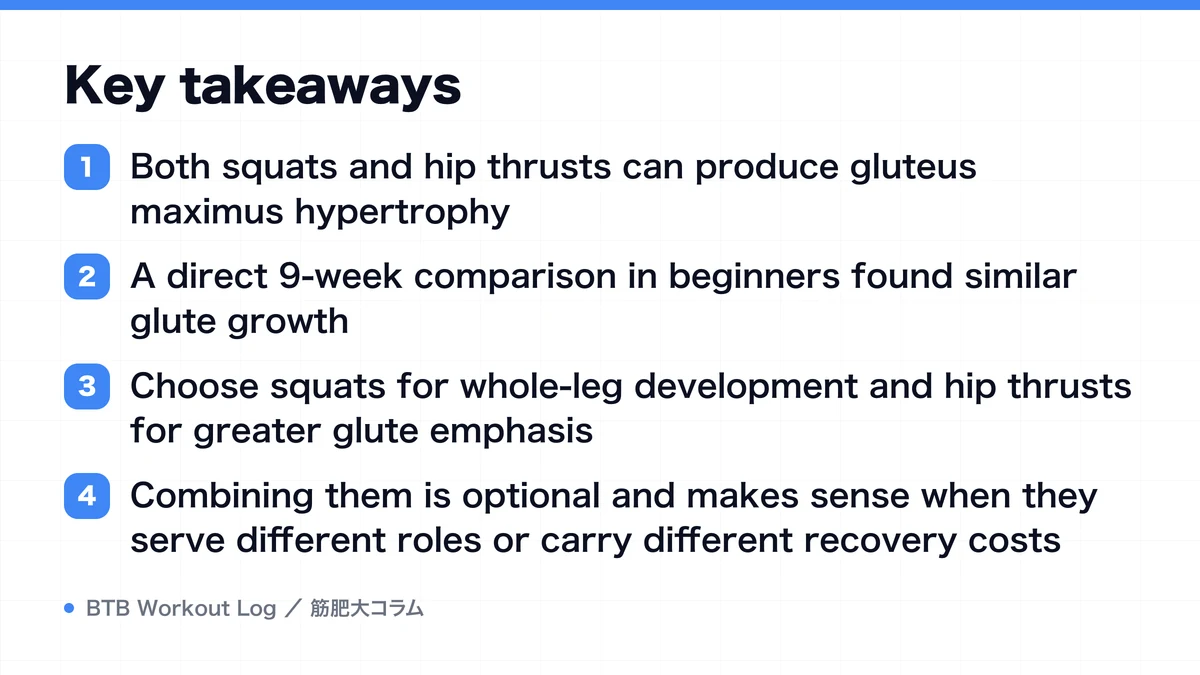
Key takeaways
- Both squats and hip thrusts can produce gluteus maximus hypertrophy
- A direct 9-week comparison in beginners found similar glute growth
- Choose squats for whole-leg development and hip thrusts for greater glute emphasis
- Combining them is optional and makes sense when they serve different roles or carry different recovery costs