5 Best Hamstring Exercises | Why You Need RDLs and Leg Curls
If you want bigger hamstrings, do not rely on Romanian deadlifts (RDLs) or leg curls alone. Choose at least one hip extension exercise and one knee flexion exercise to cover muscles with different functions.
Do not choose exercises based on popularity. Look for movements that load the hamstrings at long muscle lengths, let you repeat the target action consistently, and allow you to add weight or reps over several months.
Choose These 5 Exercises Based on Joint Action, Muscle Length, Stability, and Progression
Most of the hamstrings cross both the hip and knee, contributing to hip extension and knee flexion. The short head of the biceps femoris crosses only the knee, so a hinge alone does not load it the same way as the other hamstrings. That is the starting point for combining RDLs with leg curls. For gaps in overall leg development, see what happens when you train legs with squats alone. Here, we will focus specifically on choosing hamstring exercises.
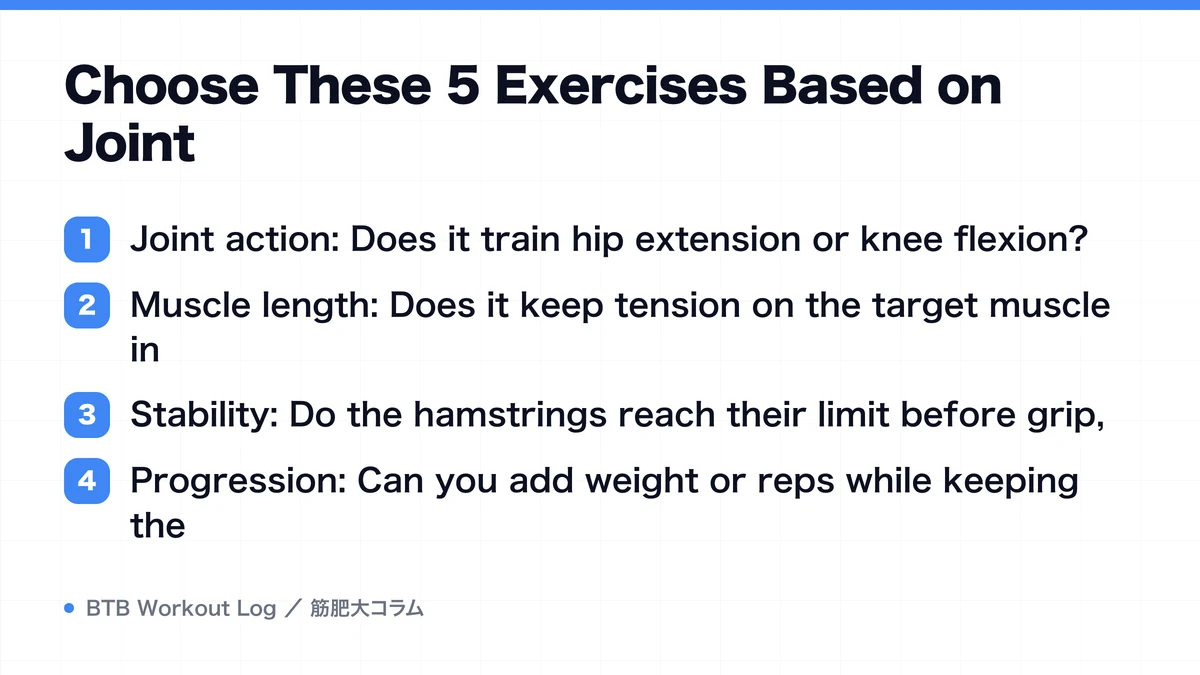
Use four questions to evaluate each option.
- Joint action: Does it train hip extension or knee flexion?
- Muscle length: Does it keep tension on the target muscle in a lengthened position?
- Stability: Do the hamstrings reach their limit before grip, lower-back fatigue, or balance does?
- Progression: Can you add weight or reps while keeping the same range of motion and form?
A strong stretch alone is not enough. The principles in how lengthened-position loading works provide the foundation, but going deeper changes the comparison if your pelvis loses position or you use more momentum. First, establish a repeatable range in which the target muscle stays under tension.
RDLs and 45-Degree Back Extensions Train Hip Extension Under Different Constraints
1. Romanian Deadlift
The RDL is a primary option for loading the hamstrings as they lengthen. Keep a slight bend in your knees and push your hips back. Hold the bar close to your legs, keep your shins nearly vertical, and hinge forward from the hips. The bottom is not the floor; it is the lowest position where you can control hamstring tension without losing your back position. RDLs allow heavy loading, but they become less set-efficient if grip or lower-back fatigue gives out first. See how to fix an RDL you cannot feel in your hamstrings for a detailed form breakdown.
2. 45-Degree Back Extension
Place your upper thighs against the pad and flex and extend at the hips instead of lifting by arching your back. The machine provides more external support than an RDL and simplifies both weight handling and full-body setup, making it useful for additional hinge work. To target the hamstrings, keep your knee angle relatively constant, push your hips back as you lower, and stop at the top when your torso and legs form a straight line. Repeatedly hyperextending your lower back does not increase the work done by hip extension.
Rather than doing high volumes of both exercises, choose your primary movement based on lower-back fatigue and how easily you can track progress. If you perform heavy RDLs early in the week, use moderate-rep back extensions later in the week to reduce unnecessary overlap.
Use 3 Leg Curl Variations Based on Muscle Length, Stability, and Resistance Curve
3. Seated Leg Curl
With the hips flexed in a seated position, the hamstrings that cross the hip begin knee flexion from a longer muscle length. The pads make it easier to secure the pelvis and thighs so you can focus on flexing the knees. In a study comparing seated and lying leg curls, young men trained each leg under a different condition for 12 weeks. The seated condition, which trained the hamstrings at longer muscle lengths, produced greater hamstring hypertrophy. One study, however, cannot establish that every machine and population will produce the same difference.
4. Lying Leg Curl
The prone position makes the torso easy to stabilize and provides a knee flexion option in gyms where the seated machine does not fit you well. Set the pad just above the Achilles tendon, curl until just before your pelvis lifts off the bench, and control the return. It tends to train the hamstrings at shorter muscle lengths than the seated version, but it remains effective if you can reproduce clean reps and progress them over time. See seated versus lying leg curls for a detailed comparison.
5. Nordic Hamstring Curl
This is a bodyweight exercise in which you secure your ankles and lower your body forward around the knees. It creates very high force while the hamstrings lengthen, and many people cannot control the descent with bodyweight alone. If needed, reduce the difficulty with band assistance or by lowering onto a raised platform. Do not compete to make every descent last 3–6 seconds; instead, add reps through the same range. Severe soreness is not the goal, so begin with a low volume.
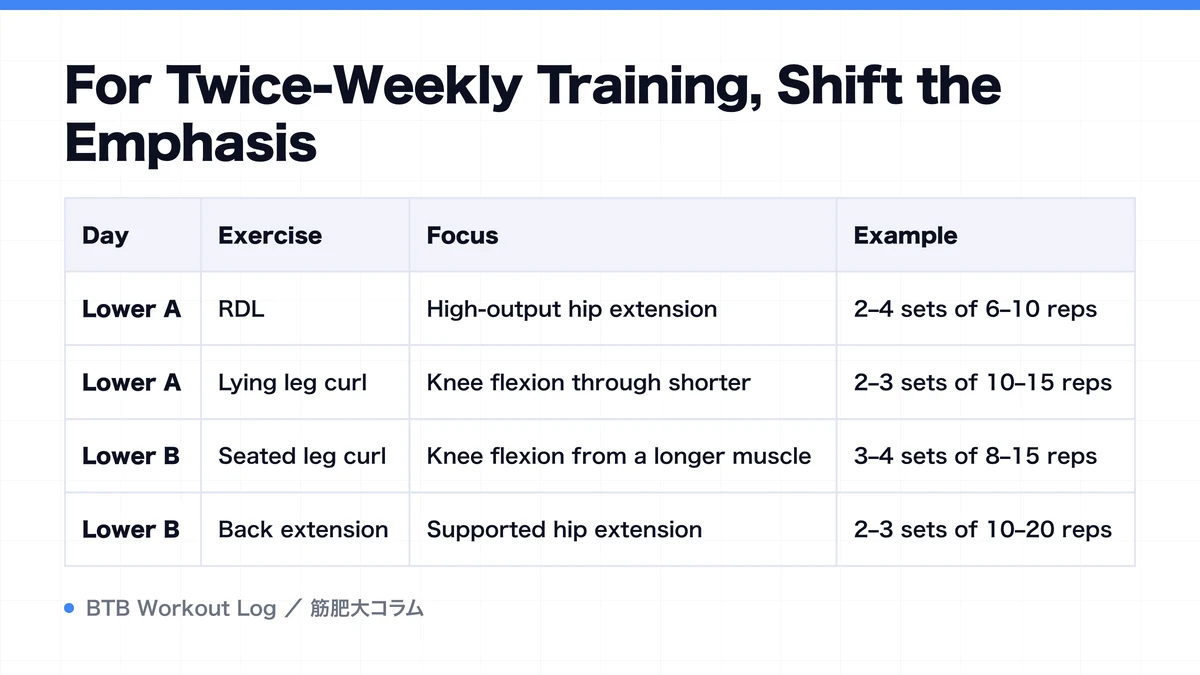
For Twice-Weekly Training, Shift the Emphasis Between Hinges and Curls
You do not need to fit all five exercises into one week. Start with one hip extension exercise and one knee flexion exercise, then add a third only when needed.
| Day | Exercise | Focus | Example |
|---|---|---|---|
| Lower A | RDL | High-output hip extension | 2–4 sets of 6–10 reps |
| Lower A | Lying leg curl | Knee flexion through shorter muscle lengths | 2–3 sets of 10–15 reps |
| Lower B | Seated leg curl | Knee flexion from a longer muscle length | 3–4 sets of 8–15 reps |
| Lower B | Back extension | Supported hip extension | 2–3 sets of 10–20 reps |
These rep ranges are guidelines. Keep most work sets at 1–3 RIR (reps you could still complete before failure), with more reps in reserve for beginners and when introducing Nordic curls. There is no single correct number of weekly sets. Adjust for the hamstring workload already coming from squats, deadlifts, and glute exercises. See how to plan weekly hard sets for general volume guidance, and start with an amount you can recover from.
If you perform both on the same day, putting the more technical, high-output RDL first is usually sensible. During a phase that prioritizes knee flexion, however, you can start with seated leg curls. If you change the exercise order, do not force yourself to maintain the same weights. Establish new baselines for the new order.
Keep Exercises Based on Repeatable Progress and Recovery, Not How Hard They Feel
Once you choose an exercise, keep the movement, order, and range of motion consistent for 4–8 weeks. For RDLs, track load, reps, and RIR along with bottom position and knee angle. For curls, keep the machine, seat setting, and pad position consistent. More reps do not represent progress on the same task if your knees bend deeper during RDLs or your pelvis lifts during curls. Progressive overload is comparable only when form standards remain consistent.
Judge an exercise by three factors: whether the target muscle limited the set, whether your performance recovered by the next session, and whether reps improved under the same conditions. Adjust the number of sets or exercise balance if severe soreness persists, lower-back fatigue causes other lower-body lifts to plateau, or knee flexion performance alone stops improving for an extended period.
RDLs and leg curls do not compete; they fill each other's gaps. If using both creates more volume than you can recover from, reduce the sets for each exercise instead of dropping the combination. Keep both hip extension and knee flexion in the week while trimming the plan to the smallest setup you can progress.
FAQ
- Can I Do RDLs and Leg Curls on the Same Day?
- Yes. Usually, perform the RDL first because it demands more full-body technique and output, then do leg curls later in the session. Avoid adding too many total sets, and monitor lower-back fatigue and recovery before your next workout. You can reverse the order during phases that prioritize knee flexion.
- Are Deadlifts Alone Enough for the Hamstrings?
- Conventional deadlifts and RDLs train hip extension hard, but they do not load knee flexion the same way leg curls do. If you want to cover knee flexion, including the role of the short head of the biceps femoris, keep at least a small amount of curl work in your program.
- What Rep Range Is Best for Leg Curl Hypertrophy?
- Start within a range of roughly 8–20 reps and choose a load that lets you approach failure without losing pelvic or pad position. Adjust the load if it is so light that discomfort or breathlessness limits high-rep sets first, or so heavy that your range of motion shortens.
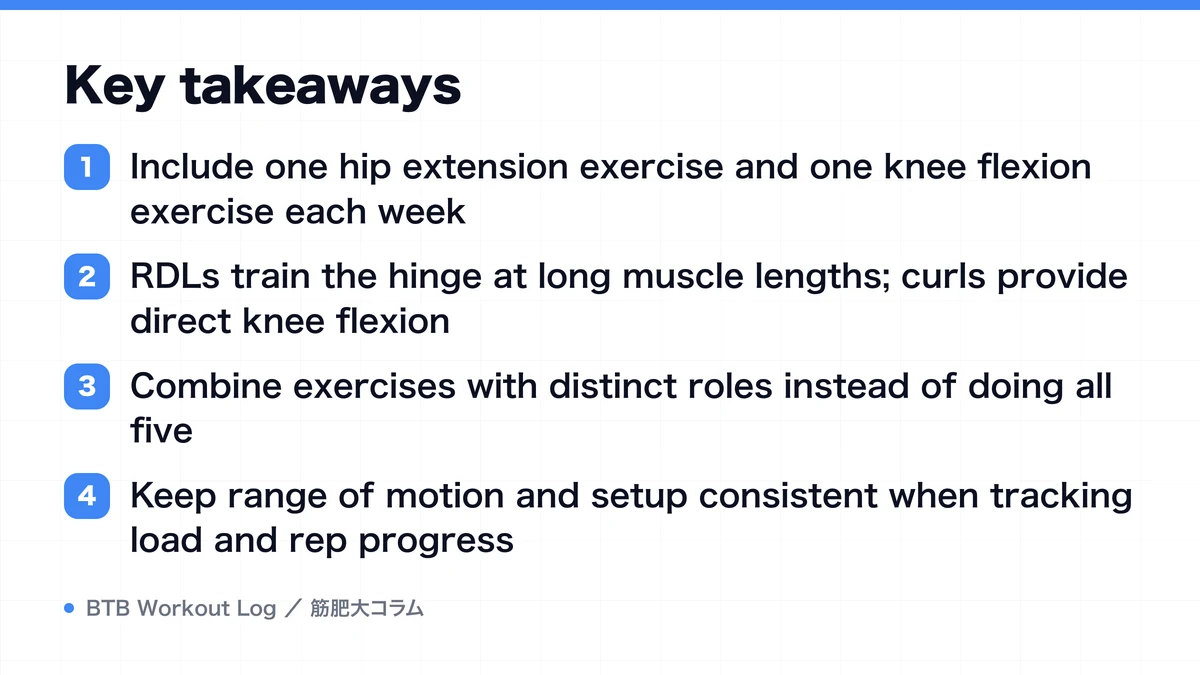
Key takeaways
- Include one hip extension exercise and one knee flexion exercise each week
- RDLs train the hinge at long muscle lengths; curls provide direct knee flexion
- Combine exercises with distinct roles instead of doing all five
- Keep range of motion and setup consistent when tracking load and rep progress