Do You Need Leg Extension? | Parts of the Quad That Grow Poorly From Squats Alone
Leg extensions are not essential for quad development. But they are valuable if squat variations do not give your quads—including the rectus femoris—enough knee-extension work, or if you want more targeted sets without adding trunk fatigue.
The real question is not whether machines work. It is whether your quads are the limiting factor in your current exercises and whether you can give all four heads of the knee extensors enough volume within your recovery capacity.
Do Not Ask Whether They Are Essential—Ask Whether They Fill a Gap in Your Squats
Squats, hack squats, and leg presses all extend the knee, so each can build the quads. The claim that your legs cannot grow without leg extensions is therefore too strong. But you also cannot assume that compound exercises distribute the same stimulus across every region of the quads.
Three questions matter. First, are your quads ending the set on compound exercises? Second, even with repeated deep knee flexion, is fatigue in your trunk or glutes limiting your weekly volume? Third, when you add an exercise that isolates knee extension, can you increase reps or load without disrupting recovery?
When squats alone are enough to train your entire legs also covers the hamstrings and lower legs. Here, the focus is narrower: the roles of the individual quad muscles and the specific value of adding leg extensions.
The Rectus Femoris Crosses Both the Hip and Knee
The vastus lateralis, vastus medialis, and vastus intermedius cross the knee and extend it. The rectus femoris also crosses the hip, making it a biarticular muscle. When you rise from a squat, the knee and hip extend together. Knee extension shortens the rectus femoris at one end, while hip extension changes its length in the opposite direction at the other. Its loading conditions are therefore not identical to those of the three vasti.
Seated leg extensions minimize large movements at the hip and repeatedly isolate knee flexion and extension. This gives the quads, including the rectus femoris, work through a different joint action than squats. That does not mean the exercise completely isolates the rectus femoris. All four quad muscles work together to extend the knee.
Avoid prescriptions claiming that turning your toes inward grows only the outer quad or turning them outward grows only the inner quad. Regional differences in muscle activity may exist, but EMG measures electrical activity at a specific moment; it does not directly prove long-term hypertrophy. Position your feet so your knees can flex and extend naturally, making your setup easier to reproduce.
A Bigger Squat Does Not Guarantee Equal Growth Across All Four Quad Muscles
Compound exercises involve several muscle groups and joints at once. A heavier barbell squat may reflect better technique, greater trunk stability, or stronger glutes and adductors. The number alone cannot tell you whether the rectus femoris grew at the same rate. Likewise, adding weight to your leg extensions cannot represent development across your entire legs.
Exercise-selection research produces different results depending on the measurement site, participants, training history, and range of motion. A difference measured at one location in the quads should not be generalized to all four heads. An exercise that creates a bigger acute pump or higher EMG activity also cannot automatically be called superior for long-term hypertrophy.
The practical takeaway is limited but useful: squat variations are a strong foundation for overall quad development, while isolation knee-extension exercises serve a different role. Even among the 5 quad exercises, leg extensions are a complementary option, not an exercise everyone should prioritize equally.
Four Signs That Leg Extensions Are Worth Adding
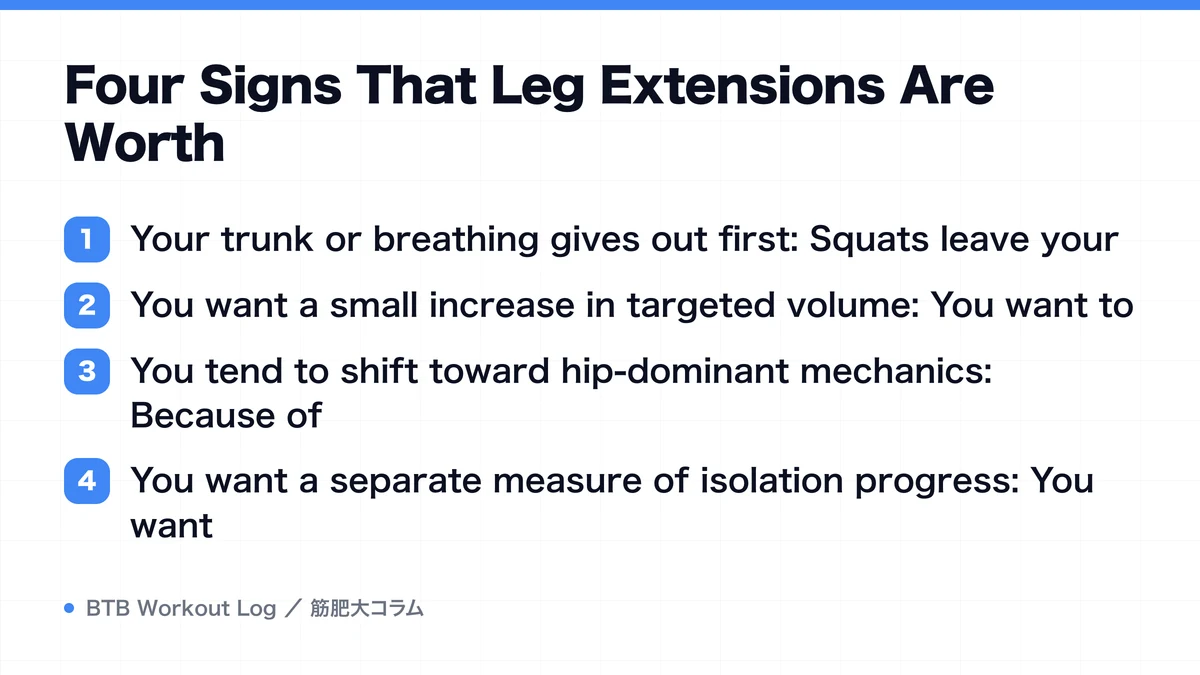
- Your trunk or breathing gives out first: Squats leave your quads with reps in reserve, but adding more compound work creates too much systemic fatigue.
- You want a small increase in targeted volume: You want to keep your main lifts while adding 2–4 weekly sets for the quads.
- You tend to shift toward hip-dominant mechanics: Because of your build or technique, your glutes or adductors approach their limit first on every squat set.
- You want a separate measure of isolation progress: You want to track reps and RIR on knee extension alone, giving you a metric distinct from your compound lifts.
Do not simply add leg extensions on top of your current quad volume. Start by replacing 2 compound sets with 2 leg-extension sets. If performance and recovery remain stable on both exercises for about four weeks, you can then consider bulking up the weekly volume. As with setting your training volume, adjust weekly sets according to your own response, not an average.
Leg extensions are a lower priority if your quads already give out first on squat variations, your key lifts are progressing, and more weekly volume worsens recovery. If the machines do not fit your body, cause pain around your knees, or are too busy for consistent use, there is no reason to treat leg extensions as essential.
Keep the Pad, Pivot, and Rep Range Consistent as You Progress
Set the seat so your back and pelvis stay firmly supported. Align your knee joint as closely as possible with the machines' pivot, and place the pad just above your ankle. Adjust the setup if the backs of your knees press hard against the seat edge, your lower back lifts, or the pad slides onto the top of your foot.
Aim for 10–20 reps. Do not kick the weight up with momentum; extend your knees as far as comfortably allowed and control the lowering phase. Use a bottom position that prevents the plates from fully settling and giving you a rest, and do not use momentum to slam your joints at the top. Once every set reaches the top of the rep range at RIR 1–3, move the pin up one increment. If adding weight shortens your range of motion, you have not progressed under the same conditions.
It is too simplistic to claim that every knee-extension exercise is dangerous or that lockout should always be avoided. Pain-free movement is still the baseline. If sharp pain or swelling continues after adjusting the setup, stop and consult a medical or exercise professional.
Use a Four-Week Substitution Test to Decide Whether You Need Them
Keep your weekly quad volume unchanged and replace 2 sets of squat variations with 2 sets of leg extensions. During the test, record load, reps, and RIR on your compound lifts; the same metrics on leg extensions; how your knees respond; and your recovery before the next leg session.
If your leg extensions progress, your main lifts maintain their performance, and you can complete the targeted quad volume, there is a reason to keep them. If only the machines plateau, your main lifts regress, or discomfort increases, the volume or exercise is not a good fit. Judge the exercise by rep quality across multiple sessions, not by one bout of soreness or an intense pump.
If squat variations are already developing your quads steadily and you have no weak point or spare recovery capacity, you do not need leg extensions. They become a useful addition only when you need a separate stimulus for knee extension, including the rectus femoris, and can recover from it.
FAQ
- Can Your Quads Grow Without Leg Extensions?
- Yes. If squats, hack squats, and similar exercises use enough knee flexion, your quads limit the sets, and you can keep progressing them, your quads can grow. Isolation exercises are not essential; they are an option for filling a missing role or adding needed volume.
- Do Leg Extensions Work Only the Rectus Femoris?
- No. Leg extensions do not isolate the rectus femoris; all four quad muscles contribute to knee extension. However, because they minimize large hip movements, they load the rectus femoris differently than squats, where the hip and knee move together.
- How Many Weekly Sets of Leg Extensions Should You Add?
- Start by replacing 2 existing compound sets and test 2–4 weekly sets. For about four weeks, monitor load, reps, RIR, performance on your main lifts, and how your knees respond. Add more only if your recovery remains adequate.
Key takeaways
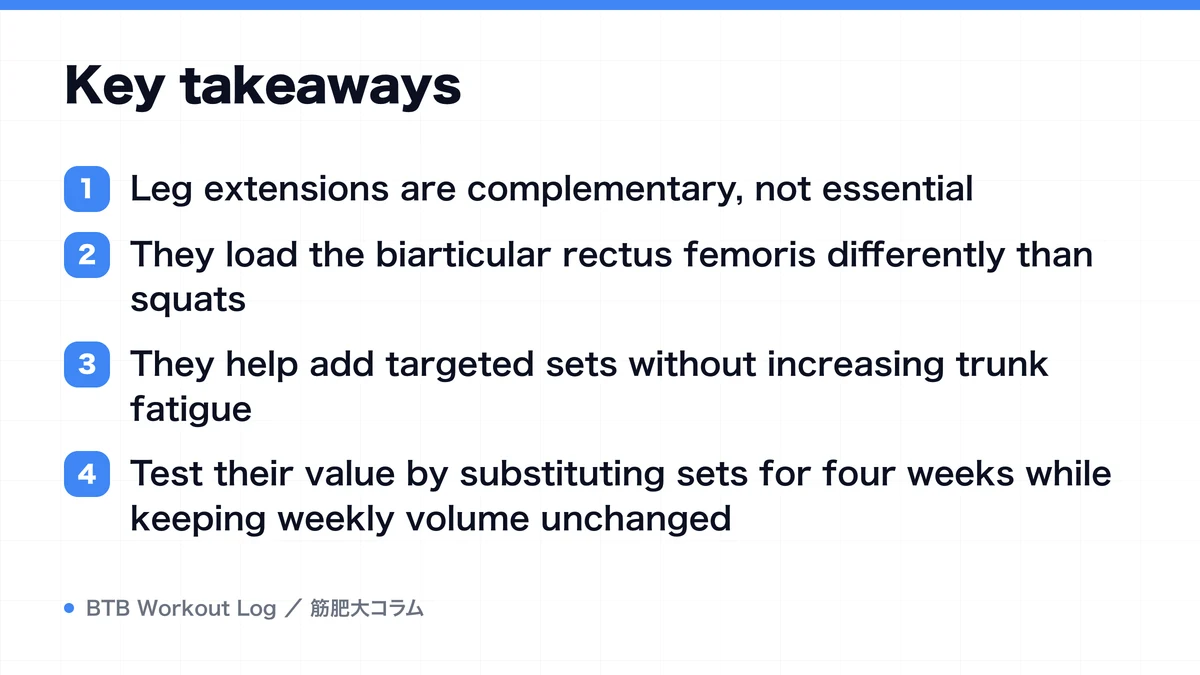
- Leg extensions are complementary, not essential
- They load the biarticular rectus femoris differently than squats
- They help add targeted sets without increasing trunk fatigue
- Test their value by substituting sets for four weeks while keeping weekly volume unchanged