Why Won't Your Calves Grow? | 5 Things to Check Before Blaming Genetics
When your calves won't grow, the first question isn't how many times you moved your ankles. It's whether you kept tension on the target muscles in the stretched position.
Cranking out high volumes of short reps won't add stimulus if you bounce out of the bottom and can't show clear week-to-week progress. Break the problem down into 5 factors: knee angle, range of motion, effort, load, and weekly volume. That will show you what to fix.
Key 1: Build Around Standing Work, and Don't Confuse the Role of Seated Work
The calf complex is made up primarily of the gastrocnemius and soleus. The gastrocnemius crosses both the knee and ankle, so bending the knee during seated work shortens it and generally prevents it from experiencing as much tension as it does when standing. The soleus doesn't cross the knee, so it still drives ankle plantar flexion in a seated position.
The first mistake is treating standing and seated calf raises as interchangeable versions of the same exercise. In a study comparing standing and seated calf raises, the standing condition produced greater hypertrophy across the calf complex, especially in the gastrocnemius. If your calves as a whole have plateaued, make a straight-knee variation the focus of your week and use seated work as additional volume for the soleus.
You don't need to lock your knees completely during standing calf raises. Keep a slight bend that stays unchanged throughout the rep, and don't lift the weight by bending and straightening your knees. A leg-press variation can serve the same purpose if you keep the knee angle fixed.
Instead of turning your toes sharply inward or outward in an attempt to isolate the inner and outer heads of the gastrocnemius, start with a natural stance. Keep the platform under the full width of the forefoot, from the ball of the big toe to the ball of the little toe, and perform each rep without letting the ankle tilt. If changing your foot angle costs you load or range of motion, prioritize repeatability over trying to target separate regions.
Muscle-belly length and its proportion relative to the Achilles tendon vary between individuals, so calves with the same circumference can have different shapes. Training can't move your attachment points, but your current shape isn't proof that you're incapable of further development. Compare changes in your own circumference and performance instead of comparing your shape with someone else's.
Key 2: Lower Your Heels and Don't Rush Through the Stretched Position
A calf raise may look like it's all about rising onto your toes at the top, but the bottom position is essential when training for hypertrophy. Use a platform to lower your heels, controlling the descent until your calves are stretched. Don't force your ankle into a position where the front begins to pinch. Set your bottom position at the deepest point where you can maintain tension on the target muscles.
In research on the gastrocnemius comparing partial reps performed only at long muscle lengths with other ranges of motion, reps in the stretched portion produced greater hypertrophy. That doesn't mean you should leave out the top position forever. As a general rule, use reps that rise fully from the bottom, then add short reps in the long-muscle-length portion only when you can no longer reach the top near the end of a set. For a broader overview of range of motion, see Full Range of Motion vs. Partials.
Control the lowering phase for about 1–3 seconds, then change direction at the bottom without bouncing. Those 2 adjustments make it easier to distinguish reps powered by the Achilles tendon's rebound from reps that keep the muscles loaded.
Key 3: Get Close to Your Limit With Consistent Form, Not Just a Burn
Using your calves frequently throughout the day doesn't mean they only respond to high reps. Both light and heavy loads can produce hypertrophy, but the lighter the load, the easier it is to mistake a set well short of failure for an effective one. The burn can give you a sense of effort, but it isn't proof of hypertrophy.
Start with around 10–20 reps per set, stopping when you could complete another 1–3 reps without bouncing: RIR 1–3. RIR means the number of reps you have left with good form. If your knees start bending, your hips start bobbing, or you stop lowering as far, treat that as technical failure and end the set. If you can keep going for 40 reps, increase the weight to bring your reps back into the target range instead of just grinding on. This makes progress easier to track.
Single-leg calf raises let you get enough resistance even with light equipment, but balance can become the limiting factor. Rest one hand on a rack and keep the amount of assistance consistent so you can compare calf performance without changes in support skewing the results.
Key 4: Don't Change Load, Reps, and Range of Motion at the Same Time
A difference of just a few centimeters in range of motion can dramatically change how many calf-raise reps you perform. That means saying, "I added 10kg since last week," isn't enough to confirm progressive overload. Keep the exercise, platform height, shoes, knee angle, and bottom-position standard consistent, then progress either reps or load under the same conditions.
For example, if you use a 10–15 rep range, wait until every set reaches 15 while maintaining your bottom position. Add only the smallest available increment at the next session, then build back up from around 10 reps. If increasing the load cuts your range of motion in half, that isn't progress; you've changed the conditions. Following the principles of progressive overload, prioritize adding reps that remain directly comparable.
If one side is weaker, train it first and stop the stronger side at the same number of reps. Adding reps only to the stronger side widens the difference in total volume. Keep the conditions matched until your form is consistent on both sides, making it easier to identify the cause of the imbalance.
Key 5: Start With Low Volume, Split the Frequency, and Reassess After 4–8 Weeks
Doing 2 spur-of-the-moment sets at the end of leg day usually isn't enough structured work to evaluate progress. At the other extreme, adding calf work every day because you're frustrated with slow growth can reduce performance by creating fatigue before recovery is complete. Start with a recoverable amount, such as 4–6 standing hard sets and 2–4 seated hard sets spread across about 2 sessions per week. This isn't a universal prescription. It's a starting point for anyone who doesn't know their current number of direct sets. The same principles are covered in How to Set Your Weekly Sets.
Use 3 measures to determine whether your changes are working, rather than relying on a pump or soreness. First, the load or reps should increase at the same range of motion. Second, you should maintain the same knee angle and bottom position through the later reps. Third, measurements or photos taken at roughly 1-month intervals, at the same time of day and with the same foot position, should show changes over several months. Keep the measurement conditions consistent so you don't mistake short-term swelling for growth.
If your performance keeps declining for 2 weeks or longer, don't add sets yet. Review your sleep, where calf work falls relative to leg training, and any discomfort around the Achilles tendon. If pain continues after you adjust your form, stop loading the area and consult a medical or exercise professional.
FAQ
- Will Training Calves Every Day Make Them Grow Faster?
- Some people tolerate high-frequency calf training, but you don't need to train them every day. Start with 2 sessions per week, and make sure rep quality and performance have recovered by each session. If you increase frequency, don't increase weekly sets at the same time. Distribute the same volume across more sessions and monitor your response.
- Are Seated Calf Raises Enough on Their Own?
- They're effective for the soleus, but bending the knee shortens the gastrocnemius. If you want to develop the entire calf, it's worth keeping a standing variation in your program. When time is limited, prioritize standing work and add seated raises as assistance when recovery and time allow.
- How Many Reps Should I Do for Calf Raises?
- No single rep range is uniquely effective. Choose a range that lets you get close to your limit without using momentum. Start with around 10–20 reps. If the load is so light that you can perform 30–40, increase it. If it's too heavy to lower your heels fully, reduce it.
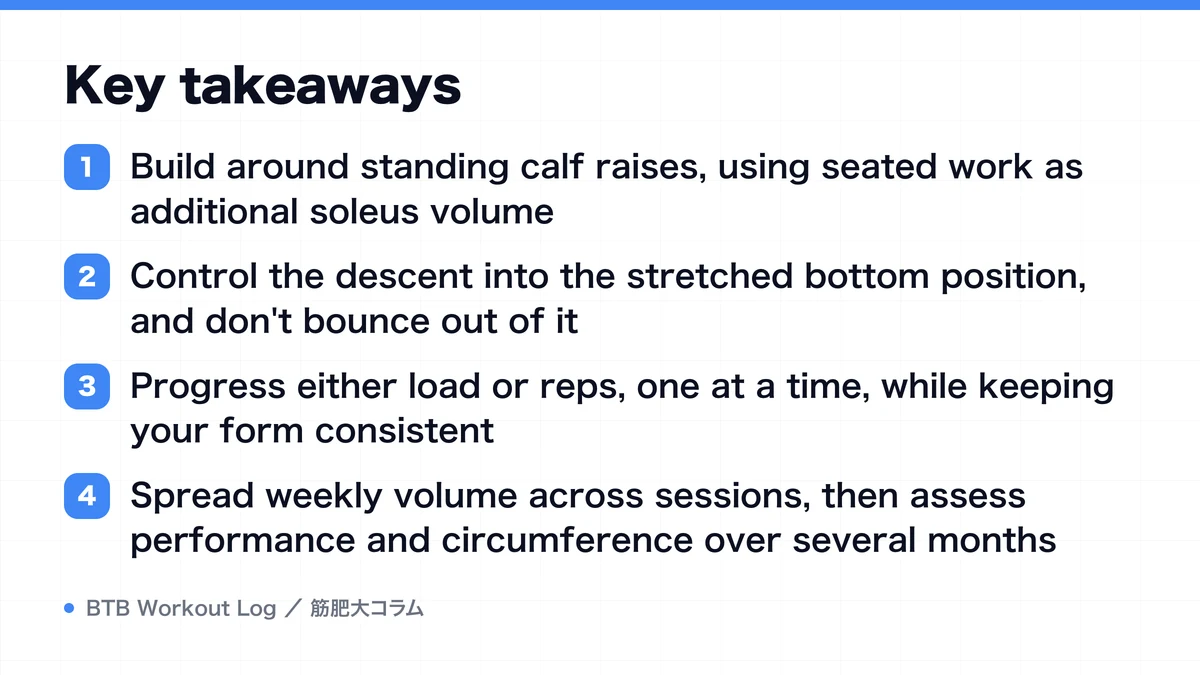
Key takeaways
- Build around standing calf raises, using seated work as additional soleus volume
- Control the descent into the stretched bottom position, and don't bounce out of it
- Progress either load or reps, one at a time, while keeping your form consistent
- Spread weekly volume across sessions, then assess performance and circumference over several months