Want Bigger Arms? Train Your Triceps | 5 Exercises to Build the Long Head
When choosing a long head exercise, prioritize a movement that lets you extend your elbows with your arms overhead, keep your torso stable, and progress the load through a repeatable path.
Because the triceps long head crosses the shoulder joint, its length changes with upper-arm position, not just elbow angle. You do not need to perform all 5 exercises. Use this list to choose one primary movement that suits your equipment and feels good on your joints.
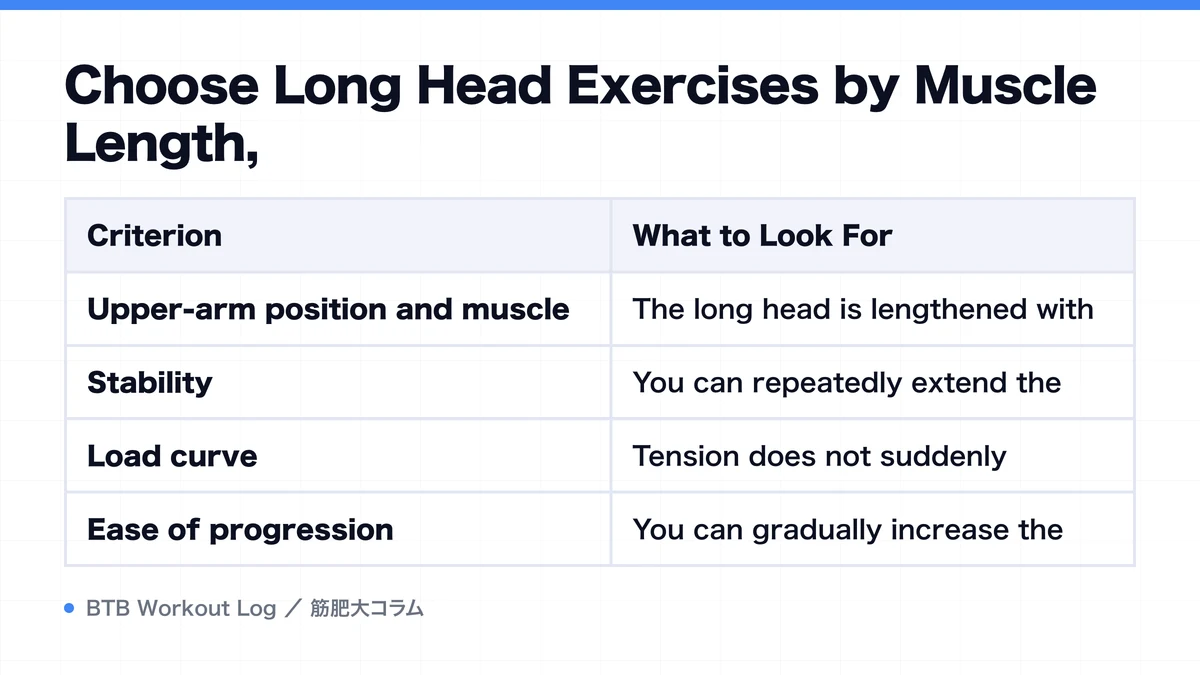
Choose Long Head Exercises by Muscle Length, Stability, Load Curve, and Progression
| Criterion | What to Look For |
|---|---|
| Upper-arm position and muscle length | The long head is lengthened with the arm overhead, and the exercise loads the bent-elbow portion of the movement |
| Stability | You can repeatedly extend the elbow without arching your lower back or shifting your shoulders |
| Load curve | Tension does not suddenly disappear from the target portion between the start and finish |
| Ease of progression | You can gradually increase the weight, reps, or range of motion |
In a 12-week study of 21 adults who trained each arm under a different condition, the arm performing overhead cable elbow extensions gained more muscle in both the long head and the triceps overall than the arm trained with the upper arm at the side. This is strong evidence for choosing a long head exercise, but it is not a direct ranking of every piece of equipment or technique.
Being an overhead exercise is not enough on its own. If you force your shoulder through an uncomfortable range of motion, arch your back to make your arms appear higher, or let your elbows flare whenever you lower the weight, you are no longer maintaining the intended position. See the overhead position and the long head for more on why arm elevation matters. Here, we will narrow the options by how practical they are to perform.
5 Exercises to Build the Triceps Long Head
1. Rope Overhead Cable Extension
Face away from the cable and extend the rope from behind your head to a point forward and above you. The cable provides consistent tension, and using both arms lets you handle a reasonable amount of weight, making this a strong first choice for your primary movement. Use a staggered stance, keep your ribs down, and hold your upper arms near your ears. It works best for lifters who are comfortable with their arms overhead and want to increase the load gradually.
2. Single-Arm Overhead Cable Extension
Training one arm at a time lets you adjust elbow direction and shoulder height independently on each side. It suits lifters who shift toward their stronger side during bilateral exercises or find a rope uncomfortable on the wrists or shoulders. Do not twist your torso to move the handle. Set your elbow position first, then move only your forearm. Even with a lighter weight, the priority is reproducing the same starting position.
3. Machine Overhead Triceps Extension
A machine with a backrest and elbow pad makes it easier to hold a stable position and reduces the chance that your torso tires first during high-rep sets. You can adjust the seat to suit your shoulder range of motion, and machines with small weight-stack increments make progress easy to track. Because the movement path varies between machines, never force your shoulders into an uncomfortable position just to fit the pads.
4. EZ-Bar Lying Triceps Extension
Lie on a bench and lower the bar slightly behind your head rather than toward your forehead. Angling your upper arms slightly behind vertical makes it easier to maintain tension with your elbows bent. This is a good choice if you want to progress a free-weight movement with both arms, but use a load that does not turn the exercise into a press driven by your elbows flaring in and out.
5. Dumbbell Overhead Triceps Extension
Holding one dumbbell with both hands lets you train elbow extension with the long head lengthened even when no cable is available. Use a bench with a backrest and lower the dumbbell behind your head without arching your lower back. Because dumbbell weight increments are often large, this exercise works well with double progression: reach the top of the rep range before bulking.
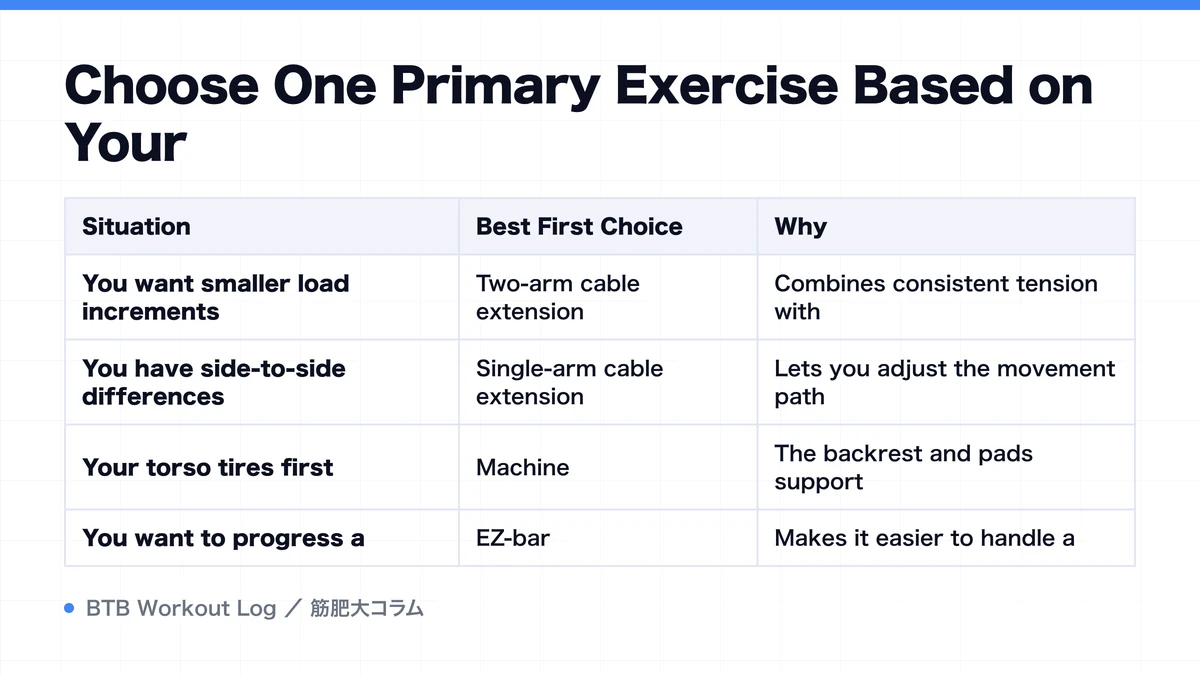
Choose One Primary Exercise Based on Your Equipment and Limiting Factor
| Situation | Best First Choice | Why |
|---|---|---|
| You want smaller load increments | Two-arm cable extension | Combines consistent tension with easy weight adjustments |
| You have side-to-side differences or tight shoulders | Single-arm cable extension | Lets you adjust the movement path for each arm |
| Your torso tires first | Machine | The backrest and pads support your position |
| You want to progress a free-weight movement | EZ-bar | Makes it easier to handle a relatively heavy load with both arms |
| You have limited equipment at home | Dumbbell | One dumbbell is enough to train in an overhead position |
When testing an exercise, check whether you can feel tension in the long head with your elbows bent, whether your triceps fatigue before shoulder or elbow discomfort appears, and whether you can maintain your upper-arm position through set 3. Do not chase the strongest possible stretch. Keep the movements you can repeat through a pain-free range.
Weight numbers are not comparable across equipment. A 10kg cable load and a 10kg dumbbell have different load curves and require different positions, so start a separate training log when you change exercises. Instead of frequently replacing your primary movement, keep the same setup for 4–8 weeks and see whether you can apply progressive overload.
Avoid Redundancy by Pairing One Overhead Exercise With a Different Angle
These 5 exercises are not meant to be performed together in one session. Choose one primary movement that trains the long head in a lengthened position. If needed, add either a pressdown with your upper arms at your sides or a compound movement such as the close-grip bench press. Combining exercises with different roles helps you avoid repeating the same position and accumulating unnecessary shoulder and elbow fatigue.
Example for 2 sessions per week: On day 1, perform 3 sets of rope overhead cable extensions for 8–15 reps, followed by 2 sets of pressdowns for 12–20 reps. On day 2, perform 2–3 sets of close-grip bench presses for 6–10 reps, followed by 2 sets of single-arm overhead cable extensions for 12–20 reps. During weeks with plenty of chest or shoulder pressing, remove the close-grip bench press and reduce your direct triceps sets.
Example for 1 session per week: Perform 3 sets of machine overhead triceps extensions and 3 sets of pressdowns. Recoverable weekly volume and set quality matter more than frequency alone. See pressdowns vs. overhead extensions for a direct comparison.
Reach the Top of the Rep Range Before Bulking in Small Increments
Set a range of 8–15 or 12–20 reps for each exercise. Once every set reaches the upper end, begin bulking by the smallest available increment. If your elbows flare significantly, your upper arms drop, or your range of motion is cut in half after bulking, you have changed the movement rather than progressed the load. Return to the previous weight and progress through more reps or a slower lowering phase.
Aim to start with 2–3 reps in reserve on the first set and finish with around 0–2 reps in reserve on the last. This keeps set quality high without taking every set to failure. Both lighter and heavier loads can produce hypertrophy, but lighter sets must be taken close enough to failure, while heavier sets must not be limited by your joints or your ability to hold position. If you are unsure how to choose your reps, use the rep range for hypertrophy as your foundation.
Sharp pain around an elbow tendon is not proof that an exercise is effectively targeting the long head. If it continues after changing your grip, equipment, or range of motion, stop the exercise and consult an appropriate healthcare professional about treatment. A long head exercise earns its place by letting you train safely under repeatable conditions and build progress over months, not by how much it hurts.
FAQ
- Are overhead exercises alone enough for the triceps long head?
- They are a strong primary option for loading the long head in a lengthened position, but they are not the only effective approach. Add pressdowns with your upper arms at your sides or compound presses as assistance work. Combining different rep ranges and load curves also makes your training easier to manage.
- Which of the 5 exercises should I choose first?
- If you have the equipment, the rope overhead cable extension is an accessible starting point. Choose a single-arm cable extension if your shoulders feel cramped or a machine if you struggle to stabilize your torso. The exercise name matters less than your ability to reproduce the same upper-arm position and range of motion.
- How many weekly sets does the long head need to grow?
- There is no fixed answer because pressing for your chest and shoulders also provides indirect work. Start with around 6 direct sets per week, split across 2 sessions. Adjust the volume gradually based on plateaus in weight or reps, how your elbows feel, and whether you recover before your next session.
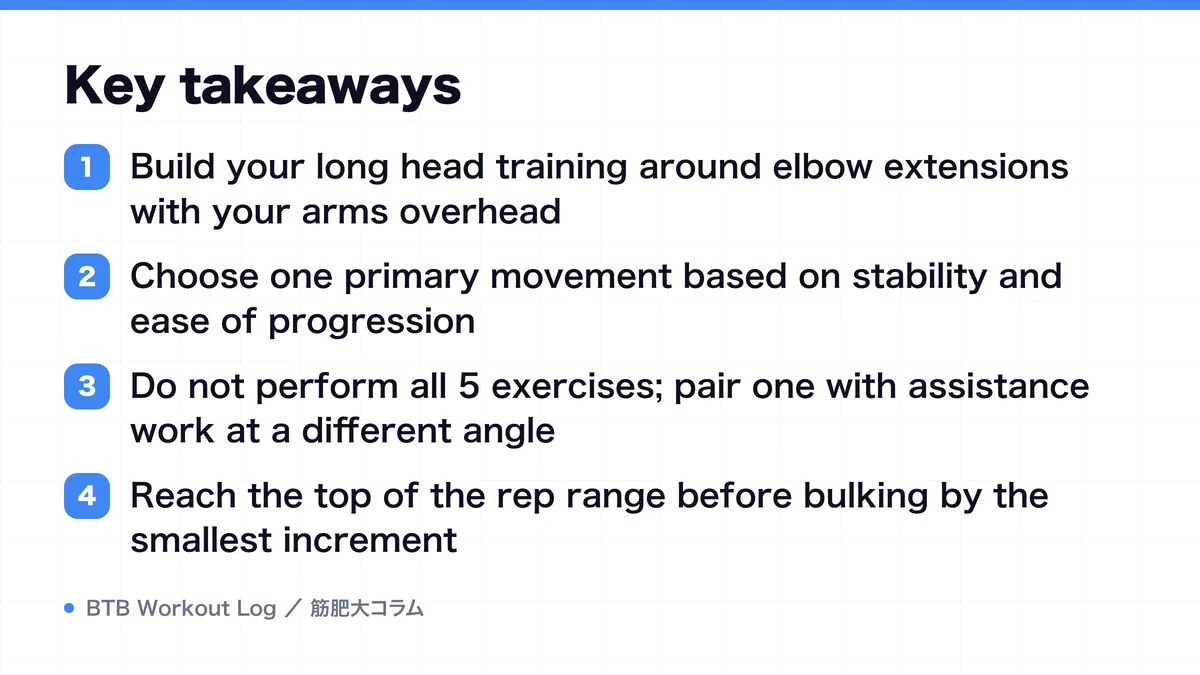
Key takeaways
- Build your long head training around elbow extensions with your arms overhead
- Choose one primary movement based on stability and ease of progression
- Do not perform all 5 exercises; pair one with assistance work at a different angle
- Reach the top of the rep range before bulking by the smallest increment
References
- Triceps Brachii Hypertrophy Is Substantially Greater After Elbow Extension Training Performed in the Overhead Versus Neutral Arm Position
- Low- vs High-load Resistance Training for Strength and Hypertrophy: Meta-analysis
- ACSM Position Stand: Progression Models in Resistance Training for Healthy Adults