Seated vs. Lying Leg Curl: Which Builds Bigger Hamstrings?
If both variations fit you comfortably and you can choose only one, there is good reason to prioritize the seated leg curl. Flexing the hips in the seated position lengthens most of the hamstrings, and a direct comparison in young men found greater hypertrophy with seated curls.
That does not mean you need to choose seated curls if the seat does not fit your build or let you secure your pelvis. Look beyond the seated and lying labels: compare muscle length, stability, range of motion, progression, and each exercise's role in your weekly program.
Compare Hypertrophy, Equipment Fit, and Progression
Seated and lying leg curls are both isolation exercises that load the hamstrings through knee flexion. We cover how they complement hip-extension exercises such as the RDL in 5 Best Hamstring Exercises; here, we will compare only the two curl variations.
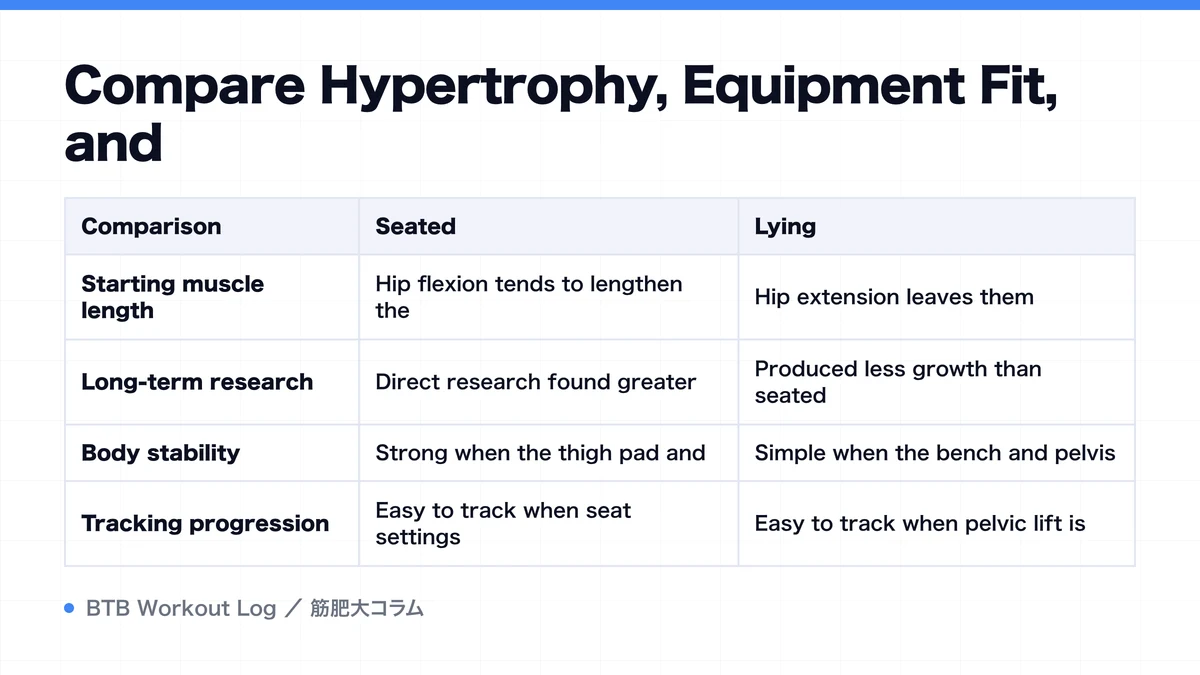
| Comparison | Seated | Lying |
|---|---|---|
| Starting muscle length | Hip flexion tends to lengthen the biarticular muscles | Hip extension leaves them relatively shorter |
| Long-term research | Direct research found greater hypertrophy | Produced less growth than seated curls in the same study |
| Body stability | Strong when the thigh pad and backrest fit properly | Simple when the bench and pelvis position fit well |
| Tracking progression | Easy to track when seat settings are recorded | Easy to track when pelvic lift is controlled |
| Weekly fatigue | Low systemic fatigue, with mostly local stress | Low systemic fatigue, with mostly local stress |
The displayed load is not directly comparable because lever length, cam design, and friction differ between units. The question is not whether a 50kg seated curl is stronger than a 40kg lying curl. Keep the settings consistent on each unit, then track whether you can progress with the same range of motion and RIR (reps left before failure).
Seated Curls Train the Biarticular Hamstrings at Longer Muscle Lengths
The semitendinosus, semimembranosus, and long head of the biceps femoris cross both the hip and knee. When you sit with your hips flexed, these muscles begin knee flexion in a lengthened position at the hip. The short head of the biceps femoris does not cross the hip, so it does not experience the same change in muscle length. This anatomical difference matters: do not assume every hamstring muscle responds identically.
In a study where young men trained each leg with either seated or prone leg curls for 12 weeks, total hamstring hypertrophy was greater in the seated condition, although growth varied between individual muscles. This provides valuable direct evidence comparing the two exercises. However, the participants, study duration, and equipment were limited, so we cannot claim that seated curls outperform lying curls by the same margin for everyone.
EMG readings and how strongly a muscle contracts during a set can indicate what is happening in that moment, but they do not measure the hypertrophy achieved months later. Feeling a harder contraction with lying curls does not prove they produce better long-term results, just as getting less of a pump from seated curls does not invalidate the research. Assess the rationale behind loading at longer muscle lengths separately from whether you can perform consistent reps on your equipment.
A Stable Lying Curl Can Beat a Seated Curl That Does Not Fit
Seated leg curl setup
On these machines, align your knee joint with the rotation axis and position the ankle pad slightly above your Achilles tendon. Set the thigh pad firmly enough to keep your legs down, then adjust the backrest so you can sit without your pelvis tucking under. If your pelvis rounds and your body slides forward as your knees extend, you are losing more stability than you gain from the longer muscle length. Make the backrest more upright or slightly reduce the range of motion.
Lying leg curl setup
Position your knees at the edge of the bench and set the pad evenly on both sides. If your pelvis lifts off the bench as you curl and you extend your lower back to squeeze out extra reps, the load is too heavy. Press your abdomen lightly into the bench, keep the front of your thighs down, and bend only at the knees. If the unit's raised hip pad matches your hip position, you can perform stable reps while lying prone.
Breathing comfort, discomfort in hip flexion, and pressure around the knees can also affect your choice. If either variation causes pain, do not keep using it just for the supposedly advantageous muscle length. If adjusting the setup does not resolve the symptoms, stop using it and consult a healthcare or exercise professional if needed.
Choose One Main Variation and Add the Other Only for a Clear Reason
Here is how to apply the comparison in practice.
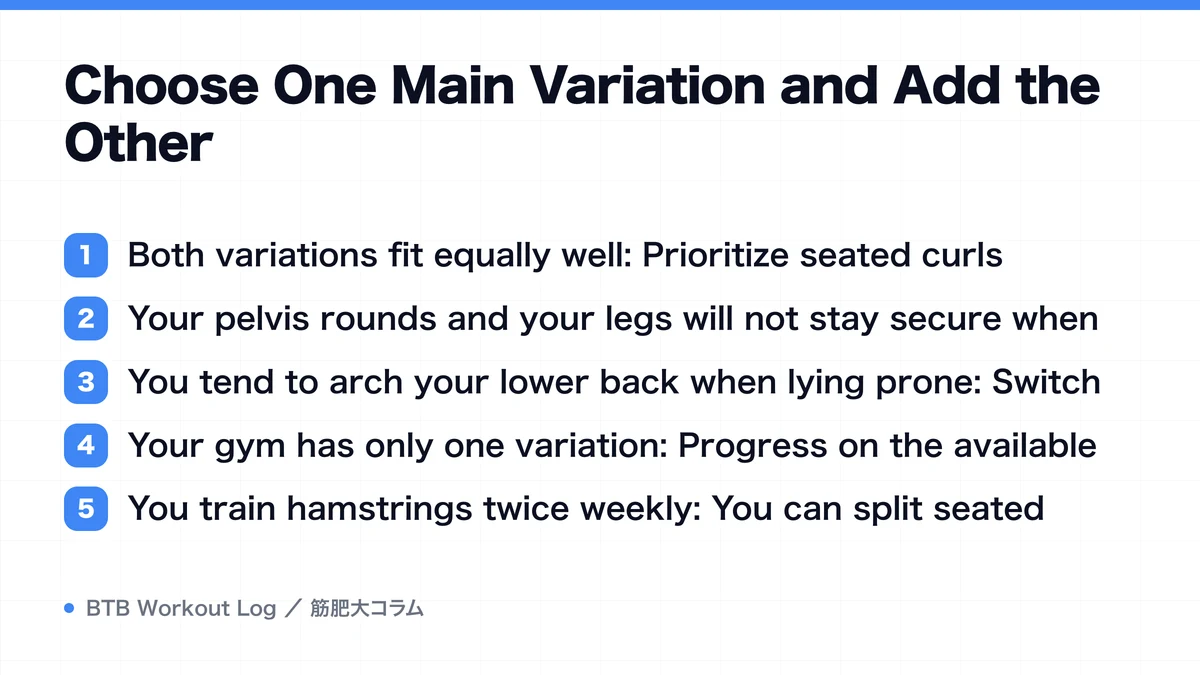
- Both variations fit equally well: Prioritize seated curls for their longer muscle length and direct comparative evidence.
- Your pelvis rounds and your legs will not stay secure when seated: Choose the controllable range of motion you can achieve with lying curls.
- You tend to arch your lower back when lying prone: Switch to seated curls and use the thigh pad for support.
- Your gym has only one variation: Progress on the available unit instead of worrying about equipment you cannot use.
- You train hamstrings twice weekly: You can split seated curls across both days; you do not need both variations merely for variety.
If you use both, place them on separate days instead of performing them back-to-back and doubling your sets in one session. For example, perform seated curls for 8–12 reps on Lower A and lying curls for 12–18 reps on Lower B to vary the range of motion and feel. Start by replacing some of your existing work, however, rather than automatically adding to your weekly sets.
Load range is separate from exercise quality. Because hypertrophy can occur across a broad range of loads, do not automatically declare the variation that lets you lift more weight the winner. Choose a range that brings the target muscles close to their limit on each set. See Heavy vs Light Weights for more detail.
Use the Same Setup for 6 Weeks, Then Assess Reps, RIR, and Compensation
Stick with your chosen unit for at least six weeks and record the seat number, backrest, thigh pad, ankle pad, and range of motion. Choose a rep range such as 8–15, stay within it, and maintain the same RIR across all sets. Once you reach the upper limit, move to the next-smallest load increase. If the weight rises only because your pelvis starts moving, you have not progressed the same movement.
On a well-fitting unit, your knees follow a consistent path through the end of the set, your hamstrings are the main limiting factor, and your knee-flexion performance recovers by the next session. If the pad shifts every workout, joint pressure stops you first, or compensation increases even after reducing the load, you have good reason to try another unit.
Seated curls are the best first choice on average, but their advantage in research does not justify struggling with equipment that does not fit. Use them if you can consistently reproduce the intended movement. If you cannot, focus on progressing your lying curls. This conditional choice respects both the evidence and individual differences.
FAQ
- Will doing both seated and lying leg curls produce more hypertrophy?
- Simply including both variations does not guarantee additional benefits. If total sets and effort are equal, making seated curls your main variation and progressing them can be enough. Consider using both if you want a different feel from each unit or need to spread local fatigue across two weekly sessions.
- Should I lean forward during seated leg curls?
- Leaning farther forward lengthens the hamstrings that cross the hip, but you lose that advantage if your pelvis rounds and your thighs lift. Stay within the angle you can stabilize with the backrest and pads. Increasing the forward lean is not a goal in itself.
- Am I at a disadvantage if my gym only has a lying leg curl?
- Research comparing the two positions favored seated curls because of the longer muscle length, but lying curls can still provide stable knee-flexion training. Progress them under consistent conditions and add a hip-extension exercise such as the RDL on another day to cover the hamstrings' broader functions.
Key takeaways
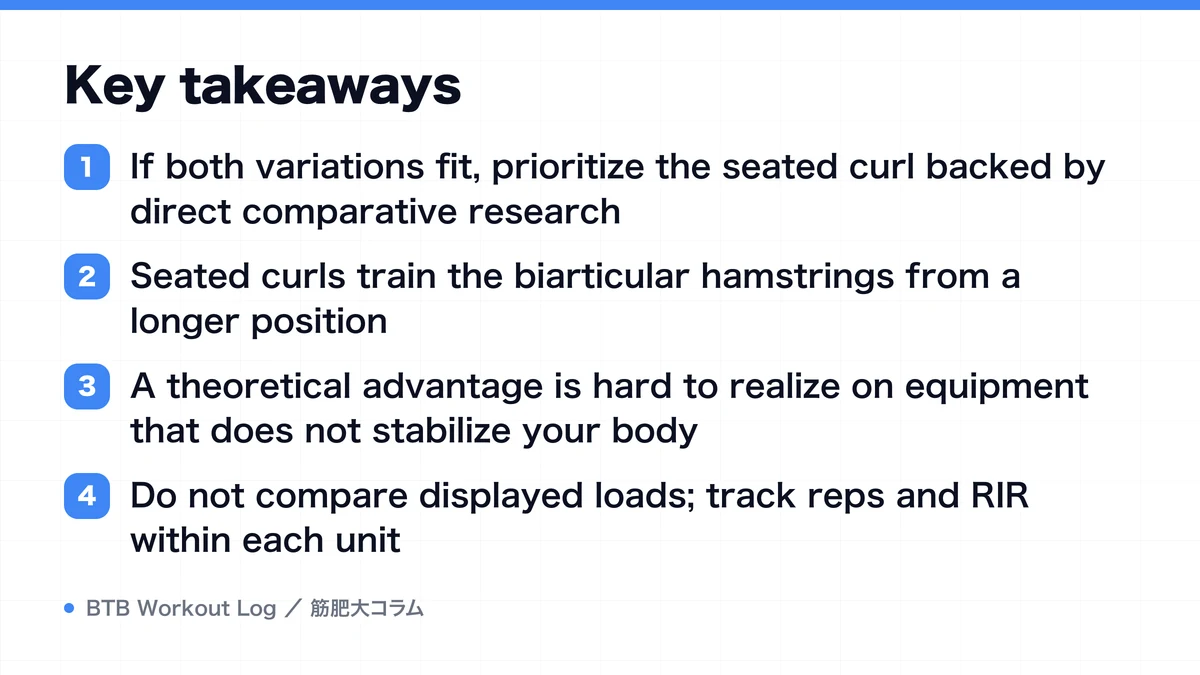
- If both variations fit, prioritize the seated curl backed by direct comparative research
- Seated curls train the biarticular hamstrings from a longer position
- A theoretical advantage is hard to realize on equipment that does not stabilize your body
- Do not compare displayed loads; track reps and RIR within each unit