
Can You Isolate the Lower Abs? | The Truth About "Lower Ab" Exercises
You cannot isolate and train the “lower abs” as a separate muscle. You can, however, choose movements that shorten the rectus abdominis from the pelvic end and make the load easier to feel lower down.
The real question is not whether an exercise targets the upper or lower abs. It is whether a leg raise moves the pelvis through the rectus abdominis instead of becoming pure hip flexion. A different sensation also does not guarantee localized hypertrophy.
The Rectus Abdominis Is One Long Muscle, Not a Separate Lower Muscle
What people call the “lower abs” is the portion of the rectus abdominis below the navel. Tendinous intersections give the muscle its segmented appearance, but they do not divide it into separate upper and lower abdominal muscles. When the rectus abdominis contracts, it brings the rib cage and pelvis toward each other. The lower portion still contributes during a standard crunch.
Innervation and the direction of a movement may prevent activation from being perfectly uniform throughout the rectus abdominis, so claiming that every exercise trains every region identically also goes too far. However, EMG measures electrical activity during a test, not the amount of regional growth that occurs months later. A single reading showing greater lower-region activity does not prove that an exercise will selectively thicken the lower abs.
The practical conclusion is that complete isolation is impossible, but movements initiated from the pelvis may alter how the load is distributed. There is no evidence that you can freely sculpt only the bottom two rows of your abs.
Do More Than Raise Your Legs: Curl Your Pelvis Toward Your Ribs
The movement to look for in a lower-ab exercise is posterior pelvic tilt. When lying down, turn your belt buckle toward the pit of your stomach. When hanging, rotate the pelvis as though scooping your hips forward. This reduces the gap between your lower back and the floor and brings the pelvis closer to the rib cage.
If your legs reach horizontal without any change in pelvic position, the main movement is hip flexion. The rectus femoris and iliopsoas do most of the work, while the abs mainly stabilize the trunk. That does not make it a bad exercise, but the movement does not match the goal if you count it as an exercise that curls the lower abs.
Straightening your knees lengthens the lever and increases the load. But if making the exercise harder stops your pelvis from moving, you have progressed in the wrong order. First, expand the range in which you can curl your pelvis with bent knees. Once you can maintain it through the end of the set, gradually move your feet farther away. On the way down, stop just before your lower back begins to arch. This is not a contest to lower your feet as close to the floor as possible.
Two Exercises That Emphasize the Lower Region and One That Builds the Whole Muscle
Reverse Crunch
Lie on your back with your knees bent, keep your thighs steady, and curl your pelvis slightly off the floor. Do not use momentum to drive your knees toward your face. Keep the movement short, lifting the tailbone first and then the sacrum. If you can also control the descent without letting the pelvis suddenly tip forward, this exercise is easy to standardize without equipment. When it becomes too easy, progress the bench incline or lowering distance before adding ankle weights.
Hanging Knee Raise
This exercise suits lifters whose grip and shoulders can handle it. Stop any initial swinging, then curl your pelvis upward at the top of each knee raise. If you swing your legs backward to build momentum before every rep, you cannot compare the load on your abs. Switching to a captain's chair with a backrest removes grip strength from the equation and lets you focus on the movement.
Cable Crunch
This movement does not start from the pelvis, but it makes it easy to apply a measurable load across the entire rectus abdominis. If you want to build overall abdominal thickness instead of chasing a localized sensation, it is worth pairing cable crunches with a reverse-crunch variation. See Loading the Abs for Hypertrophy for detailed loading guidance. Here, the priority is to avoid distorting your exercise selection around the narrow goal of training “only the lower abs.”
Lower-Ab Fatigue and Lower-Belly Appearance Are Different Issues
Feeling intense fatigue below your navel during reverse crunches does not prove that the lower region will experience more hypertrophy than the upper region. That feeling can also reflect unfamiliarity with the movement, contributions from muscles around the pelvis, and localized pressure. Next-day soreness is not a tool for measuring regional growth either.
A protruding lower belly can also be influenced by several factors, including subcutaneous abdominal fat, gut contents, posture, and abdominal pressure during breathing. Adding ab exercises will not directly remove fat from a chosen area. Building a thicker rectus abdominis and reducing body fat through diet are separate levers.
You also do not need to force a rigid posture and hold your stomach in all day. When comparing photos, keep the time of day, meal conditions, lighting, and breathing state consistent. Do not assume that daily changes in abdominal fullness mean your lower abs are weak. Judge training results over a longer period.
Regional Emphasis Only Works While Pelvic Motion and Progression Hold Up
You can begin your weekly plan with 2–4 sets of an exercise that curls from the pelvis and 2–4 sets of a loaded exercise for the entire rectus abdominis. Use ranges such as 10–20 reps for reverse crunches and 6–15 reps for hanging knee raises, provided the pelvic motion remains intact. This is not about counting the upper and lower regions as separate muscles. It is about managing total volume while practicing different movement patterns.
Do not judge progress by rep count alone. Track the position reached by the curled pelvis, the distance you can control on the descent, and whether you use momentum. Place a smartphone directly beside you and compare your first and final sets. This makes it easier to spot the moment when your legs keep rising but your pelvis stops moving. Count RIR only from reps that preserve pelvic motion. Do not add reps in reserve simply because your legs could continue moving on their own.
Hypertrophy can occur across a broad range of loads, so you can progress even when an exercise cannot be externally loaded. Increase the range of motion, slightly lengthen the leg lever, and then standardize the pause duration. When changing the movement range, review Full Range of Motion vs. Partials, and do not compare your previous short reps with the new reps as though they were identical. If you increase your total sets, consider How Set Volume Affects Growth, change only one variable at a time, and observe the result for several weeks. Complete isolation may be impossible, but a repeatable pelvic movement can still earn its place in your program.
FAQ
- Do Reverse Crunches Isolate the Lower Abs?
- No. The entire rectus abdominis works, so the lower region is not isolated. Reverse crunches do make it easier to curl the pelvis toward the ribs, giving the rectus abdominis a clearer role than in a basic leg raise. Lift from the tailbone and use only the range you can reverse without momentum.
- Am I Doing Leg Raises Wrong If My Hip Creases Get Tired?
- The hip flexors naturally work whenever you lift your legs. Whether the exercise misses the goal depends on whether posterior pelvic tilt happens at the same time. If your hip creases reach failure first, bend your knees to reduce the load or switch to reverse crunches.
- Can Ab Exercises Reduce Lower-Belly Fat?
- Ab exercises train the rectus abdominis, but they cannot selectively reduce nearby fat. To change the shape of your lower belly, treat muscle-building training separately from the diet and activity levels used to reduce overall body fat.
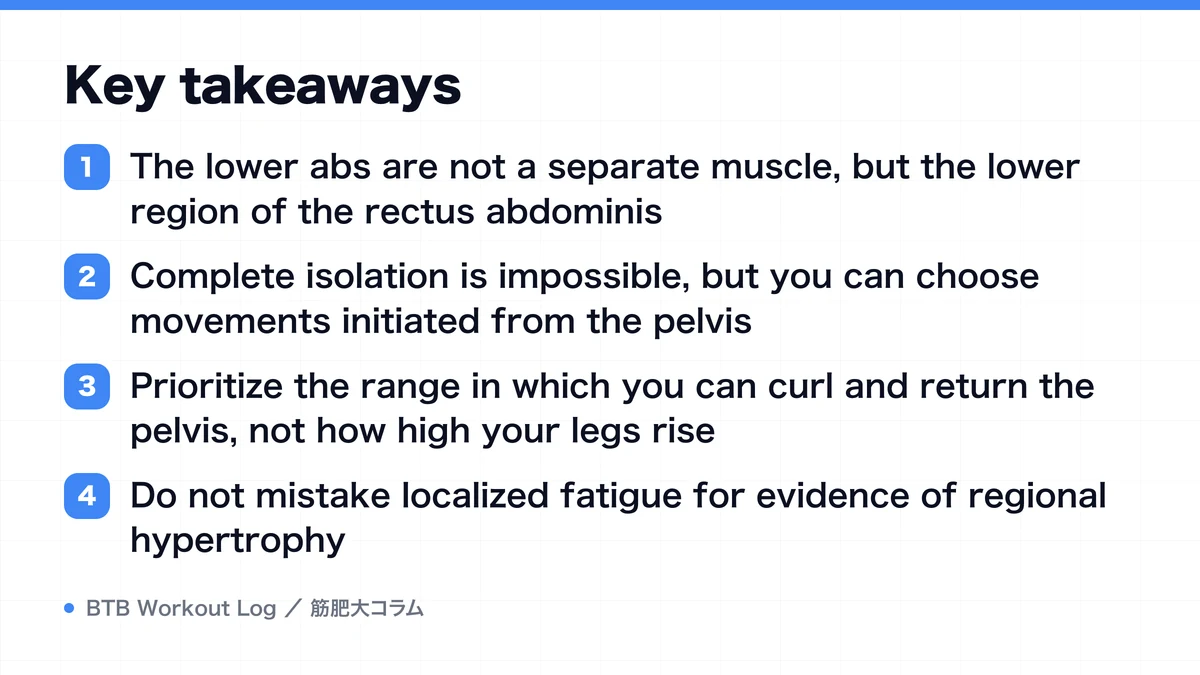
Key takeaways
- The lower abs are not a separate muscle, but the lower region of the rectus abdominis
- Complete isolation is impossible, but you can choose movements initiated from the pelvis
- Prioritize the range in which you can curl and return the pelvis, not how high your legs rise
- Do not mistake localized fatigue for evidence of regional hypertrophy