Why Does Incline Curl Work So Well? | Why Training the Biceps in a Stretched Position Makes It Bigger
Incline curls are effective because they place your elbows behind your torso, lengthening the biceps at the shoulder before you begin flexing the elbow.
But a more painful stretch is not automatically more effective. The benefit comes when the dumbbells resist the muscles at long lengths and you can repeat each rep without moving your shoulders.
Look Beyond the Stretch: Shoulder Position and External Load Both Matter
In a standard standing curl, your upper arms rest beside your torso, and fatigue can make your elbows drift forward. Leaning back against an incline bench allows your arms to hang behind your torso under gravity. Because the biceps cross both the elbow and shoulder joints, extending the shoulder increases their starting length.
The key is to distinguish between a muscle being long and the load being greatest at that point. Resistance from a dumbbell changes with the angle of your forearm relative to gravity. At the bottom, where the forearm points straight down, the moment arm around the elbow is small. As you bend your elbow and your forearm approaches parallel with the floor, the external load produces more torque. In other words, chasing an intense stretch at the bottom does not automatically maximize the mechanical challenge.
Loading the stretched position can be evaluated using three criteria: the exercise passes through a long muscle length, resistance remains through that portion of the rep, and you can maintain position with the target muscle. Incline curls make these conditions relatively easy to create.
How Placing the Shoulders Behind the Torso Creates a Hypertrophy Stimulus
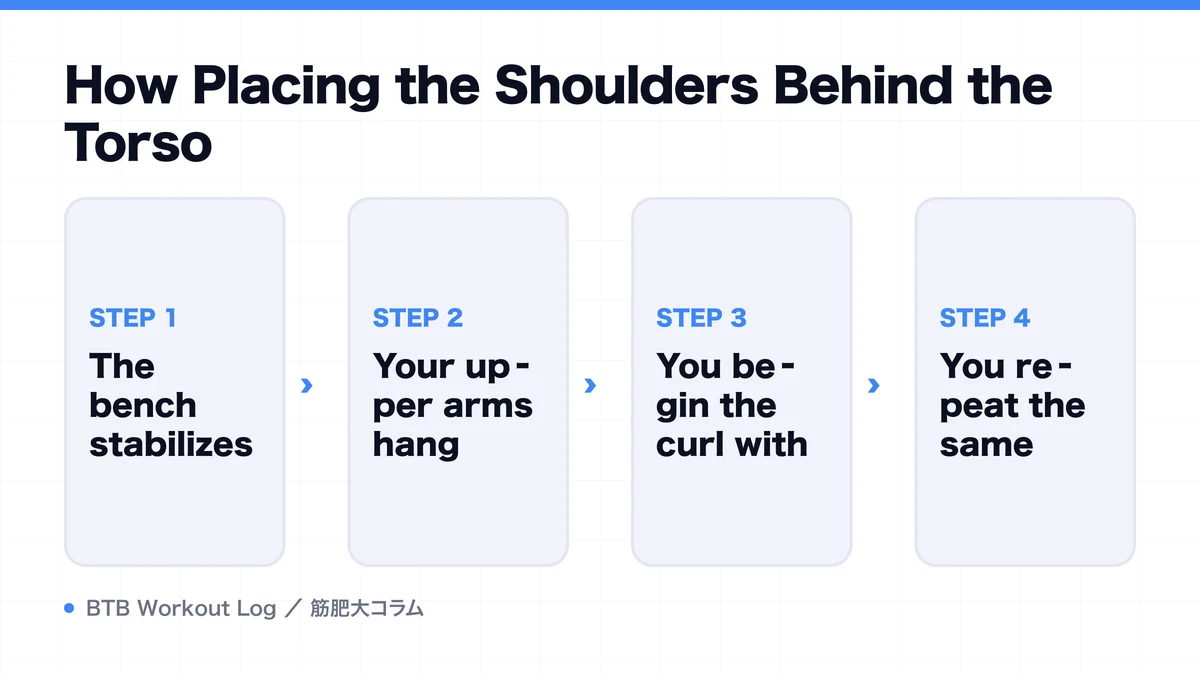
- The bench stabilizes your rib cage and shoulders: This limits lower-back arching and forward-backward swinging compared with standing curls.
- Your upper arms hang behind your torso: This lengthens the biceps from the shoulder.
- You begin the curl with the elbows extended: This exposes the muscles to tension through a range of motion that includes long muscle lengths.
- You repeat the same path: This makes it easier to interpret changes in weight or reps as improved performance rather than added momentum.
If your elbows slide forward anywhere in this sequence, you reduce the effect of the shoulder position. When the weight is so heavy that you lift your upper arms, roll your shoulders forward at the top, or drop into the bottom, you are doing an incline curl in name only. The intended challenge is gone.
Incline curls are often described as a "long-head exercise," but both heads of the biceps cross the shoulder. It is more accurate to view them as an exercise that trains the entire biceps from a long position, not as proof that the long head can be isolated. The limitations of targeting each head are covered in training the long and short heads separately.
Long-Muscle-Length Training Has Support, but Incline Curls Are Not the Clear Winner
One study compared partial reps at long muscle lengths with full-range reps for 8 weeks, using opposite arms in 30 trained participants. Both approaches produced similar improvements in elbow-flexor muscle thickness and strength endurance. This suggests that if long muscle lengths are the priority, you can achieve adaptations with full-range reps that include them rather than relying only on partials.
However, the study did not directly compare incline curls with another curl variation, nor did it rank the long and short heads separately. A general finding that long muscle lengths look promising cannot be extended into a claim that incline curls produce more hypertrophy than every other exercise. The choice between full-range and partial reps should be assessed separately as a comparison of range of motion.
There are also two ways to perform reps at long muscle lengths: moving only through the bottom portion or passing through the stretched point and curling all the way to the top. Incline curls make the second option easy and also train the shortened position. Consider adding a few bottom partials only after your standard reps are consistent. Starting with partial reps makes it harder to tell which portion of the movement has actually become stronger.
In practice, repeatability matters more than research terminology. If you tend to use momentum during standing curls, limiting torso movement with a backrest can be useful on its own. If shoulder extension feels uncomfortable and forces you to shorten your range of motion, preacher or cable curls may let you perform more high-quality sets. Choose exercises where the theoretical muscle-length benefit overlaps with a movement you can perform consistently.
Forget the Perfect Bench Angle: Find a Position That Keeps Your Upper Arms Still
Start with the backrest at around 45–60 degrees. Lowering the bench places your arms farther behind your torso, but it also increases the stretch across the front of your shoulders. Do not compete for the deepest angle. Let your shoulder blades rest naturally against the bench and choose a setting where your upper arms can hang still while your elbows reach near-full extension.
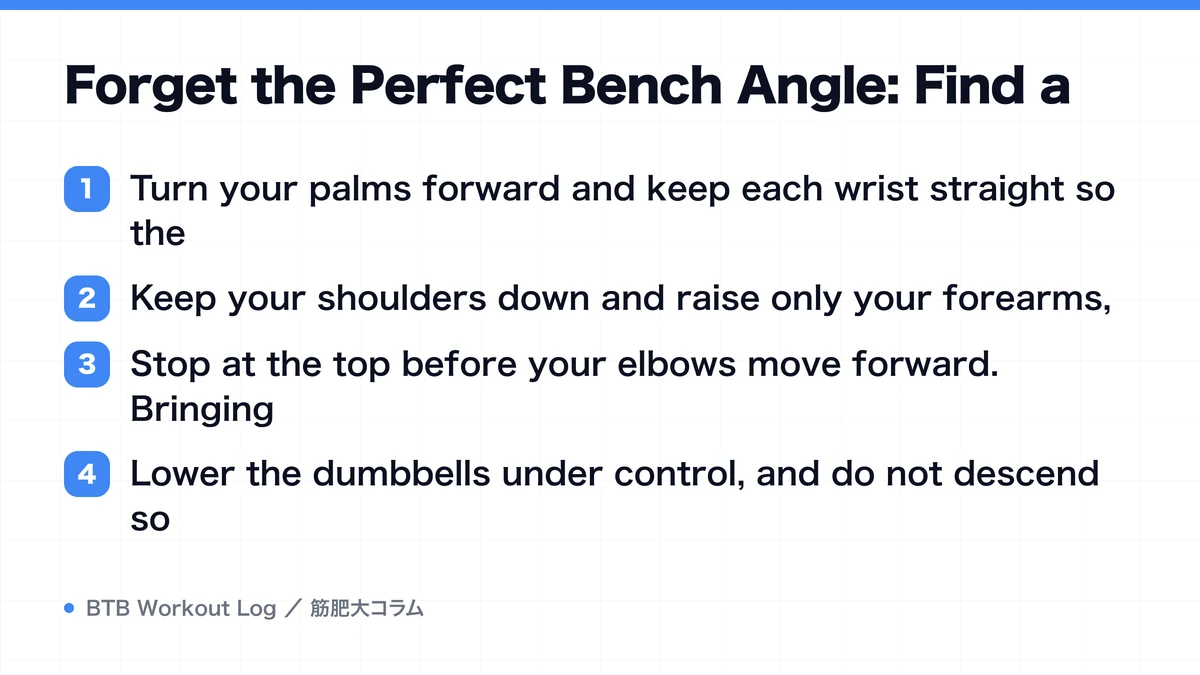
- Turn your palms forward and keep each wrist straight so the dumbbell and forearm stay aligned.
- Keep your shoulders down and raise only your forearms, imagining that your elbows are pinned to a wall.
- Stop at the top before your elbows move forward. Bringing the dumbbells all the way to your shoulders is not the goal.
- Lower the dumbbells under control, and do not descend so far that you feel a sharp sensation at the front of your shoulders.
If curling both arms together makes your torso lift from the bench, work one arm at a time so you can monitor your elbow position. If shoulder or elbow pain persists, stop the exercise instead of endlessly adjusting the angle. Consult a qualified professional when changing your form does not resolve the symptoms.
Before each set, use a light dumbbell to check your full range of motion for 1 rep, then use that depth as the standard for your working sets. End the set if fatigue makes the bottom position shallower, even if you have planned reps remaining. Returning to the same starting position every time lets you emphasize the stretch while keeping your training records comparable.
Use It as a Mid-Workout Accessory and Progress Reps Without Losing Range of Motion
Incline curls work well for 2–4 sets after compound back exercises or heavier curls. Aim for 8–15 reps and stop when you could still perform another 1–2. If your elbows move forward on the final rep, do not count it as successful. Use the same weight next time and keep every rep on the same path.
Before increasing the load, record the bench angle, seat position, and how far you lower the dumbbells. If the setup changes, the same 10kg presents a different challenge. Only begin bulking up the load in small increments after reaching the top of the target rep range on every set. If your reps drop sharply, progress one arm at a time. This is a practical way to standardize the challenge and measure progress.
If you also perform preacher curls, avoid doing high volumes of both exercises in similar rep ranges on the same day. Split them across different days of the week. Let incline curls train shoulder extension and preacher curls train with the upper arm fixed in front, so adding another exercise does more than inflate your set count.
FAQ
- What is the best bench angle for incline curls?
- There is no single angle that works for everyone. Start around 45–60 degrees and choose a position where you can extend your elbows without moving your upper arms. Lower is not automatically better. Raise the backrest if you feel discomfort at the front of your shoulders or your torso lifts from the bench.
- Do I need to fully extend my elbows at the bottom?
- You do not need to forcefully lock the joint. Lower the dumbbells until you can reverse direction without momentum while maintaining tension in the biceps. Reduce the depth if you feel sharp pain in your elbows or shoulders. If it persists, switch to another exercise.
- Are incline curls enough to build the biceps?
- They can build muscle, but there is no reason to train only with the shoulders extended. Split them across the week with standard curls performed beside the torso or exercises that fix the upper arms in front. This lets you use different muscle lengths and stability demands while managing elbow stress.
Key takeaways
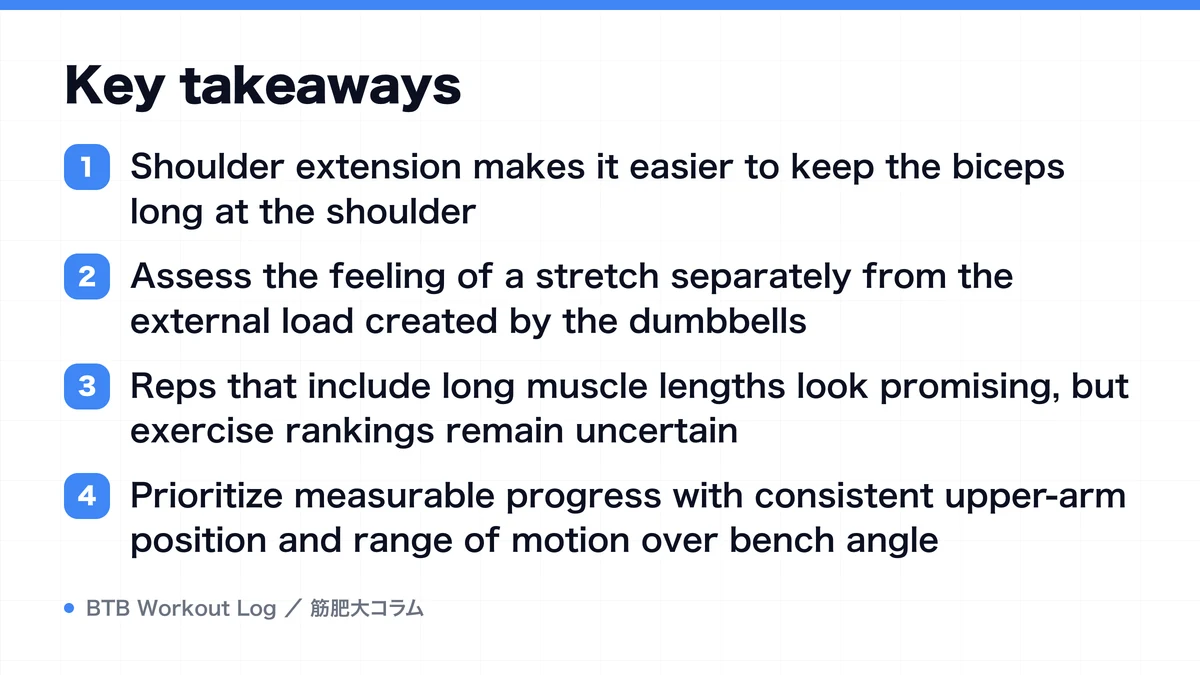
- Shoulder extension makes it easier to keep the biceps long at the shoulder
- Assess the feeling of a stretch separately from the external load created by the dumbbells
- Reps that include long muscle lengths look promising, but exercise rankings remain uncertain
- Prioritize measurable progress with consistent upper-arm position and range of motion over bench angle
References
- Lengthened Partial Repetitions Elicit Similar Muscular Adaptations as Full Range of Motion Repetitions During Resistance Training in Trained Individuals
- Training to Repetition Failure or Non-failure: Systematic Review and Meta-analysis
- Training in the Initial Range of Motion Promotes Greater Muscle Adaptations Than at Final in the Arm Curl