Can You Train the Biceps' Long and Short Heads Separately? | For Lifters Chasing a Higher Peak
You can shift more of the stimulus toward the long or short head, but you cannot isolate one completely or reshape your biceps at will with curl variations alone.
Instead of relying on simple rules like “a narrow grip targets the long head,” consider shoulder position, forearm orientation, and the direction of resistance together—and never sacrifice overall biceps progress.
Separate Biased Activation From Long-Term Growth
The biceps brachii has a long head and a short head, but both converge into a shared distal tendon. Both contribute to elbow flexion and forearm supination. Their proximal paths differ, so changing joint angles may alter their leverage and relative activity. Even so, curls do not make one head work while the other rests.
There are two levels of “targeting” to examine. The first is an acute bias, such as slightly higher EMG activity at a particular angle. The second is a long-term adaptation in which several months under those conditions produces measurably greater growth in one head. Claiming that the first “builds a higher peak” treats muscle activity as if it directly measured hypertrophy. The possibility of regional differences also does not mean you can design your biceps shape at will.
So this is not a simple choice between perfect isolation and no targeting at all. A realistic approach is to secure enough total biceps stimulus, then use different upper-arm positions to test for a modest bias.
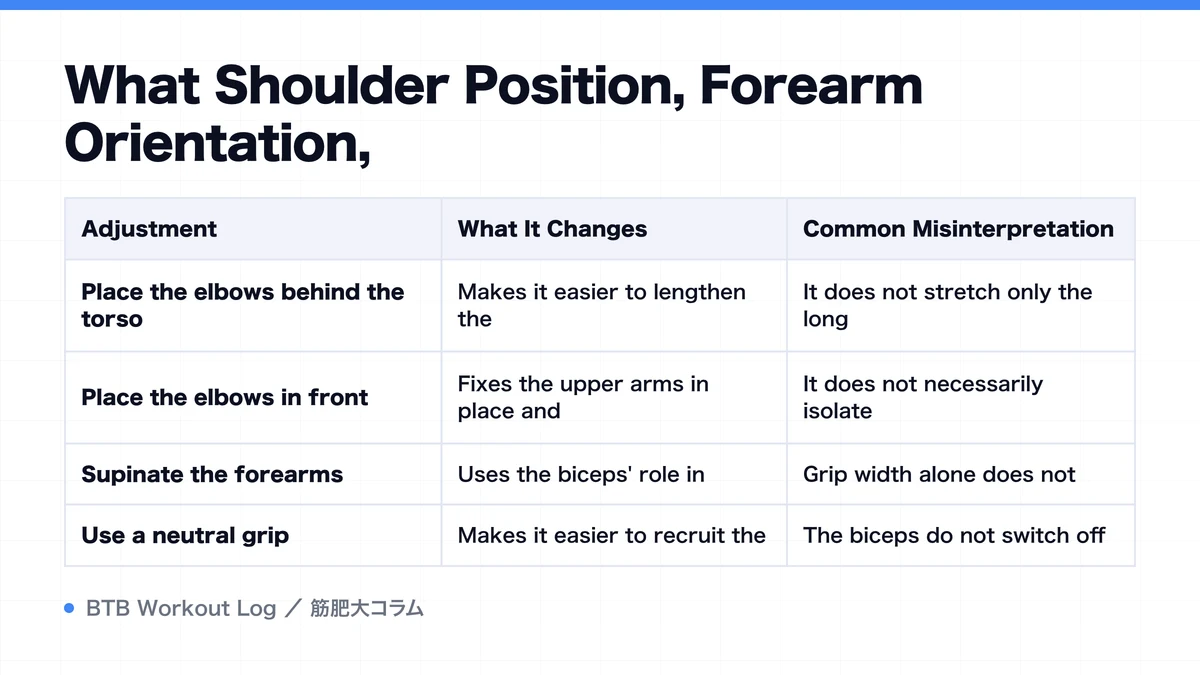
What Shoulder Position, Forearm Orientation, and Resistance Direction Change
| Adjustment | What It Changes | Common Misinterpretation |
|---|---|---|
| Place the elbows behind the torso | Makes it easier to lengthen the biceps at the shoulder | It does not stretch only the long head |
| Place the elbows in front | Fixes the upper arms in place and reduces momentum | It does not necessarily isolate the short head |
| Supinate the forearms | Uses the biceps' role in supination | Grip width alone does not determine head-specific loading |
| Use a neutral grip | Makes it easier to recruit the other elbow flexors | The biceps do not switch off |
Incline curls place your elbows behind your torso, making it easier to train the biceps from a lengthened position. Preacher curls fix your upper arms in front of you, reduce momentum, and let you focus on elbow flexion. These differences can be explained by muscle length and stability, but they do not make the first exercise 100% long head and the second 100% short head.
Changing between wide and narrow grips also changes shoulder rotation and wrist angle. If wrist discomfort or a shorter range of motion appears before any meaningful difference in head activation, the variation is not worth using. Treat EZ-bar hand position as a way to find a comfortable degree of supination, not as a precise tool for targeting each head.
Do Not Use Overall Elbow-Flexor Growth as Proof of Head-Specific Growth
Claims about targeting often become exaggerated when the measured tissue is overlooked. In an 8-week study comparing the left and right arms of 30 trained participants, changes in elbow-flexor muscle thickness were similar with lengthened partials and a full range of motion. This shows that repetitions including the lengthened position can grow the elbow flexors, including the biceps, but the study did not measure the long and short heads separately.
In another 10-week study, healthy young men performed biceps curls with different load ranges in each arm to volitional failure, and hypertrophy did not depend on whether the loads were high or low. The takeaway is that heavy curls are not the only way to build your arms. This comparison does not support prescriptions such as “heavy loads for the long head” or “high reps for the short head.”
Some studies report differences in activation or growth across regions of the biceps, but exercises, measurement sites, and training experience vary between studies. Strong claims that a particular grip width determines your biceps shape require more direct, replicated long-term evidence. For now, treat these variations as small directional biases and build your program around exercises that train the entire biceps effectively.
Peak Height Depends on Muscle Shape, Not Just Muscle Mass
The long head sits more toward the outside of the upper arm, while the short head sits more toward the inside. This is why the long head is often associated with peak height and the short head with thickness from the front. That can be a useful directional guide, but appearance also depends on muscle-belly length, tendon attachment points, bone structure, body fat, and posing. Training can grow your muscle fibers, but it cannot move your tendon attachments.
Even if your biceps look relatively flat, increasing their total cross-sectional area can still add height and circumference. Conversely, collecting exercises labeled as long-head movements will not change your appearance if your loads and reps never progress. If bigger arms are the goal, remember that the brachialis and triceps also make major contributions. Consider what hammer curls can add separately from your triceps work.
For photo comparisons, keep the lighting, elbow angle, and pump status consistent. Track load progression and upper-arm circumference for at least several weeks instead of judging a few days of fullness. This makes you less likely to switch exercises based on assumptions about individual heads.
Keep Your Main Curl and Change Just One Upper-Arm Position
Testing a head-specific bias only makes sense if you can maintain enough total sets, repeat the form of the exercises being compared, and avoid changing too many variables. Early in the week, perform standing dumbbell curls for 6–12 reps with your elbows kept close to your sides as a baseline. Later in the week, add either incline curls or preacher curls for 10–15 reps to introduce a different upper-arm position.
To test a lengthened position, keep the shoulder position during incline curls consistent. To test stability with your arms in front, use these comparison points for preacher curls. Add both at once and you will not know which change mattered. Keep the exercise, order, and bench angle consistent for 6–8 weeks, then check whether your reps or working weight are progressing.
When changing an accessory exercise, perform one fewer set than usual during the first week and monitor your elbows and forearms. Do not treat soreness from a new angle as proof that it works. Start with enough volume to reproduce the same range of motion in your next session, then build from there.
If one arm is weaker or shaped differently, do not immediately assume the two heads have developed unevenly. Compare momentum on your dominant side, forward shoulder movement, and supination angle on video. Switch to unilateral exercises if needed. Only pursue a more specific bias once your overall biceps are growing and a clear imbalance still remains.
FAQ
- Do Narrow-Grip Curls Target the Long Head and Wide-Grip Curls the Short Head?
- They may change the relative activity of each head, but that alone does not guarantee head-specific growth over time. If a grip width puts your wrists or shoulders in an awkward position, prioritize two pain-free exercises with different upper-arm positions instead.
- Does a Low Biceps Peak Mean My Long Head Is Weak?
- Not necessarily. Long-head development matters, but so do inherited features such as muscle-belly and tendon length. Do not assume that adding more long-head exercises will automatically raise your peak. First, confirm that your overall biceps mass and arm circumference are increasing consistently.
- Should I Do Both Long-Head and Short-Head Curls in Every Workout?
- No. Progress your entire biceps with a basic curl, then add a small amount of work in a different upper-arm position on another day of the week. Spreading the sets out also helps prevent forearm and elbow fatigue from reducing the quality of your later work.
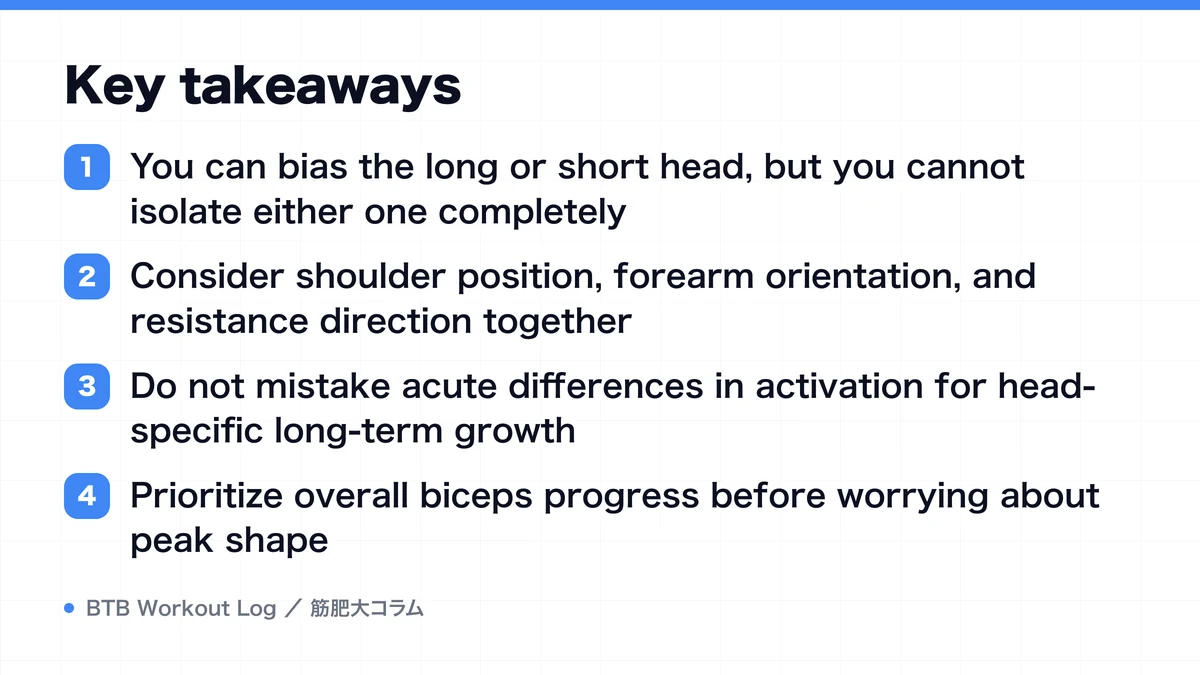
Key takeaways
- You can bias the long or short head, but you cannot isolate either one completely
- Consider shoulder position, forearm orientation, and resistance direction together
- Do not mistake acute differences in activation for head-specific long-term growth
- Prioritize overall biceps progress before worrying about peak shape
References
- Lengthened Partial Repetitions Elicit Similar Muscular Adaptations as Full Range of Motion Repetitions During Resistance Training in Trained Individuals
- Muscle Hypertrophy Is Independent of Load Across Upper and Lower Limbs When Effort Is Matched
- Comparison Between Shoulder Flexed and Extended Positions in Elbow Flexion Resistance Training on Regional Hypertrophy and Maximum Strength: Preacher versus Bayesian Cable Curls