Does Hammer Curl Build a Bigger Arm? | The Muscle Lifters Miss When They Only Train Biceps
Hammer curls can help build bigger arms. They do not switch off the biceps to isolate the brachialis; the neutral grip simply distributes the load across several elbow flexors.
The brachialis can add upper-arm thickness, while the brachioradialis affects the area around the outer elbow and upper forearm. This makes hammer curls useful for filling gaps that supinated curls alone may miss.
Break “Bigger Arms” Down into Upper Arms, Forearms, and Biceps
Hammer curls involve bending the elbow with your palms facing each other in a neutral grip. The main elbow flexors are the biceps brachii, brachialis, and brachioradialis. Changing your grip does not switch these muscles on and off; they share the work according to the joint angle.
The brachialis lies beneath the biceps brachii and contributes to elbow flexion regardless of whether the forearm is supinated or pronated. Developing it may add thickness to the front and outer upper arm. The brachioradialis runs from the outer humerus into the forearm, so it contributes more to the size around the elbow and upper forearm than to the upper arm itself. Rather than viewing hammer curls as a way to make only the upper arm bigger, treat them as an exercise that rounds out the appearance of the entire arm across the elbow.
The answer is conditional. A neutral grip can contribute to arm muscle growth if you maintain the intended range of motion, the elbow flexors are the limiting factor, and you progressively add load or reps over several weeks. If you simply swing a heavy dumbbell up with your shoulders, calling it a hammer curl will not produce the stimulus you expect.
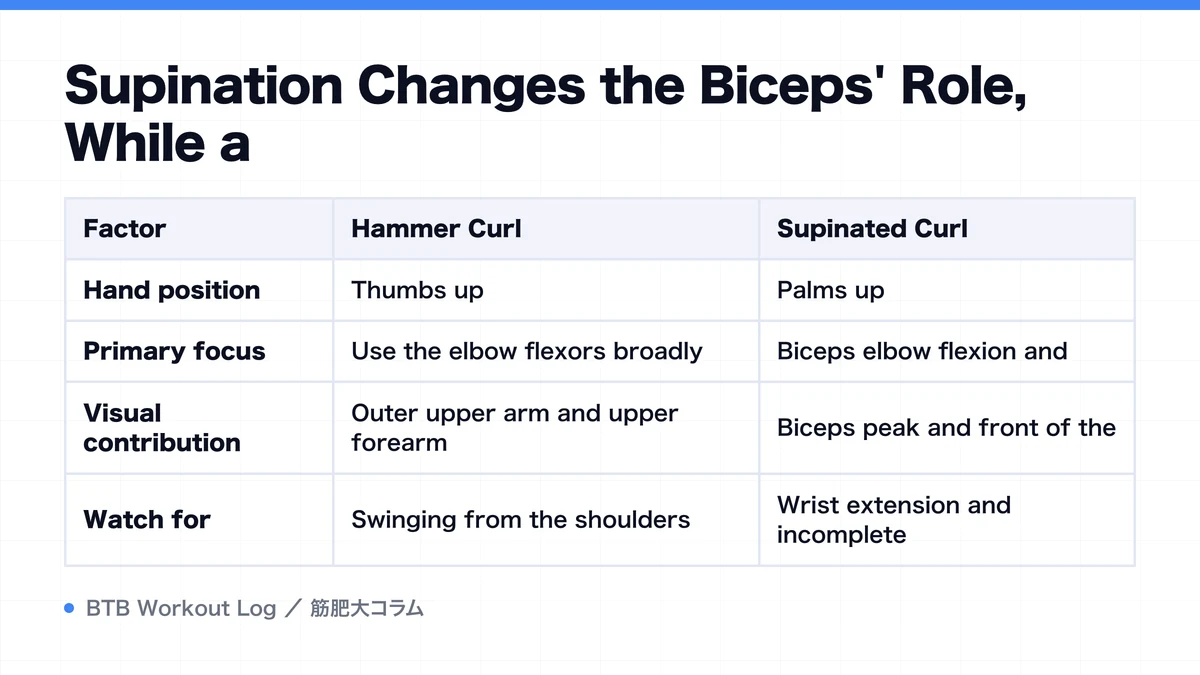
Supination Changes the Biceps' Role, While a Neutral Grip Redistributes Elbow Flexion
| Factor | Hammer Curl | Supinated Curl |
|---|---|---|
| Hand position | Thumbs up | Palms up |
| Primary focus | Use the elbow flexors broadly | Biceps elbow flexion and supination |
| Visual contribution | Outer upper arm and upper forearm | Biceps peak and front of the upper arm |
| Watch for | Swinging from the shoulders | Wrist extension and incomplete supination |
The biceps brachii helps supinate the forearm, so curling with the palms up makes it easier to train that function. A neutral grip places less emphasis on supination and shifts the task toward elbow flexion as a whole, including the brachialis and brachioradialis. The biceps still works to bend the elbow, so the claim that hammer curls do not train the biceps is incorrect.
Switching to hammer curls will not necessarily improve your ability to target the long and short heads separately. Keep the goals distinct: see the evidence on the long and short heads for biceps shape, and the dumbbell curl vs. preacher curl comparison when choosing between supinated curls.
Treat “the Brachialis Pushes Up the Biceps” as a Metaphor
You may hear that enlarging the deeper brachialis pushes up the biceps and creates a taller peak. It is reasonable to expect brachialis hypertrophy to add overall upper-arm thickness, but there is no basis for treating this as a simple process in which one muscle lifts another and reshapes it exactly as intended.
Appearance also depends on the muscle mass of the brachialis and biceps, muscle-belly length, tendon attachment points, skeletal structure, and subcutaneous fat. Hammer curls cannot guarantee an automatic biceps peak. They can still be useful for someone whose outer upper arms or upper forearms remain relatively underdeveloped after training only with supinated curls.
Do not infer brachialis growth from upper-arm circumference alone. Changes in the biceps and triceps, measurement position, and even a pump can all affect the number. Look at upper-forearm development, improved reps with a neutral grip, and whether supinated curls continue progressing. Together, those measures will tell you whether hammer curls deserve a place in your program.
If brachioradialis development is your main goal, keep the wrist neutral instead of flexing and extending it to move the weight. If you want bigger forearms overall, do not expect hammer curls alone to cover grip strength and wrist flexion and extension. Give those functions their own place through a balanced selection of forearm exercises.
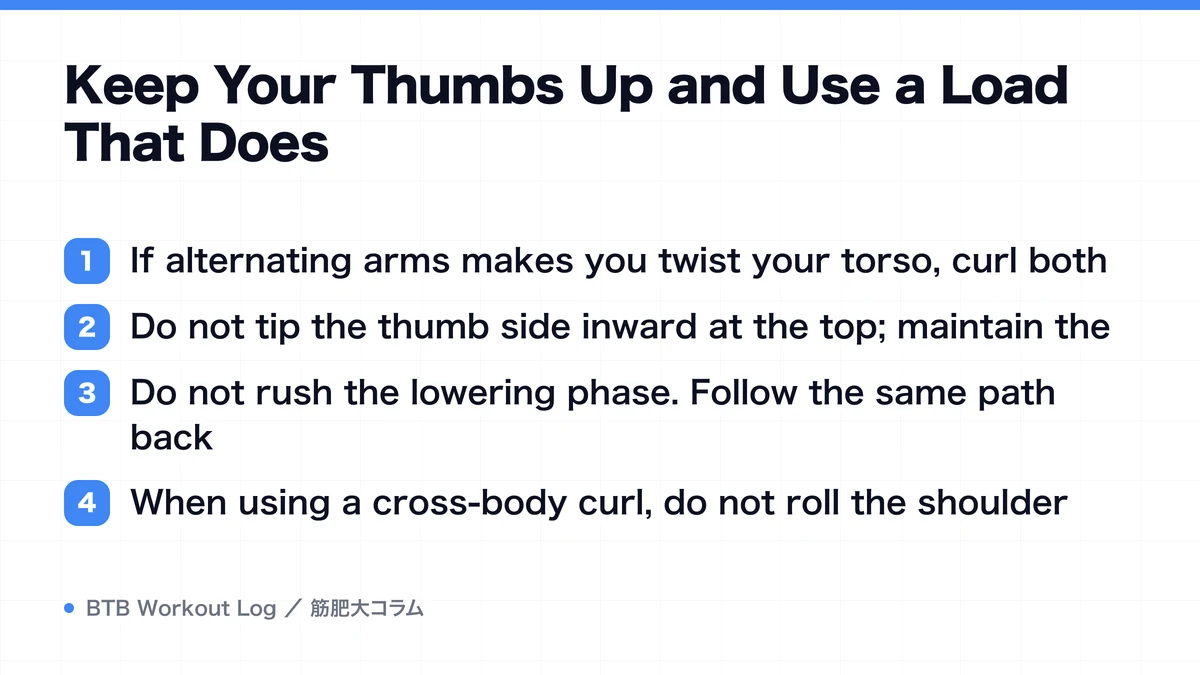
Keep Your Thumbs Up and Use a Load That Does Not Make Your Shoulders Move First
Hold the dumbbells at your sides with straight wrists and your thumbs pointing forward. Do not pin your elbows against your ribs; bend them from where they hang naturally. If your elbows start traveling forward before the dumbbells approach chest height, that is your current endpoint. Lifting higher through shoulder flexion does not increase the elbow flexors' range of motion.
- If alternating arms makes you twist your torso, curl both arms together or sit on a bench.
- Do not tip the thumb side inward at the top; maintain the same grip orientation throughout the rep.
- Do not rush the lowering phase. Follow the same path back until the elbows are nearly straight.
- When using a cross-body curl, do not roll the shoulder inward; keep the upper-arm angle consistent.
With cable curls, cross-body and straight-up versions change the direction of pull, but direct comparisons are not sufficient to show that either one produces greater brachioradialis growth for everyone. Choose the version that feels comfortable at the wrists and elbows and lets you add reps without swinging. If adjusting the load does not resolve discomfort, stop the exercise and leave treatment decisions to a qualified professional.
If your grip gives out first, stop crushing the dumbbell and use only enough force to hold it securely. If supporting the weight with your forearms still ends the set, using a cable rope with smaller load increments can make it easier to keep elbow flexion as the limiting factor.
Use Hammer Curls to Fill a Different Role, Not Compete with Supinated Curls
If overall arm development is the priority, perform supinated curls on one day and hammer curls on another. For example, do 3 sets of dumbbell curls for 6–10 reps on a back day, then 2–3 sets of hammer curls for 10–15 reps on an upper-body day. If pulling exercises already fatigue your forearms, move hammer curls to another day instead of doing them immediately after back training.
The brachialis does not require heavy loads to grow. Research as a whole shows that hypertrophy can occur across a wide range of loads, so choose a weight that lets you keep your wrists stable and begin with sets that leave about 2 reps in reserve. If you aim for 12 reps but your shoulders start swinging first, do not use that set as evidence that you are ready to add weight.
Keep the same training conditions for about 6 weeks and track dumbbell weight, reps, and fatigue around the elbow. If you measure upper-arm circumference, avoid doing so immediately after training and compare measurements taken at the same time of day with the arm in the same position. If your hammer curls improve while your supinated curls keep progressing, the two exercises are complementing each other. If both plateau, first review total volume and recovery as potential reasons your arms are not growing.
FAQ
- Do Hammer Curls Work the Biceps?
- Yes. The biceps contributes to elbow flexion, so it still works during hammer curls. A neutral grip places less emphasis on supination and changes how the work is shared with the brachialis and brachioradialis. Hammer curls do not isolate those muscles by removing the biceps.
- Can I Do Hammer Curls and Standard Dumbbell Curls on the Same Day?
- Yes, but performing similar elbow-flexion exercises back to back can reduce the quality of the later sets. On days when the biceps is the priority, perform supinated curls first, then use only a small amount of hammer-curl work or move it to another day.
- Should I Go Heavy on Hammer Curls?
- Even if you can handle more weight than on a standard curl, load is not the goal by itself. Choose a weight that lets you keep your shoulders still, your thumbs up, and lower the dumbbells until your elbows are nearly straight. Once you reach the top of your rep range, increase the load in small increments.
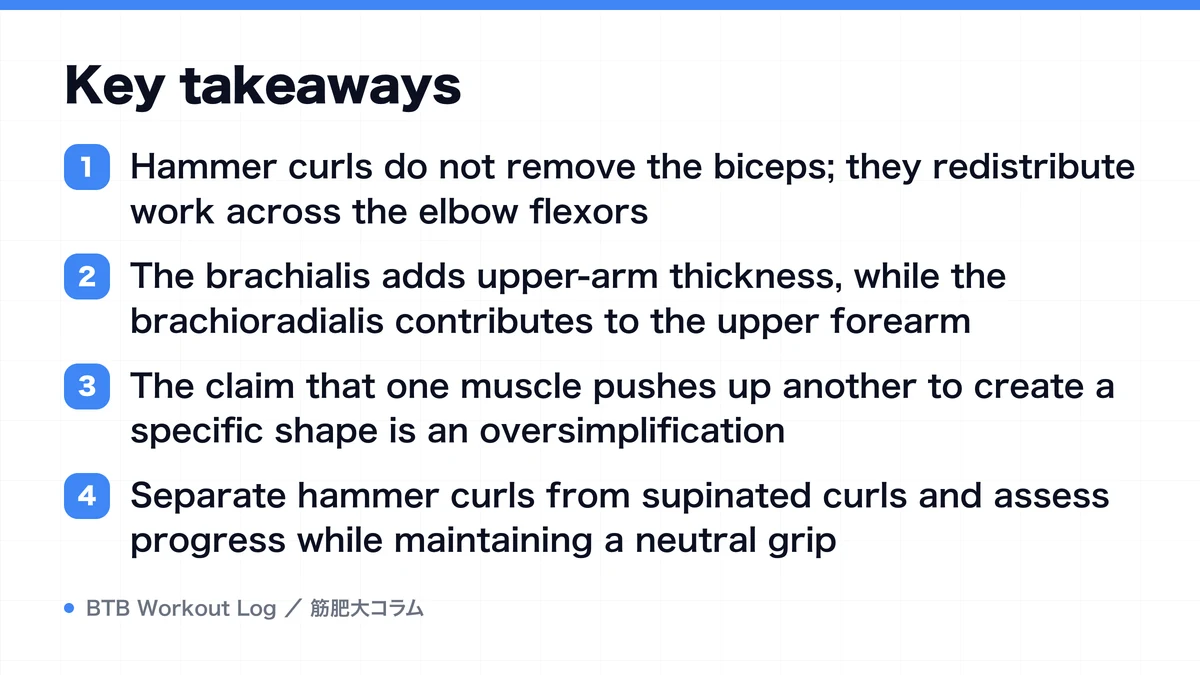
Key takeaways
- Hammer curls do not remove the biceps; they redistribute work across the elbow flexors
- The brachialis adds upper-arm thickness, while the brachioradialis contributes to the upper forearm
- The claim that one muscle pushes up another to create a specific shape is an oversimplification
- Separate hammer curls from supinated curls and assess progress while maintaining a neutral grip
References
- Low- vs High-load Resistance Training for Strength and Hypertrophy: Meta-analysis
- The Influence of Frequency, Intensity, Volume and Mode of Strength Training on Whole Muscle Cross-sectional Area in Humans
- Training in the Initial Range of Motion Promotes Greater Muscle Adaptations Than at Final in the Arm Curl