Do Abs Grow Through Hypertrophy Too? | For a Thick Six-Pack, Prioritize Load Over High Reps
Your abs can undergo hypertrophy just like any other skeletal muscle. If you want thicker abs, what matters is not how many hundreds of reps you can do, but whether you can progressively increase the external load on the rectus abdominis while keeping the movement consistent.
That does not mean heavier is always better. High reps can provide an effective stimulus when the effort is high enough. The point is to consider adding weight once your progress becomes difficult to measure.
There Is No Reason to Treat the Rectus Abdominis as an Endurance-Only Muscle
The rectus abdominis brings the ribs and pelvis closer together and resists spinal extension. It also helps maintain posture in daily life, but that does not make it resistant to hypertrophy. If it experiences enough tension, recovers from that stimulus, and handles progressively greater loads over time, its cross-sectional area can increase.
The idea of doing 100 sit-ups every day probably became popular because bodyweight crunches are convenient and the reps are easy to count. But when you rush through 100 reps of a familiar movement, your range of motion may shorten or your hip flexors may generate momentum, changing the load on the rectus abdominis within the set. More reps do not necessarily mean more work for the target muscle.
Extending your plank time can improve your ability to brace the trunk for longer, but if thicker abs are the only goal, increasing the difficulty before you are holding for several minutes makes progress easier to manage. Choose one variable—hold time, lever length, or added weight—and use the same starting position every time.
Abdominal thickness is only one part of how your abs look. If you carry more subcutaneous fat, the grooves between the muscles will remain less visible. Separating the goal of hypertrophy from the goal of revealing definition through cutting also explains why ab exercises alone may not change your appearance.
High Reps Are Not Ineffective, but Load and Effort Are Harder to Control
Meta-analyses comparing low-load and high-load resistance training indicate that hypertrophy can occur across a wide range of loads. That means ab exercises performed for 20 reps or more are not automatically a waste of time. What makes the difference is whether you take a light set close to the target muscle's limit instead of stopping with plenty of reps in reserve.
The problem is that a near-limit set of 40–60 reps takes time, and breathlessness or a local burning sensation can cloud your judgment first. This is where added weight helps. Increasing the plate, cable, or machines setting can bring you back into a manageable range of roughly 8–20 reps, allowing you to compare sessions with the same form. Weight is not a magic trigger for hypertrophy here; it is a dial that makes the stimulus measurable.
At the other extreme, a load you can perform for fewer than 5 reps can turn the exercise into a contest of bracing before you ever flex the trunk, and you are more likely to lose range of motion. Prioritize a weight that lets you shorten the rectus abdominis, and choose the specific rep target flexibly according to the principles of rep range selection.
3 Exercises That Are Easy to Progress Without Shifting Load Away From the Abs
Cable Crunch
Cable crunches offer small weight increments and make it easy to standardize each rep from either a standing or kneeling position. Instead of pulling the rope with your arms, round your spine to bring your sternum and pelvis closer together. If the weight moves every time you push your hips back, the movement is coming mainly from the hips. Keep your starting position consistent by fixing your distance from the floor or machines.
Weighted Decline Crunch
Hold a plate in front of your chest and use your rectus abdominis to curl your torso upward. Moving the plate behind your head sharply increases the load, so first add weight without changing where you hold it. Rather than sitting all the way up and resting, reverse the movement just before the tension leaves your abs to keep the conditions of each set consistent.
Ab Wheel Rollout
This exercise trains you to resist spinal extension, and you can progress either the distance from your knees or the range of motion. Do not roll out so far that only your lower back drops. Make the endpoint the furthest position from which you can return without flaring your ribs. Because the load is difficult to quantify, place a marker on the floor and record both the distance reached and the number of reps.
Leg-raise variations can also load the abs, but simply lifting and lowering your legs makes the hip flexors do most of the work. Include them only if you can create a phase in which the pelvis curls toward the ribs. The search intent behind the lower abs is covered separately in training the lower abs separately.
Use RIR and Double Progression to Select the Weight
For your first session, find a load that lets you perform 8–20 reps through your target range of motion while leaving another 2–3 reps in reserve. RIR 2 means you could complete roughly 2 more reps with good form. Because ab training overlaps with forceful exhalation, take a short breath before each rep so you do not mistake breathlessness for muscular failure.
The progression is simple. If your target is 10–15 reps, add reps to each set at the same weight. Once every set reaches 15 reps, increase the weight by one increment at the next session. If you fall below 8 reps after adding weight, or the distance between your pelvis and ribs does not change, you progressed too soon. The purpose of adding weight only holds when the movement itself remains consistent.
Research on pushing to failure suggests a possible relationship between hypertrophy and proximity to failure, but it does not mean every set must reach failure. You might keep the first set around RIR 2 and take only the final set to RIR 0–1, limiting fatigue to a level you can reproduce next time.
Start With 4–8 Weekly Sets and Track Performance Separately From Thickness
Squats and rows use the trunk, but they do not count the same as direct sets in which the rectus abdominis actively shortens. Start with 2–4 sets each of a weighted crunch variation and an exercise that resists extension, split across 2 days per week. This lets you practice the movements while limiting fatigue in any one session. Even if you can train your abs frequently, keep total weekly volume fixed at first, spread it across the week, and monitor recovery.
Track performance through weight, reps, range of motion, and RIR. Short-term physical changes are hard to judge without photos taken under the same lighting and in the same position, or measurements such as ultrasound when needed. They are also affected by body fat and abdominal fullness. Do not double your sets because the grooves are no deeper after 2 weeks. Complete about 6–12 weeks of comparable training before making adjustments.
If your weight and reps are increasing while your form remains consistent, there is no need to add another exercise yet. Add 1–2 sets only when performance reaches a plateau and your abs are no longer fatigued by the next session. This sequence lets you judge real progress toward hypertrophy instead of relying on the feeling that you completed a lot of reps.
FAQ
- Can I Train My Abs Every Day?
- Some people can recover from daily ab training, but there is no need to perform weighted exercises for thickness every day. Split your direct sets across 2–3 sessions per week and see whether your performance returns at the same weight and range of motion. If you increase frequency, keep your total weekly number of sets unchanged at first.
- How Many Ab Reps Should I Do for Hypertrophy?
- Roughly 8–20 reps is a manageable target, but hypertrophy is not limited to that range. Choose a load that brings you to RIR 1–3 without breaking down the target movement, then add a small amount of weight once you reach the top of the rep range.
- Do I Still Need Ab Exercises if I Squat and Deadlift?
- Squats and deadlifts use your abs to brace the trunk, but that role differs from progressively training the rectus abdominis through active shortening. Direct ab work may be unnecessary if bracing is your only goal, but adding a small amount of weighted crunch work is worthwhile if thicker abs are a priority.
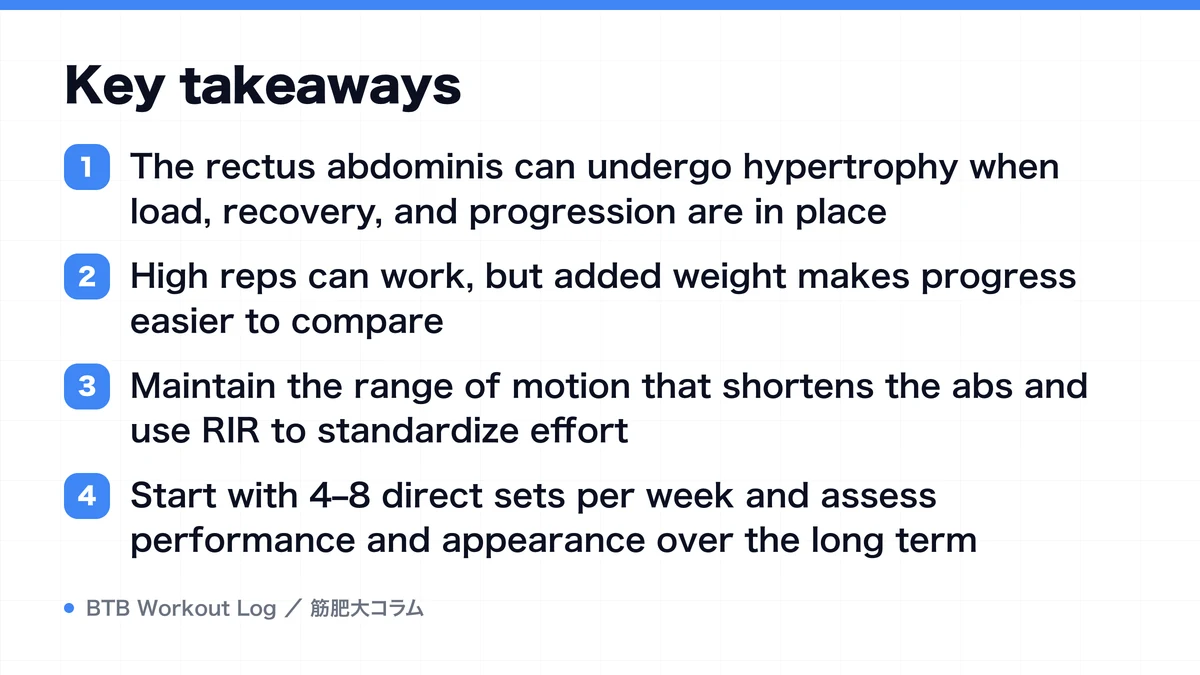
Key takeaways
- The rectus abdominis can undergo hypertrophy when load, recovery, and progression are in place
- High reps can work, but added weight makes progress easier to compare
- Maintain the range of motion that shortens the abs and use RIR to standardize effort
- Start with 4–8 direct sets per week and assess performance and appearance over the long term