Do You Need to Train Front Delts Directly? | Heavy Bench Pressers Are Most at Risk of Overdoing It
If you regularly bench press, incline press, and shoulder press, you may already be doing enough for your front delts without training them directly.
But pressing does not make direct work unnecessary for everyone. You need to consider how much your front delts limit your presses, whether they are genuinely lagging, and whether you can recover from the added work.
Review Your Weekly Pressing Load Before Adding Direct Sets
The front delts raise your upper arms forward and contribute to shoulder movement during bench press variations. Even if you separate chest, shoulder, and arm days, doing flat bench presses, incline presses, dips, and shoulder presses within the same week loads the front delts across multiple days.
Start by listing every horizontal and overhead press in your weekly program. You cannot simply count each set as 1 direct front-delt set. Your chest and triceps share the load, and your technique changes how much work the front delts perform. Still, the indirect load is not zero. Ignore its recovery cost, and you can easily add too much.
Can bench press alone build your chest? examines whether benching provides enough chest work, but those same sets mean something different from the shoulder's perspective. Do not count 10 sets performed for your chest as 10 front-delt sets. Track them as total pressing volume that repeatedly makes your front delts work.
Bench Press Trains the Front Delts, but the Stimulus Varies by Person
In a study of 13 trained lifters performing 12 reps at 60% 1RM, front-delt muscle activity was highest during the shoulder press, but activity was also recorded during the bench press. This shows that benching involves more than the pecs. It does not prove that bench press alone maximizes front-delt growth.
Electromyography measures electrical activity during the exercise; it does not directly measure muscle thickness several months later. Shoulder-joint demands also change with grip width, bench angle, elbow path, and torso position. The front-delt contribution cannot be assumed to be identical for everyone doing the same “3 sets of bench press.”
To decide whether direct work is necessary, combine the research average with your own progress. There is little reason to add front raises if your front delts are already prominent, your bench and overhead press are improving, and fatigue in the front of your shoulders lasts until the next session. Conversely, direct work may be worth testing if your chest or triceps ends every set first and your program includes almost no movement that specifically targets the front delts.
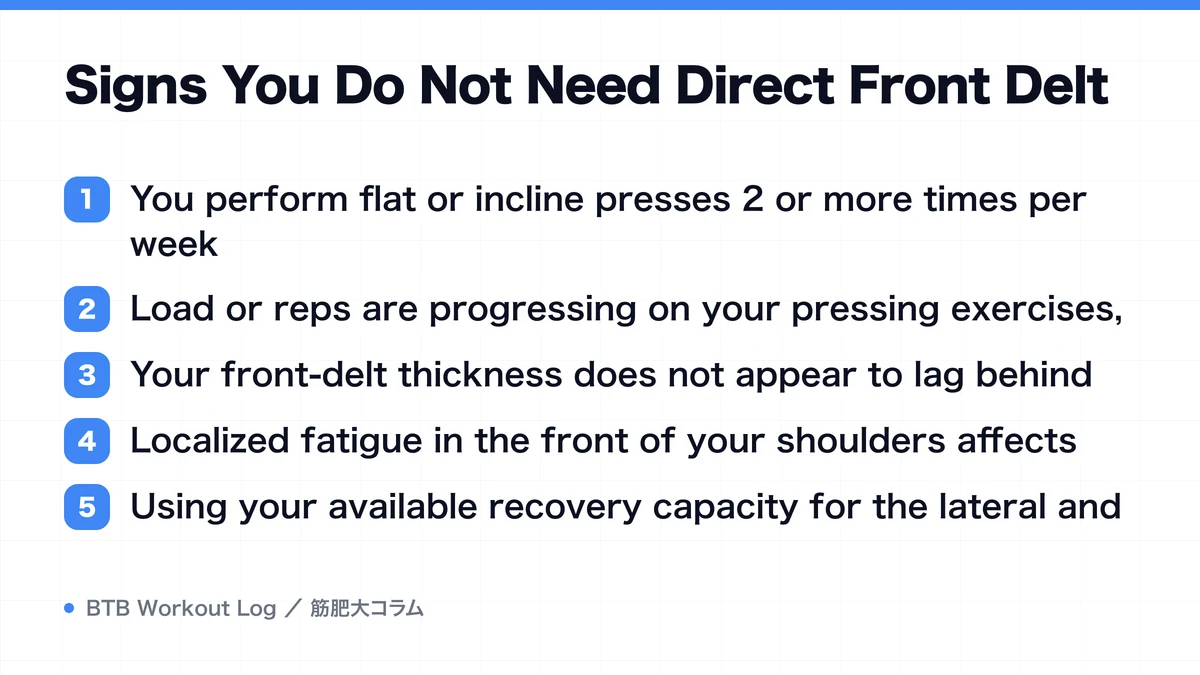
Signs You Do Not Need Direct Front Delt Training
- You perform flat or incline presses 2 or more times per week
- Load or reps are progressing on your pressing exercises, including the shoulder press
- Your front-delt thickness does not appear to lag behind your lateral or rear delts
- Localized fatigue in the front of your shoulders affects your next chest or shoulder workout
- Using your available recovery capacity for the lateral and rear delts better supports your goal
If these points describe you, skipping front-delt work is smart allocation, not cutting corners. You can spend your limited time and recovery capacity on lateral raises and rear-delt exercises, which are harder to replace with pressing. The complete shoulder workout also separates the roles of the front, lateral, and rear delts, but do not turn that into a fixed rule that “front delts never need direct work.”
Research on weekly set volume shows an average dose–response relationship, but adding more does not make everyone grow indefinitely. Adding just one form of direct work can reduce the quality of your chest training or overhead pressing that same week. Before increasing total volume, check whether your current sets reach the intended reps in reserve and whether your performance returns after recovery.
If Your Front Delts Clearly Lag, Test a Small Amount of Direct Work
Direct work is easier to justify if you do little chest pressing, avoid overhead pressing because of your sport or circumstances, struggle to give the front delts enough repetitions because your chest or triceps fails first, or have seen no change in front-delt thickness from the front for a long time. A weak pump is not enough. The gap should persist in both your program and your physique.
If you add direct work, start with 2–4 weekly sets of dumbbell or cable front raises. Use a load you can perform for roughly 10–20 reps without using momentum to lean backward, moving pain-free until your upper arms are around parallel to the floor. RIR means reps in reserve: how many more reps you could have performed. Leaving 2–3 reps in reserve is enough at first. Your priority is to monitor the response while minimizing the effect on your presses, not to exhaust your front delts.
You can also use the shoulder press as direct front-delt work. It makes progressive loading easier than a front raise, but it also involves the triceps and core. Your choice depends on whether you want to isolate the front delts or also improve your overhead pressing ability. Can shoulder presses alone train your delts? examines when a press-only approach can work.
Use a 4-Week Comparison to Decide Whether Front Delt Work Stays
Keep your main chest and shoulder exercises unchanged during the test, adding only 2–4 weekly sets of front raises. Track your rep progress on the raises, performance on the bench press and shoulder press, fatigue in the front of your shoulders, and changes in front and side photos taken under the same conditions. Recording the same metrics for 2 weeks before adding the exercise helps separate its effects from a normal stretch of good performance.
If your front delts progress without interfering with your main presses, the exercise may be worth keeping. If your bench reps fall, fatigue in the front of your shoulders does not clear, or you lose time for your lateral and rear delts, reduce or remove the added work. Whether your main lifts rebound afterward is also evidence of whether the extra volume was excessive. Do not interpret pain as proof of an effective stimulus. If it continues after adjusting your technique, consult a qualified professional.
When using BTB Workout Log, do not rely on it to automatically decide whether your front delts have grown. Use it to compare set count, load, reps, and changes in your main presses under the same conditions before and after adding direct work. With that evidence, you can avoid the vague habit of adding exercises “just in case.” See weekly hard set count for more on adjusting total weekly volume.
FAQ
- How Many Bench Press Sets Make Direct Front Delt Work Unnecessary?
- There is no universal cutoff. The front-delt stimulus from benching changes with the angle, bar path, effort level, and whether your chest or triceps limits the set. Do not decide from set count alone. Consider your progress on pressing exercises, front-delt development, and recovery in the front of your shoulders together.
- Is Incline Bench Press Enough for the Front Delts?
- You can expect the front delts to contribute, but a steeper bench angle is not always better. It also changes the load distribution with the upper chest and how the movement feels on your shoulders. If you incline press and your front delts are not lagging, there is no need to rush into adding direct work.
- Are Front Raises Likely to Hurt Your Shoulders?
- The exercise name alone does not determine whether it will cause pain. Avoid loads that require momentum, forcing the movement through a painful range, and sudden increases in set volume. If pain continues after starting lighter and adjusting your movement path, stop the exercise and consult a qualified professional instead of trying to train through it.
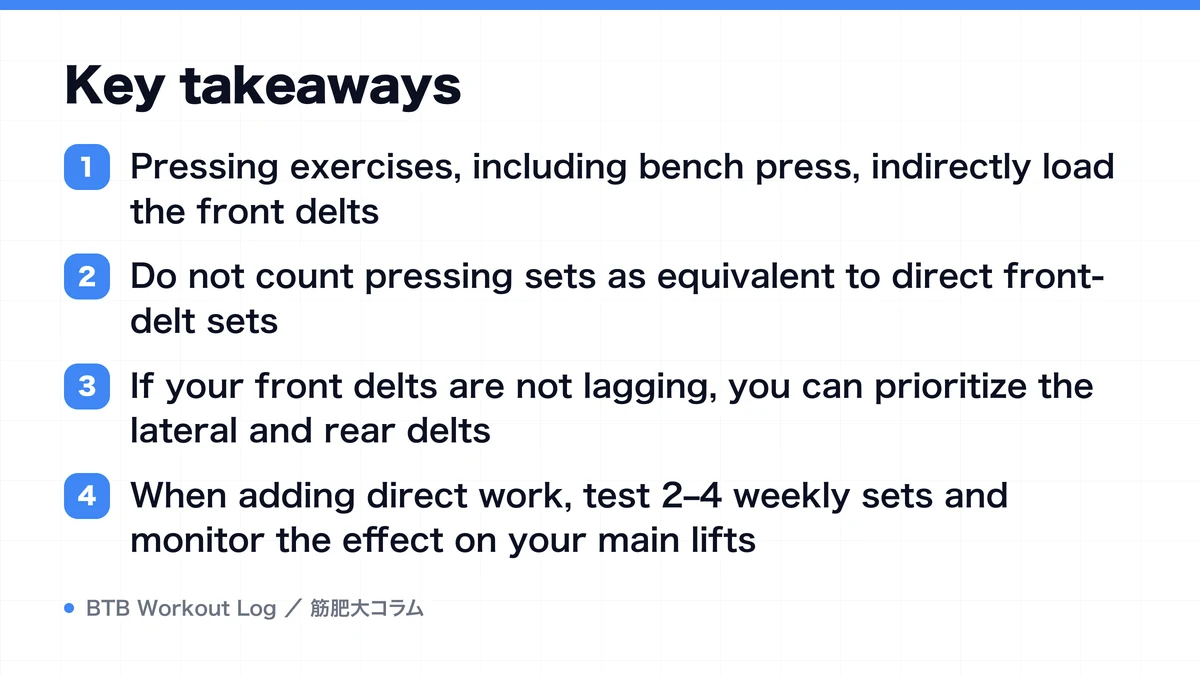
Key takeaways
- Pressing exercises, including bench press, indirectly load the front delts
- Do not count pressing sets as equivalent to direct front-delt sets
- If your front delts are not lagging, you can prioritize the lateral and rear delts
- When adding direct work, test 2–4 weekly sets and monitor the effect on your main lifts