Does Shoulder Press Alone Build Big Delts? | Why That's Not Quite Enough
Shoulder presses alone can readily build the front delts, and they also train the side delts. But if you want more shoulder width and a fully rounded look, presses alone will only be enough under certain conditions.
The question is not whether your shoulders will grow a little. It is whether you can consistently deliver an effective load to the front and side delts and build the look you want. The weight on the bar alone cannot tell you that.
Separate Front-Delt Thickness from Shoulder Width
The shoulder press is a compound exercise that raises the upper arms overhead at the shoulder while extending the elbows. Front-delt thickness from the front, side-delt projection from the side, and rear-delt roundness do not necessarily grow evenly from the same exercise. If you treat “bigger shoulders” as a single outcome, developing only the front delts can look like success.
When evaluating a press-only routine, separate three factors. First, are the load or reps increasing through the same range of motion? Second, are your sets ending because of the shoulders, rather than the triceps or excessive lower-back arching? Third, is the outline you care about changing from the front, side, or rear? Our deltoid workouts by region cover the basic structure of complete shoulder training; here, we will focus on when a single exercise can be enough.
Research Shows Muscle Activity, Not Long-Term Growth
In an acute comparison, 13 resistance-trained men performed 12 reps at 60% 1RM. Front-delt activity during the shoulder press was higher than during the bench press, dumbbell fly, and lateral raise. For the side delts, the shoulder press and lateral raise produced more activity than the bench press and dumbbell fly. So it is inaccurate to treat the press as a front-delt-only exercise that does nothing for the side delts.
However, this study measured muscle activity during a single workout. It was not a training intervention directly comparing which exercise produced more side-delt growth several months later. EMG tells us that a muscle participated in the movement; it is not a ranking of hypertrophy outcomes.
The triceps also extend the elbows during presses, while the upper chest and trunk help maintain position. Even when the target muscle is active, some lifters reach failure in a supporting muscle before the delts receive enough stimulus in each set. The large loads that make compound exercises useful are not directed exclusively to the delts.
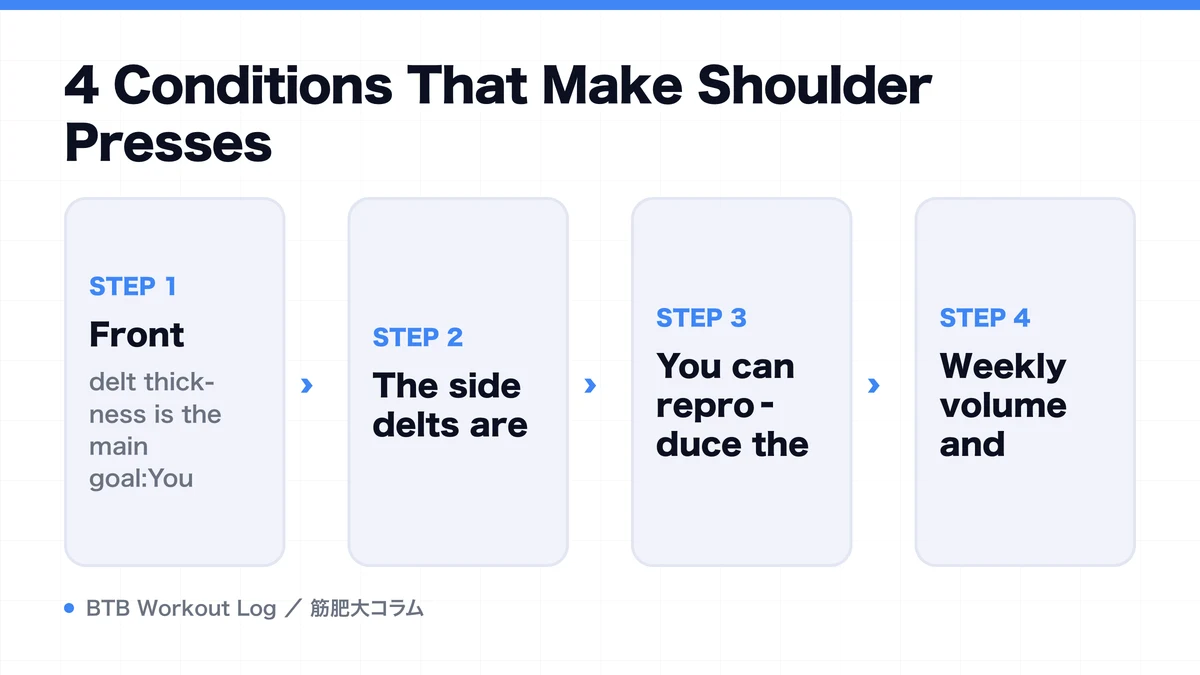
4 Conditions That Make Shoulder Presses Enough on Their Own
- Front-delt thickness is the main goal:You prioritize frontal shoulder mass or overhead pressing strength over shoulder width.
- The side delts are genuinely the limiting muscle:Your shoulder output drops before your triceps or lower-back position gives out, and you can keep your elbows traveling upward and out to the sides through the final reps.
- You can reproduce the range of motion:You can move comfortably through the bottom and avoid arching your lower back to get underneath the weight at the top.
- Weekly volume and progress are sufficient:You perform enough recoverable hard sets and add reps or load over periods of several weeks.
If you meet these conditions and your physique is changing in the intended direction, there is no reason to add more exercises. Beginners and lifters with little direct shoulder-training experience may respond to the novel stimulus of a single press. With more training experience, however, the gap between a strong front delt and a lagging side delt is more likely to persist when you rely on the same movement.
You do not need to lock yourself into one rep target. A range of about 6–15 reps is usually practical for maintaining sound technique. You also do not have to take every set to failure; stopping with 1–3 reps in reserve can still provide an appropriate level of effort for hypertrophy. See how to choose your rep range for the broader picture.
Use Different Movements to Build Side-Delt Width and Rear-Delt Roundness
If your press keeps improving but only the front of your shoulders gets thicker, the exercise may not be giving your side delts enough stimulus. Pressing numbers are especially unlikely to track with shoulder width when you use a relatively narrow grip with the elbows pointing forward, your triceps fatigue first, or you perform reps through only the upper half of the range of motion.
In that case, keep the press and add about 4–8 weekly sets of lateral raises to train the shoulder moving outward separately. Whether the load is heavy or light matters less than choosing a setup that limits torso momentum and lets the side delts end the set. Treating heavy versus light lateral raises as a separate question keeps their role distinct from pressing.
The rear delts are another issue. They are active during shoulder presses, but presses are unlikely to fully replace movements that take the arms backward. If you want more roundness from the rear, assess the contribution of rear-delt flyes and rowing movements. If your back consistently limits your rear-delt work, start by fixing your rear-delt fly form.
Hold the Variables Constant for 6 Weeks Before Adding Exercises
If presses are currently your only direct shoulder exercise, establish a 6-week baseline before jumping to three movements. Train twice per week with the same equipment and seat position, distributing a total of 6–10 hard sets across those sessions. Keep the range of motion consistent and record the load, reps, and what caused each set to end. If your numbers improve and your front and side delts change as intended, stay with the plan.
If the load increases but your shoulder width does not, only your triceps fatigue worsens, or your lower-back arch becomes more pronounced in later sets, split the jobs between exercises instead of adding more press sets. One weekly setup is 3–4 sets of shoulder presses and 3 sets of lateral raises on day 1, followed by 3 sets of lateral raises and 3 sets of a rear-delt exercise on day 2. Avoid cramming everything into one session if it reduces the quality of each movement.
If you use progress photos, keep the lighting, distance, and arm position consistent. Daily changes in your pump and body weight can distort your impression of your physique, so compare photos under the same conditions every 2 weeks and treat them as a separate metric from performance in your training log. If you have a pronounced left-to-right imbalance, machines or dumbbells that allow unilateral training are also worth considering.
Whether presses alone are enough depends on the alignment between your goal, the limiting muscle, and measurable progress—not the exercise name. A single press can work for front-delt-focused development, but the more you want complete shoulders with side-delt width and rear-delt roundness, the stronger the case for adding movements in different directions.
FAQ
- Do shoulder presses train the side delts?
- The side delts do participate in the movement. In an acute study of resistance-trained men, side-delt activity during the shoulder press was not significantly different from the lateral raise. However, EMG results alone cannot establish that both exercises produce the same long-term hypertrophy.
- Which exercise should I choose if I only do one shoulder movement?
- The shoulder press is a strong choice if front-delt thickness and pressing strength are your priorities. If shoulder width comes first, lateral raises play a larger role. Choose based on the look you want and the stimulus your delts already receive from chest and back exercises, not on which single movement seems most versatile.
- How many sets of lateral raises should I add to my presses?
- Start with about 4–8 weekly sets split across roughly 2 sessions, maintaining good form and stopping with 1–3 reps in reserve. There is no single fixed answer, so monitor pressing performance, shoulder recovery, and changes in width for 4–8 weeks, then adjust the volume gradually if needed.
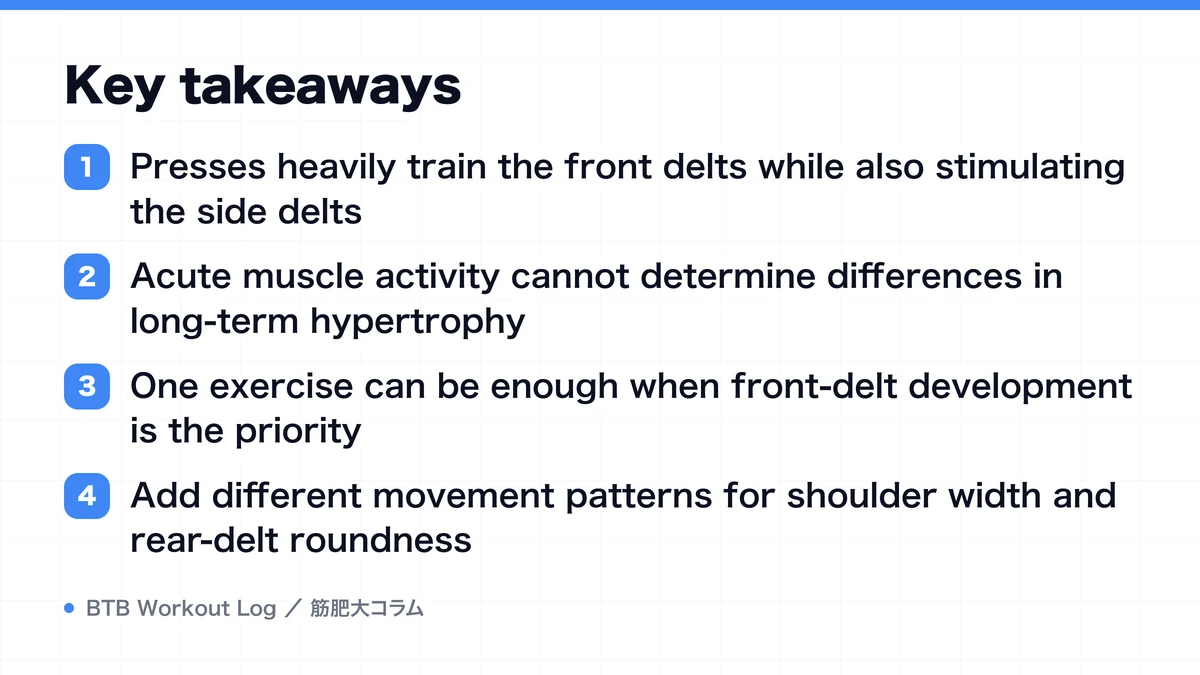
Key takeaways
- Presses heavily train the front delts while also stimulating the side delts
- Acute muscle activity cannot determine differences in long-term hypertrophy
- One exercise can be enough when front-delt development is the priority
- Add different movement patterns for shoulder width and rear-delt roundness