Cable vs. Dumbbell Lateral Raise: Which Widens Your Shoulders More?
No single implement is always best for building wider shoulders. Choose cables if you want resistance from the bottom, or dumbbells if you value quick setup and training both sides at once.
What matters is not whether you feel constant tension, but whether you can work hard through the target range of motion and keep progressing the same movement over time.
Set 5 Criteria Before Comparing the Two
Cable and dumbbell lateral raises both train the lateral delts by moving the upper arm away from the body. The names may be similar, but the direction of resistance and setup differ. We will compare them in the same order: hypertrophy stimulus, resistance curve, movement stability, progression increments, and time efficiency.
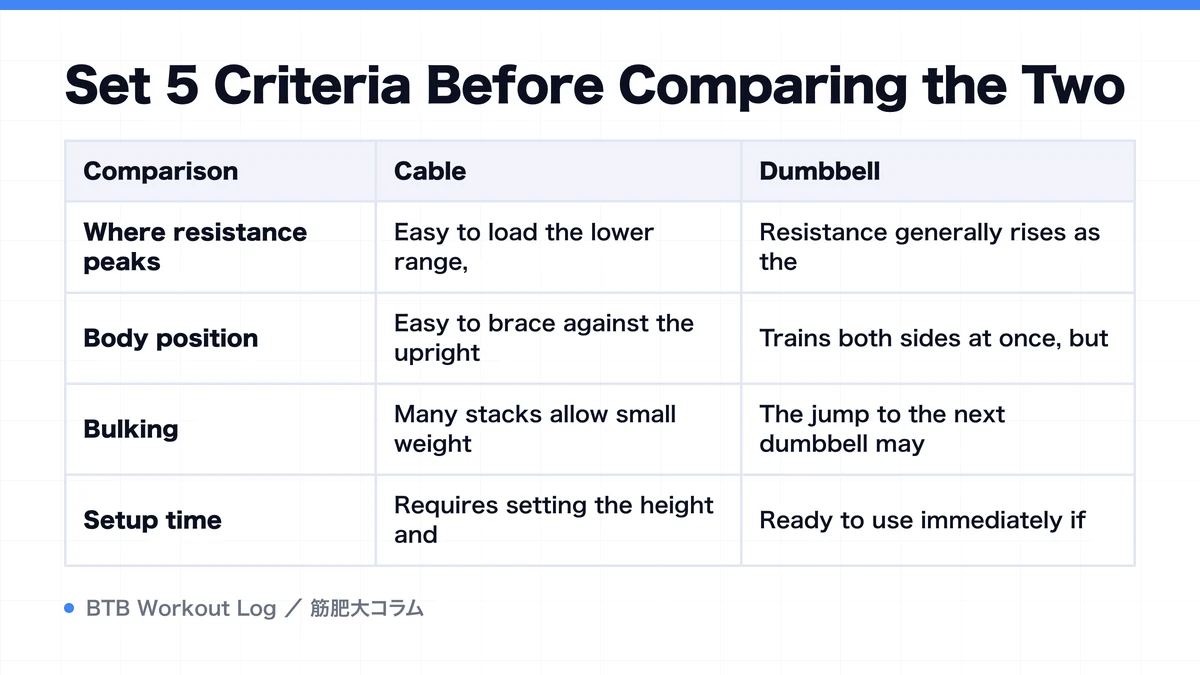
| Comparison | Cable | Dumbbell |
|---|---|---|
| Where resistance peaks | Easy to load the lower range, depending on the anchor point | Resistance generally rises as the arm approaches horizontal |
| Body position | Easy to brace against the upright during unilateral work | Trains both sides at once, but makes momentum easier to use |
| Bulking | Many stacks allow small weight increments | The jump to the next dumbbell may be large |
| Setup time | Requires setting the height and your position | Ready to use immediately if available |
| Left-right differences | Easy to assess one side at a time | Training both sides together can hide imbalances |
Beyond the resistance itself, consider whether you can perform the exercise consistently in a crowded gym. First, review your deltoid exercise selection to see whether your overall shoulder program lacks enough lateral-delt work.
Cables Load the Bottom More Easily; Dumbbells Load the Top
A dumbbell always pulls toward the floor. At the starting position, with the arm hanging beside the body, the distance from the shoulder joint to the line of gravity is short, so external torque on the lateral delt is low. That distance increases as the elbow approaches shoulder height, making the upper portion feel harder.
With a cable set low, the wire pulls across the body, creating distance between the shoulder joint and the line of force even when the arm is lowered. Starting with the arm crossing in front of the opposite leg also makes it easier to load the adducted position. However, changing the pulley height, your distance from the stack, or the cable angle changes the exercise. You cannot assume that cables provide constant resistance through the full range of motion.
Loading the lengthened position relates to stretch-position loading, but it does not directly prove that cable lateral raises are superior for hypertrophy. The mechanical difference of having tension in the lower range must be separated from the question of which option produces more long-term growth.
How Easily You Can Track Progress Depends on the Equipment and Weight Increments
During a single-arm cable raise, you can hold the upright with your free hand and keep your rib cage and pelvis stable. A wrist cuff can also reduce the influence of your grip. However, leaning farther away from the upright changes both the range of motion and cable angle. Unless you standardize the lean, you are not repeating the same exercise from one session to the next.
Dumbbells let you train both sides at once, so the same number of sets usually takes less time. You can easily check your form in a mirror and perform the exercise at home. However, increasing each hand from 5 kg to 6 kg is a 20% jump, which is substantial for a small muscle group. When bulking is not yet possible, add reps at the same weight and reach the top of your rep range without shortening the range of motion before moving up.
With either option, do not treat the displayed weight alone as progressive overload. Only when your starting position, elbow bend, top position, and RIR remain consistent can added reps or resistance count as progress. Because pulley configurations affect the difference between a cable stack's displayed weight and the resistance in your hand, avoid directly comparing numbers from different machines.
Muscle Activity and General Loading Research Cannot Settle the Debate
EMG studies of shoulder exercises, including lateral raises, have found differences in lateral-delt activity between movements. This supports lateral raises as an option for targeting the lateral delts, but it does not show whether cables or dumbbells produce more hypertrophy after several months. EMG measures activity during a test; it is not a substitute for long-term adaptation.
Across resistance training research, pooled studies comparing low and high loads taken to failure have found similar changes in hypertrophy. This is not an equipment comparison, and the studies also required every set to reach failure. It tells us that heavier dumbbells are not automatically better, but it does not guarantee that a light cable produces the same result.
In practice, the biggest difference is often whether you can direct your effort into the target muscle. If dumbbells cause trap-dominant movement but cables help you control the path, cables are the better choice for you. Conversely, if your cable setup changes every session while dumbbells let you reproduce the same position, that consistency matters more than the theoretical resistance curve.
Choose by Goal, or Use Both Across the Week
When to Prioritize Cables
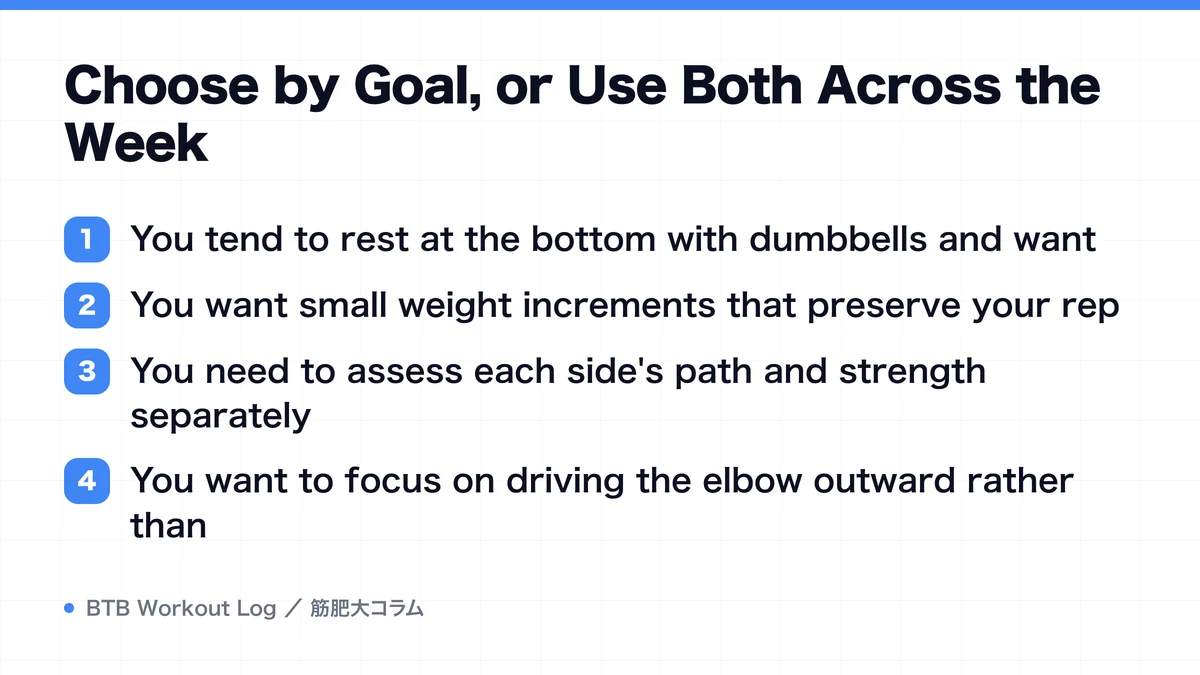
- You tend to rest at the bottom with dumbbells and want resistance from an adducted position
- You want small weight increments that preserve your rep range and allow bulking without changing form
- You need to assess each side's path and strength separately
- You want to focus on driving the elbow outward rather than on your wrist or grip
When to Prioritize Dumbbells
- You want to train both sides together and finish your sets quickly
- You want to keep your shoulder sessions consistent even when the cable station is busy
- You can access the same equipment anywhere, including at home
- You can maintain your body position and elbow path through the middle and upper range of motion
If you cannot choose, use cables for 10–20 reps in one of your 2 weekly sessions and dumbbells for 15–25 reps in the other. However, adding both in the first week mixes the effect of equipment choice with an increase in total volume. Replace your existing lateral raises and start with 2–4 sets of each.
Keep the same exercise order and form standards for about 6 weeks, then compare rep progress, how your shoulders and neck feel, and the total time including setup. If you progress with both, the difference is probably small, so choose based on preference and equipment access. Instead of searching for the universal winner for shoulder width, keep the option that lets you perform high-quality sets consistently within a weekly volume compatible with recovery.
FAQ
- Are cables better than dumbbells because they maintain constant tension?
- The cable remains under tension, but torque at the shoulder changes with the pulley position and arm angle. Cables can make the lower range easier to load, but they are not guaranteed to produce more long-term hypertrophy. Choose based on repeatability and measurable progress as well.
- Which is more efficient: single-arm or two-arm lateral raises?
- Two-arm dumbbell raises take less time, while single-arm cable raises generally make it easier to stabilize your body and assess left-right differences. Unilateral work takes longer once rest periods are included, so choose the method that fits your full session.
- Should I do both cable and dumbbell lateral raises on the same day?
- It is not required. If you want to cover different parts of the range of motion, you can perform about 2 sets of each, but that also creates overlap between similar movements. First confirm that you can progress with one, then add the other only when you identify a clear gap.
Key takeaways
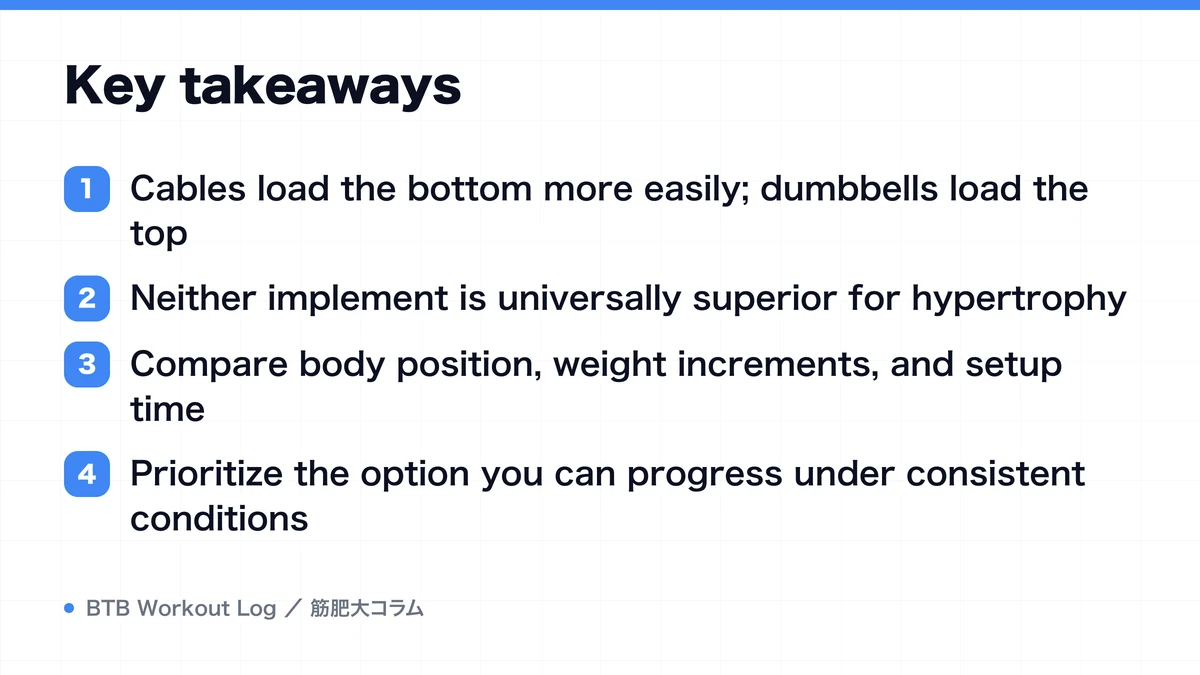
- Cables load the bottom more easily; dumbbells load the top
- Neither implement is universally superior for hypertrophy
- Compare body position, weight increments, and setup time
- Prioritize the option you can progress under consistent conditions