Do You Need Shrugs for a Bigger Trap? | Are Deadlifts and Rows Already Enough?
Shrugs are a strong choice if you specifically want bigger upper traps, but they are not essential for everyone chasing overall trap growth.
Deadlifts make your shoulder girdle resist being pulled downward, rows retract your shoulder blades, and shrugs elevate them. Whether you need shrugs depends on which region you want to grow and which movement your current program is missing.
Define “Bigger Traps”: Upper, Middle, or Lower
The trapezius is a single broad muscle spanning the back of the head, thoracic spine, and shoulder blades, but its fiber direction and function vary by region. The upper traps, which create the slope from your neck to your shoulders, contribute to scapular elevation and upward rotation. The middle traps pull the shoulder blades toward the spine, while the lower traps assist with depression and upward rotation.
Shrugs therefore target the upper traps most directly. If you want more thickness through the middle of your back, simply adding more shrugs will not provide enough scapular retraction. Conversely, if your goal is a thicker neck and shoulder profile from the front or side, rows alone may not provide enough dynamic loading for the upper traps.
If the middle traps are your priority, consider chest-supported rows or reverse flyes. If you also need more lower-trap work, movements that take the arms overhead are another option. Once you stop expecting one shrug variation to develop all three regions equally, you can avoid adding unnecessary direct sets.
Start by using photos and your training goals to identify what you actually need: more height beside the neck, more thickness between the shoulder blades, or better scapular stability. Treating every trap exercise as interchangeable simply because it trains the same named muscle is a poor starting point.
Deadlifts Make the Traps Hold Heavy Loads, but They Do Not Elevate the Shoulder Blades
During a deadlift, your arms hang long while the barbell pulls your shoulder girdle downward. The upper back, including the traps, supports a heavy load isometrically to keep your shoulders from collapsing under that force. This can stimulate the traps, but it is not the same as repeatedly moving the shoulder blades up and down in a shrug.
Your maximum deadlift load also depends on several factors, including your glutes, hamstrings, spinal erectors, grip, and technique. Even when you want to keep pushing the traps to failure, adding more deadlifts may increase whole-body fatigue before it adds useful trap work. The case for including deadlifts is covered in the value of deadlifts for back hypertrophy. Here, treat “holding something heavy” and “shortening the upper traps” as two different stimuli.
If you also want to improve hip-hinge strength and your upper traps are already growing from deadlifts, skipping shrugs is reasonable. If deadlifts only exhaust your lower back and grip while your neck and traps remain unchanged, however, do not assume the load is sufficient simply because it is heavy.
Rows Build Back Thickness, but Their Main Scapular Action Is Retraction
During barbell and seated rows, your shoulder blades retract as your elbows travel behind you. The middle traps, rhomboids, lats, and rear delts work together, making rows important for building thickness between the shoulder blades. They are not, however, designed primarily to elevate your shoulders toward your ears.
Rows performed with the elbows slightly flared and pulled toward the chest tend to emphasize the upper back. Keeping the elbows tucked and pulling toward the waist shifts more of the work toward shoulder extension by the lats. See barbell rows vs. seated rows when choosing between row variations, and judge whether they can replace shrugs by tracking upper-trap growth.
Adding a shrug at the end of each row to extend the range of motion can simply turn the finish into an upper-trap-dominant compensation under a heavy load. Keep sets for the middle back focused on scapular retraction, and train elevation separately if that is your goal. This makes progress in each movement easier to track.
If Your Upper Traps Are Lagging, Shrugs Add Direct Work with Little Technical Cost
Add shrugs when upper-trap development is a high priority, your appearance or performance is not changing with your current pulling exercises, and you have enough recovery capacity for another 2–6 sets. Shrugs are more targeted than adding deadlifts, and using machines or dumbbells can limit stress on the lower back. This lets you address a weak point without disrupting your full-body program.
Keep your arms long and raise your shoulders straight upward or along their natural scapular plane. You do not need to force your shoulders all the way into your ears. Pause briefly at the highest position your shoulder blades can actually reach, then lower the weight under control. Large forward-and-back shoulder circles do not match the direction of resistance and make each rep harder to standardize, so they are unnecessary.
Start with a load that lets you maintain your range of motion for roughly 8–20 reps. If adding weight reduces the movement to a few millimeters, lower the load. If your grip fails before your traps, decide whether to use straps based on your goal and keep that choice consistent between sets. For more detail, see straps for back training.
Stop if elevating your shoulders causes sharp pain or numbness instead of repeatedly trying to correct the path yourself. If the symptoms continue after reducing the load, consult a qualified medical or exercise professional.
Use 4–8 Weeks of Direct Work to Decide Whether Shrugs Stay or Go
If your current program includes 3 sets of deadlifts and 6 sets of rows, but you want to prioritize the upper traps further, start by adding 2–3 sets of shrugs on machines later in the week. You can also place dumbbell shrugs on another day and spread 4–6 weekly sets across both sessions. Do not immediately remove rows. Add a small amount of elevation work first, then monitor its effect on recovery.
Track load, reps, and elevation distance within the same exercise, along with month-to-month changes around your neck. Do not compare deadlift and shrug loads because the movements and range of motion are different. Hypertrophy from resistance training depends on the combination of load, volume, frequency, and exercise type, so there is no threshold at which pulling a specific weight guarantees sufficient trap development.
Keep shrugs if your performance improves, your upper traps develop as intended, and the added work does not interfere with your other pulling exercises. If nothing changes except increased forearm or neck fatigue, review your form, exercise placement, and set volume one at a time. Remove shrugs if they still provide no benefit. Their value is not determined by the exercise name, but by whether they supply missing elevation work at a low recovery cost.
FAQ
- Do heavier deadlifts make shrugs unnecessary?
- Yes, if deadlifts are already developing your upper traps sufficiently and further growth is not a priority. Deadlifts mainly make the traps work isometrically to stabilize the shoulder girdle, however, while shrugs repeatedly train elevation. If your neck and upper traps are lagging, try adding a small amount of direct work.
- Where should I pull my elbows when using rows to train the traps?
- To build thickness between the shoulder blades, flare your elbows slightly and pull toward your chest to place more work on the upper back. Finish by drawing the shoulder blades toward the spine, not by shrugging your shoulders. Train upper-trap elevation in separate sets to keep the goal clear.
- Should you roll your shoulders during shrugs?
- No large circular motion is necessary. Simply elevate your shoulder blades against the direction of resistance from gravity or the cable, then lower them under control. Rolling forward and backward makes the range of motion harder to standardize, so use the same path along your natural scapular plane on every rep.
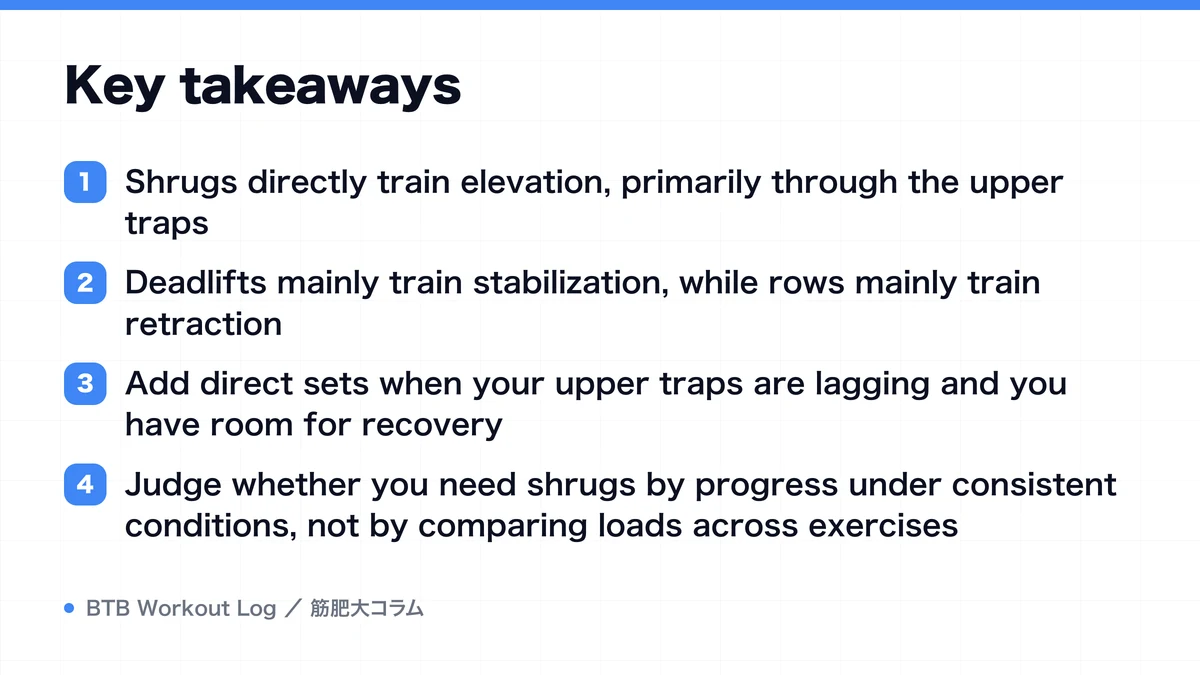
Key takeaways
- Shrugs directly train elevation, primarily through the upper traps
- Deadlifts mainly train stabilization, while rows mainly train retraction
- Add direct sets when your upper traps are lagging and you have room for recovery
- Judge whether you need shrugs by progress under consistent conditions, not by comparing loads across exercises