The Ultimate Shoulder Hypertrophy Workout | How to Build Round Delts That Actually Show Under a T-Shirt
The key to shoulder width and roundness is how much volume you give the lateral (middle) and rear deltoid heads. The front head is stimulated routinely by bench press and overhead press, so adding direct work for it is a lower priority.
The three deltoid heads run in different directions and handle different movements. Start by counting how much volume you are putting into each direction.
Front, lateral, and rear: what each head does
The deltoid splits into front, lateral and rear heads, each with a different role. The front head is used heavily by pressing movements day to day and tends to develop easily. The lateral (middle) head is the center of shoulder width and roundness, and its main job is raising the upper arm out to the side. The rear head is driven by carrying the upper arm backward, and for most people it is the head that gets the least volume.
The three directions are regions within the same muscle, and you cannot use them in complete isolation. Still, the balance shifts clearly depending on the exercise, so counting "how many sets go into which movement" makes a shortfall visible immediately. The difficulty of shoulder training is that the structure makes it easy for the front head alone to accumulate volume.
Treating the priority order as lateral, rear, then front is a manageable starting point. The more pressing you already do, the better this order matches your situation.
Counting is simple: look at a week of your program and total the sets for exercises that raise the upper arm out to the side, exercises that carry it backward, and exercises that press it forward. It is not unusual to have 10 or more sets of pressing but only 3 sets of raising the arm out to the side.
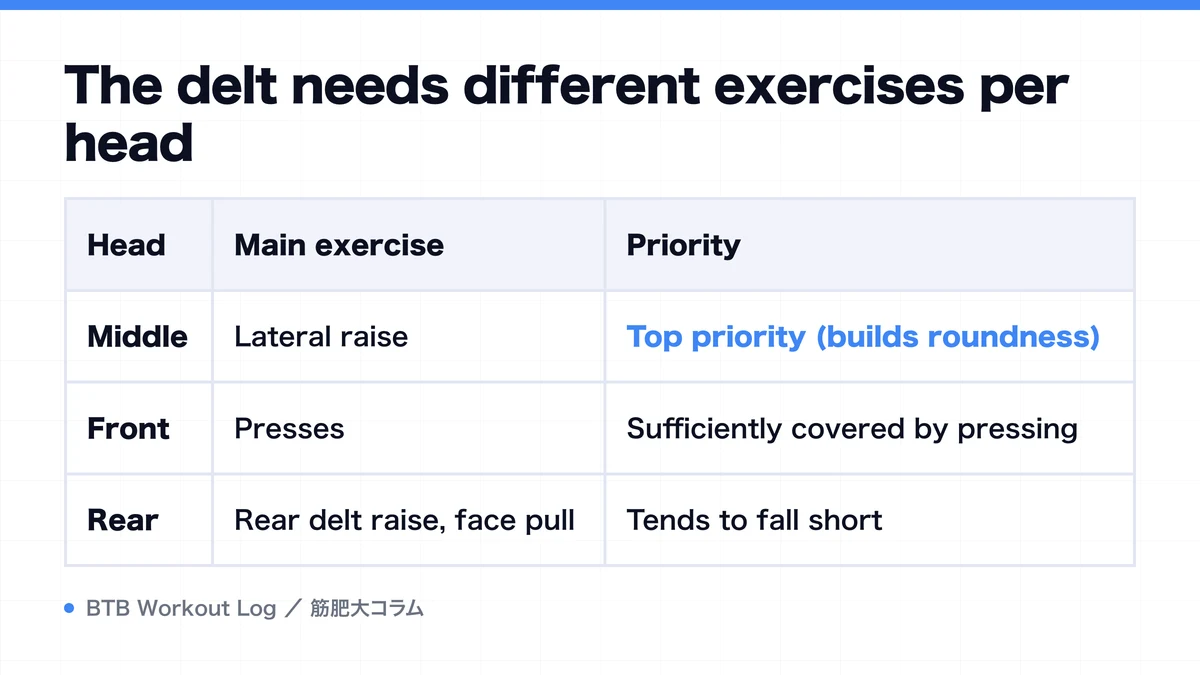
Exercises and priority for each deltoid head
| Head | Exercises | Priority |
|---|---|---|
| Lateral (middle) | Lateral raise, cable raise | Top priority (builds shoulder width) |
| Rear | Rear delt raise, face pull | High (commonly under-trained) |
| Front | Overhead press | Usually covered by your pressing |
For lateral head work, cables and dumbbells load different points in the movement. Dumbbells peak with the arm raised, while cables keep tension even in the lowered position. Neither one is the single right answer - pick one as your main lift and stabilize your rep range first.
The rear head has plenty of options, so try several rear delt exercises and pick the one that lets you carry the upper arm backward without retracting the shoulder blades.
If you are unsure which equipment to use, judge by where in the range of motion the exercise is hardest. If you line up nothing but exercises that lose tension with the arm down, the range that receives stimulus ends up lopsided. Keeping one dumbbell exercise and one cable exercise lets the two cover each other's range.
Making lateral raises reach the lateral head
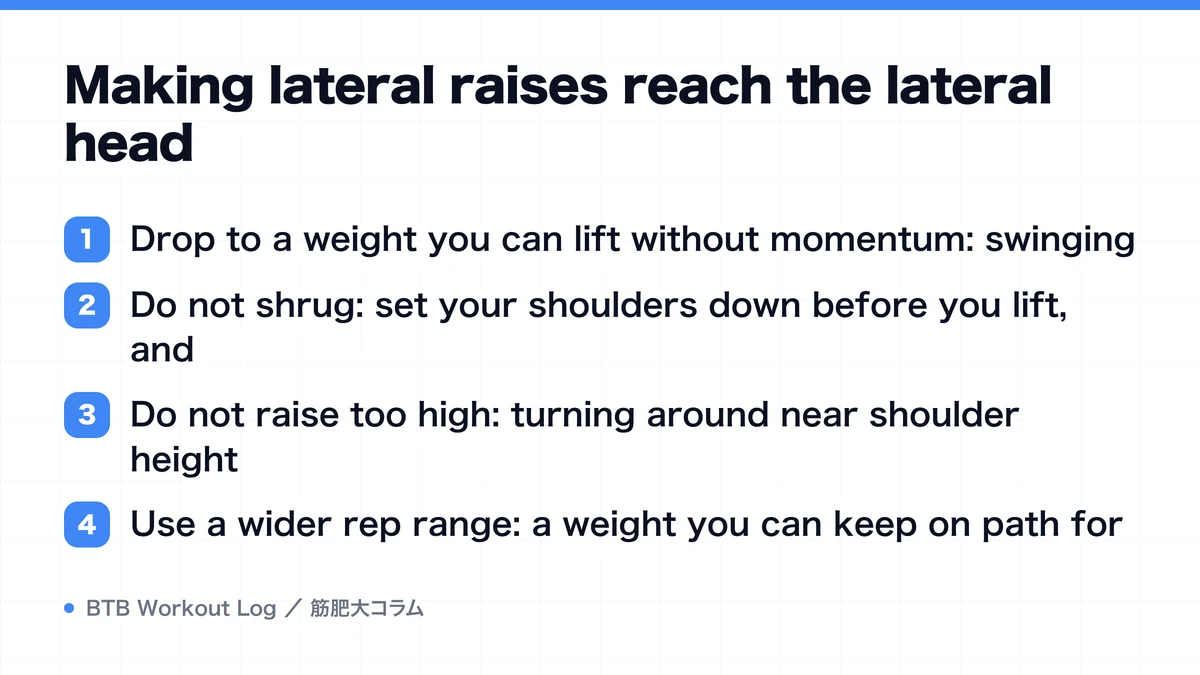
- Drop to a weight you can lift without momentum: swinging the weight up hands the work to the traps and to momentum.
- Do not shrug: set your shoulders down before you lift, and carry the upper arm out to the side while holding that position.
- Do not raise too high: turning around near shoulder height lets you stop before trap involvement increases.
- Use a wider rep range: a weight you can keep on path for 12-20 reps is a manageable range.
If you still only feel it in the traps, suspect your starting position rather than the weight. Change one thing - your stance, your elbow angle, or your torso lean - test it for 2-3 sets, and keep the condition that produced a change.
As for load, hypertrophy happens with both heavy and light weights. Adding weight within the range where you can hold the path is an easy way to progress and judge.
If the path breaks down late in a set, whether you stop there or continue a few reps within the form you can hold depends on your goal. Continuing a little is fine if you are prioritizing stimulus, but do not include the broken-down reps in your log. The comparison with your next session stops holding up.
Keeping rear delt work from turning into back work
The most common mistake on rear delt exercises is retracting the shoulder blades hard, which turns the set into work for the mid traps and rhomboids (rear delt fly form). Hold the shoulder blades in place instead of retracting them, and isolate only the motion of carrying the upper arm backward.
You do not need a large range of motion. Taking the upper arm slightly past the line of the torso is enough, and pulling further shifts the work to the back. The weight will be lighter, but that is fine as long as it reaches the direction you are targeting.
The rear head recovers quickly, so it is easy to accumulate volume across 2-3 sessions a week. Raising frequency makes it easier to hold the path than cramming a lot of sets into one session.
Another advantage is that rear delt work slots in easily alongside other muscle groups. You can insert a few sets in a short window, at the end of a back day or after your warm-up on a chest day. Since you can secure your weekly total without setting aside a dedicated block of time, this is the first place to start if your volume is short.
Should you train the front head directly?
The front deltoid also works hard on bench press and incline press. Count how many pressing sets you do per week, and judge from there whether direct front delt work is necessary. The more pressing volume you have, counting chest days, the lower the priority of adding front raises.
On the other hand, overhead press alone often does not give the lateral head enough volume, and adding more pressing tends not to build shoulder width. Treat pressing as an exercise that covers the front head and part of the lateral head, and secure the lateral head with dedicated exercises.
If you do add direct front delt work, cutting your pressing volume or placing it at the end of a chest day rather than a shoulder day keeps total fatigue down. The front head recovers quickly, but the front of the shoulder joint already takes concentrated load from pressing, so be careful about deciding to pile on more volume.
Separating the delts from the traps
On shoulder exercises, the traps easily become the main mover without you intending it. It shows up as shrugging on lateral raises, or the shoulder blades moving on rear delt work. You do not need to reduce trap involvement to zero, but if the deltoid is the target, keep the weight and range of motion within a point where the traps do not fatigue first.
If you want to build the traps themselves, handle that separately. The order is to count the volume they already get from deadlifts and rows, and then decide whether to add shrugs. Trying to cover both with deltoid exercises leaves both half done.
The habit of shrugging tends to appear more in weeks where fatigue has accumulated. Once form starts breaking down, dropping the weight, or cutting lateral head volume that day and moving it to the rear head, ends up preserving more total volume. Forcing the same weight only increases the work the traps do.
Weekly structure and set distribution
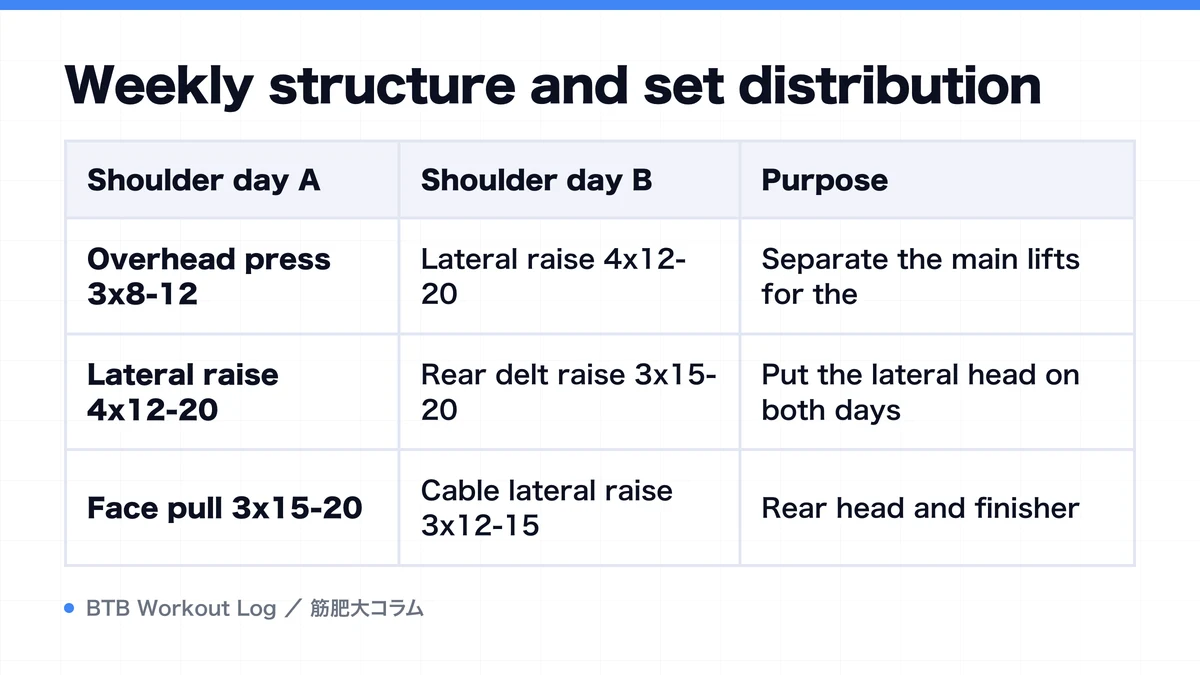
The lateral and rear deltoid heads are small and recover quickly, so they tolerate high frequency. Split 12-20 weekly sets across 2-3 sessions a week, using 4-6 sets for the lateral head and 3-5 sets for the rear head per session as a rough guide.
| Shoulder day A | Shoulder day B | Purpose |
|---|---|---|
| Overhead press 3x8-12 | Lateral raise 4x12-20 | Separate the main lifts for the front and lateral heads |
| Lateral raise 4x12-20 | Rear delt raise 3x15-20 | Put the lateral head on both days |
| Face pull 3x15-20 | Cable lateral raise 3x12-15 | Rear head and finisher |
In weeks with a lot of pressing, cut press sets and move them to the lateral and rear heads. Changing the distribution comes before increasing total volume.
The first signs to appear when you raise shoulder volume are form breakdown and tightness in the shoulder joint. These often show up before your weights drop, so in a week where you added sets, check every session whether you are still holding the path. If you are not, redirect the added sets to lower-stress work such as rear delt exercises or face pulls.
How to judge shoulder progress
On light exercises like lateral raises, the weight increments are coarse and progress is hard to see. There are three things to judge on: reps at the same weight, reps held without momentum, and consistency of range of motion. If your smallest increment is 1kg, build reps first and then add weight.
The visual appearance of shoulder width carries large measurement error, so take photos every few weeks under the same lighting and in the same stance. If neither the numbers nor the photos are moving, the problem is more likely form or distribution than volume (progressive overload).
Keeping your log split by head makes imbalances visible: the lateral head alone not progressing, or rear head volume being zero for two weeks. Because shoulder training tends to involve a lot of exercises, a log helps you judge (workout log app).
Use 4-6 weeks as a rough guide for your judgement cycle. The lateral deltoid shows progress in small increments, and a few weeks is not enough to read a difference. Fix your exercises and their order during that period, and change only weight or reps, so you have something to judge on next time.
If things still are not moving, check total volume, sleep and calorie intake rather than the shoulders themselves. Small muscle groups are easily affected by your overall condition, and swapping exercises will not change the result if the foundation is not there.
FAQ
- Will overhead pressing alone build big shoulders?
- It develops mainly the front head, but the lateral head tends to be short on volume, so shoulder width is unlikely to grow. Keeping pressing as your main lift and adding a few sets of lateral raises per week is a manageable fix.
- How heavy should I go on lateral raises?
- The starting point is a weight you can take for 12-20 reps on the same path without momentum. Hypertrophy happens with both heavy and light loads, so adding a little at a time within the range where you can hold the path is an easy way to progress and judge.
- Can I train shoulders every day?
- The lateral and rear heads recover quickly and tolerate high frequency, but you do not need to train them every day. Secure your total volume across 2-3 sessions a week, and judge whether the frequency is right by whether your weight and reps beat the previous session.
- I do not feel the rear delt working.
- Shoulder blade retraction may be doing most of the work. Hold the shoulder blades in place and move only through the range that carries the upper arm backward. The weight will be lighter, but it will reach the direction you are targeting.
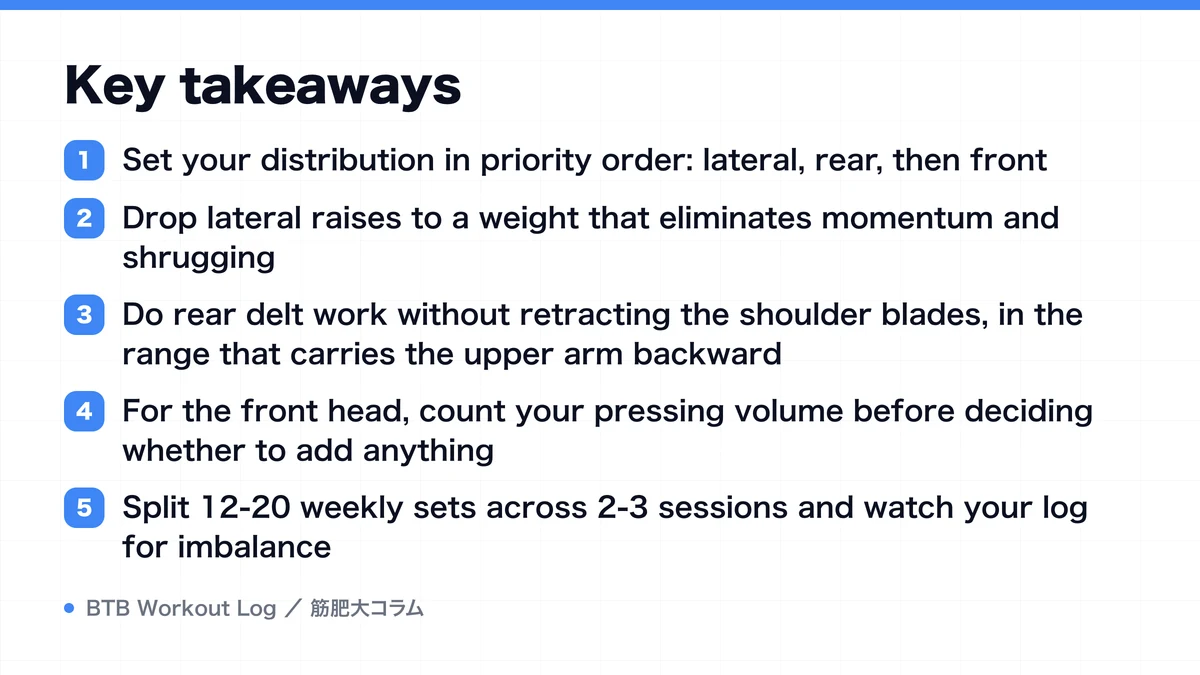
Key takeaways
- Set your distribution in priority order: lateral, rear, then front
- Drop lateral raises to a weight that eliminates momentum and shrugging
- Do rear delt work without retracting the shoulder blades, in the range that carries the upper arm backward
- For the front head, count your pressing volume before deciding whether to add anything
- Split 12-20 weekly sets across 2-3 sessions and watch your log for imbalance