Does a Wider Grip Make Lat Pulldown More Effective? | The Real Difference Between Wide, Narrow, and Neutral Grips
Wider is not always better. For most lifters, a neutral grip around shoulder width is the best starting point for combining a full range of motion, a strong downward elbow path, and joint comfort.
The difference between wide, narrow, and neutral grips is not whether they work. It is how they change the path of your upper arms and the conditions under which you can progress your sets. For a separate comparison of lat pulldowns and pull-ups, see how to choose between the two vertical pulls.
Compare Grips by Range of Motion and Practical Use, Not Activation Alone
If you focus only on which grip uses the lats most, you are letting a single EMG reading make the decision. For hypertrophy, compare these five factors together.
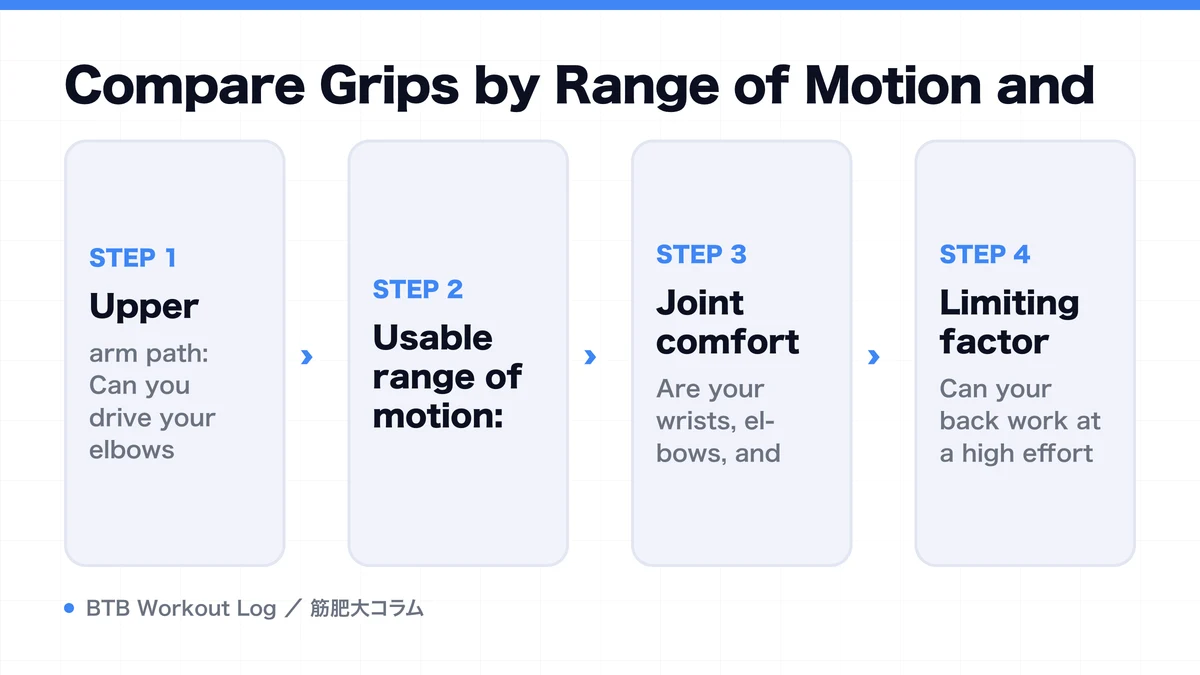
- Upper-arm path: Can you drive your elbows toward your pelvis and produce shoulder adduction or extension?
- Usable range of motion: Can you move from a full reach at the top to the lowest position you can control without arching your torso?
- Joint comfort: Are your wrists, elbows, and shoulders free of discomfort that worsens with repeated use?
- Limiting factor: Can your back work at a high effort without your grip or biceps failing first?
- Progression: Can you keep the attachment and body position consistent while gradually adding load or reps?
Grip width and hand orientation are separate variables. In practice, a narrow grip often means an underhand grip or V-bar, while wide grips are usually overhand and neutral grips use handles with the palms facing each other. Keep in mind from the start that you are rarely comparing width alone.
What Changes Between Wide, Narrow, and Neutral Grips
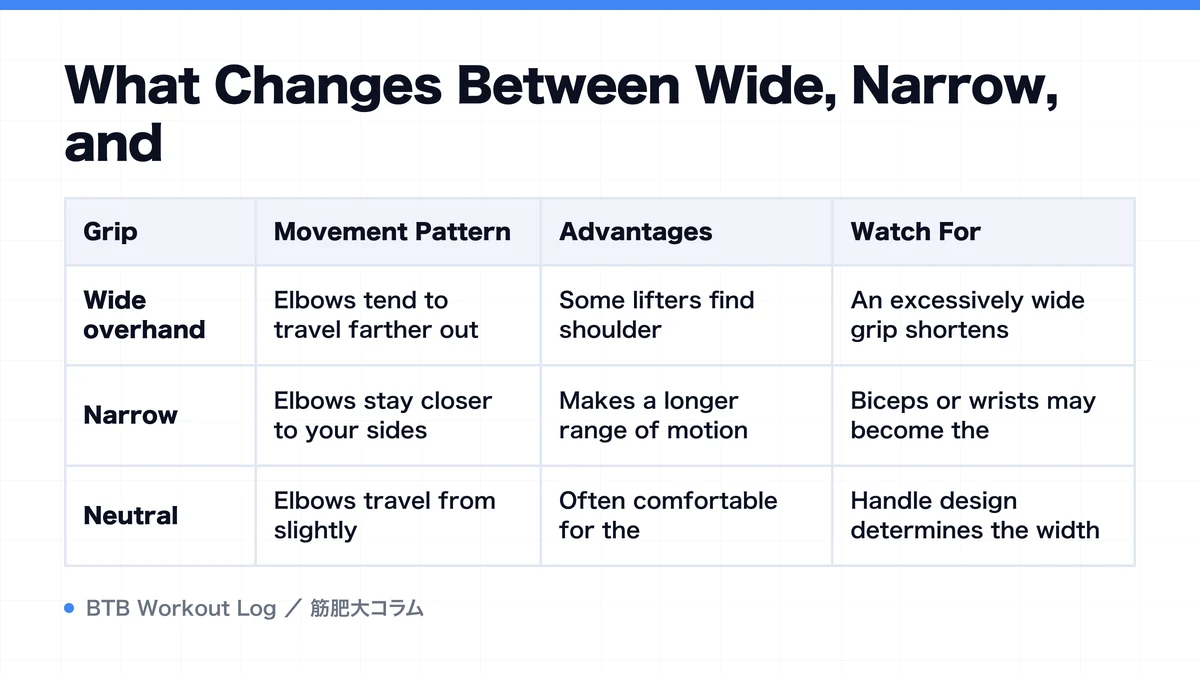
| Grip | Movement Pattern | Advantages | Watch For |
|---|---|---|---|
| Wide overhand | Elbows tend to travel farther out | Some lifters find shoulder adduction easier to feel | An excessively wide grip shortens the vertical travel |
| Narrow | Elbows stay closer to your sides | Makes a longer range of motion easier to achieve | Biceps or wrists may become the limiting factor |
| Neutral | Elbows travel from slightly forward down toward your sides | Often comfortable for the shoulders and wrists, with an easy-to-repeat path | Handle design determines the width |
Wide overhand does not mean gripping the ends of the bar. Use only as much width as lets your forearms stay roughly vertical to the floor while you drive your upper arms down. There is no need to pull the bar behind your neck; bring it down in front of your face toward your collarbone.
Narrow grips make it easier to drive your elbows toward your hips and usually allow a longer reach at the top. An underhand grip involves the elbow flexors more, so if your arms fail first, reduce the weight or switch to parallel handles of a similar width.
Neutral grips place less demand on forearm rotation and are a versatile choice at around shoulder width. They are not comfortable for everyone, though. If a fixed V-bar feels too narrow, use independent handles or a medium-width attachment.
Small EMG Differences Cannot Identify a Long-Term Winner
Studies comparing traditional lat-focused exercises have reported small differences in muscle activation between movements such as wide-grip pulldowns, reverse-grip pulldowns, and seated rows. These studies measured short-term muscle activity; they did not compare muscle size after long-term training with all three grips.
EMG is one piece of evidence showing how active a muscle was under a specific set of conditions. Body fat, electrode placement, lifting technique, and load selection can all affect the reading. Higher activation does not automatically mean more hypertrophy several months later. Sustainable set volume, recovery, and load progression still stand between those two outcomes.
It is therefore misleading to generalize that research proves the wide grip is best. If a wide grip shortens your range of motion, hurts your shoulders, and prevents load progression, there is no reason to prioritize an average difference measured in a lab. Conversely, if it feels comfortable, makes your lats the limiting factor, and lets you improve over time, there is no reason to drop it.
Narrow the Options Based on Your Build, Assistance Muscles, and Shoulders
When a wide grip is worth keeping
A wide grip may suit you if moving your shoulders outward feels comfortable, you can pull the bar toward your chest without increasing your backward lean, and your lats limit the final part of the set. Start at roughly 1.3–1.5 times shoulder width. Reaching the ends of the bar is not the goal.
When a narrow grip tends to work well
A narrow grip may suit you if you want more movement from the overhead position, find it easier to target your lats by keeping your elbows near your ribs, or want to progress the load in smaller increments. If an underhand grip bends your wrists back, switch to parallel handles instead of forcing a narrow bar grip.
When to use a neutral grip as your baseline
Start with neutral if you are unsure which grip to choose, do not want to lock your shoulders into strong internal or external rotation, or want a consistent elbow path on both sides. Use it as your baseline and note what actually improves when you switch to wide or narrow. This makes the choice less dependent on which one feels more stimulating.
Whatever grip you use, stop the exercise and consult a qualified professional if raising your arms causes sharp shoulder pain, pulling causes numbness, or pain remains after training. Small grip-width adjustments are not the answer to those symptoms.
Test Each Grip Across Multiple Sessions and Score Four Factors
Trying all three grips once and choosing by pump strength allows exercise order and familiarity to skew the result. Start by using a neutral grip for 3–4 back workouts, then test the grip you want to compare for the same number of sessions. Weight-stack numbers are not equivalent across attachments, so select each grip's load separately to keep you around 8–12 reps at RIR 1–3.
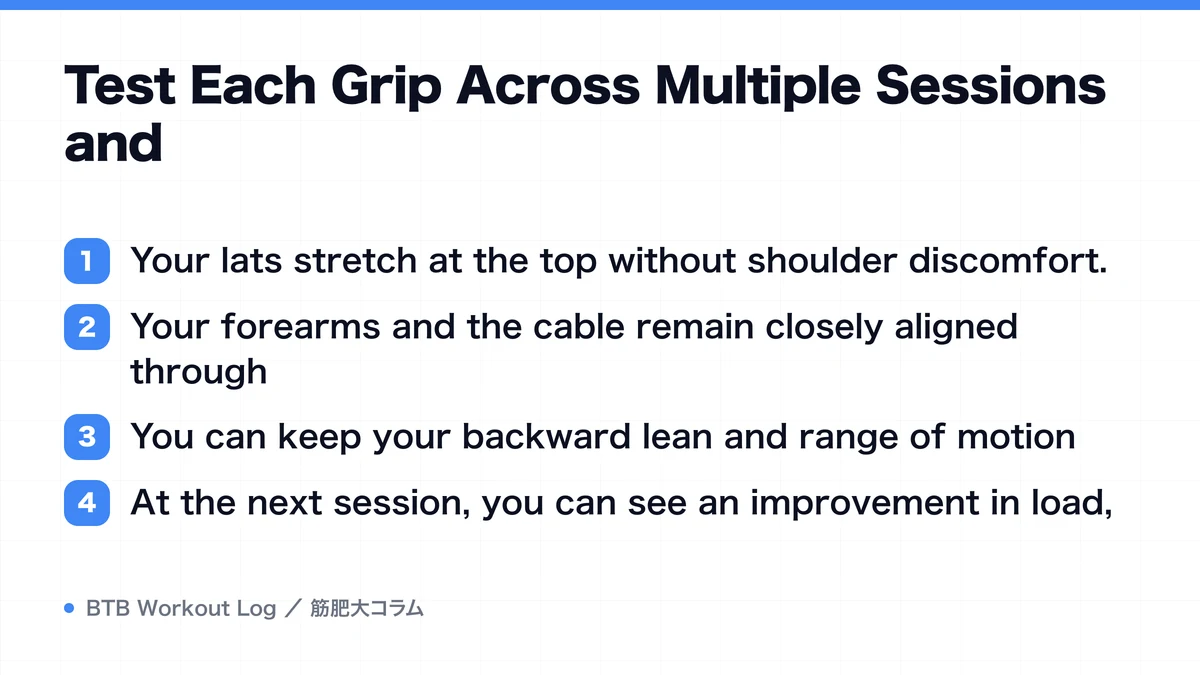
- Your lats stretch at the top without shoulder discomfort.
- Your forearms and the cable remain closely aligned through the bottom position.
- You can keep your backward lean and range of motion consistent during the final 2–3 reps.
- At the next session, you can see an improvement in load, reps, or reps in reserve.
If one grip is clearly worse on any of the four factors, there is little reason to make it your main option. If the differences are minimal, choose the grip that feels easiest on your joints and requires the least setup. If you rotate grips for variety, keep each one for a set period instead of switching randomly every week.
Grip width is a fine-tuning variable, not the center of your program. Once you choose one, what matters is whether you can create progress under consistent conditions. When planning the rest of your lat training, avoid unnecessary overlap with these 5 exercises for back width.
After the comparison, use the easiest grip to manage as your main option. Keep another grip as an accessory only if it serves a specific purpose.
FAQ
- How far should you pull the bar down on a lat pulldown?
- Pull it down in front of your face until your elbows are beside your torso and your upper arms reach the intended position. If you have to arch hard just to touch the bar to your chest, you are pulling too far. Prioritize a consistent torso angle and lat tension over whether the bar makes contact.
- Does a wide grip target the upper lats while a narrow grip targets the lower lats?
- Not that cleanly. Changing your elbow path may shift where you feel or distribute the stimulus, but grip width alone cannot isolate a specific region that precisely. Prioritize joint comfort and measurable progress, and treat any regional difference as secondary.
- Is it okay to use different weights when changing grip width?
- Yes. The handle, range of motion, and involvement of assistance muscles all change, so comparing the displayed weight directly tells you little. Choose a load that gives you the target reps and RIR with each grip, then track progress only within the same grip.
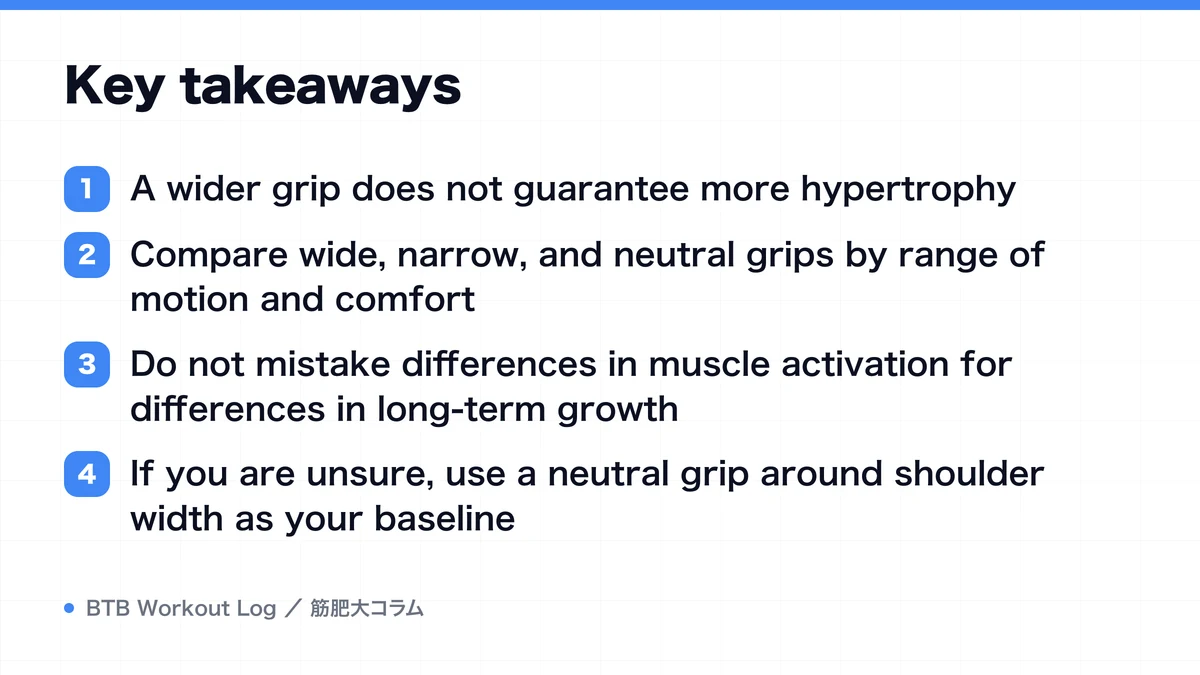
Key takeaways
- A wider grip does not guarantee more hypertrophy
- Compare wide, narrow, and neutral grips by range of motion and comfort
- Do not mistake differences in muscle activation for differences in long-term growth
- If you are unsure, use a neutral grip around shoulder width as your baseline