Dumbbell Fly vs. Cable Fly: Which Builds More Chest Hypertrophy?
Neither fly is always better for chest hypertrophy. Dumbbells make it easier to load the lengthened position, while cables can maintain tension through the final portion as your arms come together. Choose the one that fills the gap left by your current presses, not the one with the better reputation.
Do not compare them by the size of the pump. Look at where the load peaks across different muscle lengths, how well you can stabilize your body, the fatigue and setup time involved, and whether you can progress under consistent conditions. Judge the exercise by how it performs over time, not by the contraction you feel during one set.
Compare Where the Exercise Loads You, Not Just Its Name
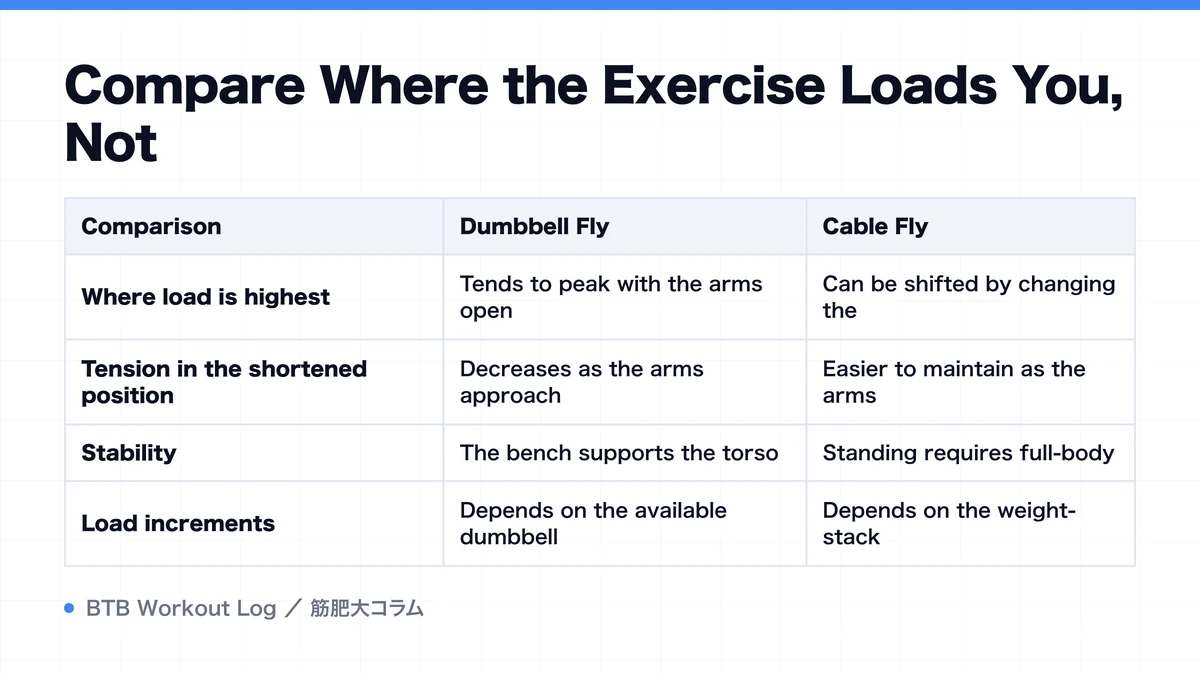
Both fly variations bring the upper arms in front of the body without substantially changing the elbow angle. They may look similar, but gravity and the cable's line of pull differ, so the hardest point of each rep is not the same.
| Comparison | Dumbbell Fly | Cable Fly |
|---|---|---|
| Where load is highest | Tends to peak with the arms open | Can be shifted by changing the pulley position |
| Tension in the shortened position | Decreases as the arms approach vertical | Easier to maintain as the arms come together |
| Stability | The bench supports the torso | Standing requires full-body bracing |
| Load increments | Depends on the available dumbbell jumps | Depends on the weight-stack increments |
| Setup | Requires a bench and dumbbells | Requires both pulleys to be adjusted |
The specified sources include no long-term study directly comparing hypertrophy between these exercises, so their mechanical differences alone cannot establish a winner. Use the table to identify which role is currently missing from your workout.
Dumbbells Emphasize the Lengthened Position; Cables Let You Adjust the Line of Pull
During a lying dumbbell fly, the external moment around the shoulder increases as the arms approach parallel with the floor, then decreases as they come together. This makes it easier to load the bottom position where the chest is lengthened. However, pressing the dumbbells together at the top does not create an equivalent increase in resistance in the direction your arms are closing.
With cables, the line from the pulley to the handle determines the direction of resistance. You can change the hardest portion by using a horizontal fly with the pulleys around shoulder height, a low-to-high path, or a high-to-low path. That flexibility comes with a tradeoff: changing your stance each time also changes the resistance curve, making your training log harder to compare.
Although training in lengthened positions has received plenty of attention, deeper is not automatically better. A study of trained lifters reported similar muscular adaptations with lengthened partials and a full range of motion, but it did not compare the two fly variations. Use a full range of motion or partials according to your goal while staying within a range of motion where the front of your shoulder remains stable.
Hypertrophy Depends More on Set Quality Than the Equipment
The mechanical tension required for hypertrophy is not determined by whether an exercise uses dumbbells or cables. Either variation becomes productive only when the chest is the limiting factor, effort is sufficiently high, weekly volume remains recoverable, and the load progresses over time.
If your shoulder position breaks down during a deep dumbbell fly and you bounce out of the bottom, you cannot reproduce the intended tension. A strong contraction during cable flies is not enough either if the load is so light that you finish with dozens of reps in reserve. Start around RIR (reps in reserve) 1–3 and use a load that lets you maintain the same elbow angle and path through the final rep.
An analysis of resistance training for the upper and lower body reported hypertrophy across different loads when effort was matched. This was not a direct comparison of fly variations, but it does challenge the assumption that lifting heavier dumbbells is automatically better. Measure progress within the same technique.
Fatigue, Time Efficiency, and Joint Comfort May Decide the Better Choice
The bench supports your torso during dumbbell flies, so balance is less likely to interfere with the target muscles. However, you still have to move heavy dumbbells into the starting position and need enough control to exit safely when a rep fails. The exercise may not suit lifters who feel discomfort or instability in the front of the shoulder before reaching a useful bottom position, even with a lighter load.
Standing cable flies make it easy to move the pin, allowing you to perform drop sets quickly. However, arching your torso, pushing back through the lead leg, or letting the shoulders roll forward changes the movement entirely. Placing a bench between the cables improves stability, but it also adds setup time and may be impractical in a crowded gym.
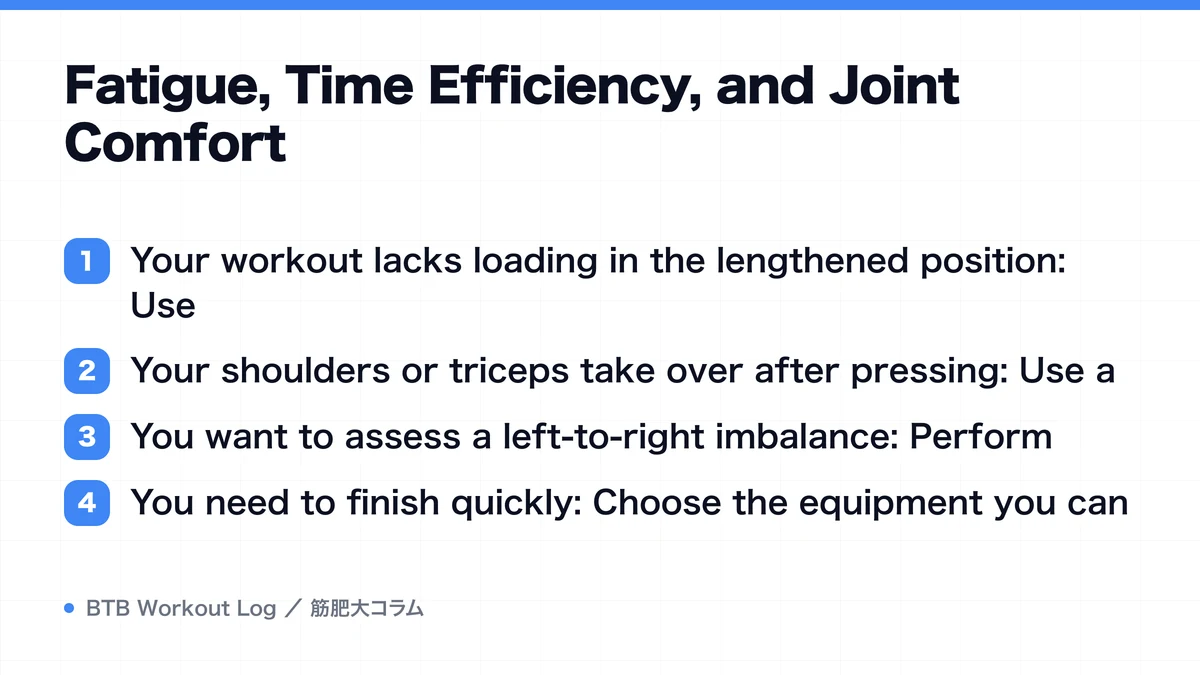
- Your workout lacks loading in the lengthened position: Use lighter dumbbells and prioritize depth and control.
- Your shoulders or triceps take over after pressing: Use a cable setup that lets you focus on bringing the upper arms inward.
- You want to assess a left-to-right imbalance: Perform unilateral cable reps while preventing torso rotation.
- You need to finish quickly: Choose the equipment you can access easily and judge efficiency by total time, including setup.
Joint pain is not proof that an exercise is working. If it continues after changing the range of motion or equipment, stop trying to solve it through workout adjustments alone and consult a qualified professional.
Make One Variation Your Main Fly and Add the Other Only When Needed
If your chest day already includes presses and you want to add a fly, work backward from the portion the presses fail to cover. If your main lift is a deep-range press on machines, cables can complement it by maintaining tension in the shortened position. If you mainly use presses with a short range of motion, controlled dumbbell flies can add more loading in the lengthened position.
Even if you want to use both, there is no need to pile on high volumes of each in the same session. With 2 chest workouts per week, perform 2–3 sets of dumbbell flies on Day A and 2–3 sets of cable flies on Day B. Alternatively, use only one variation for 4–6 weeks at a time and compare your progress and joint comfort. Before choosing cables to target the "inner" chest, understand the limits of building the chest gap and targeting specific regions.
Track load, reps, RIR, range of motion, and total time including setup. When the dumbbell jumps are large, add reps before increasing the load. For cable flies, keep your stance and pulley height consistent. The variation that lets you apply progressive overload under the same conditions is the more effective choice for your current workout.
FAQ
- Should You Do Both Dumbbell Flies and Cable Flies?
- No. If your current presses lack loading in the lengthened position, choose dumbbells. If you need more tension as your arms come together, choose cables. If you use both, perform them on separate days to reduce unnecessary overlap.
- Are Dumbbell Flies Better for Hypertrophy Because They Stretch the Chest More?
- They do make it easier to load the lengthened position, but the specified research does not directly show a long-term difference in hypertrophy compared with cable flies. Prioritize shoulder stability and your ability to progress at a consistent depth.
- What Pulley Height Should You Use for Cable Flies?
- Base it on the path you want and the exercises already in your workout. Start around shoulder height for a horizontal path, and keep your stance fixed when testing low-to-high or high-to-low variations. Use a height that does not fatigue your shoulders or torso before your chest.
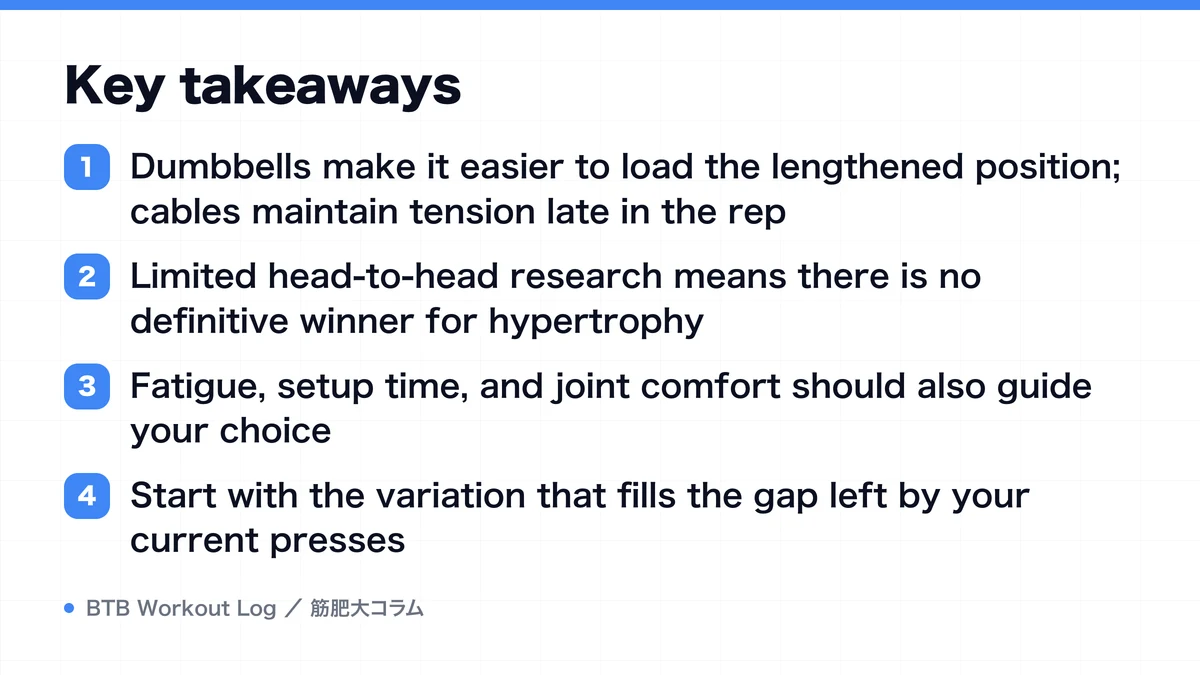
Key takeaways
- Dumbbells make it easier to load the lengthened position; cables maintain tension late in the rep
- Limited head-to-head research means there is no definitive winner for hypertrophy
- Fatigue, setup time, and joint comfort should also guide your choice
- Start with the variation that fills the gap left by your current presses
References
- The Mechanisms of Muscle Hypertrophy and Their Application to Resistance Training
- Lengthened Partial Repetitions Elicit Similar Muscular Adaptations as Full Range of Motion Repetitions During Resistance Training in Trained Individuals
- Muscle Hypertrophy Is Independent of Load Across Upper and Lower Limbs When Effort Is Matched