For Lifters Whose Upper Chest Won't Grow | What's the Best Incline Bench Angle? The Angle Changes Everything
For upper-chest growth, starting with a low incline of 15–30° is the practical move. Steeper isn’t automatically better. Your best angle is the one that keeps tension on the upper chest without your front delts fatiguing first.
A lagging upper chest isn’t always caused by too little incline. Isolate the variables: bench angle, bar touch point, elbow path, and loading. Prioritize a setup you can reproduce over the number printed on the bench.
Why “steeper is better for the upper chest” misses the point
During an incline bench press, the upper arm moves through more shoulder flexion relative to the torso than it does on a flat bench, making it easier to involve the clavicular head of the pecs. However, as the bench gets steeper, the direction of resistance shifts toward a shoulder press and the front delts take on more work. The goal is not to use the steepest angle possible. It is to create a line of force that favors the upper chest without losing your ability to press through the pecs.
In a study using high-density surface electromyography, moving from a flat bench to 45° shifted the location of peak amplitude from the sternocostal region toward the clavicular region of the pecs. However, this was an acute muscle-activation measurement involving 8 participants working at 50% and 70% 1RM. It was not a trial showing that 45° produces the most hypertrophy over time. EMG can help guide angle selection, but it cannot rank angles by the growth they produce.
Our guide to training your entire chest covers the broader roles of horizontal and incline exercises. Here, we will focus specifically on narrowing down the right angle for upper-chest sets.
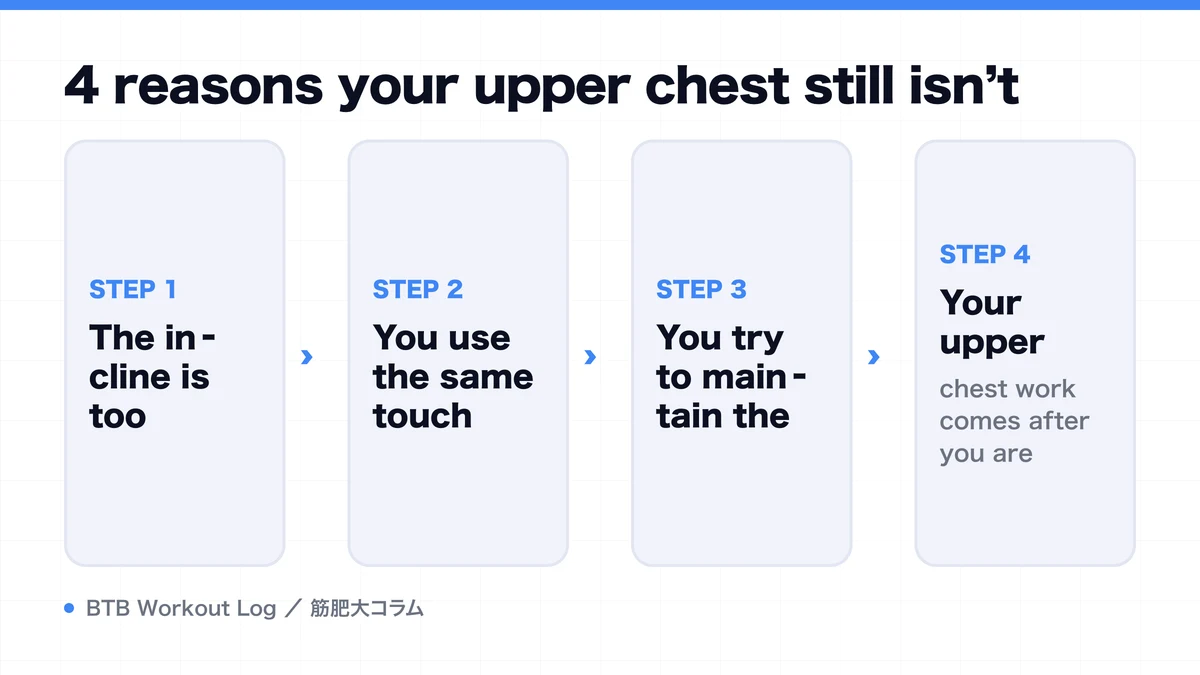
4 reasons your upper chest still isn’t growing after changing the angle
- The incline is too steep: If your front delts fatigue first at 45° or above, your attempt to emphasize the upper chest has turned the movement into more of a shoulder exercise. Lower the bench by one setting first.
- You use the same touch point as your flat bench: Lowering the bar toward the solar plexus while inclined tilts your forearms and misaligns your pressing direction with the load. Find a natural path that brings the bar toward the upper chest, not directly onto the collarbones.
- You try to maintain the same weight: It is normal to handle less weight on an incline than on a flat bench. If you shorten your range of motion just to preserve the number, you lose the tension you are trying to create.
- Your upper-chest work comes after you are already fatigued: After a high volume of flat pressing, your chest and triceps are already depleted. During a phase focused on bringing up this weak point, placing incline work first makes your results easier to assess.
If you change the angle every workout, you will not know which adjustment worked. Keep your grip, rep range, and exercise order fixed while testing one incline setting at a time. You should also determine whether your upper chest is genuinely lagging because of too much flat pressing by reviewing the conditions under which one bench press exercise is enough.
Start at 15–30° and keep the work out of your shoulders
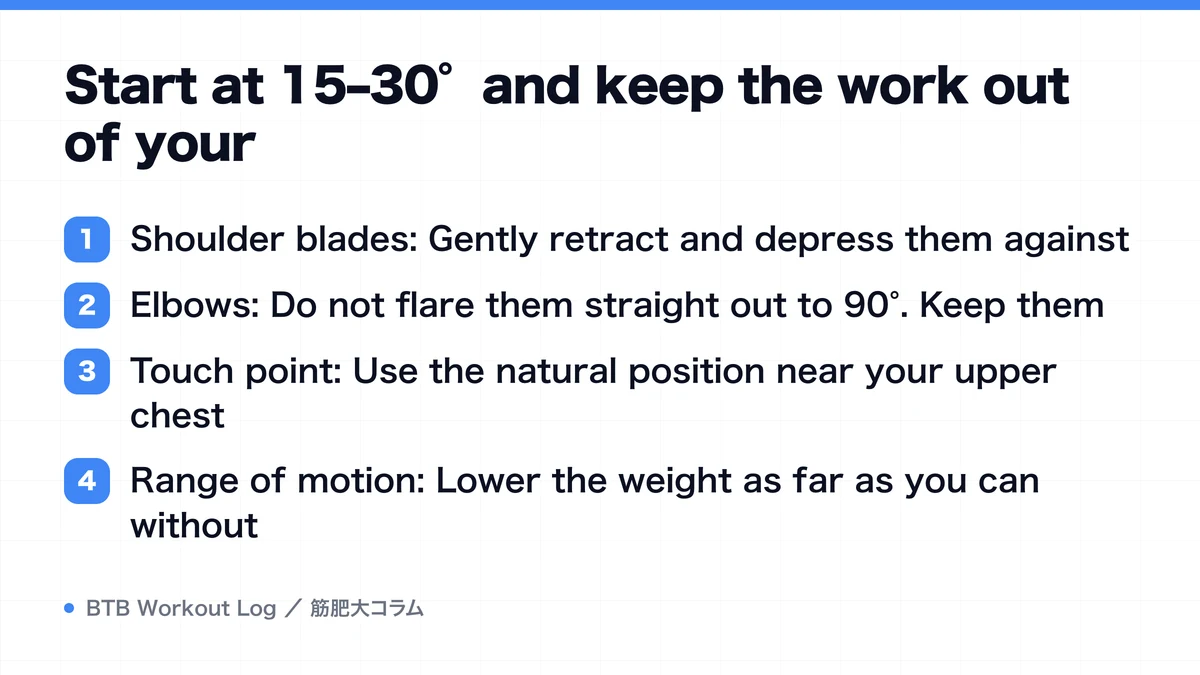
Start your testing at 15°. If you can maintain tension in the upper chest but notice little difference from a flat bench, move to 30°. If 30° mainly loads your front delts, return toward 15°. Bench markings vary by manufacturer, so record the backrest position as well as the stated angle to make your setup repeatable.
- Shoulder blades: Gently retract and depress them against the backrest to stabilize your rib cage. Do not use such a large arch that you effectively cancel out the incline.
- Elbows: Do not flare them straight out to 90°. Keep them within a position that allows your forearms to remain nearly vertical to the floor, but do not tuck them so tightly that the triceps take over.
- Touch point: Use the natural position near your upper chest that keeps your forearms vertical. There is no need to force the bar toward your neck.
- Range of motion: Lower the weight as far as you can without pain in the front of the shoulder while maintaining a stretch in the upper chest. Base the depth on your shoulders and equipment, not where the bar touches someone else’s chest.
Dumbbells make it easier to fine-tune each arm’s path, while a barbell makes the path and loading easier to standardize. When testing angles, stick with the same equipment to reduce noise in your comparisons. If pain remains after adjusting your form, stop experimenting with angles and consult a qualified professional.
Replace existing sets before adding more upper-chest work
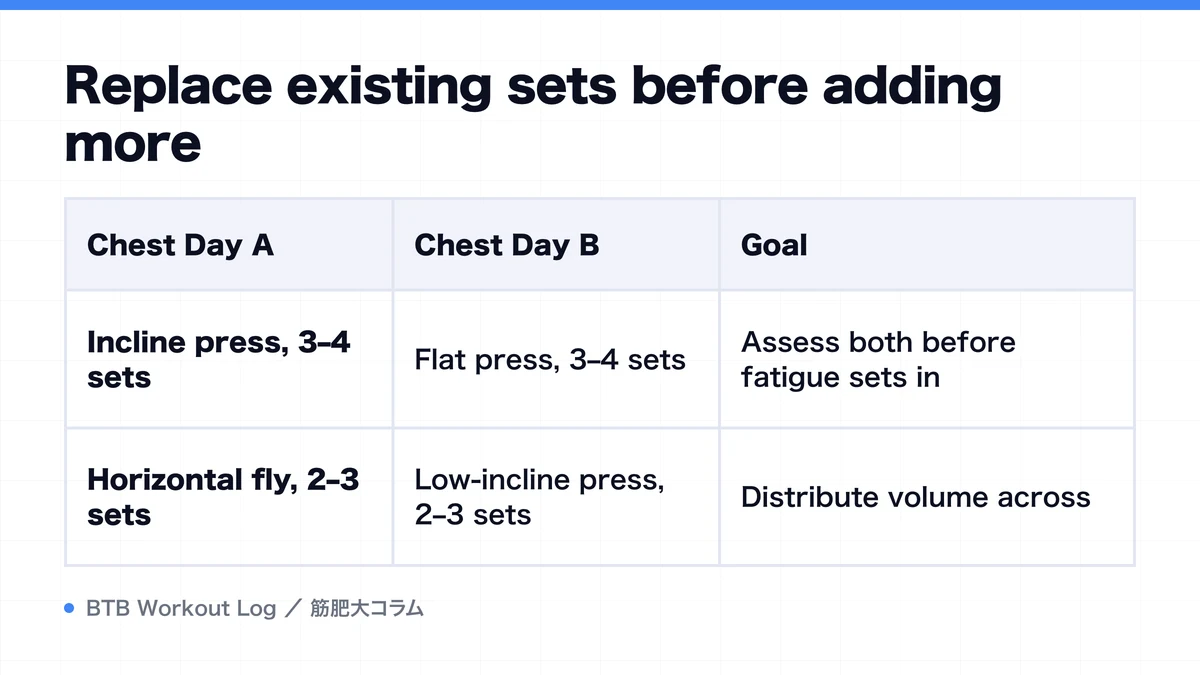
A lagging upper chest does not mean you need to add more sets on top of your current chest volume. Start by replacing some flat-press sets with incline work. If you train your chest twice per week, a practical approach is to begin one session with a low incline and keep the flat press as the main lift in the other.
| Chest Day A | Chest Day B | Goal |
|---|---|---|
| Incline press, 3–4 sets | Flat press, 3–4 sets | Assess both before fatigue sets in |
| Horizontal fly, 2–3 sets | Low-incline press, 2–3 sets | Distribute volume across different movement paths |
Start with roughly 6–15 reps, where it is easier to maintain your intended path. If the work still shifts to your shoulders at RIR 1–3, the problem is your form or loading, not a lack of pushing to failure. Instead of suddenly bulking up your upper-chest volume, redistribute the work within what your total workload and recovery can support.
Test your ideal angle under the same conditions for 4–6 weeks
Do not judge an angle from a single pump. Narrow your options to 15° and 30°, then test each angle for at least 2 weeks using the same exercise order and rep range. For every set, record the weight, reps, and RIR, along with whether your front delts, triceps, or upper chest lost output first.
The right angle should meet 3 conditions: you feel a stretch in the upper chest, the set is not limited entirely by your shoulders or triceps, and your reps or weight improve through the same range of motion. Visual changes in the upper chest are difficult to measure accurately, so compare photos taken several weeks apart under the same lighting and in the same posture. Weight can increase simply because your technique improves, so track how consistently you reproduce the same path as well.
While comparing angles, avoid making major changes to your chest’s weekly set volume or training frequency. If fatigue changes at the same time, you will be comparing recovery status rather than bench angles. Only assess sets performed under conditions you could reproduce from the previous workout.
If you feel no meaningful difference between 15° and 30° and continue progressing with both, choose based on bench availability or shoulder comfort. If both angles shift the work to your shoulders, lower the load or switch to dumbbells or machines instead of searching for another angle. The right angle is not a fixed number; it is the setup that lets you perform repeatable reps through your chest.
FAQ
- Is 30° or 45° better for targeting the upper chest?
- Start at 15–30° to establish tension and a consistent path through the upper chest. Lower the angle if your front delts fatigue first. Research has reported greater muscle activation toward the clavicular region at 45°, but it has not shown that 45° is always superior for long-term hypertrophy.
- Is it okay to use less weight on incline bench than on flat bench?
- Yes. Changing your torso angle changes how much load you can handle. Do not use your flat-bench weight as the benchmark. Choose a weight that lets you maintain the same range of motion and path while finishing your target rep range at around RIR 1–3.
- Is incline pressing alone enough to build the upper chest?
- Even during an upper-chest-focused phase, combining incline work with horizontal presses and flyes is a practical way to develop the entire chest. Replace some of your existing chest sets with incline work and assess your response without sharply increasing total volume.
Key takeaways
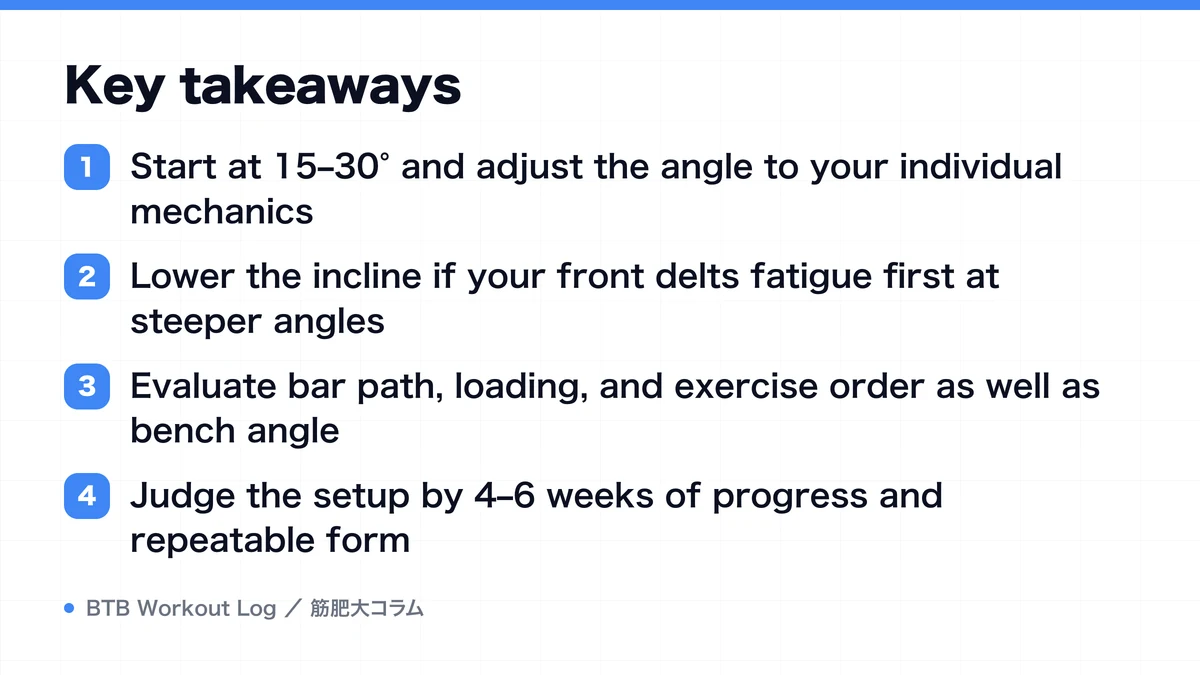
- Start at 15–30° and adjust the angle to your individual mechanics
- Lower the incline if your front delts fatigue first at steeper angles
- Evaluate bar path, loading, and exercise order as well as bench angle
- Judge the setup by 4–6 weeks of progress and repeatable form