
Is Keeping a Workout Log Worth It? Stop Relying on Memory — 4 Things Logging Changes
A workout log does more than help you remember your weights. Having your previous numbers in front of you gives you a clear basis for deciding what to aim for in today's next set. Your log turns past effort into better decisions.
Logging alone, however, does not build muscle. It becomes useful when you use those numbers to change what you do.
You cannot reliably remember your last workout
Can you say exactly how many kg you bench-pressed for how many reps 3 weeks ago? With 10 exercises at 3–4 sets each, you have 30–40 numbers just for weights and reps. Add rest periods, reps in reserve, range of motion, and any pain, and that is more than you can reliably remember.
Recent, intense experiences tend to dominate memory. You may remember feeling that you pushed hard today, but not what has changed since 6 weeks ago. Progressive overload depends on doing a little more than before. If your previous performance is vague, you cannot tell whether the set you just finished actually exceeded it.
A log's first job is to take that burden off your memory. You can focus on lifting instead of remembering. This is more than a convenience: it determines where your attention goes during training.
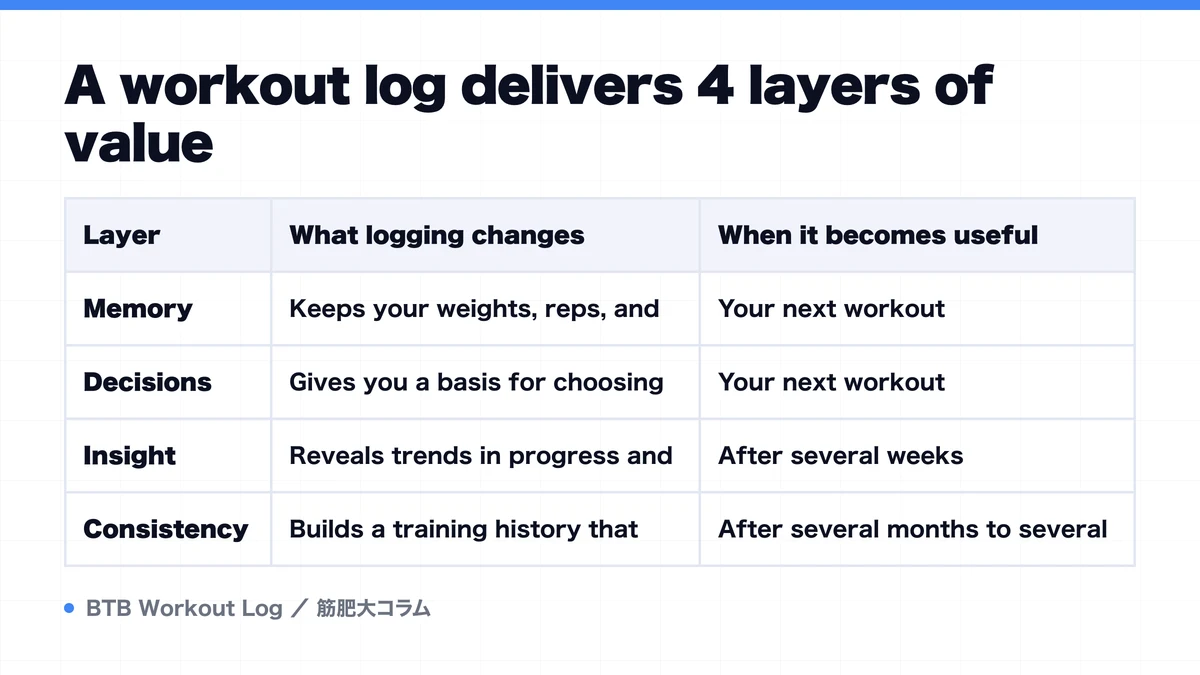
A workout log delivers 4 layers of value
Lumping every benefit of logging together misses an important distinction: different benefits take different amounts of time to emerge.
| Layer | What logging changes | When it becomes useful |
|---|---|---|
| Memory | Keeps your weights, reps, and reps in reserve available | Your next workout |
| Decisions | Gives you a basis for choosing your next target | Your next workout |
| Insight | Reveals trends in progress and plateaus | After several weeks |
| Consistency | Builds a training history that helps you keep going | After several months to several years |
The first 2 layers can help from the day after you start logging. The other 2 grow more valuable over time, and you cannot buy back years of training history. When deciding to stop logging, it is easy to overlook those last 2 benefits you would be giving up.
What does the research actually say about logging?
Researchers have studied the act of measuring and recording progress toward a goal. A meta-analysis by Harkin et al. (2016), covering 138 studies and 19,951 participants, compared interventions that encouraged progress monitoring with control conditions and reported an effect size of d+ = 0.40 for goal attainment. Effects also tended to be larger when progress was physically recorded or reported to someone else. However, most of the goals involved health outcomes such as cutting, quitting smoking, or managing blood pressure, rather than logging strength training.
Looking specifically at physical activity, a 2024 meta-analysis of interventions combining self-monitoring with feedback reported d = 0.29 for physical activity levels. That figure comes from a correction published after the original paper: the initially reported value (0.73) was corrected because of a calculation error. The analysis included 10 studies and did not establish which form of feedback works best.
For strength and hypertrophy themselves, ACSM guidelines identify the progressive management of load and volume as a foundation. To manage those variables, you need to know where you stand. That is where a training log comes in. The research supports a clear distinction.
Recording your workouts does not build muscle. Using those records to change what you do is where the value lies. There does not appear to be research directly showing that keeping a training log accelerates hypertrophy.
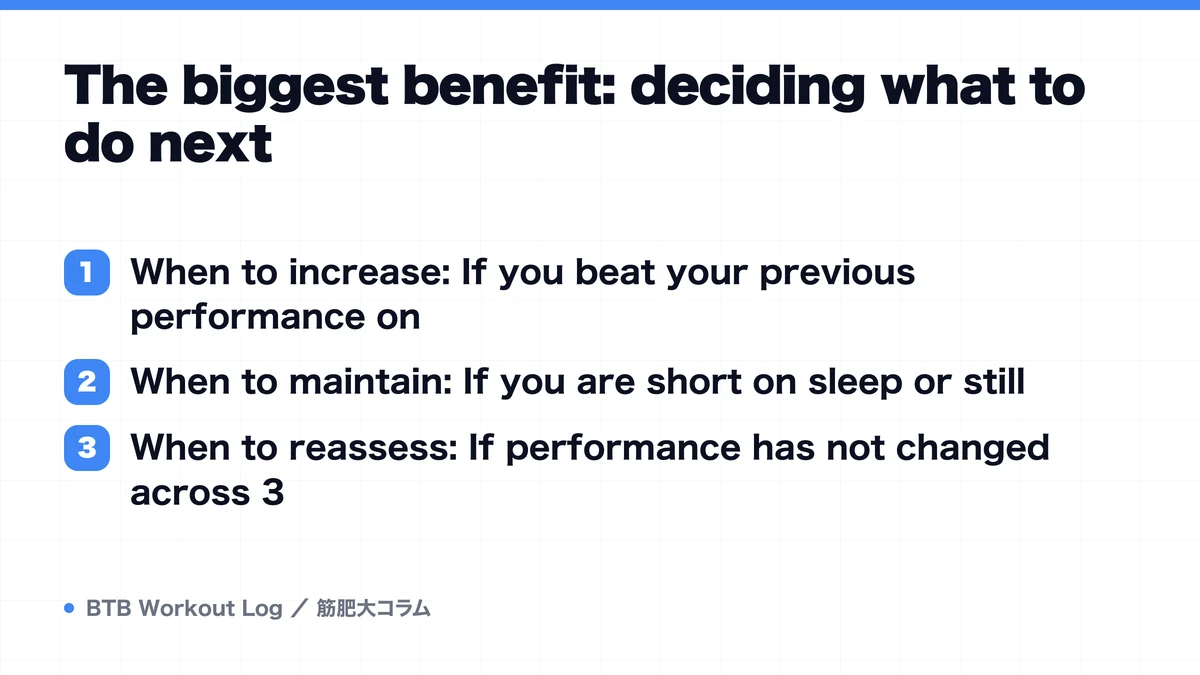
The biggest benefit: deciding what to do next set
Suppose you squatted 80kg for 10 reps last time. With a log, today's target becomes a concrete choice: 80kg for 11 reps, 82.5kg for 10 reps, or the same 80kg for 10 reps with reps in reserve. Without a log, you are left starting with something that feels about the same as last time.
- When to increase: If you beat your previous performance on an exercise, choose whether to add weight or reps.
- When to maintain: If you are short on sleep or still fatigued, matching your previous numbers can be the goal.
- When to reassess: If performance has not changed across 3 or more attempts under the same conditions, examine exercise order, rest periods, RIR, and weekly volume.
Each of these decisions depends on having a record. For a closer look at identifying the cause of a plateau, see how to spot a plateau in your workout log. The key shift is from choosing by feel alone to choosing for a reason.
Progress is hard to see day to day. A log makes it visible
Hypertrophy will not show up in the mirror or on the scale for several weeks. In the meantime, progress may mean more reps with the same weight, or more reps in reserve after completing the same reps. Those improvements leave no record unless you log them.
Useful comparisons require consistent conditions. Compare squats performed first with squats performed after 3 leg exercises, and you should expect fewer reps in the latter. A deeper range of motion or shorter rest periods also changes what the numbers mean. Tracking weight, reps, and weekly sets as your main measures, with a brief note only when conditions change, offers a practical balance between effort and meaningful comparisons.
There is an emotional benefit, too. The feeling that you are making no progress usually comes from your last 2–3 workouts. Having your numbers from half a year ago lets you check that feeling against the facts.
When a workout log offers less value
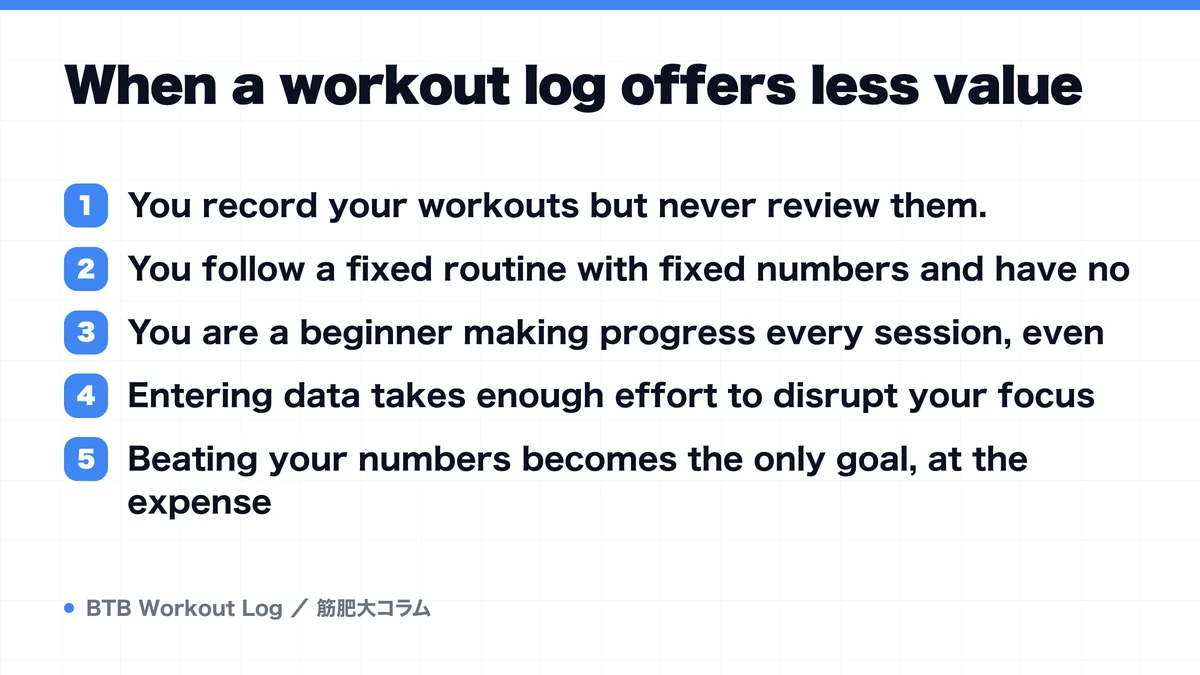
It would be too broad to say that everyone who lifts should keep a notebook. Some approaches to logging offer little value.
- You record your workouts but never review them.
- You follow a fixed routine with fixed numbers and have no room to adjust.
- You are a beginner making progress every session, even without a log.
- Entering data takes enough effort to disrupt your focus between sets.
- Beating your numbers becomes the only goal, at the expense of technique or recovery.
Research also offers support for that last concern. Consumer behavior experiments found that measuring an activity increased how much people did but reduced how much they enjoyed it (Etkin, 2016). A log should remain a way to check progress, rather than become a source of pressure.
Ultimately, the value you feel comes down to this difference: Perceived value = benefits gained − effort spent logging. Even substantial benefits will not keep you logging if data entry is a chore. Logging habits usually break down because of friction, rather than a lack of willpower. That is also central to choosing a workout log app.
Start small: 3 details are enough to make logging useful
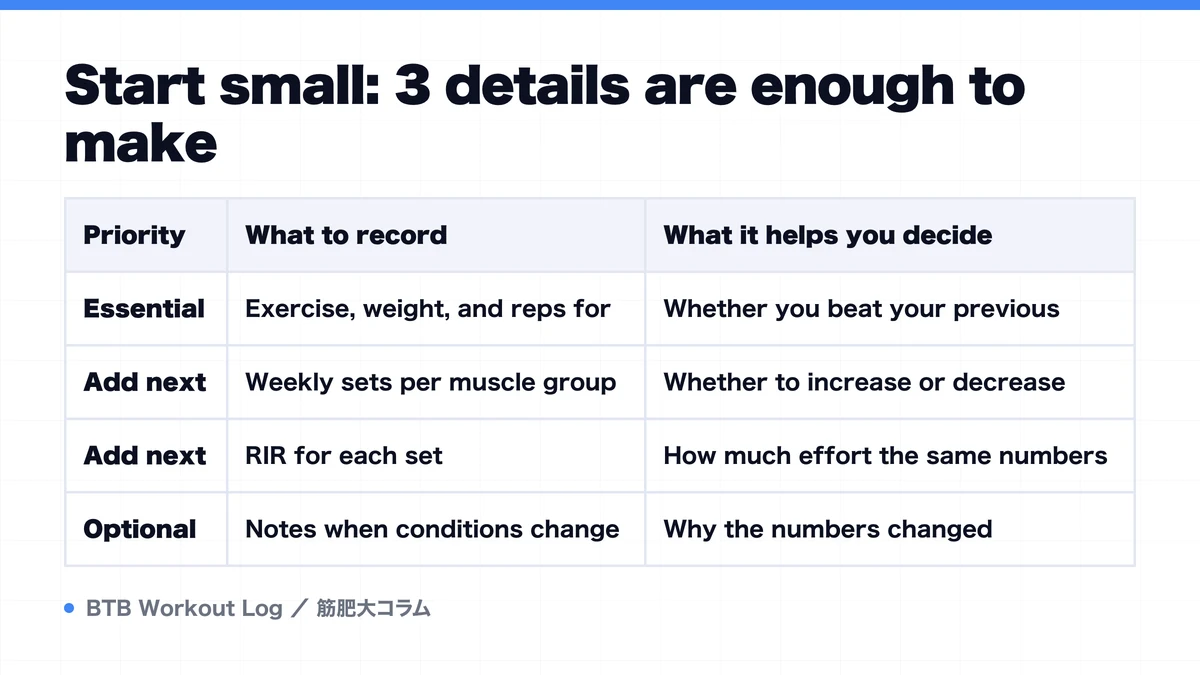
Trying to record everything from day one makes the habit hard to sustain. You'll get more value from tracking a few things consistently that help you decide what to do next.
| Priority | What to record | What it helps you decide |
|---|---|---|
| Essential | Exercise, weight, reps for each set | Did you beat your previous session? |
| Add next | Weekly sets per muscle group | Should you increase or decrease training volume? |
| Add next | RIR for each set | How much effort did the same numbers require? |
| Optional | Notes when training conditions change | Why did your numbers change? |
You can track these 3–4 items in a paper notebook. An app's advantages are instant access to your previous numbers, automatic weekly totals, and the ability to look back through your training history in seconds. Select an exercise in BTB Workout Log to see your previous weight and reps, log your sets in a few taps, and get automatic weekly hard set totals for each muscle group. It works offline and has no ads, so you can stay focused between sets at the gym.
When progress stalls, having something to review starts with writing down a single line today. You need records to start narrowing down why you're not making progress. For days when logging feels like a chore, we've collected advice from coaches and champions in our workout logging quotes.
FAQ
- Is keeping a workout log really worthwhile?
- Yes, if you use the numbers to guide your next decision. A meta-analysis found that interventions involving recording and reporting progress helped people reach their goals (d+ = 0.40). It did not directly test whether workout logs increase hypertrophy, though. The practical value depends on reviewing your log and adjusting weight, reps, and volume.
- Is a paper notebook or an app more useful?
- Whichever you will keep using and can easily review. Paper works for recording exercises, weights, and reps. An app adds immediate access to previous numbers, automatic weekly set totals per muscle group, and quick access to your history. Its value lies in faster comparisons and calculations.
- I log my workouts but am not progressing. Is logging pointless?
- The issue may be how you use your log, rather than how much you record. Compare the same exercise under the same conditions and check whether weight, reps, sets, or RIR has changed. If any of them has moved, progress is continuing. If all have stalled, change just one variable and compare the next several weeks.
Key takeaways
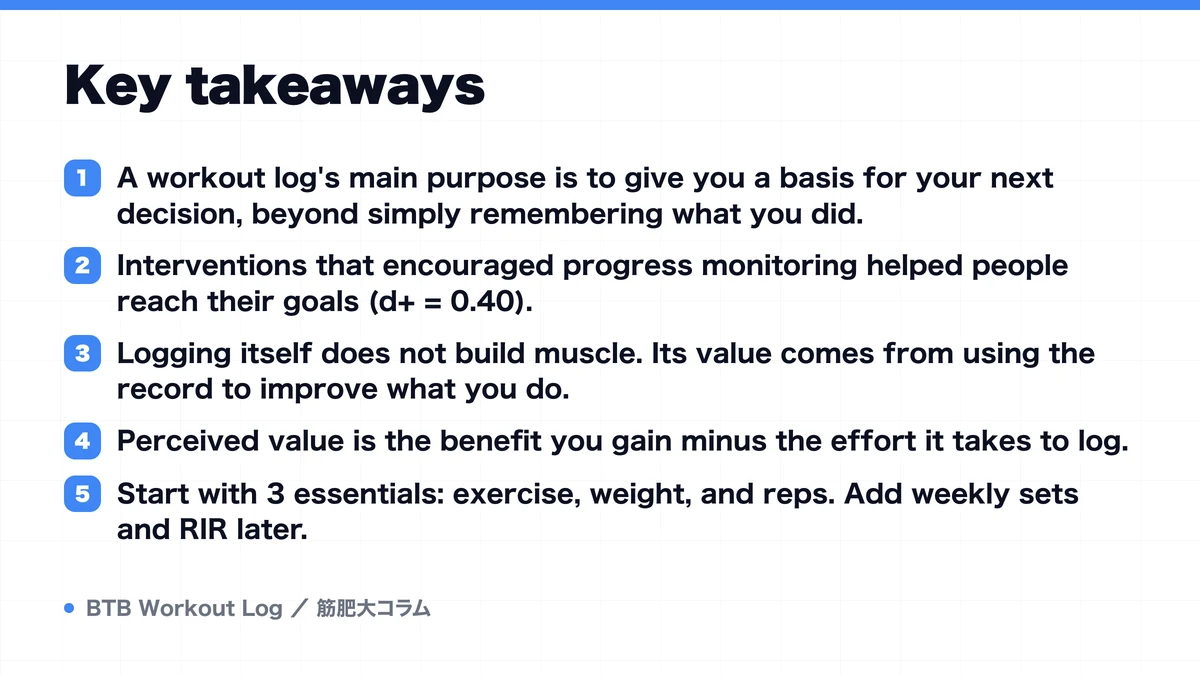
- A workout log's main purpose is to give you a basis for your next decision, beyond simply remembering what you did.
- Interventions that encouraged progress monitoring helped people reach their goals (d+ = 0.40).
- Logging itself does not build muscle. Its value comes from using the record to improve what you do.
- Perceived value is the benefit you gain minus the effort it takes to log.
- Start with 3 essentials: exercise, weight, and reps. Add weekly sets and RIR later.
References
- Does Monitoring Goal Progress Promote Goal Attainment? A Meta-Analysis of the Experimental Evidence
- Impact of Feedback Generation and Presentation on Self-monitoring Behaviors, Dietary Intake, Physical Activity, and Weight: A Systematic Review and Meta-analysis
- Correction: Impact of Feedback Generation and Presentation on Self-monitoring Behaviors, Dietary Intake, Physical Activity, and Weight
- ACSM Position Stand: Resistance Training Prescription for Muscle Function, Hypertrophy, and Physical Performance in Healthy Adults: An Overview of Reviews
- ACSM Position Stand: Progression Models in Resistance Training for Healthy Adults
- The Hidden Cost of Personal Quantification (Journal of Consumer Research)
