
Quotes on Keeping a Workout Log | Why Champions Don't Trust Memory: 6 Voices on "Log It, Don't Just Remember It"
These quotes on keeping a training log come from coaches, bodybuilding champions and an Olympic marathon gold medalist. Bookmark this page for the days when writing down your sets feels like a chore.
The quotes cover 4 themes: records over memory, making progress visible, beating your last session and building a history of hard work. Later, you'll find separate collections of popular sayings with uncertain origins and original lines from our editors.
The labels on each card tell you how well the wording is supported by its source. Verified wording means the original wording was checked against the source; the Japanese edition uses our editors' translation. Summary identifies a summary of the source, originally written in Japanese, while Source unknown marks a saying passed along without a confirmed source. For an explanation of why logging works, read why keeping a workout journal is worth it.
1. Records Over Memory: Put It in Your Notebook
“Your training log is the greatest book on training you will ever read.”
Your training log is the GREATEST BOOK ON TRAINING YOU WILL EVER READ.
The capitals are Wendler's. His point: a book filled with the results of your own training is more useful to you than any classic training text.
“If you've decided to achieve something, keeping a log is essential. If you only go to the gym occasionally to move around, there's no reason to keep one.”
The distinction is clear: if one session has no bearing on the next, you don't need a log. If today's training builds on your last session, you do. Rippetoe writes that he still briefly records every set, even though he no longer competes seriously, and that he cannot train effectively without a log.
“Workout books become extremely important for keeping track of what works and what doesn't work for you.”
Workout books become extremely important for keeping track of what works and what doesn't work for you.
You remember thinking, “That seemed to work.” You're less likely to remember exactly what you changed the week you made progress. A log helps you avoid repeating the same mistakes.
“Even the best memory is no match for notes made with a worn-out brush.”
This proverb wasn't coined for lifting, but it sums up every quote here. A single workout involves 30–40 weight and rep figures. That's too much to keep in your head.
2. Making Progress Visible: Turn Small Gains into Evidence
“The most effective form of motivation is progress.”
The most effective form of motivation is progress.
Visible hypertrophy takes weeks. In the meantime, a logged gain of 1 rep at the same weight is the only signal that you're moving forward.
“Habit tracking provides visual proof of your hard work.”
Habit tracking provides visual proof of your hard work.
Clear isn't talking specifically about lifting. But his point applies directly: the longer results take to appear, the more those signs of progress along the way help you keep going.
“I've kept a training diary for the past 13 years.”
Keeping a diary was the 1st of his 10 tips for success. His reason: it lets him track what works and what doesn't. The sport may be different, but it's worth remembering that an athlete at the very top of his field put keeping a record first.
3. Beating Your Last Session: Progressive Overload Needs a Baseline
“Planning your training and logging it go hand in hand. You can't make progress without knowing what you did last time.”
Progressive overload means repeatedly doing a little more than you did before. If your memory of the last session is vague, you can't tell whether today's set improved on it. Pendlay lamented how many athletes resisted keeping records and recommended a paper notebook, which he considered harder to lose than a phone.
“From when I started in 1984 until I retired in 1997, I wrote down each day's training and goals, regularly looking back through the pages for patterns.”
Yates also recorded his diet, energy and mood. His goal for each workout was reportedly to beat the numbers in his notebook. His famously heavy, low-volume approach depended on having his previous numbers in front of him.
For practical ways to turn your last session's numbers into today's targets, read whether to add weight or reps and how to count reps.
4. Building a History of Hard Work: Your Log Gains Value Every Year
“They become more valuable the longer you lift as they create a history of your weightlifting career.”
They become more valuable the longer you lift as they create a history of your weightlifting career.
Schmitz's first entry dates to June 27, 1960: his height and bodyweight, plus military presses, curls, squats, and deadlifts for 10 reps each at 35 pounds. His log went on to span more than half a century. Once those years have passed, no amount of money can buy back the training history you never recorded.
“If you want to learn about training, keep one. If you do so, like magic, you become better at training.”
If you want to learn about training, keep one. If you do so, like magic, you become better at training.
Wendler encourages lifters with years of logs to look back at how they trained during stressful periods. The idea is simple: the answer may be in your own notebook rather than a book.
“Keep a journal. That is my most important commandment.”
Drawing on his coaching experience, Dan John writes that only a journal could show him how to identify a plateau and get training back on track. A plateau shows up in a series of numbers, not just a vague feeling that you haven't improved lately. For a practical approach, see how to spot a plateau in your workout log.
5. Popular Quotes with Questionable Sources
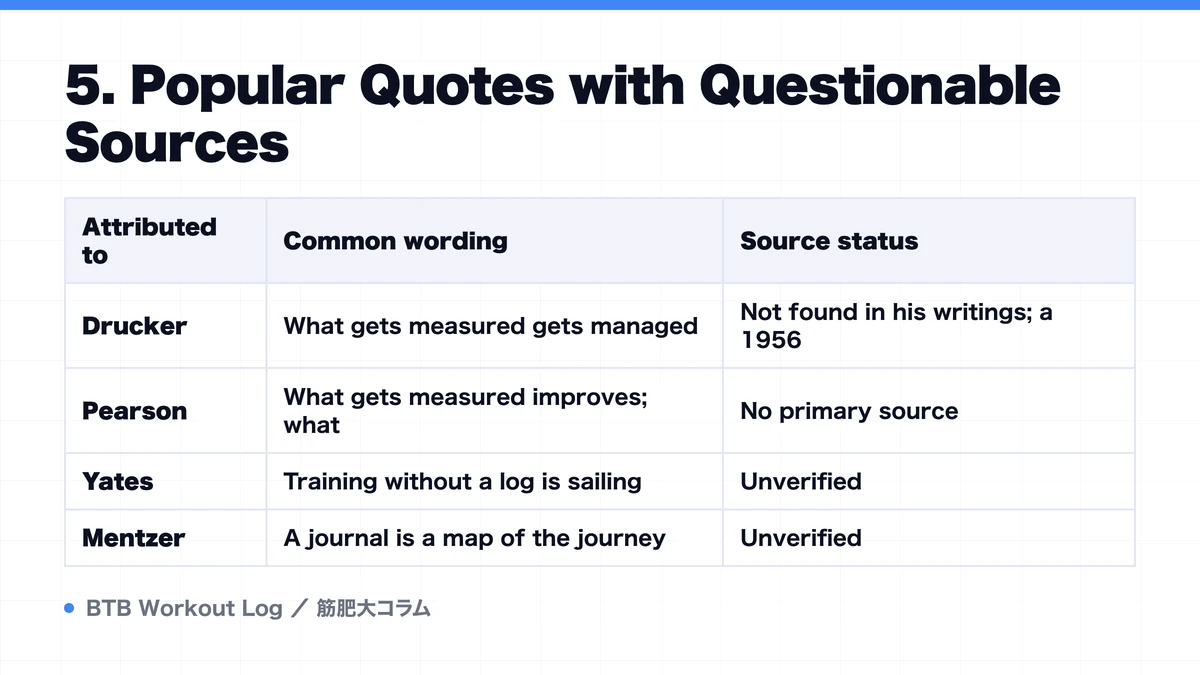
Some widely shared quotes about tracking and measurement can't be verified as the words of the people credited with them. You can still use the ideas, but check the attribution before attaching a name. Here are a few to watch for.
| Attributed to | Common wording | Source status |
|---|---|---|
| Drucker | What gets measured gets managed | Not found in his writings; a 1956 paper is cited as the origin |
| Pearson | What gets measured improves; what gets reported improves faster | No primary source |
| Yates | Training without a log is sailing without a chart | Unverified |
| Mentzer | A journal is a map of the journey | Unverified |
The first quote has an ironic backstory. V. F. Ridgway's 1956 paper, often cited as its origin, was a warning: when people are judged by numbers, they start chasing those numbers and lose sight of the actual goal. The same thing can happen in the gym. If you shorten your range of motion to lift more weight, your numbers may improve while the stimulus to your muscles decreases. Your log is a tool for making decisions, not the goal itself.
We also left out quotes whose original wording we couldn't verify, including statements about training logs circulated under the names of Dante Trudel and Stuart McRobert.
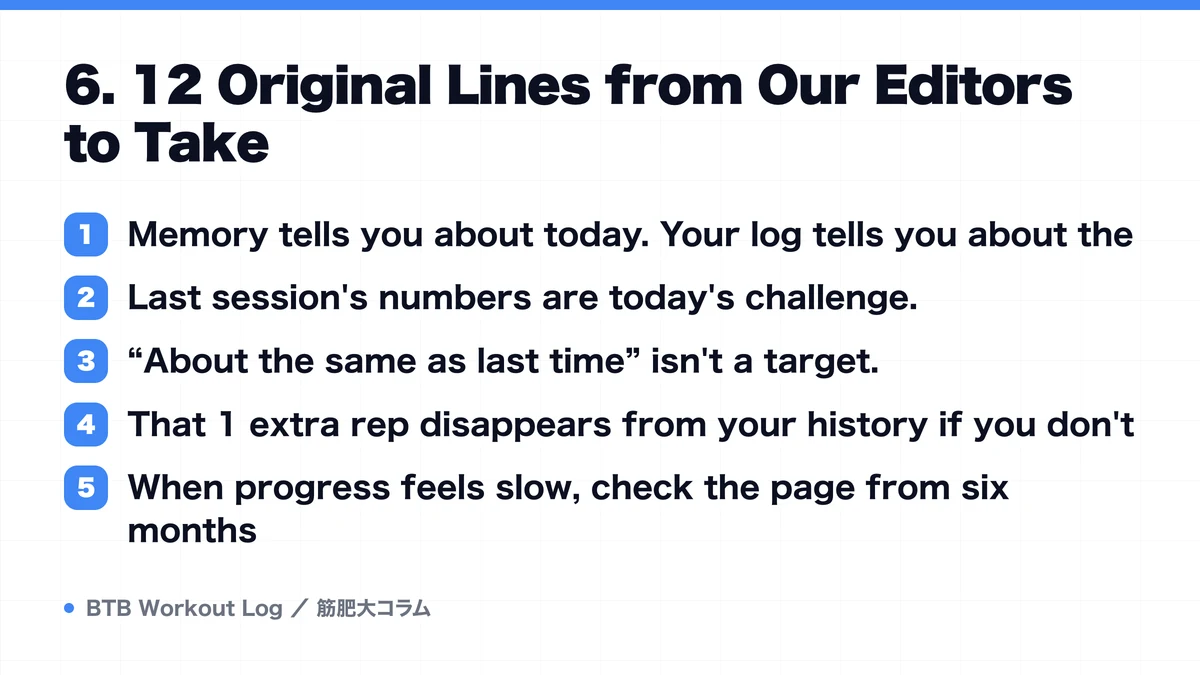
6. 12 Original Lines from Our Editors to Take to the Gym
The lines below were written by the BTB Workout Log editorial team, not quoted from anyone else. Feel free to use them on your lock screen, on your notebook cover, or as reminders to yourself.
- Memory tells you about today. Your log tells you about the last six months.
- Last session's numbers are today's challenge.
- “About the same as last time” isn't a target.
- That 1 extra rep disappears from your history if you don't write it down.
- When progress feels slow, check the page from six months ago.
- Your log isn't for the past. It's for your next 1 set.
- Matching last session's numbers on a bad day is progress, too.
- When the numbers won't budge, note the conditions.
- A plateau only becomes visible in your log.
- Proof that you're stronger shows up in your notebook before the mirror.
- Spend less time writing and more time looking back.
- Today's 1 line can become your confidence 1 year from now.
7. 3 Habits to Put These Quotes to Work at Your Next Session
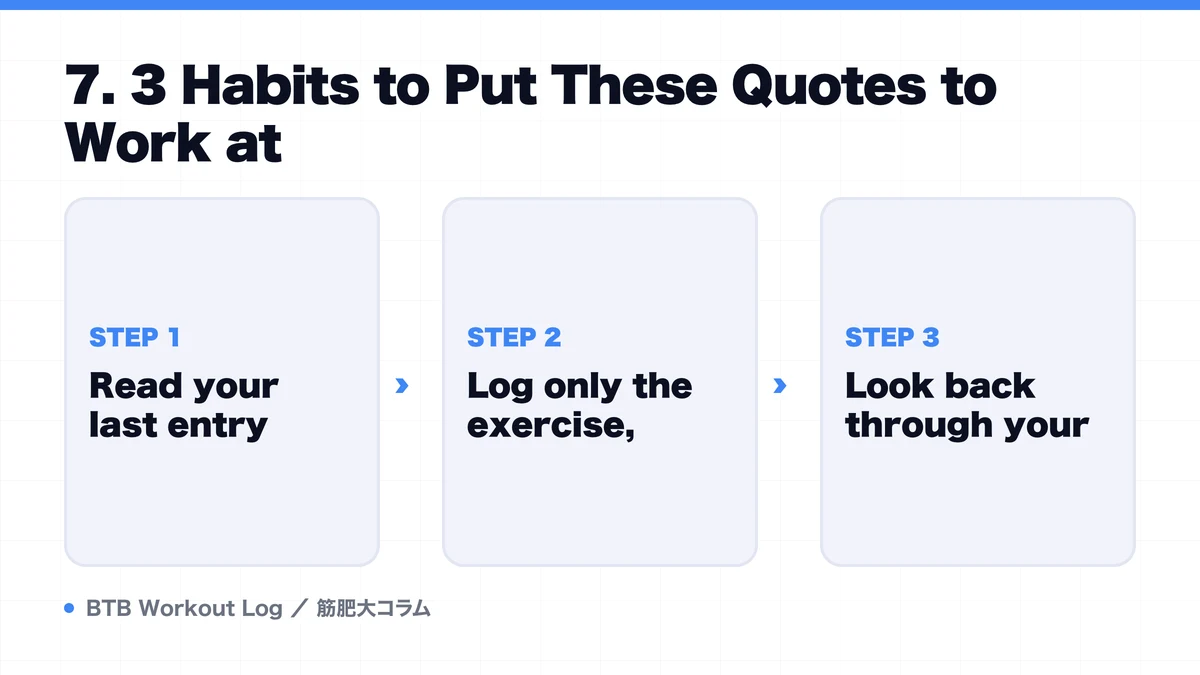
A quote won't help if you read it and move on. Here's how to turn these ideas into actions at your next workout.
- Read your last entry before you start: Before you grab the bar, set today's target: last session plus 1 rep, or last session plus 1 weight increment.
- Log only the exercise, weight, and reps: Fewer fields make the habit easier to keep. Add reps in reserve (RIR) and notes on training conditions later.
- Look back through your log once a month: Compare your numbers with 1 month ago and six months ago. Identify which lifts have improved and which have stalled.
“You don't want to spend more time filling out your workout book than working out.”
You don't want to spend more time filling out your workout book than working out.
Even the strongest advocates of keeping a log are strict about how much time it should take. In BTB Workout Log, selecting an exercise brings up your previous weight and reps, and logging 1 set takes just a few taps. It works offline with no ads, so you can check your last session and record today's work without losing focus between sets.
FAQ
- Did these people actually say the quotes attributed to them?
- Each card has a label. “Source verified” means we checked the original wording against the source. “Paraphrase” means we summarized the source's content. “Source unknown” marks an unverified attribution. Popular phrases whose sources we couldn't confirm are grouped in Section 5 with explanatory notes.
- Can I use these quotes on social media or in my notebook?
- You're free to use the original lines written by our editors in Section 6. When sharing someone else's words, we recommend including both their name and the source.
- What should I do if I can't stick with logging my workouts?
- Track fewer things. Just 3 details—exercise, weight, and reps—are enough to tell whether you beat your last session. The problem is often the effort of entering data rather than a lack of willpower, so choose a method that makes your previous numbers easy to see.
Key takeaways
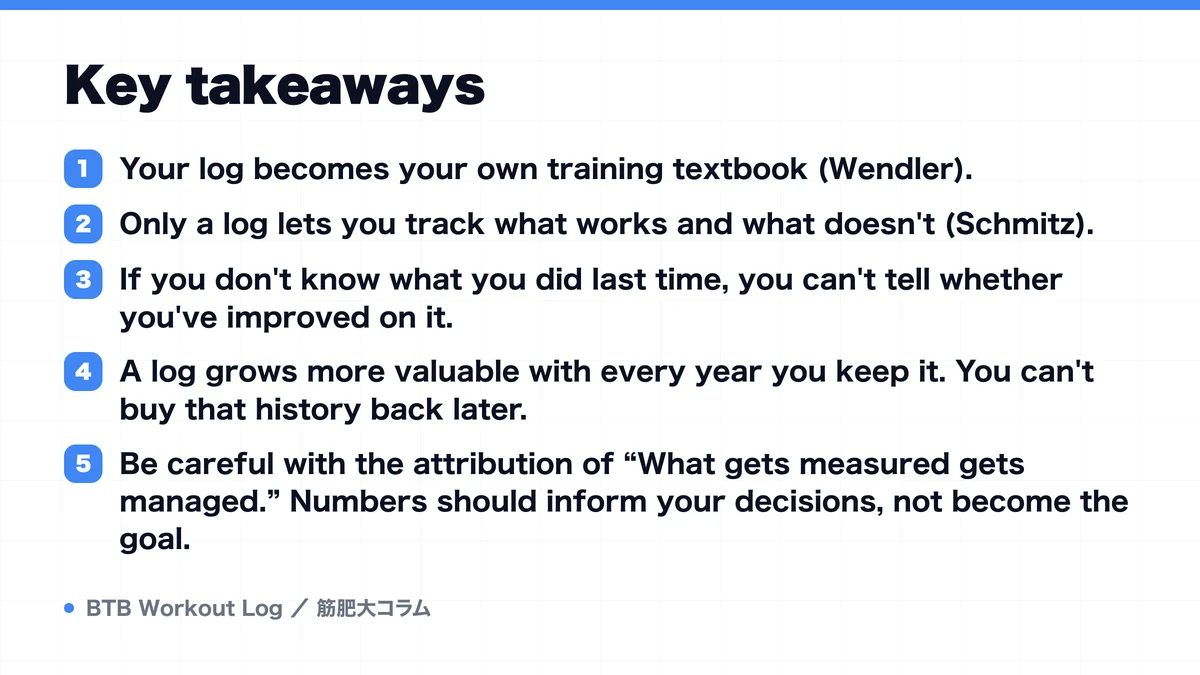
- Your log becomes your own training textbook (Wendler).
- Only a log lets you track what works and what doesn't (Schmitz).
- If you don't know what you did last time, you can't tell whether you've improved on it.
- A log grows more valuable with every year you keep it. You can't buy that history back later.
- Be careful with the attribution of “What gets measured gets managed.” Numbers should inform your decisions, not become the goal.
References
- Jim Wendler: Answering the Impossible Question
- Jim Schmitz on the Lifts: The Training Log (IronMind)
- Mark Rippetoe: Keeping a Training Log (Starting Strength)
- Glenn Pendlay: The Training Log (On Target Publications)
- Do You Really Need to Keep a Training Log? Dorian Yates Did (elitefts, from Muscular Development)
- James Clear: Visualize Your Progress and Stay the Course with a Habit Tracker
- Up your game with winning tips from champ Kipchoge (Business Daily Africa)
- Mining for Gold: The Art of the Training Journal (quoting Easy Strength)
- Dysfunctional Consequences of Performance Measurements (Administrative Science Quarterly, 1956)
- The Hidden Cost of Personal Quantification (Journal of Consumer Research)
