To Grow the Triceps Long Head, Raise Your Arm | Why Overhead Exercises Are Essential for Bigger Arms
Raising your arms lengthens the triceps long head, which crosses the shoulder joint, allowing it to handle elbow-extension loads in a stretched position. That is the main reason to include overhead exercises.
An overhead position alone does not guarantee hypertrophy. Its value depends on whether you can create a long muscle length while maintaining your range of motion, effort, and weekly volume.
Only the triceps long head is affected by upper-arm position
The triceps consists of the long, lateral, and medial heads, and all three extend the elbow. Only the long head originates from the shoulder blade and crosses both the shoulder and elbow, making it a biarticular muscle. The lateral and medial heads originate from the upper-arm bone, so their length does not change in the same way when you move your arms from your sides to overhead.
As you raise your upper arms forward and overhead, the distance increases between the long head's attachment at the shoulder and its attachment near the elbow. Bending your elbows from there stretches it further at the elbow. In other words, starting with your arms raised and elbows bent makes it easier to lengthen the long head across both joints.
This does not mean you can completely isolate the long head. All three heads contribute when you extend your elbows, and their share of the work varies with your build and technique. Overhead exercises create favorable loading conditions for the long head; they do not switch off the other two heads.
How raising your arms can create a hypertrophy stimulus
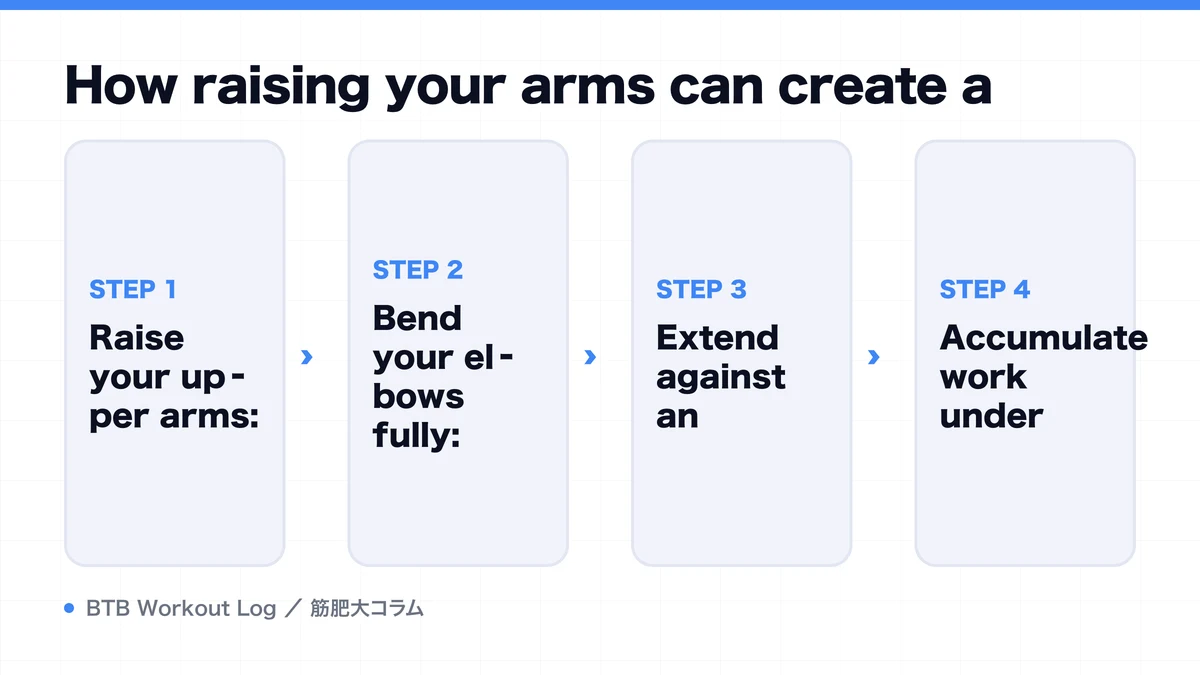
- Raise your upper arms: This lengthens the long head across the shoulder and creates a different starting position from elbow extensions performed with your arms at your sides.
- Bend your elbows fully: Letting your forearms move behind your head takes the long head into an even more stretched range.
- Extend against an external load: Produce elbow-extension torque against resistance from a cable or similar equipment to complete each rep.
- Accumulate work under the same conditions: Repeatedly produce enough tension through the target range while adding recoverable sets and progressively increasing the load.
Several factors contribute to hypertrophy, including mechanical tension. A long muscle length is a useful programming variable, but a stronger stretch does not automatically produce more growth. The target stimulus will be difficult to accumulate if the load leaves too many reps in reserve, your shoulders drop and you lose the overhead position, or your range of motion gets shorter from set to set.
Loading the stretched portion of a rep is a principle that applies to exercise selection across the body. For the triceps long head, however, we also have an intervention study that directly compared different upper-arm positions.
A within-subject study found better results with the overhead position
In a study of 21 participants, each person performed overhead cable elbow extensions with one arm and cable elbow extensions with the other arm held at their side. They trained twice per week for 5 sets per session over 12 weeks, with muscle volume measured by MRI. Long-head muscle volume increased by 28.5% on the overhead side and 19.6% on the arm-at-side side. Total triceps growth was also greater with the overhead position, at 19.9% versus 13.9%.
Notably, the overhead arm used less absolute weight during training but still gained more muscle. This suggests that the weight moved alone cannot determine the hypertrophy stimulus; the muscle length at which that load is applied may also affect the result.
However, this study does not show that every triceps set should be performed overhead or that dumbbells would produce the same difference. The findings came from specific adults performing cable elbow extensions for 12 weeks. Comparing each participant's arms helps control for individual differences, but the exact effect size should not be applied directly to people with different shoulder mobility or training histories.
Keep the load on the long head without forcing your shoulders into position
For cable overhead extensions, set up facing away from the machines and use a staggered stance to stabilize your torso. Aim to keep your upper arms beside your ears, but do not shrug or force your shoulders into a painful position. If your ribs flare and your lower back arches hard, you are creating the appearance of shoulder elevation by moving your torso instead.
Do not try to force your elbows completely together and parallel. Keep them at a width that lets them point forward naturally. At the start of each rep, lower your forearms behind your head, then extend from the deepest position where you can maintain tension in the long head. Prioritize keeping your shoulders up and returning to the same starting position on the next rep over locking your elbows as hard as possible at the top.
If you struggle to hold an overhead position, use a single-arm cable and let the path move slightly outward, use machines with back support, or lower your upper-arm angle slightly. If pain continues, do not treat overhead work as mandatory; choose a comfortable elbow-extension exercise instead. The benefit of a longer muscle length is not worth accepting pain that technique changes cannot resolve.
Use overhead work for some sets and compare it with arm-at-side exercises
If you perform 6–10 direct triceps sets per week, start by assigning roughly half to overhead exercises. Use arm-at-side movements such as pressdowns for the rest so you are not repeating the same joint position on every set. If your program includes plenty of chest and shoulder pressing, account for the triceps fatigue from those lifts and start at the lower end of the direct-set range.
You can use a primary exercise for 8–15 reps and an accessory for 12–20 reps. The labels matter less than getting within 1–3 reps in reserve while holding the planned position, then adding reps or load the following week. See 5 exercises for the long head for specific options and the pressdown comparison for the differences between overhead and arm-at-side exercises.
Keep your upper-arm angle, equipment, and rep range consistent for 4–8 weeks. If your shoulders or torso become the limiting factor only on the overhead exercise, you are not putting its theoretical advantage into practice. If your reps improve while your range of motion stays consistent, with no issues in your elbows or recovery, the exercise works as a primary long-head movement for you. As with choosing a range of motion, build progress through an effective range you can repeat, not simply the largest movement possible.
FAQ
- Do I have to raise my arms straight overhead to train the long head?
- No. Raising your upper arms generally lengthens the long head more than keeping them at your sides, but shoulder range of motion varies between individuals. Choose an angle you can hold without pain or arching your lower back, then perform each elbow extension from that position consistently.
- Are overhead exercises always better than pressdowns?
- A specific cable intervention produced greater hypertrophy with the overhead position, but the best choice still depends on your goal and how well you can perform the exercise. Pressdowns make it easy to accumulate stable training volume, so they work well alongside a long-muscle-length exercise as a second angle.
- Is it okay to use less weight on overhead exercises?
- Yes. Using less weight than you would with your arms at your sides is not a problem. In the study, the overhead arm used less absolute weight but gained more muscle. Do not compare kg between different exercises; track whether you can add reps or load while maintaining the same position and range of motion.
Key takeaways
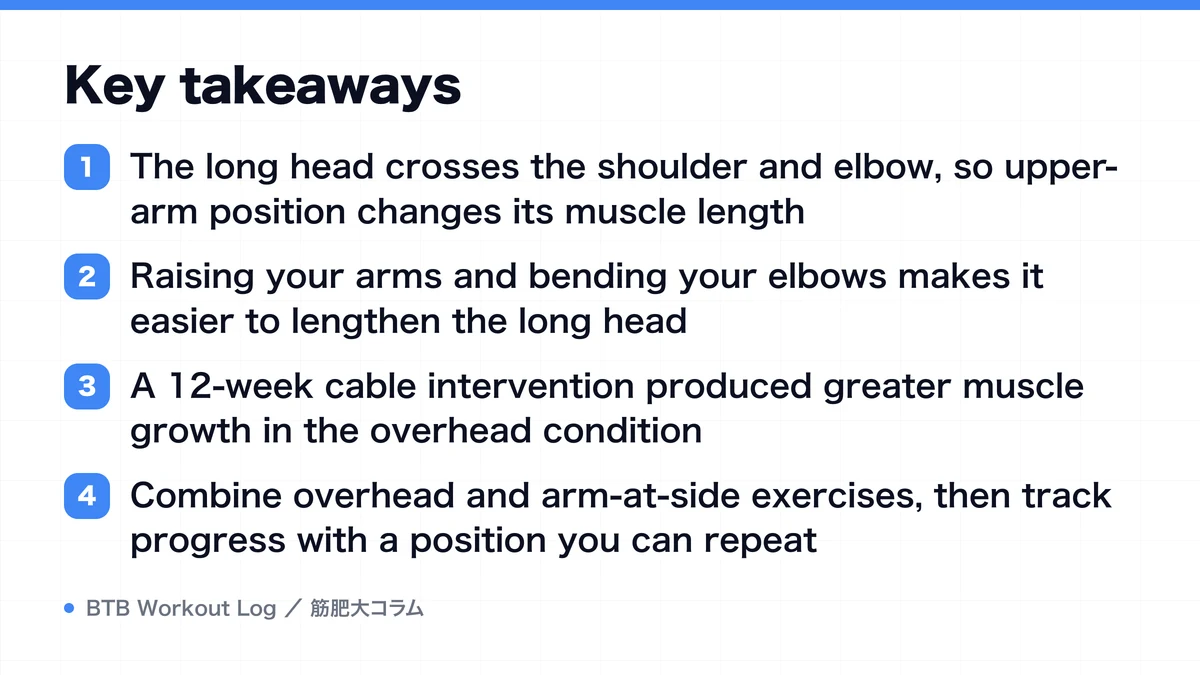
- The long head crosses the shoulder and elbow, so upper-arm position changes its muscle length
- Raising your arms and bending your elbows makes it easier to lengthen the long head
- A 12-week cable intervention produced greater muscle growth in the overhead condition
- Combine overhead and arm-at-side exercises, then track progress with a position you can repeat