Pushdown vs. Overhead Extension: Which Builds Bigger Arms?
If your priority is developing the entire triceps, including the long head, and you can comfortably hold an overhead position, the overhead extension is a strong choice. Pushdowns, however, are easier to perform consistently and control.
Do not judge them by how much weight you can move. Compare muscle length, movement stability, joint compatibility, and the quality of your effective sets alongside the rest of your weekly training.
Judge Both Exercises on the Same 5 Criteria
Both are elbow-extension isolation exercises that work the long, lateral, and medial heads of the triceps. The main difference is that only the long head crosses the shoulder joint, so its starting length changes depending on whether your upper arm is beside your torso or overhead. Pushdowns do not isolate only the lateral head, and overhead extensions do not isolate only the long head.
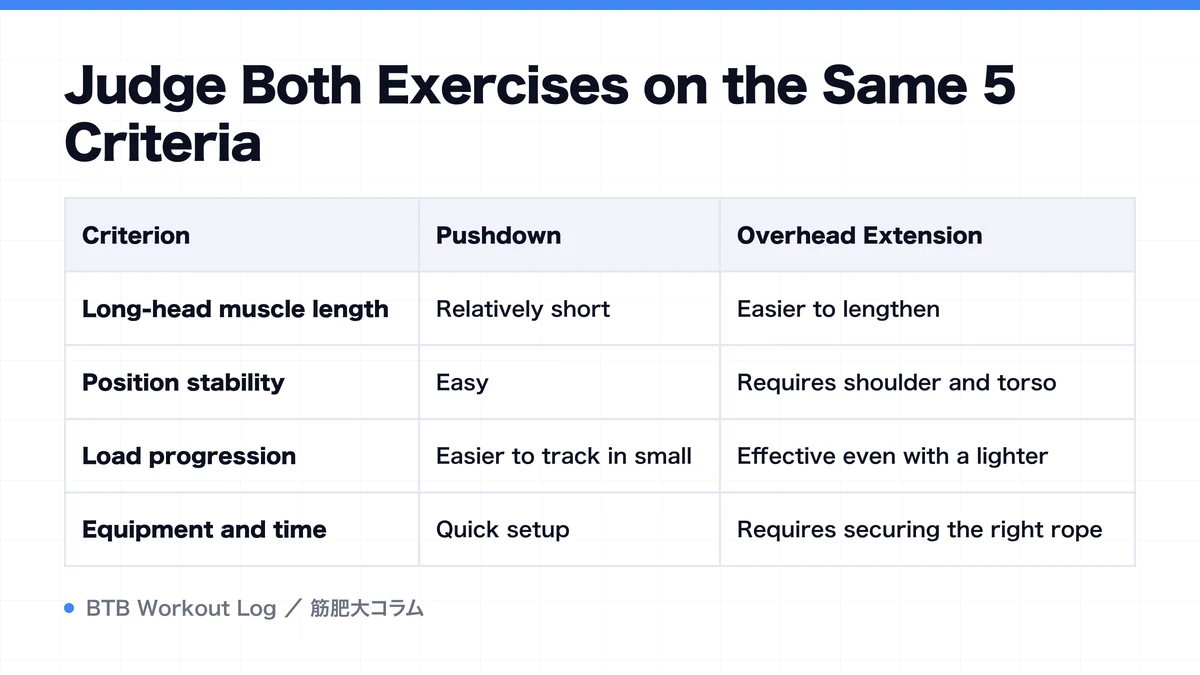
The 5 criteria are ① whether the muscle is loaded at a long length, ② how easily you can keep your form fixed, ③ whether your shoulders and elbows can comfortably move through the range of motion, ④ how reliably you can track progress in weight or reps, and ⑤ how much fatigue overlaps with pressing exercises performed that day. A pump or next-day tightness can be useful feedback, but neither directly measures hypertrophy.
| Criterion | Pushdown | Overhead Extension |
|---|---|---|
| Long-head muscle length | Relatively short | Easier to lengthen |
| Position stability | Easy | Requires shoulder and torso control |
| Load progression | Easier to track in small increments | Effective even with a lighter stack setting |
| Equipment and time | Quick setup | Requires securing the right rope position |
A Within-Person Trial Favored the Overhead Position
This comparison is supported by a study that measured changes in muscle size over 12 weeks, not just muscle activation. A group of 21 adults performed cable elbow extensions 2 times per week, training one arm overhead and the other with the upper arm beside the torso. MRI measurements showed greater growth on the overhead side in the long head, the combined lateral and medial heads, and the triceps as a whole. The difference was especially pronounced in the long head. The overhead side also used a lighter absolute load, so a smaller number on the stack does not mean the stimulus was inadequate.
Still, this was a single 12-week intervention using a specific cable exercise and 10 sets per week. The same difference may not apply to EZ bars, dumbbells, different ranges of motion, or long-term programs for experienced lifters. The study makes overhead extensions a strong candidate, but it does not mean everyone should replace every set with them. For more on why arm position matters, see how upper-arm position affects the long head.
It would also be wrong to conclude that pushdowns have no long-term benefit. Muscle size increased with the arms-at-sides condition as well. If you can consistently use a large range of motion and the triceps are the first muscles to approach their limit, pushdowns remain a practical hypertrophy exercise.
Pushdowns Are Easier to Stabilize; Overhead Extensions Lengthen the Long Head
Pushdown
Keep your elbows beside your torso, your shoulders down, and move only your forearms. You can spread the rope apart at the bottom, but do not pull your shoulders back to manufacture extra range of motion. At the top, return until just before your forearms become parallel to the floor, and find a position where the stack does not touch down. The stable torso position makes pushdowns an easy way to add direct triceps work quickly after pressing.
Overhead Extension
Run the rope behind your head and bend your elbows at an angle where your shoulders feel stable. Do not force your upper arms tightly beside your ears. Feeling the long head stretch at the bottom does not mean you need to arch your chest to go deeper. Resistance drops when the cable and forearm become too closely aligned, so adjust your stance 1 step at a time until you find a position that maintains tension through the middle of the movement.
If the front of your shoulder feels pinched overhead, or you cannot raise your arm without arching your rib cage, try a single-arm cable with your upper arm angled slightly forward. If pain persists, stop instead of trying to fix it by going deeper, and seek a professional assessment if needed.
Track the Endpoint and What Ends the Set, Not the Stack Weight
Pushdowns make it easier to use a heavier stack setting, but leaning over late in the set brings shoulder extension and bodyweight into the movement. An overhead extension can be difficult even with a lighter setting because you extend the elbow from a position where the long head is lengthened. Do not compare kilograms across different exercises. Compare each movement only after standardizing its starting position, elbow position, and range of motion.
Double progression works well here. For example, use a range of 8–15 reps. Once every set reaches the upper limit with the same endpoint, increase the cable by 1 increment. If 1 increment is too large, spend longer adding reps or switch to a single-arm attachment. Training close to failure is one way to create a strong stimulus, but reaching repetition failure on every set has not been shown to be essential for hypertrophy.
A rope, straight bar, or single-hand attachment is not a switch for selecting different triceps heads. Choose based on whether you can keep your wrists comfortable, maintain your elbow position through the endpoint, and adjust the load in suitable increments. Changing attachments can also change your range of motion, so track the new setup as a separate progression.
If localized elbow fatigue carries into the next day's pressing, the likely cause is not the exercise name but your set count, frequency, or late-set pushing to failure. Include the indirect stimulus from bench presses and shoulder presses in your recovery budget, not just direct triceps work.
Prioritize Overhead Work for the Long Head and Pushdowns When Consistency Is Limited
Situations that favor overhead extensions include prioritizing long-head development, being able to maintain a stable overhead position, having access to a suitable cable position, and already doing mostly arms-at-sides exercises. It is worth including at least 1 overhead movement in your weekly triceps training.
Situations that favor pushdowns include discomfort when raising your arms, wanting a safe option for pushing to failure after presses, needing to train both arms quickly, and finding that your torso becomes the limiting factor overhead. If there is a major difference in how consistently you can reproduce your form, prioritize execution quality over theoretical muscle length.
If both exercises work for you, try 3 sets of overhead extensions earlier in the week and 2–3 sets of pushdowns on another day. This makes the comparison easier to control. If your program already includes an overhead movement as a primary long-head triceps exercise, use pushdowns in the additional slot to change the angle. Keep the same structure for about 6 weeks, then adjust the split based on elbow comfort, rep progression, and the effect on your pressing exercises.
FAQ
- Are Pushdowns Unnecessary if I Want Bigger Triceps?
- No. The triceps still grow when trained with the arms beside the torso, and pushdowns offer excellent stability and time efficiency. If long-head development is a priority, use overhead work for at least some of your training and fill the remaining volume with pushdowns.
- Are Dumbbells or Cables Better for Overhead Extensions?
- The directly studied condition used cables. In practice, choose the option that maintains resistance from the lengthened position through the end of the movement while allowing you to stabilize your shoulders and elbows. If a dumbbell feels heavy only at the bottom and loses tension at the top, try a cable.
- Can I Perform Both Exercises Back to Back on the Same Day?
- Yes, but fatigue will reduce your reps on the second exercise. Perform your priority movement first, and do not sharply increase your total sets from the previous week. Splitting them across separate days makes it easier to compare performance and joint response.
Key takeaways
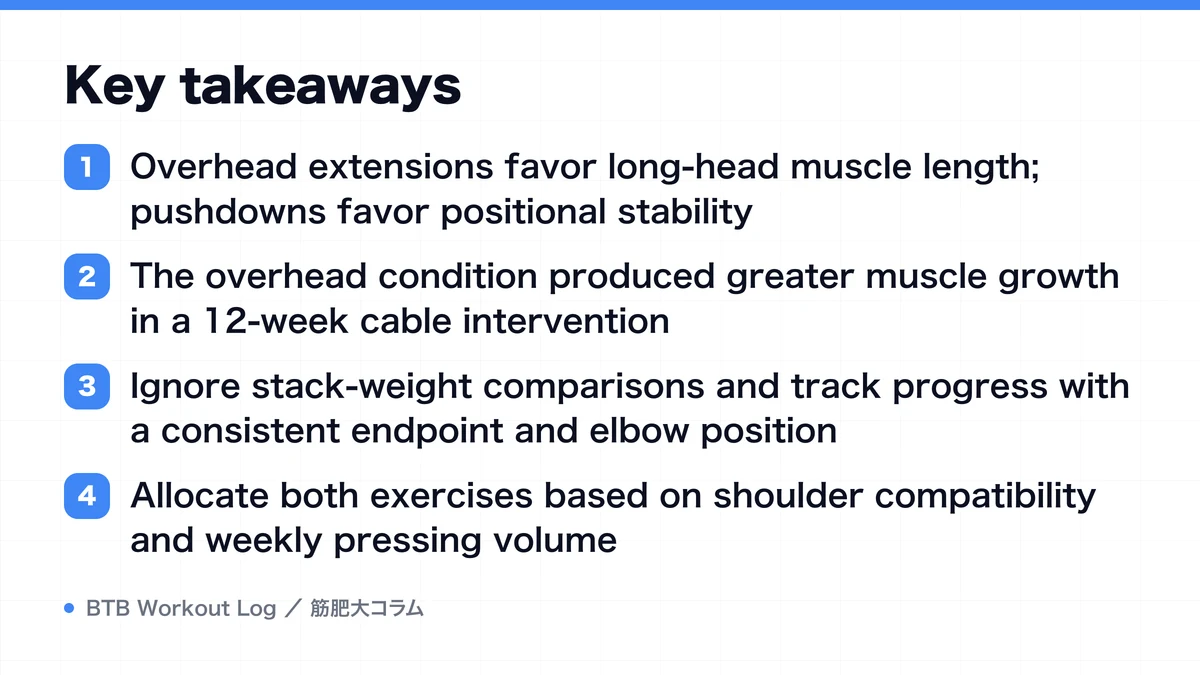
- Overhead extensions favor long-head muscle length; pushdowns favor positional stability
- The overhead condition produced greater muscle growth in a 12-week cable intervention
- Ignore stack-weight comparisons and track progress with a consistent endpoint and elbow position
- Allocate both exercises based on shoulder compatibility and weekly pressing volume