5 Exercises for a Bigger Glute Max | Program Design for Lifters Who Can't Feel It in Their Glutes
Squats aren’t the only way to build your glutes, and neither are hip thrusts. Choose movements by their role: exercises that use deep hip flexion, keep tension near full hip extension, or let you train one leg hard with solid stability. That makes it easier to fix the problem of your legs or lower back giving out before your glutes.
This isn’t a workout that includes all 5 exercises. It’s a shortlist to help you choose 2–3 movements in which the target muscle is the limiting factor. Focus less on whether you feel a burn and more on whether you can build repeatable reps under consistent conditions.
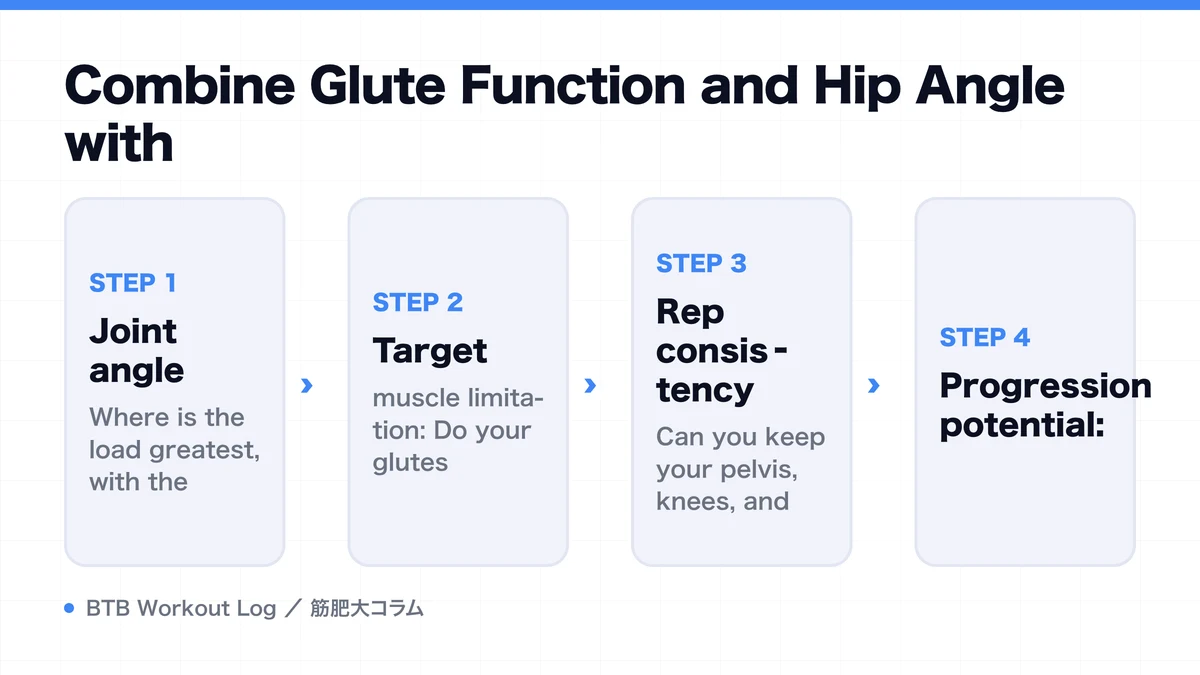
Combine Glute Function and Hip Angle with Stability and Progression
The gluteus maximus is primarily responsible for hip extension and lengthens as the hip moves into deeper flexion. But simply using the most stretched position doesn’t automatically direct the load to your glutes. The direction of resistance, the amount of work done by the knee joint, and your ability to control your pelvis can shift the limiting factor to your quads, hamstrings, or lower back.
Evaluate each option against these 4 criteria.
- Joint angle: Where is the load greatest, with the hip flexed or extended?
- Target-muscle limitation: Do your glutes approach their limit before your cardio, grip, or balance does?
- Rep consistency: Can you keep your pelvis, knees, and feet on the same path through the final reps?
- Progression potential: Can you increase the load or reps in small steps and compare your performance with the previous session?
A review of research on the gluteus maximus reported hypertrophy across several exercise types, including back squats, hip thrusts, leg presses, and hip extensions. Don’t choose an exercise because it looks glute-specific. Use it to fill a loading-position or limiting-factor gap in your current program.
1. Deep Squats and 2. Bulgarian Split Squats Train Deep Hip Flexion
1. Deep Squat
This compound exercise flexes both the hips and knees, training the quads and adductors alongside the gluteus maximus. To emphasize your glutes, keep your whole foot planted and squat only as deep as you can control your pelvis. The goal isn’t to go as deep as possible. Use the deepest range in which your knee and hip paths remain consistent on the way down and up. If your breathing or trunk strength always gives out first, this becomes a less efficient way to add direct glute sets.
For a breakdown of which muscles squats cover and which roles they leave unfilled, see Training Legs with Squats Alone. Here, the squat is treated as one option for glute training.
2. Bulgarian Split Squat
This single-leg exercise places the rear foot on a bench and loads the front leg through deep hip flexion. Position your front foot so that your shin leans slightly forward at the bottom without your heel lifting, then bring your torso and pelvis over the front leg. Don’t move your foot so far forward that your split stance becomes the limiting factor. What matters is moving consistently through a range that stretches the glutes.
If holding dumbbells in both hands makes grip or balance fail first, hold the rack with one hand and a dumbbell in the other. External support doesn’t make the movement less functional. It lets you continue the set until your glutes are much closer to their limit.
Fill the Gaps with 3. Hip Thrusts, 4. RDLs, and 5. Cable Hip Extensions
3. Barbell Hip Thrust
The hip thrust places substantial load near the top, where the hips are extended, and lets you add glute work with less demand on knee extension. Set the lower edge of the bench around your shoulder blades and start with your feet roughly hip-width apart. Adjust your foot position so your shins are nearly vertical at the top and you can posteriorly tilt your pelvis without flaring your ribs. See Squats vs. Hip Thrusts for the long-term comparison and how their roles differ.
4. Romanian Deadlift
Soften your knees slightly and push your hips back to load the glutes and hamstrings in hip flexion. It works well if you want to train the entire posterior chain with one exercise, but it doesn’t isolate the glutes. If your grip or lower back ends the set, reduce the load and keep the bar close to your legs. If your hinge shifts into your lower back, start with the RDL Form Fix.
5. Cable Hip Extension
Attach an ankle strap, face the cable machine, and drive one leg backward for an isolation-focused option. Hold the rack with both hands, keep your pelvis facing forward, and move only at the hip without arching your lower back. Kicking higher isn’t better. Stop as the glute reaches its shortened position. Because this exercise creates little whole-body fatigue, it’s easy to add sets of around 12–20 reps after compound movements.
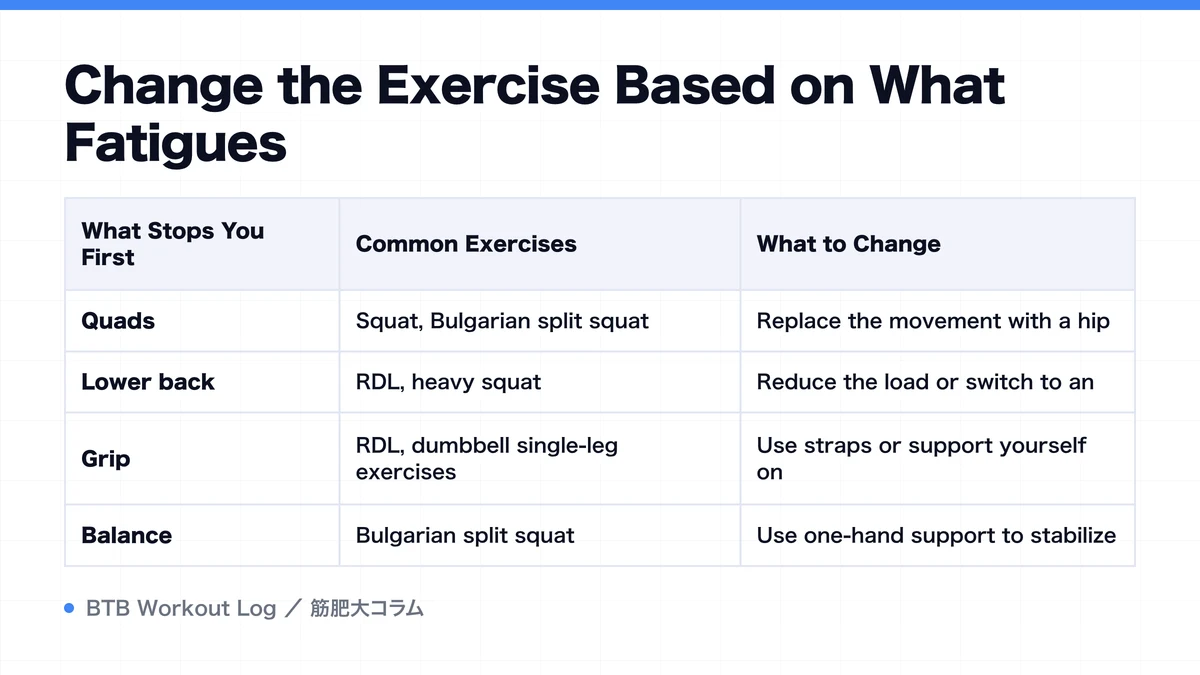
Change the Exercise Based on What Fatigues Before Your Glutes
| What Stops You First | Common Exercises | What to Change |
|---|---|---|
| Quads | Squat, Bulgarian split squat | Replace the movement with a hip thrust or cable exercise instead of adding one |
| Lower back | RDL, heavy squat | Reduce the load or switch to an exercise with external support |
| Grip | RDL, dumbbell single-leg exercises | Use straps or support yourself on a rack |
| Balance | Bulgarian split squat | Use one-hand support to stabilize reps on the front leg |
| Lower-back arch at the top | Hip thrust, cable exercise | Shorten the range of motion and finish with a posterior pelvic tilt |
If you can’t feel your glutes, adding all 5 exercises only makes it harder to tell whether the problem is insufficient loading or excessive fatigue. Remove one exercise, add one replacement, and keep the conditions consistent for 3–6 weeks. Treat the sensation of a stretch as supporting information. The real questions are whether your glutes determined when the set ended and whether your performance recovered by the following week.
Don’t mistake sharp hip or lower-back pain for muscular stimulus. If the pain continues after reducing the load, adjusting your foot position, and shortening the range of motion, stop the exercise and consult a medical or exercise professional.
Split Loading Positions Across 2 Days and Keep Only the Exercises You Need
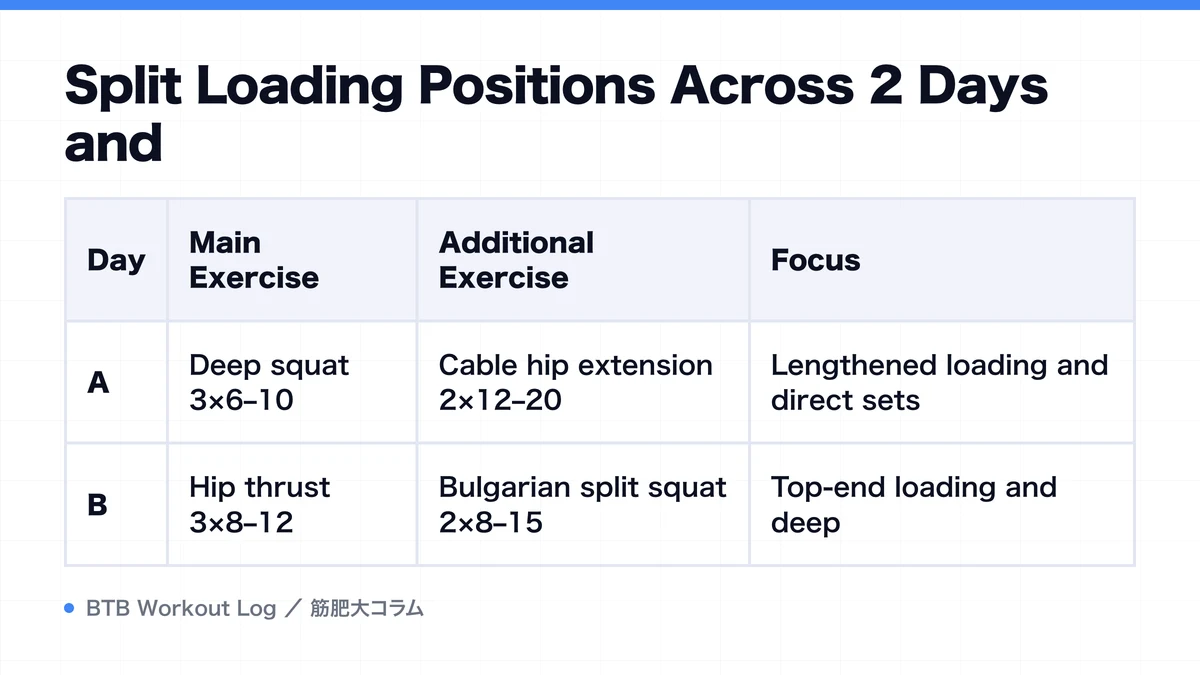
For glute training twice per week, make Day A focused on deep hip flexion and Day B focused on top-end loading and external support.
| Day | Main Exercise | Additional Exercise | Focus |
|---|---|---|---|
| A | Deep squat 3×6–10 | Cable hip extension 2×12–20 | Lengthened loading and direct sets |
| B | Hip thrust 3×8–12 | Bulgarian split squat 2×8–15 | Top-end loading and deep single-leg work |
During phases when you also want to prioritize your hamstrings, replace either the Day A squat or the Day B Bulgarian split squat with an RDL. This isn’t an example of programming all 5 exercises. Recount the glute sets already in your program, and reduce the volume if your reps and range of motion drop substantially in later sets. See Weekly Hard Sets for general guidance on training volume.
Judge progress under consistent conditions for each exercise. Once you reach the top of the prescribed rep range while maintaining your target RIR and range of motion, add a small amount of weight. If adding weight immediately makes your squat shallower, causes your lower back to arch at the top of a hip thrust, or makes you lose support during a Bulgarian split squat, that isn’t progressive overload. It’s a change in movement execution.
Effective glute programming isn’t about using more exercises. Identify which role your main movement lacks, whether that is lengthened loading, loading near full hip extension, or single-leg work with external support, then add one exercise to fill the gap and keep progressing the combination.
FAQ
- Do You Need All 5 Exercises to Build Bigger Glutes?
- No. Start with one main exercise that uses deep hip flexion and one additional exercise with a different loading position or external support. Add a third only after identifying a clear gap, and don’t increase your set count automatically.
- If Squats Only Fatigue Your Thighs, Should You Widen Your Stance?
- Changing stance width alone won’t necessarily shift the work to your glutes. First check the depth you can reach without lifting your heels, the path of your knees relative to your toes, and whether your glutes are the limiting factor. If your quads consistently give out first, replace some of your squat work with another exercise such as the hip thrust.
- Should You Change Exercises If Your Glutes Aren’t Sore?
- Don’t change an exercise based on soreness alone. Keep it if your reps or load are increasing at the same range of motion and RIR, your glutes are the main reason the set ends, and your recovery remains on track. Reconsider the exercise if progress stalls for several weeks and another body part consistently gives out first.
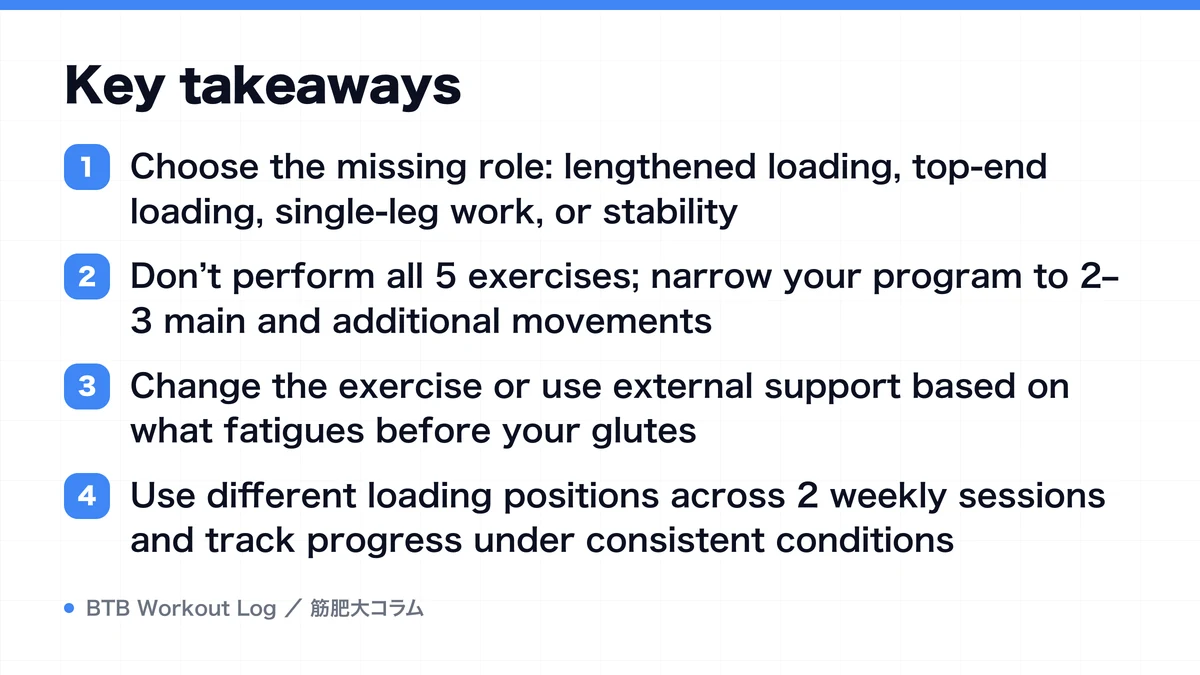
Key takeaways
- Choose the missing role: lengthened loading, top-end loading, single-leg work, or stability
- Don’t perform all 5 exercises; narrow your program to 2–3 main and additional movements
- Change the exercise or use external support based on what fatigues before your glutes
- Use different loading positions across 2 weekly sessions and track progress under consistent conditions