Where Does the 1.6g/kg/Day Protein Target Come From? | The Limit of "More Is Always Better" From Morton 2018
Conclusion: 1.62 g/kg/day is neither "ineffective if you don't take this much" nor "any more is completely wasteful". This is the breaking point in the meta-regression where the additional effect on fat-free mass becomes smaller on average.
It is practical to first approach the total intake to approximately 1.6 g/day per 1 kg of body weight and adjust it according to dietary preferences, weight loss period, and individual differences.
Paper details
| Original title | A Systematic Review, Meta-analysis and Meta-regression of the Effect of Protein Supplementation on Resistance Training-induced Gains |
|---|---|
| Authors | Robert W. Morton et al. |
| Journal | British Journal of Sports Medicine, 52(6), 376-384 |
| Year | 2018 |
| Study design | Systematic review, meta-analysis, meta-regression |
| Participants / scale | 49 studies, 1863 people in total |
| Comparison / methods | Comparing protein supplementation with control after 6 weeks or more of resistance training |
| Main outcomes | 1RM, fat-free mass, muscle fiber cross-sectional area, mid-thigh cross-sectional area |
| DOI | 10.1136/bjsports-2017-097608 |
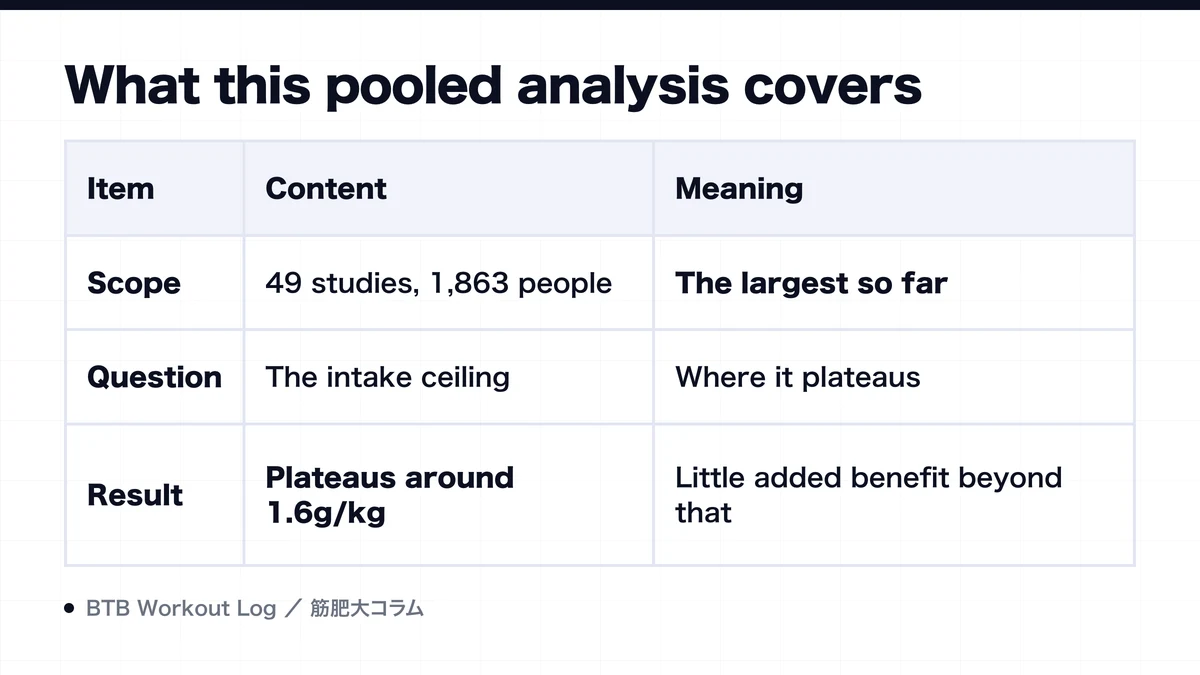
Largest combined analysis of 49 studies and 1863 people
Morton et al. combined 49 studies that compared protein-supplemented groups with control groups over six weeks of resistance training. Muscle strength, fat-free mass, muscle fiber cross-sectional area, and mid-thigh cross-sectional area are evaluated.
Furthermore, we used meta-regression to analyze the relationship between total protein intake and fat-free mass increase, and estimated at which intake the additional effect becomes smaller.
The average addition of supplementation is 0.30 kg of lean mass.
The average addition of protein supplementation to the control group was the increase in lean mass.0.30kg(95% confidence interval 0.09-0.52kg), 1RM2.49kg(0.64 to 4.33 kg).
The cross-sectional area of muscle fibers was 310 µm², and the cross-sectional area of the mid-thigh region was increased by 7.2 mm². Although the effect was statistically confirmed, it is supplementary compared to the effect of muscle training itself.
1.62g/kg/day is the breaking point of the regression line
In meta-regression, the total intake is1.62g/kg/dayThe additional effect on fat-free mass approached a plateau on average. If you weigh 70kg, it is about 113g/day.
This is an estimate of the population average and is neither a minimum requirement nor a safe upper limit. Because of confidence intervals, errors in food records, and individual differences, there is no point in adjusting to the decimal point.
Interpretation changes for those with experience, insufficient intake, and weight loss period
The analysis showed that those with training experience tended to have a larger increase in fat-free mass. On the other hand, people who already consume enough protein have less room to add.
During weight loss, it becomes difficult to maintain muscle mass due to a lack of total energy, so you may set your goals a little higher. However, this paper alone did not determine the optimal value for the weight loss period.
Allocate the daily target amount to meals
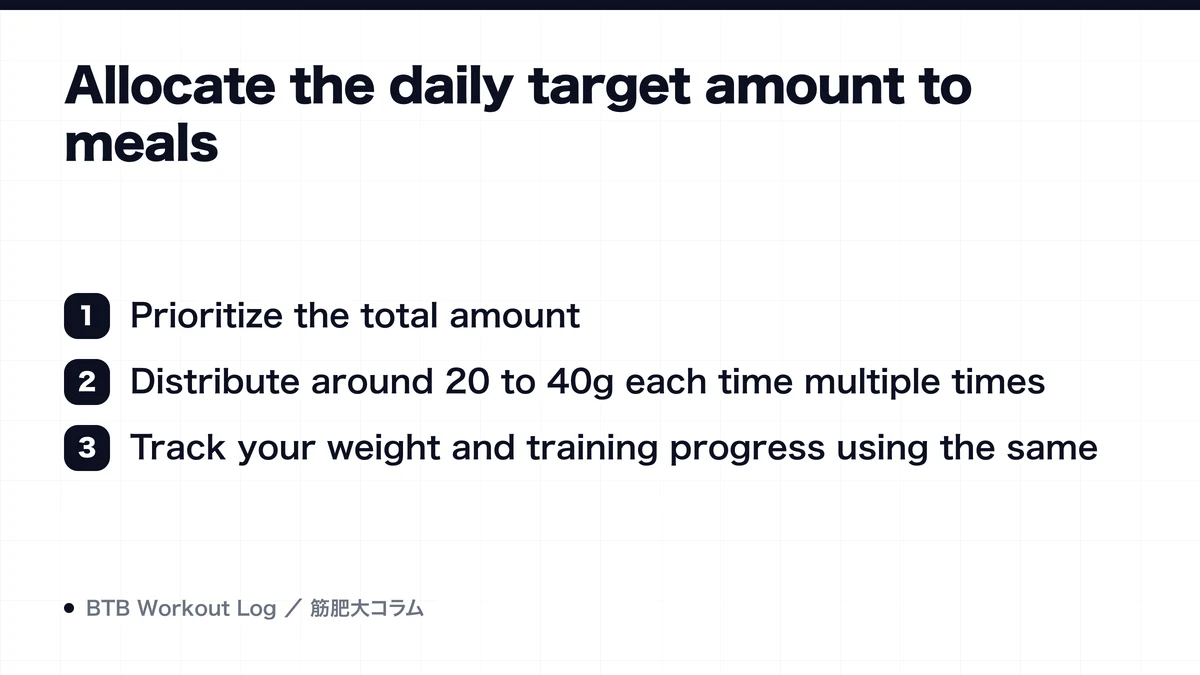
Estimate your weight x 1.6g and divide it into 3 to 5 meals. If you weigh 70kg, it's about 112g, so if you're doing it 4 times, you should aim for around 28g each time. Use protein as much as you need from food.
- Prioritize the total amount
- Distribute around 20 to 40g each time multiple times
- Track your weight and training progress using the same standards for 2-4 weeks.
FAQ
- Will I not be able to gain muscle if it is less than 1.6g/kg?
- It will increase. 1.62g/kg/day is the estimated breaking point at which the additive effect becomes smaller, not the starting point of the effect.
- Is more than 2.0g/kg a waste?
- I can't say it's completely wasteful. It may be used during weight loss periods or depending on individual differences, but we believe that the average additional effect is likely to be small.
- Do you use your current weight or your goal weight?
- You can usually estimate it based on your current weight. If your body fat percentage is extremely high, you can also use target weight or fat-free mass.
Key takeaways
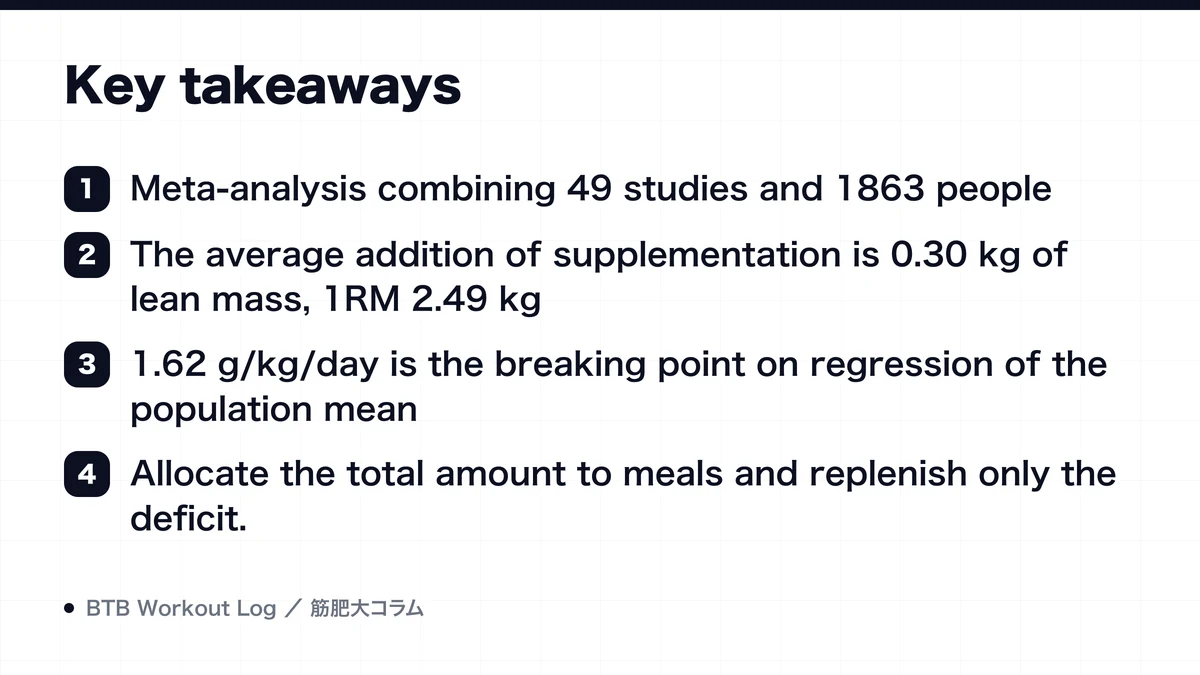
- Meta-analysis combining 49 studies and 1863 people
- The average addition of supplementation is 0.30 kg of lean mass, 1RM 2.49 kg
- 1.62 g/kg/day is the breaking point on regression of the population mean
- Allocate the total amount to meals and replenish only the deficit.