How Much Muscle Does Protein Actually Add? | The Realistic Effect Shown by the Cermak 2012 Meta-Analysis
Conclusion: Protein supplementation increased lean mass by an average of 0.69kg and leg press 1RM by 13.5kg compared to resistance training alone. Although it is effective, the main focus is training, and supplementation is just an addition to fill in the gaps.
This study, which combines 22 randomized controlled trials, is the first major meta-analysis to quantitatively answer the question, "Does protein really matter?"
Paper details
| Original title | Protein Supplementation Augments the Adaptive Response of Skeletal Muscle to Resistance-type Exercise Training |
|---|---|
| Authors | Naomi M. Cermak et al. |
| Journal | American Journal of Clinical Nutrition, 96(6), 1454-1464 |
| Year | 2012 |
| Study design | Systematic review/meta-analysis of randomized controlled trials |
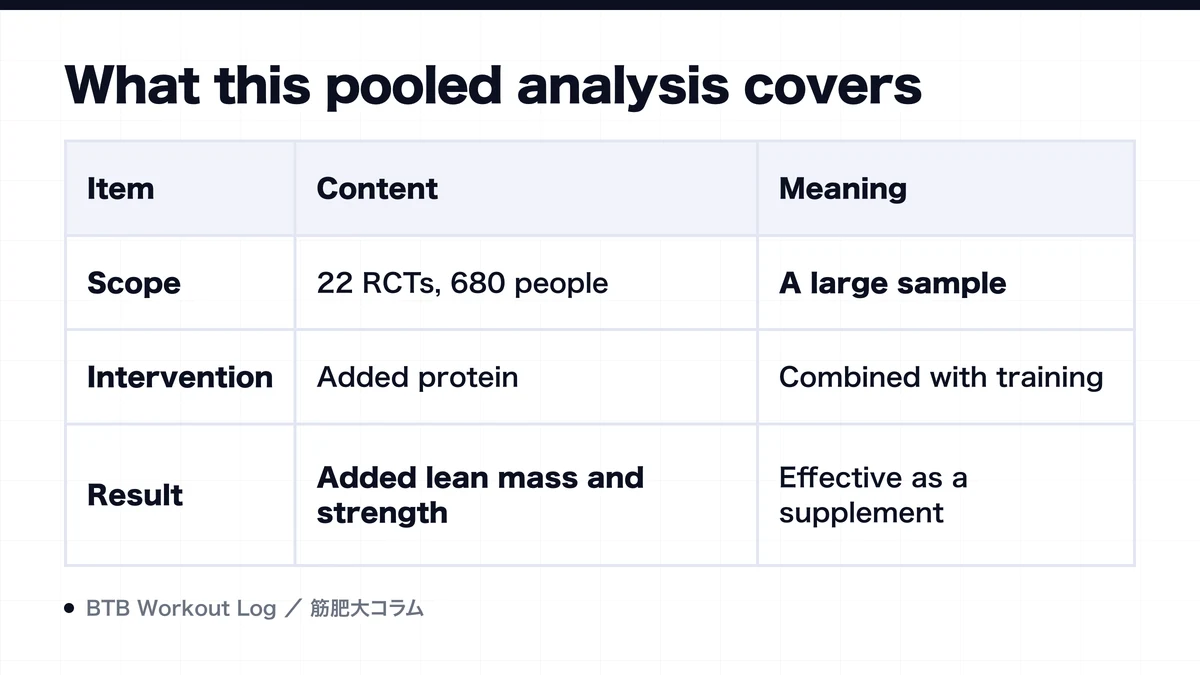
| Participants / scale | 22 studies, total of 680 people (young and elderly) |
| Comparison / methods | Protein supplementation versus control over 6 weeks of resistance training |
| Main outcomes | Fat-free mass, muscle fiber cross-sectional area, and leg press 1RM |
| DOI | 10.3945/ajcn.112.037556 |
22 studies, 680 people, comparing muscle training over 6 weeks
The subjects were healthy adults who performed resistance training for 6 weeks or more, and compared a protein supplemented group with a placebo or non-supplemented group. Studies of young and older adults were included.
It is important that the study evaluates long-term adaptations such as post-training fat-free mass, muscle fiber cross-sectional area, and leg press strength, rather than single-shot muscle protein synthesis.
Fat-free mass 0.69kg, leg press 13.5kg added
The difference from the control group is fat-free mass0.69kg(95% confidence interval 0.47-0.91kg), leg press 1RM13.5kg(6.4-20.7kg). Myofiber cross-sectional area also increased more in the supplemented group.
This difference is not an increase in protein alone, but an additional amount compared to the control group who also did muscle training. I read that training is the foundation, and nutrition boosts the adaptation.
Additions were seen in older as well as younger adults
Subgroup analysis showed an addition to lean mass and muscle strength in both young and older adults. As we age, the muscle protein synthesis response to the same meal may become weaker, so it makes sense to ensure a sufficient amount even in the elderly.
However, age alone does not determine the amount you need. We will also assess your weight, food intake, health condition including kidney function, and training content.
Why 0.69 kg cannot be used as a predictive value for everyone
The amount of supplementation, type of protein, timing of intake, subjects, and duration differ for each study. Fat-free mass includes water other than muscle, and the range of individual responses cannot be determined from the average value.
In addition, people who were originally deficient in protein in their diets may be more likely to benefit from supplementation. If you add it to someone who is getting enough, you won't necessarily get the same 0.69kg.
Calculate your protein deficiency before buying protein
First, estimate your daily protein intake based on your typical diet. Use protein to compensate for the amount of protein that you don't reach your goal for, or for times when it's difficult to eat.
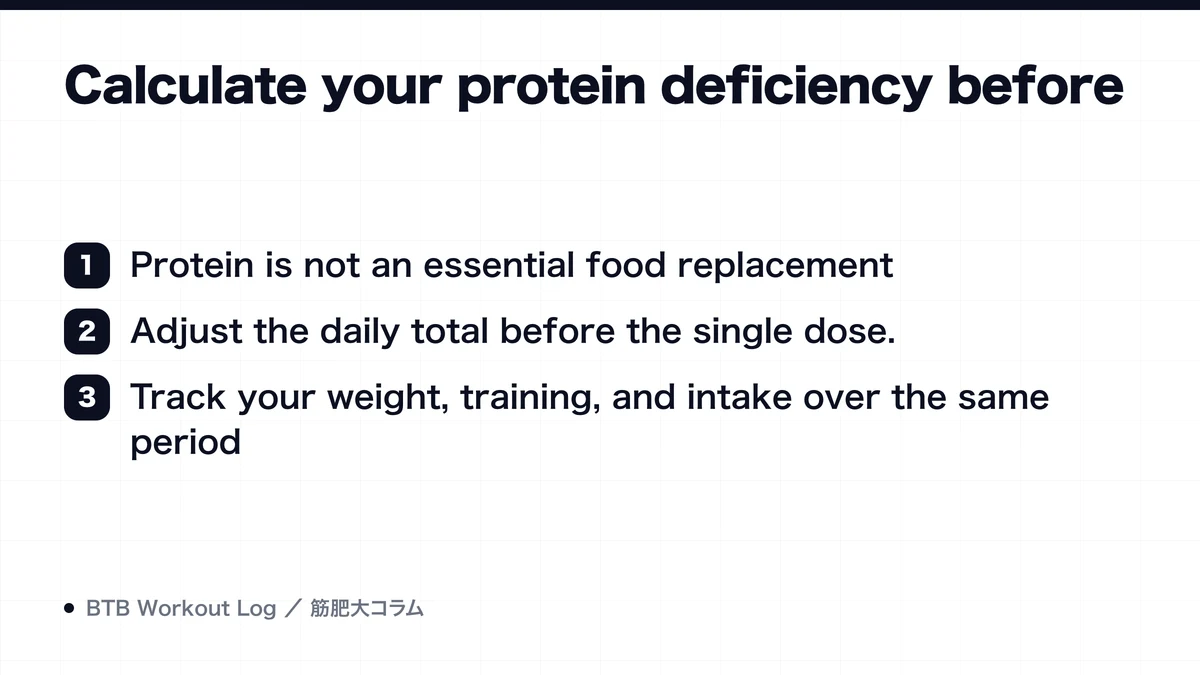
- Protein is not an essential food replacement
- Adjust the daily total before the single dose.
- Track your weight, training, and intake over the same period
The specific intake amount isThe dose response of Morton 2018is helpful.
FAQ
- Can you gain 0.69kg of muscle with just protein?
- No. This is an average increase over a control group that did muscle training, and is not a guaranteed value for individuals.
- Is it effective for elderly people?
- This analysis also showed an added benefit for older people. However, if you have a pre-existing medical condition or are concerned about your kidney function, please consult a medical professional.
- Is it unnecessary if the food is enough?
- Basically unnecessary. Protein is a convenient option to supplement the amount you lack in your diet.
Key takeaways
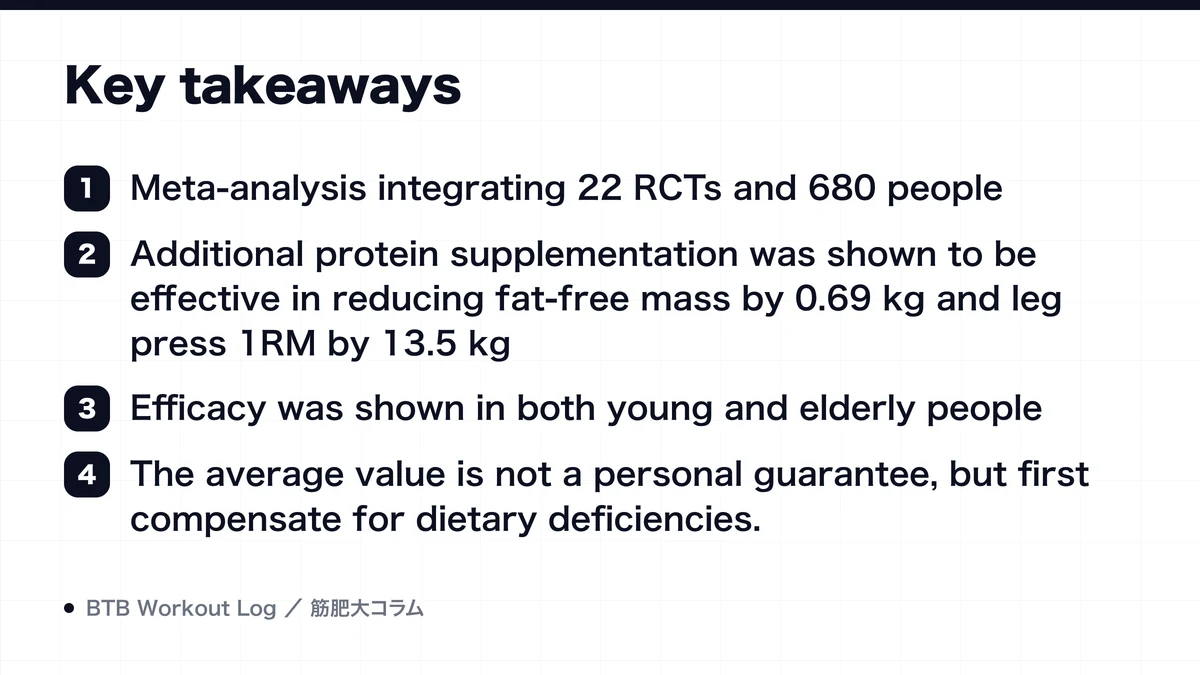
- Meta-analysis integrating 22 RCTs and 680 people
- Additional protein supplementation was shown to be effective in reducing fat-free mass by 0.69 kg and leg press 1RM by 13.5 kg
- Efficacy was shown in both young and elderly people
- The average value is not a personal guarantee, but first compensate for dietary deficiencies.