Protein Before or After Training: Which Is Right? | Revisiting Tipton 2001 With Today's Evidence
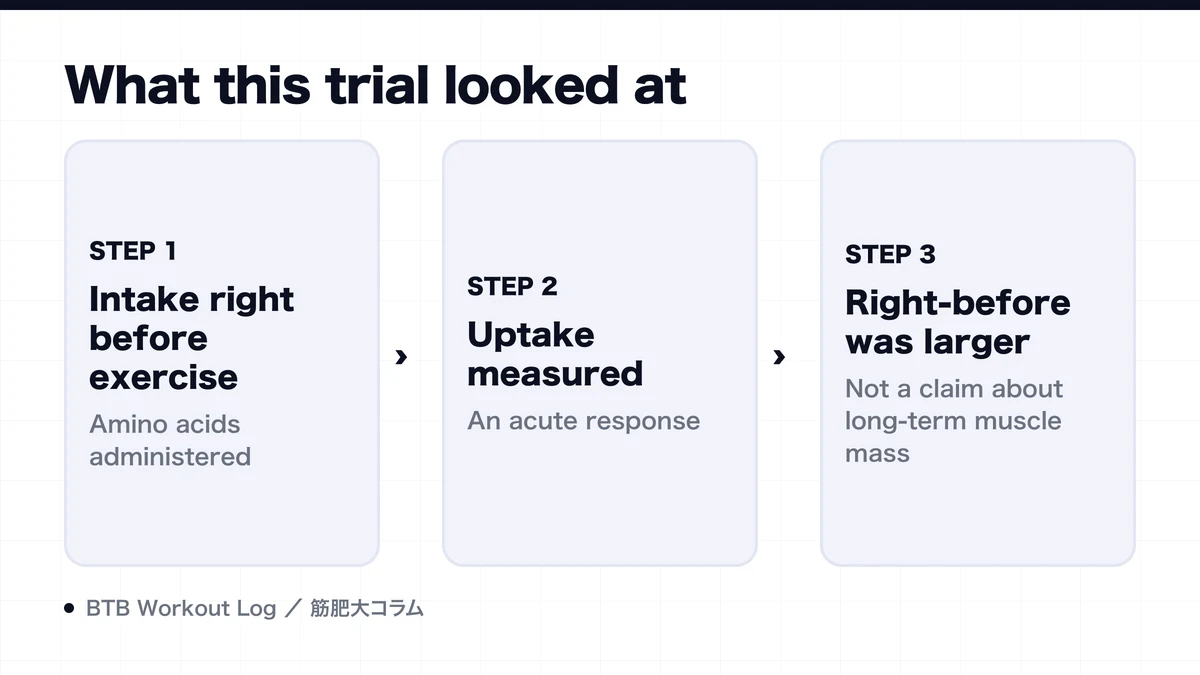
Conclusion: In an acute study on these 6 people, EAA and carbohydrate intake immediately before exercise showed greater amino acid uptake than intake immediately after exercise. However, this is not a study that proves that ``before is better than after'' in terms of long-term muscle hypertrophy.
Right now, my priority is to balance my daily protein intake and my 3-4 hourly allocation, rather than competing for a few minutes before and after.
Paper details
| Original title | Timing of Amino Acid-carbohydrate Ingestion Alters Anabolic Response of Muscle to Resistance Exercise |
|---|---|
| Authors | Kevin D. Tipton et al. |
| Journal | American Journal of Physiology-Endocrinology and Metabolism, 281(2), E197-E206 |
| Year | 2001 |
| Study design | Randomized crossover acute study |
| Participants / scale | Six healthy men and women |
| Comparison / methods | Eating 6g of EAA and 35g of carbohydrates immediately before or after leg training |
| Main outcomes | Amino acid uptake, muscle protein metabolism, and blood flow in the legs |
| DOI | 10.1152/ajpendo.2001.281.2.E197 |
Six people underwent both pre- and post-exercise conditions
Participants performed leg resistance exercise and consumed a beverage containing 6g of essential amino acids and 35g of carbohydrates either immediately before or after exercise. It is a cross-over design in which the same person experiences both conditions on different days.
Researchers used stable isotope tracers, arteriovenous catheters, and muscle biopsies to measure phenylalanine uptake in the exercised legs. Although the measurements are precise, the number of subjects is six, and the observation time is several hours.
Net uptake of 209mg before exercise and 81mg after exercise
Net phenylalanine uptake by the leg was 209±42mg in the pre-exercise condition and 81±19mg in the post-exercise condition. The difference was statistically significant (p=0.0002).
In the pre-exercise condition, exercise-induced blood flow coincided with elevated blood amino acid concentrations, increasing amino acid delivery to muscle. This result helped popularize consuming amino acids before training.
Acute uptake is not long-term muscle hypertrophy
This study did not compare muscle thickness or lean mass after several weeks of training. Because the acute amino acid uptake was large, it is not possible to directly estimate the difference in muscle hypertrophy after several months.
Also, we only compared ``just before'' and ``just after'', and did not examine differences in regular meals, whey protein alone, fasting time, etc. The average value for 6 people may not be the same for all people.
Currently, we consider the total amount, one-time amount, and distribution in that order.
The current organization of sports nutrition is to first meet the daily total protein amount, and then distribute high-quality protein at a time of 20 to 40 g every 3 to 4 hours. If you have a long gap between meals before and after your workout, make up for it before or after, and if you've eaten enough right before, there's no need to rush right after.
When combined with the dose-response of total intake shown by Morton 2018, timing priorities become clear.
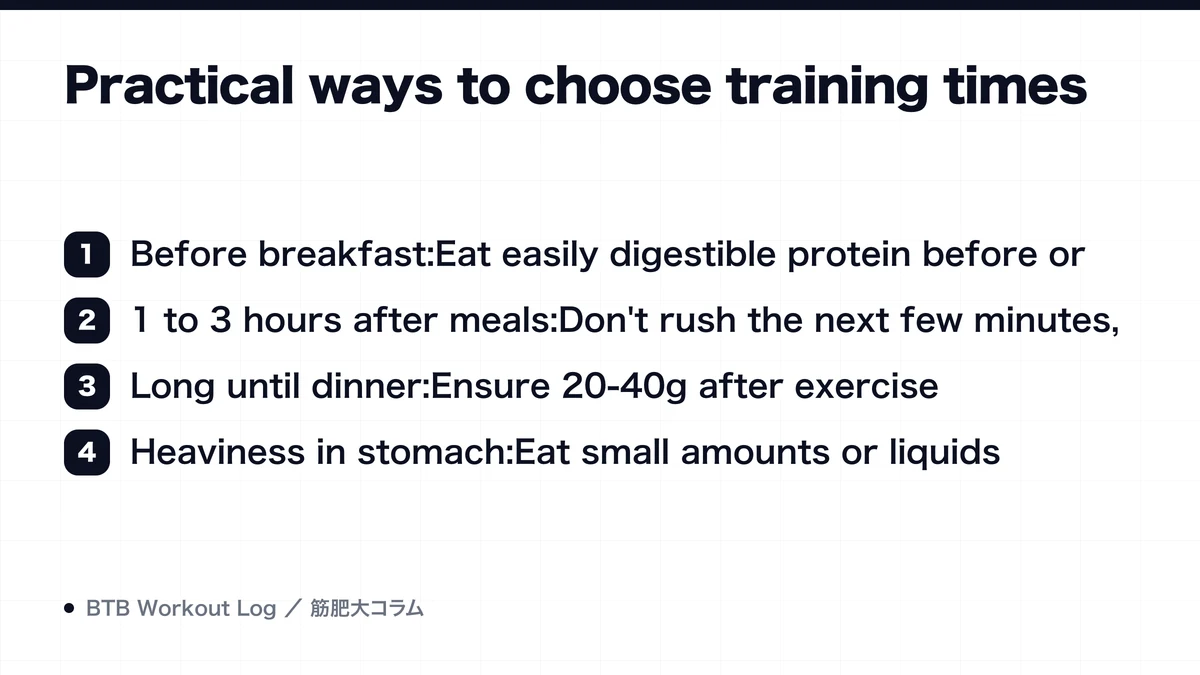
Practical ways to choose training times
- Before breakfast:Eat easily digestible protein before or immediately after exercise
- 1 to 3 hours after meals:Don't rush the next few minutes, make up for it with the next regular meal.
- Long until dinner:Ensure 20-40g after exercise
- Heaviness in stomach:Eat small amounts or liquids beforehand, and postpone main intake until later
The best timing is when you are comfortable with digestion and can continue without disrupting your meal plan for the day.
FAQ
- Is it best to consume protein just before muscle training?
- In this study, there was an advantage immediately before, but the long-term difference in muscle hypertrophy was not measured. This will be determined based on the last meal and the total amount for the day.
- Is it a waste to miss 30 minutes after exercise?
- It won't go to waste. If you eat just before, there are still amino acids available. Think about the whole meal, not just the minutes but the hours before and after.
- Are EAA and whey the same?
- They are not the same. This study involved a mixed drink with 6g of EAA and 35g of carbohydrates. Although whey is a complete protein containing EAA, the conditions cannot be directly equated.
Key takeaways
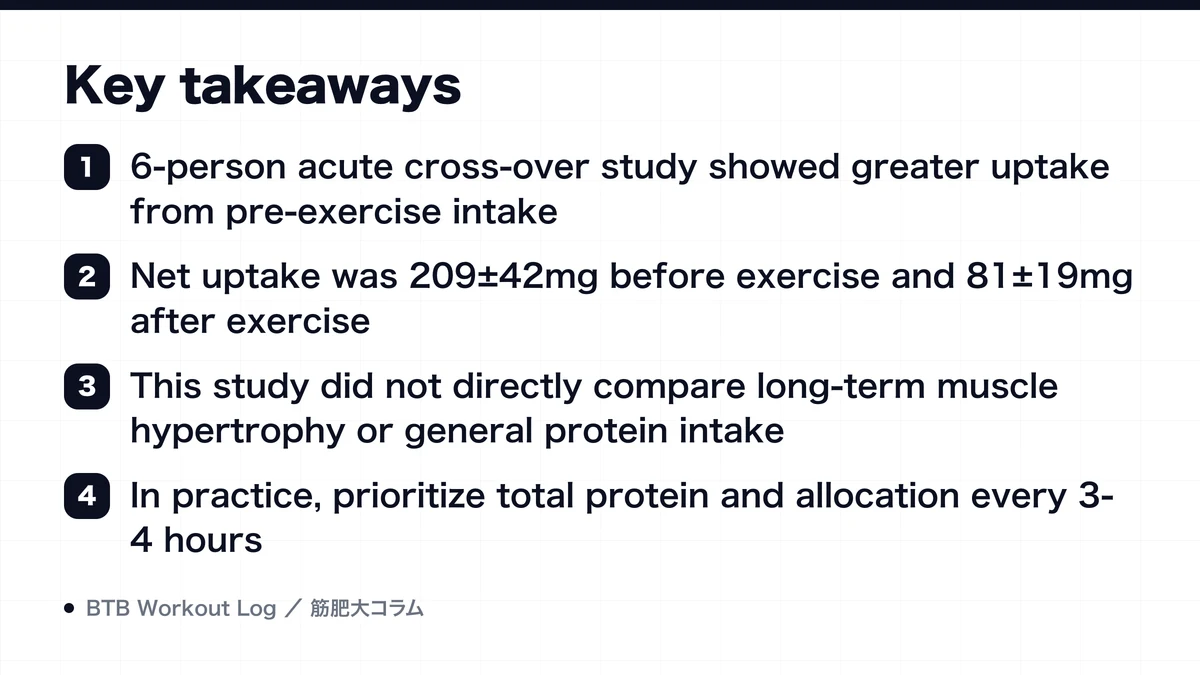
- 6-person acute cross-over study showed greater uptake from pre-exercise intake
- Net uptake was 209±42mg before exercise and 81±19mg after exercise
- This study did not directly compare long-term muscle hypertrophy or general protein intake
- In practice, prioritize total protein and allocation every 3-4 hours