The Complete Hypertrophy Diet Guide | If Training Alone Isn't Growing You, Fix Your Calories and Protein First
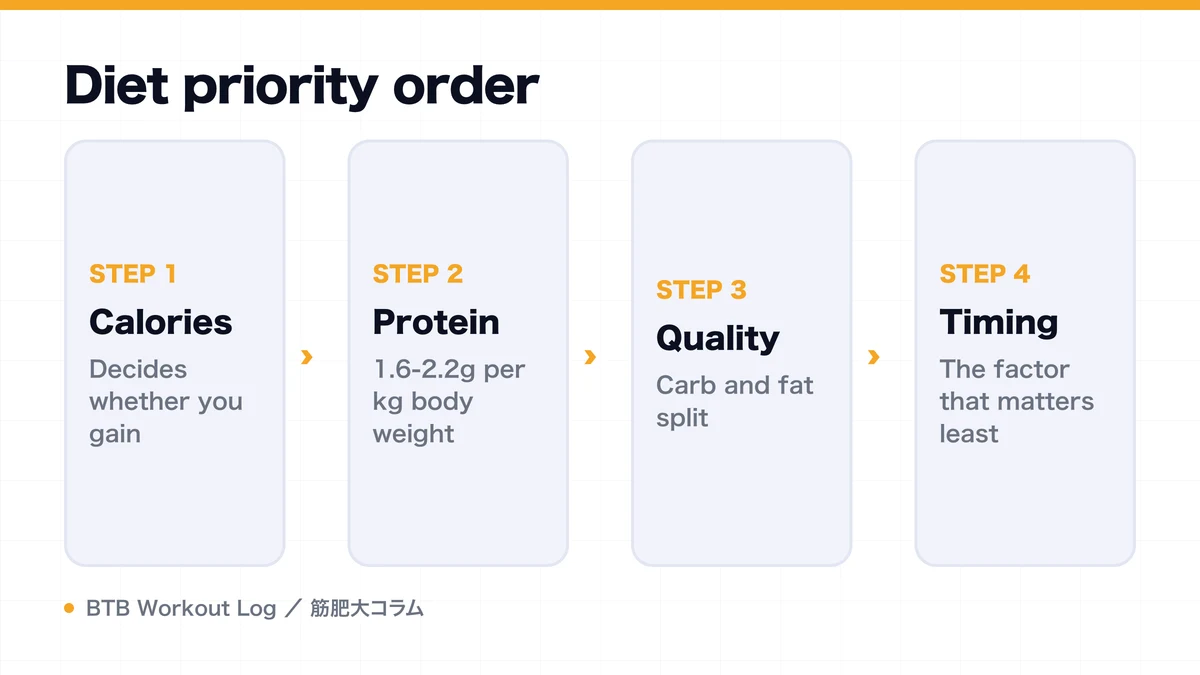
Nutrition for hypertrophy is easier to navigate when you work through it in order of impact. A practical order is 1. total calories, 2. protein, 3. food quality, 4. timing.
This order is a priority ranking based on the effect sizes research has found, not a claim that the lower items are meaningless. Stabilize the foundation of calories and protein first, then adjust by watching how your bodyweight and your weight and reps move.
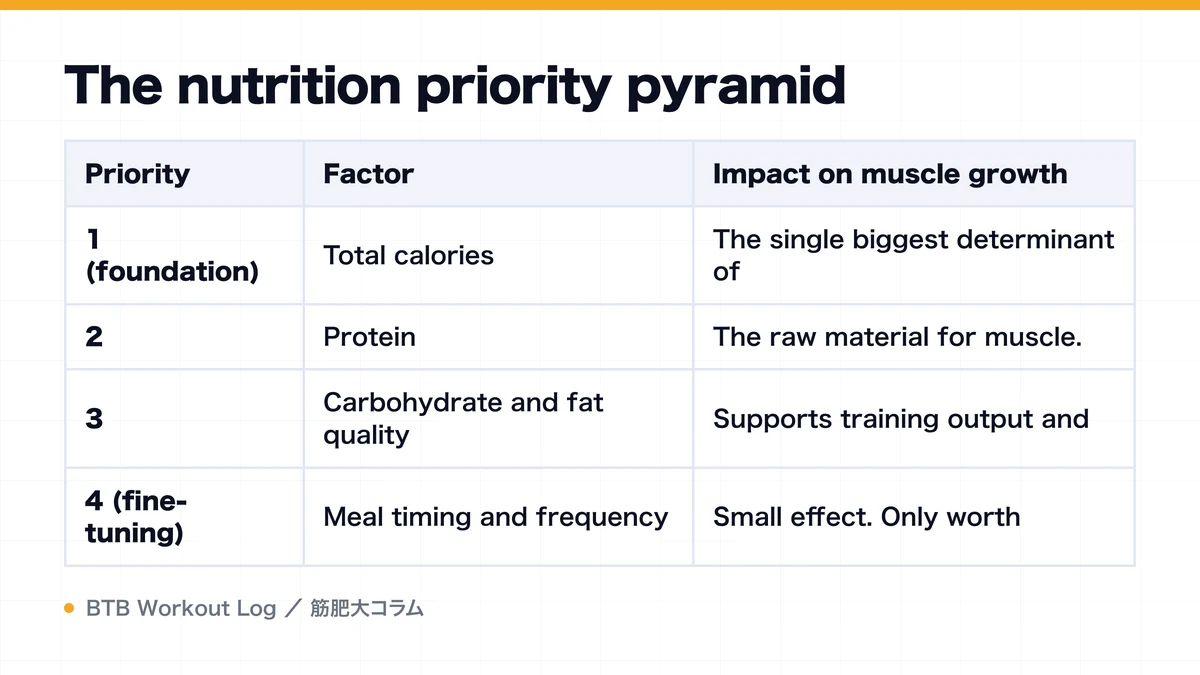
The nutrition priority pyramid
Work from the highest-impact factors down. The base of the pyramid contributes the most to muscle growth; each level above it is a finer adjustment.
| Priority | Factor | Impact on muscle growth |
|---|---|---|
| 1 (foundation) | Total calories | The single biggest determinant of whether you can gain |
| 2 | Protein | The raw material for muscle. Target: bodyweight x 1.6-2.2 g |
| 3 | Carbohydrate and fat quality | Supports training output and overall health |
| 4 (fine-tuning) | Meal timing and frequency | Small effect. Only worth addressing once total intake is solid |
1. Total calories: build a small surplus
Building new muscle requires an energy surplus. Aim for maintenance calories + 200-400 kcal. Eat too much above maintenance and you'll mostly gain fat, so the ideal pace is a lean bulk: bodyweight up roughly 0.5-1% per month. The most important indicator is your actual weight trend - if the scale hasn't budged in a couple of weeks, you're not eating enough (calorie calculation guide).
2. Protein: keep the supply coming
Protein is the raw material for muscle. Target 1.6-2.2 g per kg of bodyweight per day - for a 70 kg person that's 112-154 g. Because there's a ceiling on how much muscle protein synthesis one meal can drive, spreading your intake across 3-4 meals is more efficient. For a per-bodyweight quick-reference table and a food list, see the protein intake article.
3. Food quality and 4. Meal timing
3. Food quality: carbohydrates are your training fuel - slash them too aggressively and set quality suffers. Fat supports hormone production; keep it around 20-30% of total calories. A base of whole grains, meat or fish, and vegetables covers your needs without overcomplicating things.
4. Meal timing: the idea of a narrow post-workout "anabolic window" has been walked back considerably. If your daily totals for calories and protein are on target, the precise timing of meals has only a small effect on muscle growth. Get the totals right first; timing is the last thing to fine-tune.
Diet and training are two sides of the same coin
Even a perfect diet just turns into fat without the training stimulus to convert it into muscle. Conversely, perfect training spins its wheels without the raw materials. Once nutrition has set the foundation, the rest is to make sure training actually uses up those materials - that is, to keep delivering a stimulus that beats last time. Progress on the training side can only be compared under the same conditions once it is written down. Keeping food in a food app and training in a logging app, with the numbers managed separately, makes them less likely to blur together (progressive overload).
FAQ
- Will I gain fat while bulking?
- Some fat gain is unavoidable, but keeping your surplus at +200-400 kcal minimizes it. Stick to the lean bulk pace of 0.5-1% bodyweight gain per month, and dial calories back slightly if you're gaining too fast.
- Can I build muscle while cutting?
- Yes, for beginners, people with higher body fat, or those returning to training after a break (body recomposition). For intermediate and advanced lifters it's difficult - a small caloric surplus is more favorable for muscle growth. If you are cutting, raise protein to at least 2 g per kg of bodyweight to protect muscle mass.
- How important is meal timing?
- As long as total calories and protein are on target, timing matters very little. Avoid being extremely hungry right before or after training, and spread your protein across 3-4 meals through the day. Beyond that, obsessing over the clock isn't worth it.
Key takeaways
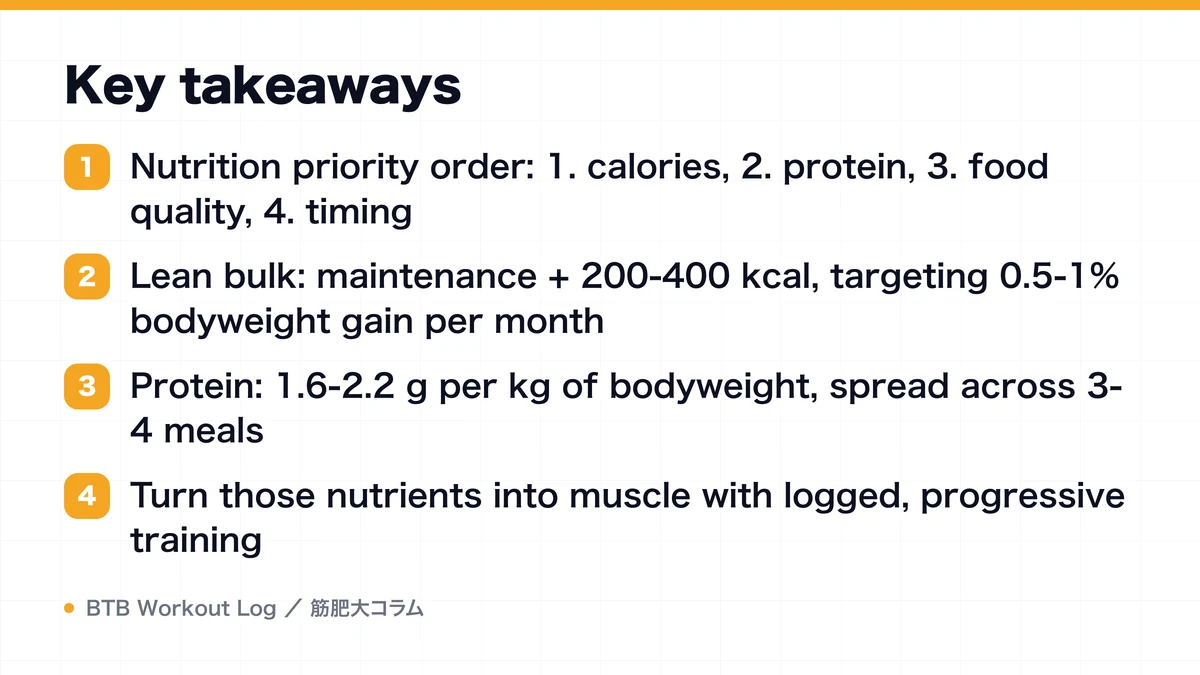
- Nutrition priority order: 1. calories, 2. protein, 3. food quality, 4. timing
- Lean bulk: maintenance + 200-400 kcal, targeting 0.5-1% bodyweight gain per month
- Protein: 1.6-2.2 g per kg of bodyweight, spread across 3-4 meals
- Turn those nutrients into muscle with logged, progressive training