Best Workout Split Routine for Your Schedule | Full Body vs. Upper/Lower vs. PPL
There is no one correct split. The only criterion that matters: can it train each muscle twice a week?
Research shows that with frequency and volume matched, the choice of split makes little difference to muscle growth. So all you need is the split that delivers twice-a-week frequency on the days you can train.
Frequency is what makes or breaks a split
Studies report that when total volume (weekly sets) is matched, full-body and split routines produce similar muscle growth. That said, two sessions per muscle per week make the same total volume easier to digest than one. So the essence of choosing a split isn't which one sounds coolest: it's whether the layout trains each muscle twice a week.
The four main splits: traits and best fit
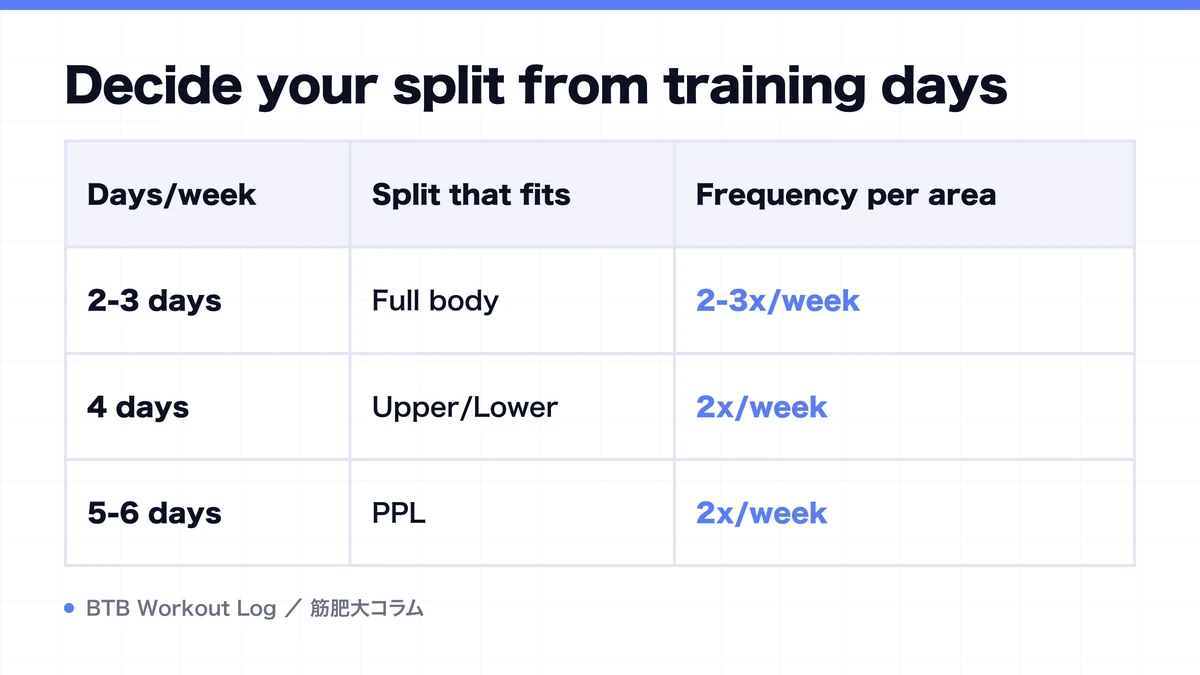
| Split | Frequency per muscle | Best for | Traits |
|---|---|---|---|
| Full body | 2-3x/week | 2-3 days a week | Easiest way to rack up frequency; ideal for beginners. Sessions run longer |
| Upper/lower | 2x/week | 4 days a week | The classic balance of time and frequency |
| PPL | 1-2x/week | 3 or 6 days a week | Focused sessions. Careful: at 3 days, frequency drops to once a week |
| Body-part split | 1x/week | 5-6 days a week (advanced) | Lets you hammer one muscle per day, but frequency is low and everything hinges on recovery |
The no-brainer choice for your training days
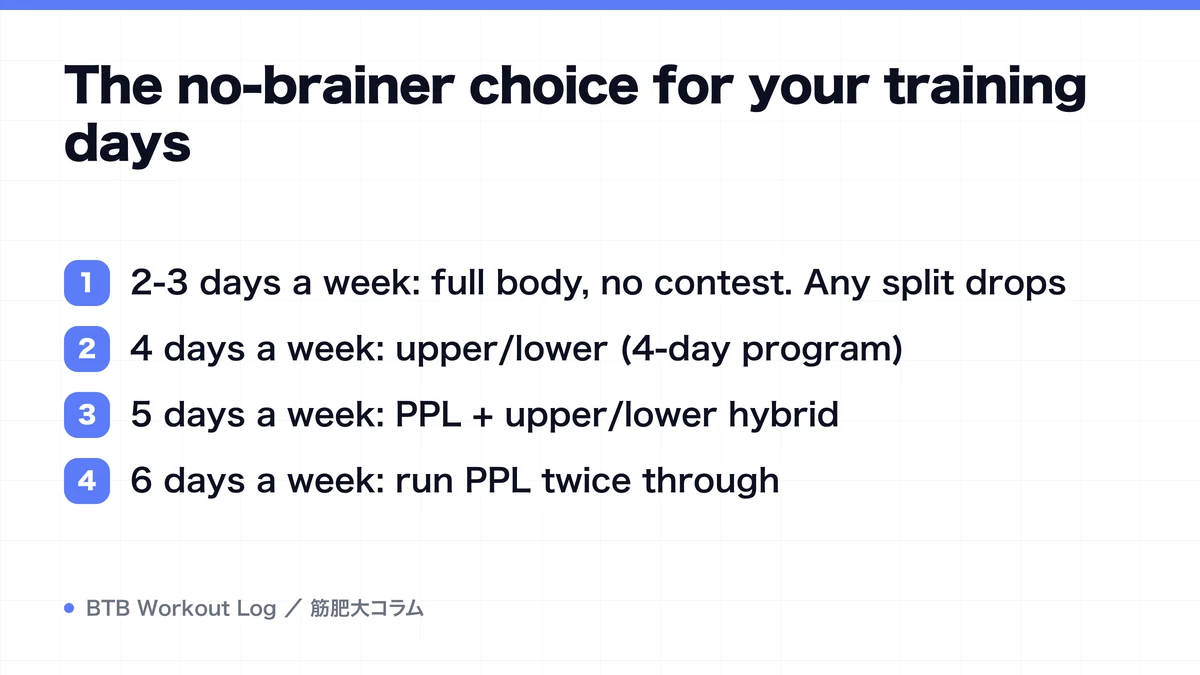
- 2-3 days a week: full body, no contest. Any split drops frequency to once a week
- 4 days a week: upper/lower (4-day program)
- 5 days a week: PPL + upper/lower hybrid
- 6 days a week: run PPL twice through
To dig deeper into how frequency and splits interact, see the training frequency guide.
The classic ways splits go wrong
The most common mistake: running a body-part split on 3 days a week, leaving each muscle trained just once. "Chest day, back day, leg day" has a nice ring to it, but on 3 days it starves your volume and frequency. The other failure mode is clinging to a split that hits the same muscles too hard on consecutive days, outrunning recovery until your lifts stop going up. Put frequency and total volume first; the split is just the vehicle.
FAQ
- Full body or a split: which is better for beginners?
- Full body. It makes frequency easy to hit and has you practicing the main lifts every session, so your technique improves faster too. Starting out at 2-3 days a week, full body is the most efficient option.
- Is a body-part split (one muscle per day) less effective?
- Not inherently, but it tends to leave each muscle trained once a week, and at equal total volume, splitting that work across two sessions is superior. It's an option for advanced lifters who can train 5-6 days and recover well.
- Should I rotate splits periodically?
- No need to change often. Stick with the same split as long as progressive overload keeps working, and revisit it when your schedule or available training days change.
Key takeaways
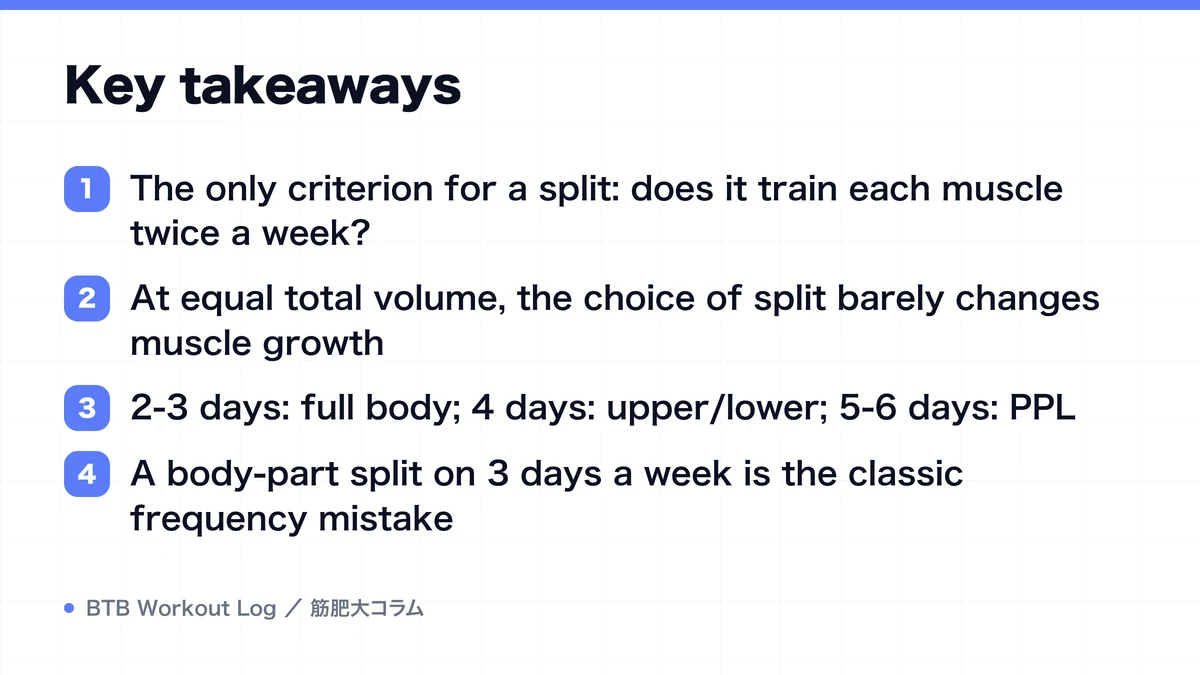
- The only criterion for a split: does it train each muscle twice a week?
- At equal total volume, the choice of split barely changes muscle growth
- 2-3 days: full body; 4 days: upper/lower; 5-6 days: PPL
- A body-part split on 3 days a week is the classic frequency mistake
References
- Resistance Training Frequency and Muscle Hypertrophy: Systematic Review and Meta-analysis
- Dose-response Relationship Between Weekly Resistance Training Volume and Muscle Mass
- Effects of Resistance Training Frequency on Muscle Hypertrophy: Systematic Review and Meta-analysis
- ACSM Position Stand: Progression Models in Resistance Training for Healthy Adults